Greek Nose: What It Is, Key Traits, Greek vs Roman Nose and Rhinoplasty
Smart Digest
A Greek nose is a straight nose: the bridge runs in one even line from the forehead to the tip, with no visible hump or dip and a tip that neither droops nor turns up sharply.
It is an aesthetic description, not a medical diagnosis, and takes its name from the straight profiles of ancient Greek sculpture.
A Roman (aquiline) nose differs because it has a visible bump or curve on the bridge.
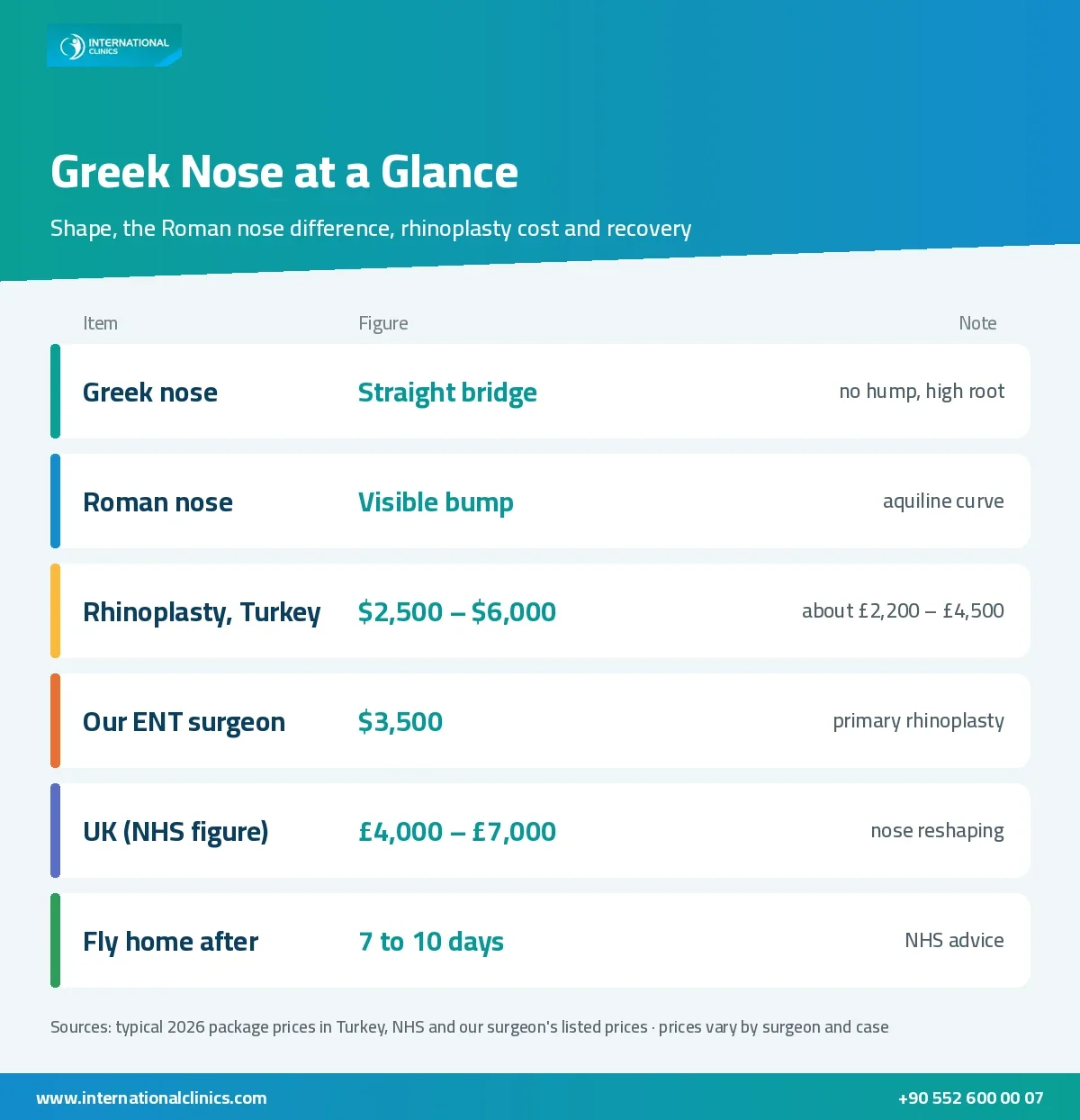
Rhinoplasty can straighten a profile by reducing a hump and refining the tip, and in Turkey it typically costs $2,500 to $6,000.
The NHS puts nose reshaping in the UK at £4,000 to £7,000.
A Greek nose is a straight nose: the bridge runs in one even line from the forehead down to the tip, with no visible hump, bump or dip, and the tip neither droops nor turns up sharply. It is an aesthetic description rather than a medical diagnosis, named after the straight profiles of ancient Greek statues. The main difference from a Roman nose is the bridge: a Greek nose is straight, while a Roman (aquiline) nose has a visible bump or curve.
What Is a Greek Nose?
A Greek nose, also called a straight nose, is a nose whose bridge forms a continuous straight line from the root (between the eyes) to the tip. In profile it looks smooth and level. The term describes a natural variation in nose shape; it is not a condition and does not need treatment. Most people do not have a single textbook shape: they have a mix of traits, such as a mostly straight bridge with a slightly fuller tip.
Key Traits: Side Profile and Front View
These are the characteristics most often used to describe a Greek nose:
Straight bridge: the nasal bone and cartilage form one even line from the root to the tip.
No dorsal hump: there is no outward bump on the bridge, which is the main feature of a Roman nose.
High root: the bridge starts high and meets the forehead at a very shallow angle, so the forehead and nose can look almost continuous in profile.
Balanced tip: the tip is defined and level, neither hanging down nor sharply upturned.
Front view: from the front, the bridge looks narrow and even, with straight, parallel lines down to the tip.
The point where the nose meets the forehead is called the radix. A 2024 study in the World Journal of Plastic Surgery notes that the radix and the nasofrontal angle "play an essential role in forming an aesthetically pleasing nose because they influence the length and projection of the nose." A shallow angle at this point is what gives the Greek profile its unbroken line.
Greek Nose on Women
On women, a Greek nose usually looks slender and refined: a completely straight bridge running from the brow to the tip, with no bumps, dips or curves, and a delicate, balanced tip that sits well with softer jawlines and cheekbones.
Greek Nose on Men
On men, the same straight, smooth bridge usually looks stronger: slightly wider at the bridge, more projected, and aligned cleanly with the forehead and jaw. The bridge often appears to start high, blending into the brow line.
Greek Nose vs Roman Nose
The Greek nose and the Roman nose are the two classical profiles people compare most often. The difference is the shape of the bridge.
Feature
Greek nose
Roman (aquiline) nose
Bridge
Straight, one even line
Prominent bridge with a visible bump, curve or hook
Dorsal hump
None
Present, sometimes strong
Transition to the forehead
High root, very shallow angle
Usually a clearer angle at the root
Tip
Balanced, neither drooping nor upturned
Can point slightly downward
Overall look
Smooth, harmonious, classical
Bold, angular, strong
Usual rhinoplasty goal
Often kept as it is, or refined at the tip
Hump reduction for a smoother, straighter profile
To tell which one you have, look at your side profile in a photo: if the bridge forms a straight line, it is closer to a Greek nose; if it bulges outward, it is closer to a Roman nose. Hump reduction is explained in Roman rhinoplasty in Turkey, and stronger, hooked profiles in aquiline nose rhinoplasty.
Why It Is Called Greek: Ancient Statues and the Greek God Nose
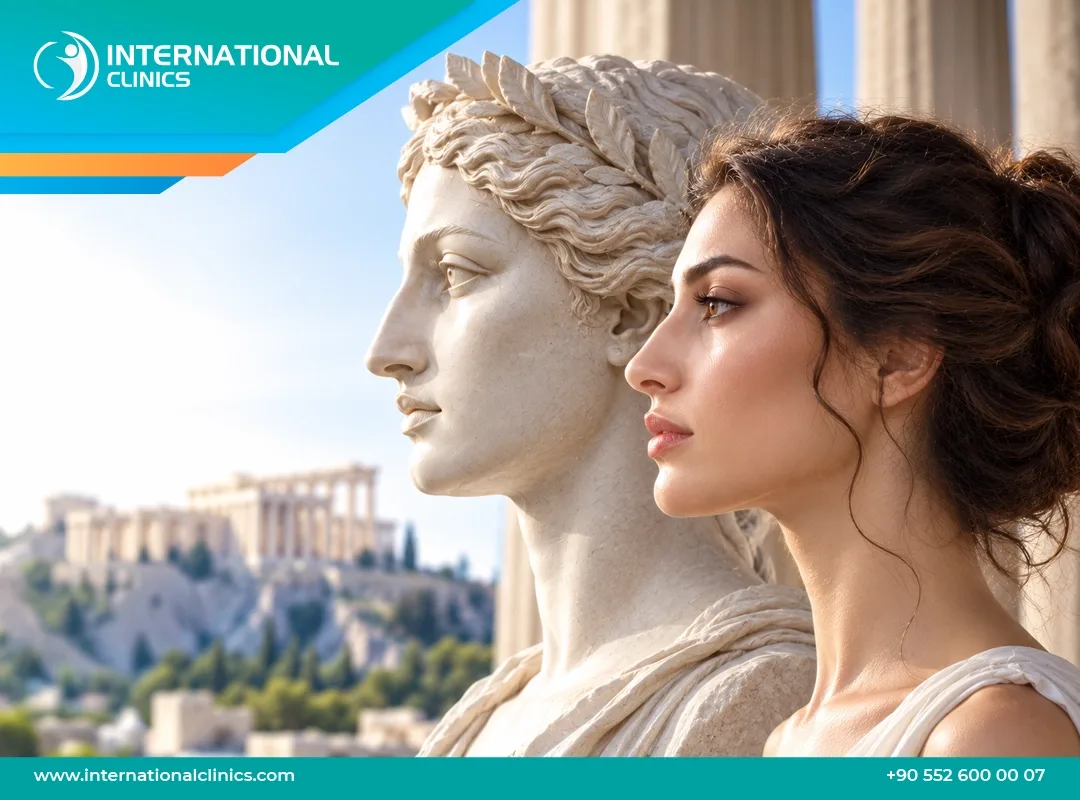
The name comes from classical Greek art. Sculptors of gods and heroes carved straight, harmonious facial profiles in which the nose continues the line of the forehead, and that ideal was copied in Roman and Renaissance art. This is why the same shape is also called the Greek statue nose or the Greek god nose. Having one does not say anything about your ancestry: a straight nose appears in people of every background.
Greek Nose Celebrities
Celebrities often cited as having a classic straight Greek profile include Jennifer Aniston, Angelina Jolie, Brad Pitt and Keira Knightley. These lists are based on how their noses look in photos, not on any statement from the celebrities themselves, and they say nothing about whether anyone has or has not had surgery. For another celebrity profile analysed step by step, see Hailey Biebers nose type.
Can Rhinoplasty Create a Straight, Greek-Style Profile?
Often, yes, within the limits of your own anatomy. Rhinoplasty can change bone, cartilage, skin or all three, and the changes needed for a straighter profile are usually small. Mayo Clinic puts it this way:
"Very small changes to your noses structure — even just a few millimeters — can make a big difference in how your nose looks." — Mayo Clinic, Rhinoplasty.
Depending on your starting point, a surgeon may:
Reduce a dorsal hump so the bridge forms a straight line.
Adjust the root (radix) so the nose meets the forehead more smoothly.
Refine the tip so it is balanced rather than drooping or bulbous.
Straighten the septum when the inside of the nose also affects breathing, which turns the operation into a septorhinoplasty.
A good result is a nose that suits your own face, not a copy of a statue. Your other facial features and the thickness of your skin limit how sharp a profile can look, and every operation carries risks; the NHS lists breathing difficulty, damage to the septum, an altered sense of smell and heavy nosebleeds among them. Gentler techniques that keep the natural bridge are explained in preservation rhinoplasty, and the main approaches in types of rhinoplasty.
Recovery After a Profile Rhinoplasty
Stage
What to expect (NHS)
Splint
Removed after about 1 week
Flying home
Not for 7 to 10 days after facial cosmetic procedures
A nose job in Turkey typically costs $2,500 to $6,000 (about £2,200 to £4,500), usually as a package that covers the surgeon, anaesthesia, hospital, hotel and transfers. The NHS puts nose reshaping in the UK at £4,000 to £7,000.
Item
Typical cost
Rhinoplasty in Turkey (USD)
$2,500 – $6,000
Rhinoplasty in Turkey (GBP)
About £2,200 – £4,500
Primary rhinoplasty, Turkey
$3,000 – $5,500
Primary rhinoplasty, listed by our ENT surgeon in Istanbul
$3,500
Septorhinoplasty (shape and breathing), listed by our ENT surgeon
$4,500
Nose reshaping in the UK (NHS figure)
£4,000 – £7,000
The listed prices come from the profile of Assoc. Prof Mustafa Çelik, an ENT specialist in Istanbul and a member of the Turkish Rhinologic Society and the European Rhinologic Society. The final price depends on whether only the shape is changed or the septum is corrected too, and on how much work the bridge and tip need. For the full breakdown, see rhinoplasty cost in Turkey.
Video from the International Clinics YouTube channel: a patients nose job in Turkey and her feedback.
Sources
Mayo Clinic — Rhinoplasty, mayoclinic.org.
NHS — Nose reshaping (rhinoplasty), nhs.uk.
NHS — Cosmetic surgery abroad, nhs.uk.
Motazedian G, et al. Radixs Importance for Plastic Surgeons: A Descriptive Cross-Sectional Study. World Journal of Plastic Surgery, 2024 (PMC11346693).
International Clinics — Assoc. Prof Mustafa Çelik, procedure prices (profile page).
Featured image background: Marble head of a Hellenistic ruler, The Metropolitan Museum of Art, CC0, via Wikimedia Commons. Interior photo: Caryatids of the Erechtheion by Gary Todd, CC0, via Wikimedia Commons.
Medical Sources
Mayo Clinic — Rhinoplasty, mayoclinic.org. | NHS — Nose reshaping (rhinoplasty), nhs.uk. | NHS — Cosmetic surgery abroad, nhs.uk. | Motazedian G, et al. Radixs Importance for Plastic Surgeons: A Descriptive Cross-Sectional Study. World Journal of Plastic Surgery, 2024 (PMC11346693). | International Clinics — Assoc. Prof Mustafa Çelik, procedure prices (profile page).
FAQ's
What is considered a Greek nose?
A Greek nose is a straight nose: the bridge runs in one even line from the forehead to the tip, with no visible hump or dip, and the tip is balanced rather than drooping or upturned. The bridge usually starts high, so the forehead and nose look almost continuous in profile.
Is Greek nose shape attractive?
Many people find a Greek nose attractive because it creates a smooth, balanced profile, which is why classical sculptors idealised it. Attractiveness is personal, though: a nose looks best when it is in proportion with the rest of the face, whatever its shape.
What are the prettiest nose shapes?
There is no medical ranking of the prettiest nose shapes. Straight (Greek) and softly defined profiles are often named in beauty surveys and online lists, but surgeons aim for a nose that suits each face, judging size, bridge, tip and proportions together rather than copying one shape.
What's the rarest nose type?
There is no official global data that names one single rarest nose type. Researchers have not mapped how common each shape is across the whole population, most people have a mix of traits rather than one textbook shape, and a shape that is uncommon in one region can be common in another.
Is my nose Greek or Roman?
Look at your side profile. If the bridge forms a straight line from your forehead to the tip, your nose is closer to a Greek nose. If the bridge has a visible bump or curves outward, it is closer to a Roman (aquiline) nose. Many noses fall somewhere in between.
Is it rare to have a Greek nose?
A perfectly straight nose with no bump at all is relatively uncommon, but there are no reliable figures on how many people have one. Most people with a "Greek nose" have a mostly straight bridge with small variations, and the shape appears in people of every background.
What is the most desirable nose shape for men?
There is no single most desirable nose shape for men. A straight, well-proportioned bridge that lines up with the forehead and jaw, as in a male Greek nose, is often admired, but a nose that suits the face and keeps breathing easy is the practical goal of male rhinoplasty.
Can you fly after a nose job?
Yes, but not straight away. The NHS recommends not flying for 7 to 10 days after facial cosmetic procedures such as a nose job, so if you have rhinoplasty in Turkey, plan to stay until your surgeon has checked you and removed the splint.
×
Get a Free Consultation
International Clinics Guarantees
Reliable medical care provided within our accredited facilities
Final fixed price with no hidden costs
Full medical support with professional interpreters
Clear treatment plans and follow-up at international standards
Personalized assistance throughout the entire treatment journey
We use our own cookies and third-party cookies so that we can display this website and better understand how you use it, with the aim of improving the services we offer. If you continue browsing, we consider that you have accepted the cookies.