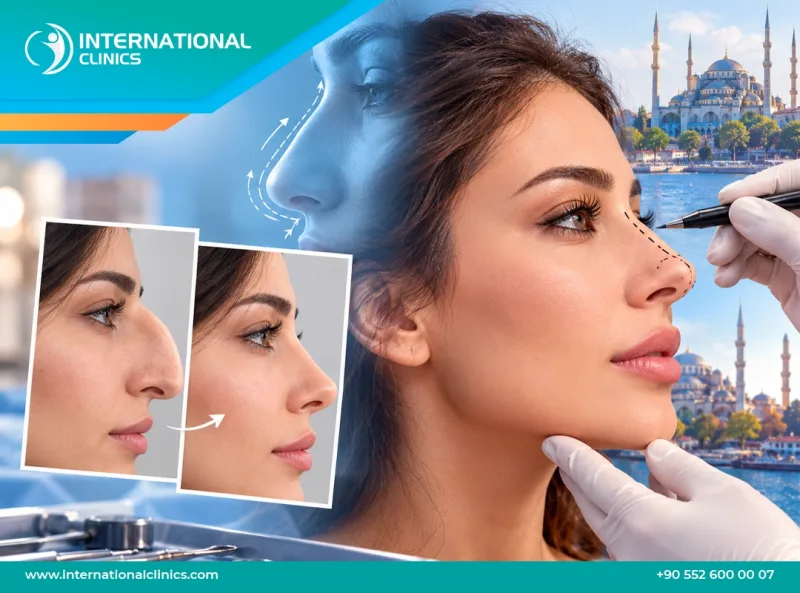
Teenage rhinoplasty in Turkey is nose surgery performed on adolescents once the nose has reached its adult size, to correct a hump, a crooked bridge, a bulbous tip or a deviated septum that blocks breathing. The right teenage rhinoplasty age is about 15 or 16 in girls and a year later in boys, parental consent is required for every patient under 18, and a primary rhinoplasty costs $2,500–$3,000 (approx. £1,850–£2,250) with the surgeons contracted by International Clinics in Istanbul ($2,500–$4,500 (approx. £1,850–£3,350) across all rhinoplasty types). This guide explains whether rhinoplasty is a high-risk or dangerous surgery for a teenager, the medical criteria for rhinoplasty at 16 or 17, the steps of the operation, the cost, the recovery timeline and how parents can check the surgeon and the hospital. (Source: ASPS)
Rhinoplasty is plastic surgery that changes the shape and size of the nose to improve its appearance or to fix medical problems that interfere with breathing; cosmetic rhinoplasty targets appearance, functional rhinoplasty improves breathing, and surgeons trained in plastic surgery or facial plastic surgery (ENT) perform it. (Source: Cleveland Clinic)
Teenage Rhinoplasty in Turkey at a Glance
| Teenage rhinoplasty in Turkey | Key facts |
|---|---|
| Minimum age | When the nose has reached its adult size: about 15 or 16 in girls and a year later in boys (ASPS); earlier only for breathing problems or injury |
| Parental consent | Required for every plastic surgery procedure on a patient under 18 |
| Price in Turkey | $2,500–$3,000 (approx. £1,850–£2,250) for a primary rhinoplasty with the surgeons contracted by International Clinics; $2,500–$4,500 (approx. £1,850–£3,350) across all rhinoplasty types |
| Anesthesia and duration | General anesthesia; 1.5 to 3 hours; usually 1 night in hospital |
| Splint | External splint for 1 to 2 weeks |
| Back to school | About 1 to 2 weeks; no sport for 4 to 6 weeks |
| Stay in Istanbul | About 7 to 10 days: the NHS advises not to fly for 7 to 10 days after facial cosmetic surgery |
| Final result | Up to 1 year; about 90% of the swelling is gone by 3 months |
| Revision rate | About 15% of patients need a small follow-up correction (Cleveland Clinic) |
What is Teenage Rhinoplasty?
Teenage rhinoplasty is a cosmetic or functional nose operation performed on an adolescent whose facial growth is complete. The ASPS lists a complete facial growth, good physical health, no smoking and realistic goals as the conditions for any rhinoplasty candidate, which is why surgeons wait until the nasal bones and cartilage have reached their final size before operating on a teenager. (Source: ASPS)
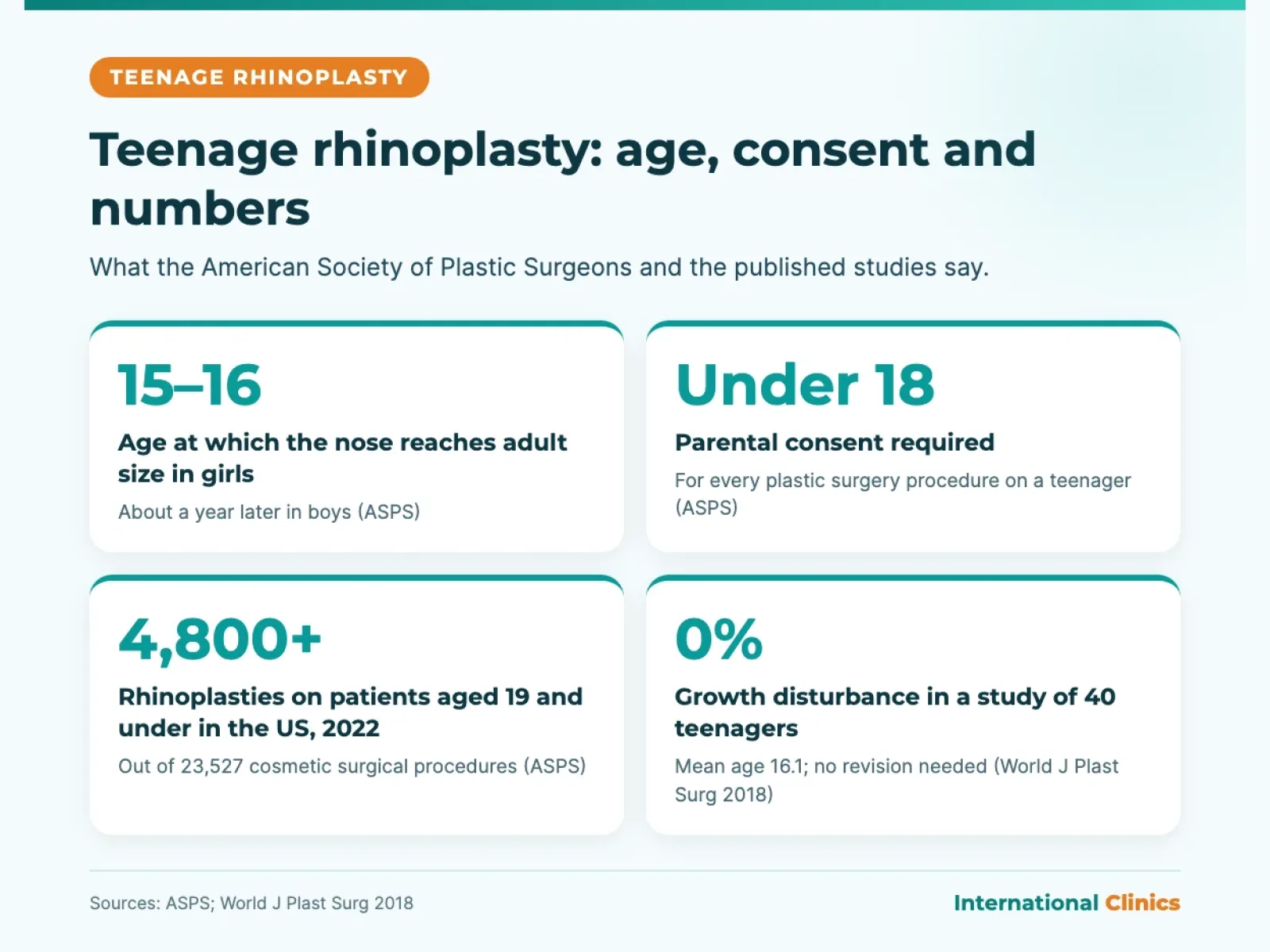
Nose surgery is the most requested cosmetic operation among teenagers: the ASPS recorded more than 4,800 rhinoplasty procedures on patients aged 19 and under in the United States in 2022, out of 23,527 cosmetic surgical procedures in that age group. Nose surgery can straighten the bridge, remove a hump, reshape the tip or open the breathing passages. (Source: ASPS)
Teenage Rhinoplasty Age: Rhinoplasty at 16 or 17 and Parental Consent
The ASPS states that nose surgery is usually delayed until the nose reaches its adult size, at about age 15 or 16 in girls and a year later in boys, and that parental consent is required for all plastic surgery procedures performed on teens younger than 18. A 2016 review of rhinoseptoplasty in children places the end of nasal growth later, at 16 to 18 years in females and 18 to 20 in males, and recommends postponing cosmetic surgery until after the pubertal growth spurt, with exceptions for breathing problems caused by the septum, severe trauma or a septal abscess. (Source: Open Access Maced J Med Sci, 2016)
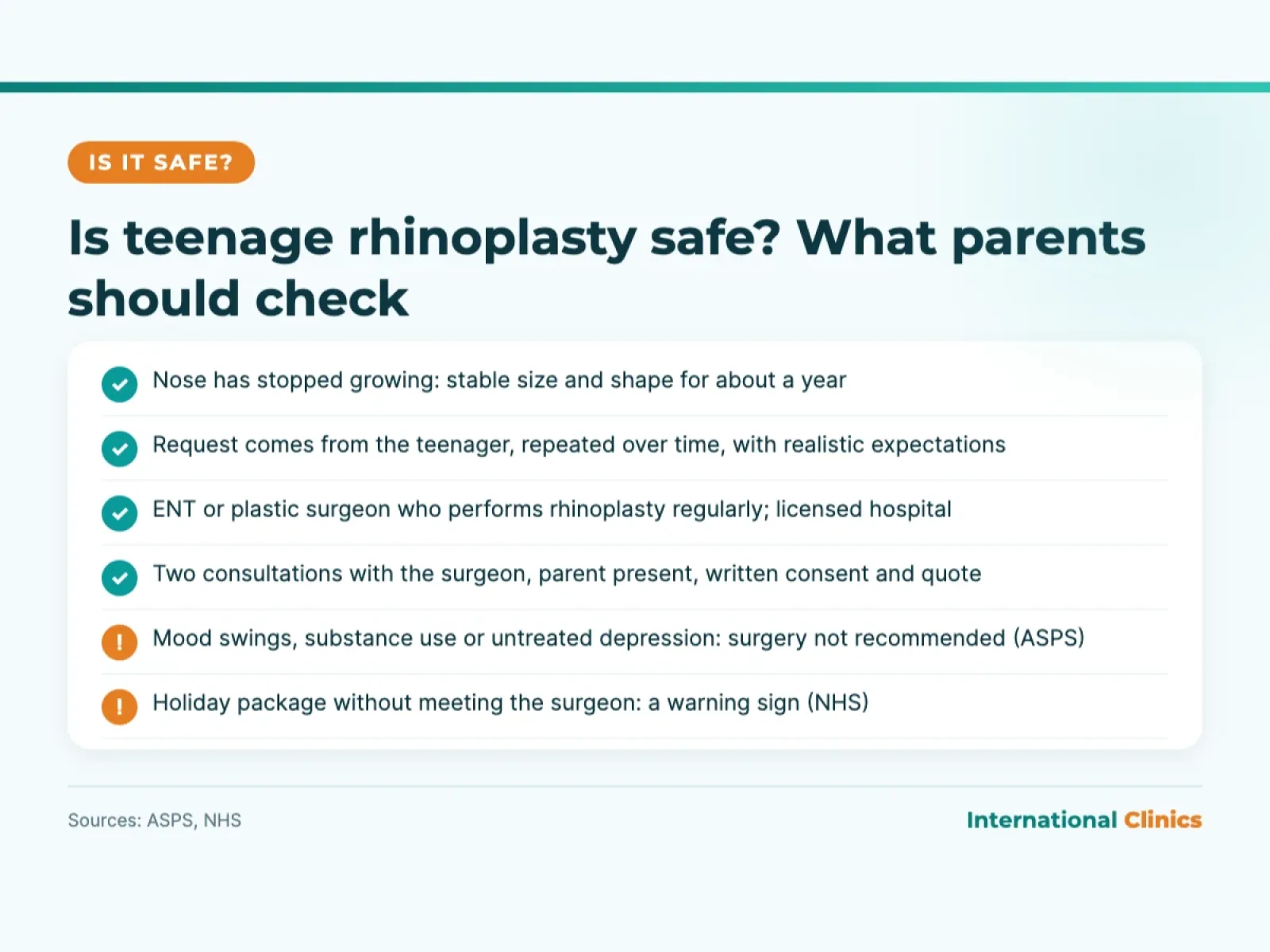
In practice, rhinoplasty at 16 is possible for most girls and rhinoplasty at 17 for most boys, provided the surgeon confirms that the nose has stopped changing (the same size and shape for about a year) and that the request comes from the teenager, has been expressed repeatedly over time, and rests on realistic expectations and emotional maturity. The ASPS does not recommend surgery for teens with erratic mood swings, substance abuse or untreated depression or mental illness. (Source: ASPS)
Is Teenage Rhinoplasty Safe or a High-Risk, Dangerous Surgery in Turkey?
Is rhinoplasty a high-risk and dangerous surgery for a teenager in Turkey? No: rhinoplasty is not classed as a high-risk operation, but it is real surgery under general anesthesia, and the ASPS lists its possible complications: anesthesia risks, change in skin sensation (numbness or pain), difficulty breathing, infection, nasal septal perforation (rare), poor wound healing or scarring, the possibility of revisional surgery, skin discoloration and swelling, and an unsatisfactory nasal appearance. (Source: ASPS)
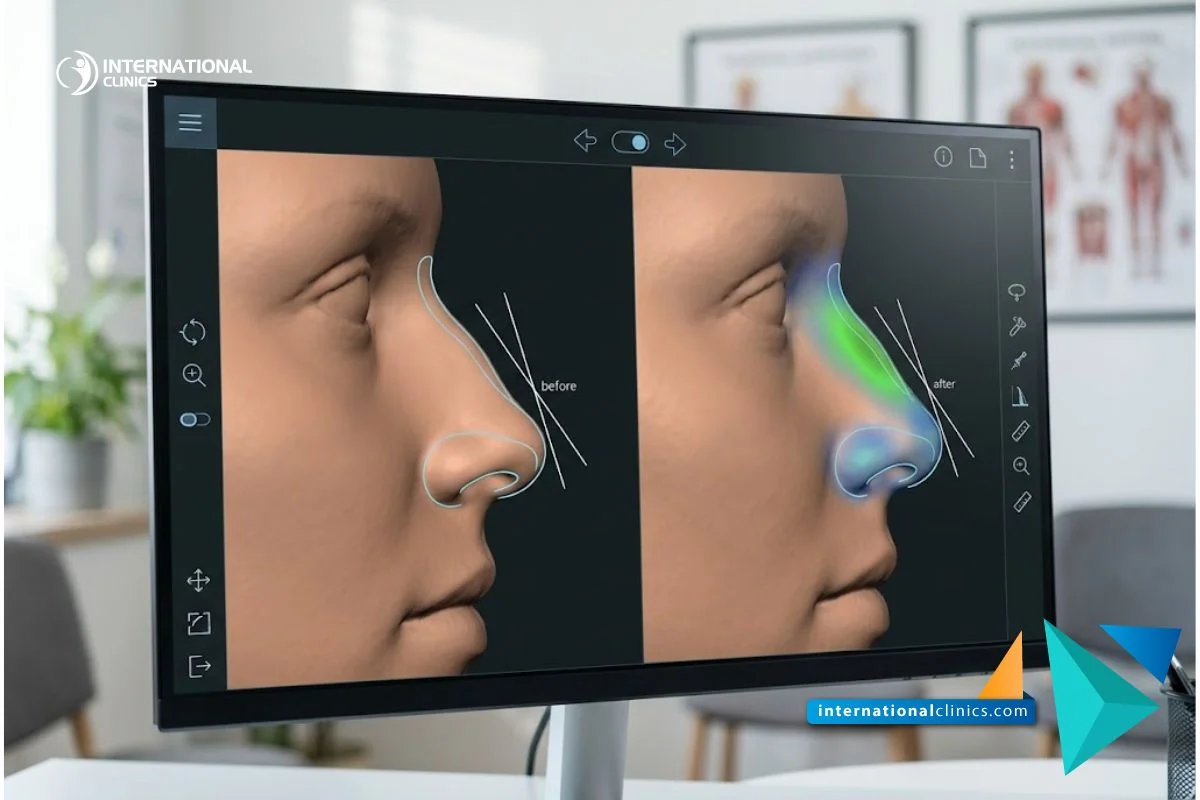
The published evidence on teenagers is reassuring when the timing is right: in a prospective study of 40 patients under 18 (mean age 16.1 years, youngest 14) followed for an average of 29.5 months, short-term complications occurred in 4 patients (10%: one infection, two cases of swelling around the stitches, one nosebleed), none was severe, no revision was needed, 87.5% reported complete satisfaction, and craniofacial growth was not affected in any patient; the authors concluded that septorhinoplasty is safe in teenagers when indicated. (Source: World J Plast Surg, 2018)
The danger lies in the choice of surgeon and hospital rather than in the operation or the country. The NHS advises patients who travel for cosmetic surgery to check how surgeons and clinics are regulated in that country, to ask about the surgeon’s training, qualifications and number of similar procedures, to have two consultations with the surgeon who will operate, to make sure he speaks a language the family understands, and to confirm who provides follow-up and what happens if a complication appears after the return home. (Source: NHS)
Why Choose Turkey for Teenage Rhinoplasty?
Turkey is one of the busiest destinations for rhinoplasty because ENT and plastic surgeons there perform nose surgery in high volume, hospitals licensed by the Turkish Ministry of Health treat international patients routinely, and prices are published in advance. The decisive factors remain the surgeon and the hospital, not the destination, so each reason below comes with what parents should check.
There are several practical reasons to consider teenage rhinoplasty in Turkey:
- Expert Surgeons: ENT and plastic surgeons who operate on the nose regularly; ask how many teenage rhinoplasties the surgeon performs each year and whether he preserves growth zones in younger patients. (Source: NHS)
- Advanced Technology: piezoelectric (ultrasonic) instruments that reshape bone with less bruising; ask which technique is planned and why.
- Psychological Support: the consultation assesses the teenager’s motivation and emotional maturity, as the ASPS recommends. (Source: ASPS)
- Competitive Cost: a primary rhinoplasty costs $2,500–$3,000 (approx. £1,850–£2,250), compared with an average surgeon fee of $7,637 (approx. £5,700) in the United States that excludes anesthesia and the operating room. (Source: ASPS)
- Licensed Hospitals: the hospitals contracted by International Clinics hold a Turkish Ministry of Health licence; ask which international accreditation the hospital holds and check it yourself.
- Natural Results: the aim is a nose in proportion with a still-young face, not an exaggerated change.
- Organised Stay: packages that include the hotel for the patient and one parent, transfers and an interpreter, so that every instruction is understood.
- Ongoing Follow-up: check-ups in Istanbul before the flight home and remote follow-up during the first year, agreed in writing. (Source: NHS)
Surgeons experienced in teenage rhinoplasty
Before the consultation, parents can compare the profiles of the surgeons contracted by International Clinics, such as Dr Mustafa Çelik, an ENT surgeon who specialises in rhinoplasty, or browse the list of plastic surgeons in Turkey; our guide to choosing the best rhinoplasty surgeon in Turkey lists the questions to ask.
Medical Criteria and Age Requirements
Before any surgery, the surgeon examines the teenager, reviews the medical history and confirms that the nose has reached its adult size; the ASPS puts this at about age 15 or 16 in girls and a year later in boys, and requires parental consent under 18. (Source: ASPS)
The following requirements must be met before teenage rhinoplasty in Turkey:
- Skeletal Maturity: complete development of the nasal bones and cartilage, confirmed by a stable nose size for about a year.
- Emotional Readiness: a mature, realistic understanding of what surgery can and cannot do, and the ability to tolerate the discomfort and temporary bruising. (Source: ASPS)
- Personal Motivation: the teenager initiates the request, repeatedly over time, without pressure from parents or friends. (Source: ASPS)
- General Health: no uncontrolled chronic condition, no smoking or vaping. (Source: ASPS)
- Breathing Issues: a deviated septum or blocked nasal passage can justify functional surgery earlier, with growth-preserving techniques. (Source: Open Access Maced J Med Sci, 2016)
- Injury or Congenital Defects: a broken nose or a structural abnormality may need reconstructive surgery regardless of age.
- Parental Consent: written consent of a parent or legal guardian, who also attends the consultations. (Source: ASPS)
- Recovery Commitment: the discipline to avoid sport and contact for the weeks the surgeon specifies.
Step-by-Step Surgical Procedure
Teenage rhinoplasty follows the same steps as adult rhinoplasty, with extra care to preserve the structures that support the nose. The NHS describes the operation as usually performed under general anaesthetic, lasting 1.5 to 3 hours, with a stay of 1 or 2 nights in hospital and a splint taped over the nose for 7 days. (Source: NHS)
The sequence of teenage rhinoplasty in Turkey is as follows:
- General Anesthesia: administered by an anesthesiologist after the pre-operative tests.
- Incisions: inside the nostrils (closed rhinoplasty) or with a small added incision on the columella (open rhinoplasty); our guide to open vs closed rhinoplasty explains the difference.
- Tissue Elevation: the skin is lifted to expose the cartilage and bone framework.
- Septum Correction: a deviated septum is straightened to improve airflow; read rhinoplasty vs septoplasty if breathing is the main problem.
- Bone Sculpting: the hump is reduced and the bones repositioned, often with piezoelectric instruments.
- Cartilage Grafting: the tip is supported with the patient’s own cartilage from the septum when needed.
- Incision Closure: fine sutures, dissolvable inside the nose.
- Splint Placement: an external splint protects the new shape for 1 to 2 weeks; packing, if used, is removed within 24 to 48 hours. (Source: Cleveland Clinic)
Detailed Breakdown of Teenage Rhinoplasty in Turkey Costs
Teenage rhinoplasty in Turkey costs $2,500–$3,000 (approx. £1,850–£2,250) for a primary rhinoplasty with the surgeons contracted by International Clinics in Istanbul, and $2,500–$4,500 (approx. £1,850–£3,350) across all rhinoplasty types, including $2,800–$3,500 (approx. £2,100–£2,600) for a separate septoplasty and $3,500–$4,500 (approx. £2,600–£3,350) for a revision. The price covers the surgeon and anesthesia fees, the hospital night and the follow-up visits; packages for international patients add the hotel for the patient and one parent, transfers and an interpreter.

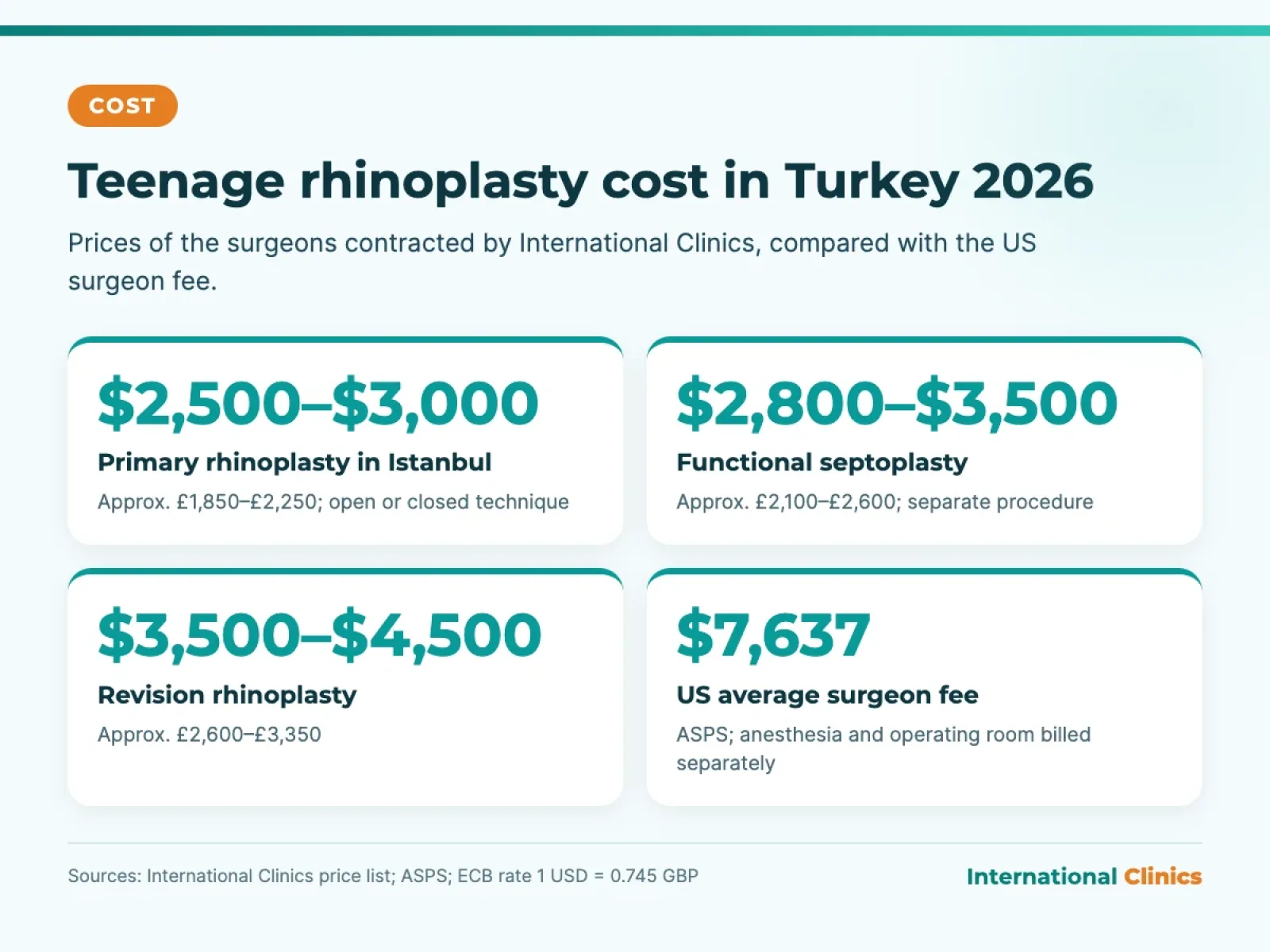
For comparison, the ASPS puts the average surgeon fee for rhinoplasty in the United States at $7,637 (approx. £5,700), a figure that does not include anesthesia, operating room facilities or other related expenses, and the NHS gives a range of £4,000 to £7,000 in the United Kingdom, plus consultations and any follow-up surgery. (Source: ASPS)
| Procedure / Service | Price in Turkey (USD, approx. GBP) | Included Medical Details |
|---|---|---|
| Primary rhinoplasty (open or closed) | $2,500–$3,000 (approx. £1,850–£2,250) | Reshaping of the bridge, tip and nostrils; the open technique adds a small incision on the columella, the closed technique leaves no external scar |
| Functional septoplasty (separate procedure) | $2,800–$3,500 (approx. £2,100–£2,600) | Straightening of a deviated septum to improve breathing; often combined with the rhinoplasty in one session (septorhinoplasty) |
| Revision rhinoplasty (after a previous operation) | $3,500–$4,500 (approx. £2,600–£3,350) | Correction of a previous result, often with cartilage grafts |
| VIP Hotel Stay | Included in Package | Lodging for the patient and one accompanying parent or guardian |
| Logistical Transfers | Included in Package | Private driver between the airport, hotel and hospital |
| Pre-op Diagnostics | Included in Package | Blood tests, ECG and the preoperative physical examination |
This pricing makes teenage rhinoplasty in Turkey predictable for families. For the full price table and the answers to the most frequent questions, read our questions and answers on rhinoplasty in Turkey, rhinoplasty costs in Istanbul and nose job in Turkey guides. (Source: NHS)
Pros & Cons of Teenage Rhinoplasty
Every operation has benefits and risks that the teenager and the parents must weigh together. Transparency at the first consultation, including the list of complications published by the ASPS, lets families decide with realistic expectations. (Source: ASPS)
| Advantages (Pros) | Risks (Cons) |
|---|---|
| Better Breathing: correction of a deviated septum or a blocked nasal passage improves breathing, sleep and sport | Temporary Swelling: facial puffiness for about 4 to 6 weeks; the final shape takes up to a year |
| Boosted Confidence: a nose in proportion with the face can ease the self-consciousness that bullying about a nose creates | Visible Bruising: temporary discoloration around the lower eyelids for 1 to 2 weeks |
| Long-lasting Results: once the nose has stopped growing, the result is permanent, apart from normal ageing | Altered Sensation: numbness of the tip for weeks to months |
| One Operation: breathing and shape can be treated in the same session | Anesthesia Risks and Complications: infection, bleeding, septal perforation, poor healing, unsatisfactory appearance and the possibility of revision surgery (ASPS) |
| Good Healing: healthy young tissues heal well when the instructions are followed | Strict Compliance: no contact sport for at least 6 weeks; a knock on the nose can displace the result |
The ASPS also observes that teens tend to have plastic surgery to fit in with peers, while adults do it to stand out, and asks families to make sure that the wish is the teenager’s own and has lasted over time. (Source: ASPS)
Recovery Stages and Timeline
Recovery is as important as the surgery itself. The Cleveland Clinic timeline for rhinoplasty applies to teenagers: packing out within 24 to 48 hours, the splint off after 1 to 2 weeks, swelling for about 4 to 6 weeks with about 90% gone by 3 months, a return to school in 1 to 2 weeks, light exercise within 4 to 6 weeks, no heavy lifting for 4 to 6 weeks, and up to a year for the nose to settle fully into its new shape. (Source: Cleveland Clinic)
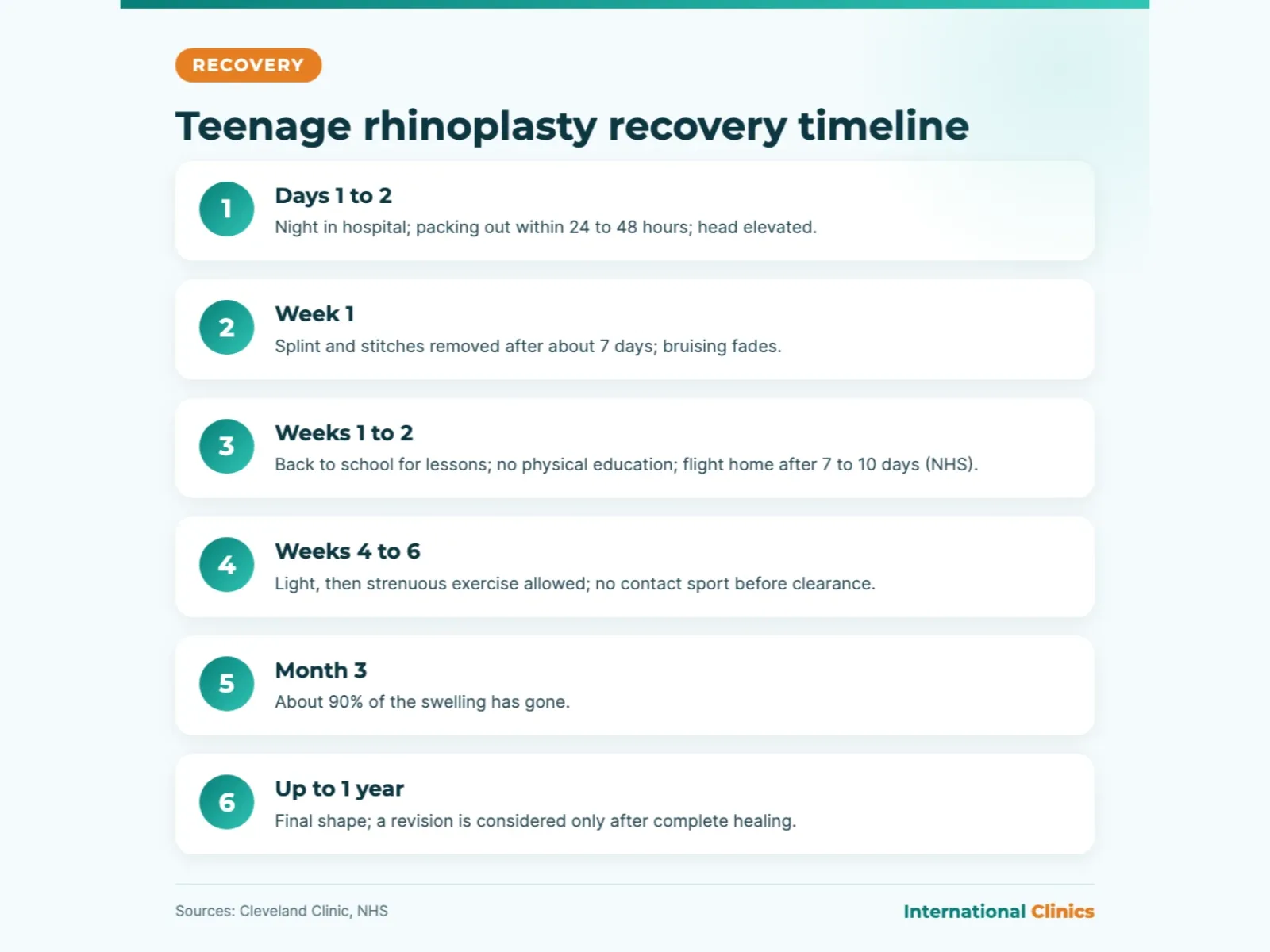
The healing stages after teenage rhinoplasty in Turkey are:
- First Week: rest with the head elevated, the splint in place and cold packs around the eyes, never on the nose.
- Splint Removal: after about 7 days, together with any non-dissolvable stitches; the new shape is visible but swollen. (Source: NHS)
- Swelling Reduction: gradual over 4 to 6 weeks; bruising under the eyes fades within 2 weeks.
- School Return: after about 1 to 2 weeks for lessons; physical education waits for the surgeon’s clearance. (Source: Cleveland Clinic)
- Activity Restriction: no strenuous exercise or contact sport for 4 to 6 weeks, and no ball games that could hit the nose before the surgeon allows them. (Source: NHS)
- Third Month: about 90% of the swelling has gone and the contours emerge.
- Daily Cleaning: saline sprays as prescribed to keep the inside of the nose clean.
- Final Outcome: the nose settles fully after up to a year; our rhinoplasty recovery photos day by day show what each stage looks like.
| Recovery phase | What to expect after teenage rhinoplasty |
|---|---|
| Days 1 to 2 | Night in hospital; packing removed within 24 to 48 hours if used; head elevated, cold packs around the eyes |
| Week 1 | Splint and any non-dissolvable stitches removed after about 7 days; bruising fades; breathing through the nose is difficult for about a week |
| Weeks 1 to 2 | Return to school for lessons; no physical education; the NHS allows up to 2 weeks off |
| Weeks 4 to 6 | Light exercise, then strenuous exercise; no heavy lifting before this point |
| Month 3 | About 90% of the swelling has gone; the shape is clearly visible |
| Month 6 to 12 | Final result; minimal swelling of the tip can remain up to a year |
Real Patient Stories
We do not publish unverified testimonials. Real patient stories about teenage rhinoplasty usually follow the same pattern: a teenager who waited until the nose had stopped growing, a consultation with the parents present, a week with a splint, a return to school after two weeks and a result judged only after several months. When you read such stories online, look for before and after photos taken at least 6 to 12 months after surgery, from the same angle and in the same light, and ask the surgeon for his own cases of patients of the same age and nose type.

Keep in mind that about 15% of people who have rhinoplasty need a small follow-up (revision) surgery, and that a revision is considered only after the nose has healed completely, at about one year. A story that promises a perfect nose in two weeks is describing swelling, not a result. (Source: Cleveland Clinic)
How to Start Your Journey with International Clinics?
International Clinics is neither a treatment centre nor a hospital broker: it is the link between your family and the right treatment. We searched for skilled ENT and plastic surgeons and reputable hospitals, contracted with them against the highest standards of medical quality, and prepare a treatment plan tailored to each teenager, with a written price that lists what it covers.
Organising teenage rhinoplasty in Turkey takes the following steps:
- Initial Contact: a message to the medical coordination team with photos of the nose from the front, both sides and below.
- Free Evaluation: the surgeon reviews the photos, the age and the medical history and confirms that the nose has stopped growing.
- Treatment Plan: a written surgical plan and a transparent quote.
- Travel Logistics: flights, and a hotel for the patient and one parent or guardian.
- Airport Transfer: a private driver on arrival in Istanbul.
- Direct Consultation: an in-person meeting with the surgeon, with the parent present, to finalise the goals and sign the consent; the NHS recommends two consultations before surgery. (Source: NHS)
- Surgical Procedure: the operation in a hospital licensed by the Turkish Ministry of Health, with a night of observation.
- Ongoing Support: a check-up before the flight home (not before 7 to 10 days after facial surgery) and remote follow-up afterwards. (Source: NHS)
Expert Pro-Tips
These practical habits help a teenager heal faster and protect the result; they complement the surgeon’s instructions without replacing them.
- Follow Instructions: take the prescribed medication on schedule and keep every follow-up appointment.
- Sleep Elevated: prop the head up on two pillows for the first weeks to limit swelling.
- Take It Easy: no heavy lifting, gym or contact sport for 4 to 6 weeks. (Source: Cleveland Clinic)
- Cool Compresses: ice packs around the eyes, never directly on the nose.
- Soft Diet: soups and smoothies in the first days, nothing that requires wide chewing.
- Sneeze Safely: with the mouth open, to avoid pressure inside the nose.
- Keep Clean: saline sprays as prescribed; no nose blowing until the surgeon allows it.
- Be Patient: the shape keeps improving for up to a year; do not judge the result in the first weeks.
Conclusion
Teenage rhinoplasty in Turkey is a reasonable option for an adolescent whose nose has stopped growing, whose motivation is personal and stable, and whose parents consent and take part in the consultations. It is not a high-risk surgery when a qualified surgeon operates in a licensed hospital, the published complication rate in teenagers is low, and a primary rhinoplasty costs $2,500–$3,000 (approx. £1,850–£2,250) with the surgeons contracted by International Clinics, compared with an average surgeon fee of $7,637 (approx. £5,700) in the United States. (Source: ASPS)
If you and your teenager are considering this step, contact International Clinics through the Contact Us button on this page and send the photos, the age and the medical history to receive a written evaluation that says whether the nose is ready for surgery and what the price covers.
Medical review and disclaimer:
This article was reviewed by a specialist physician contracted with International Clinics. It is general health information, not a substitute for medical advice, and results vary between individuals.