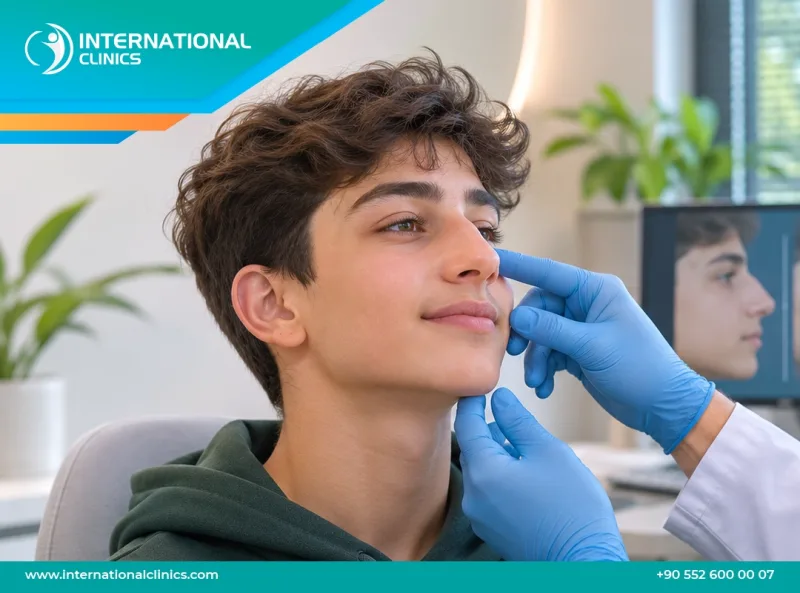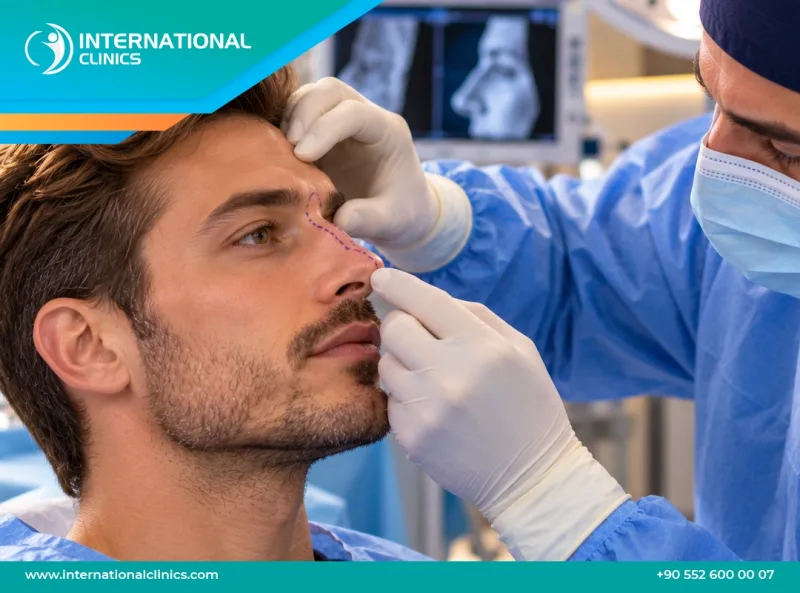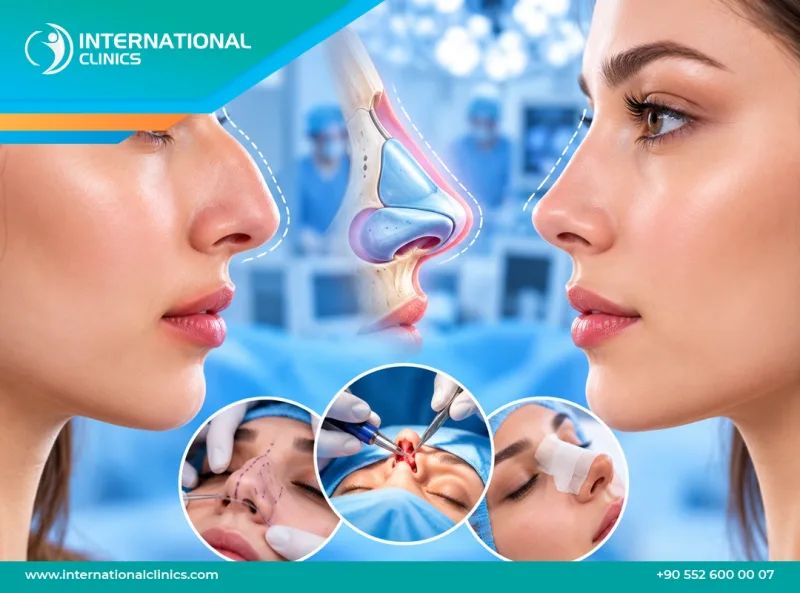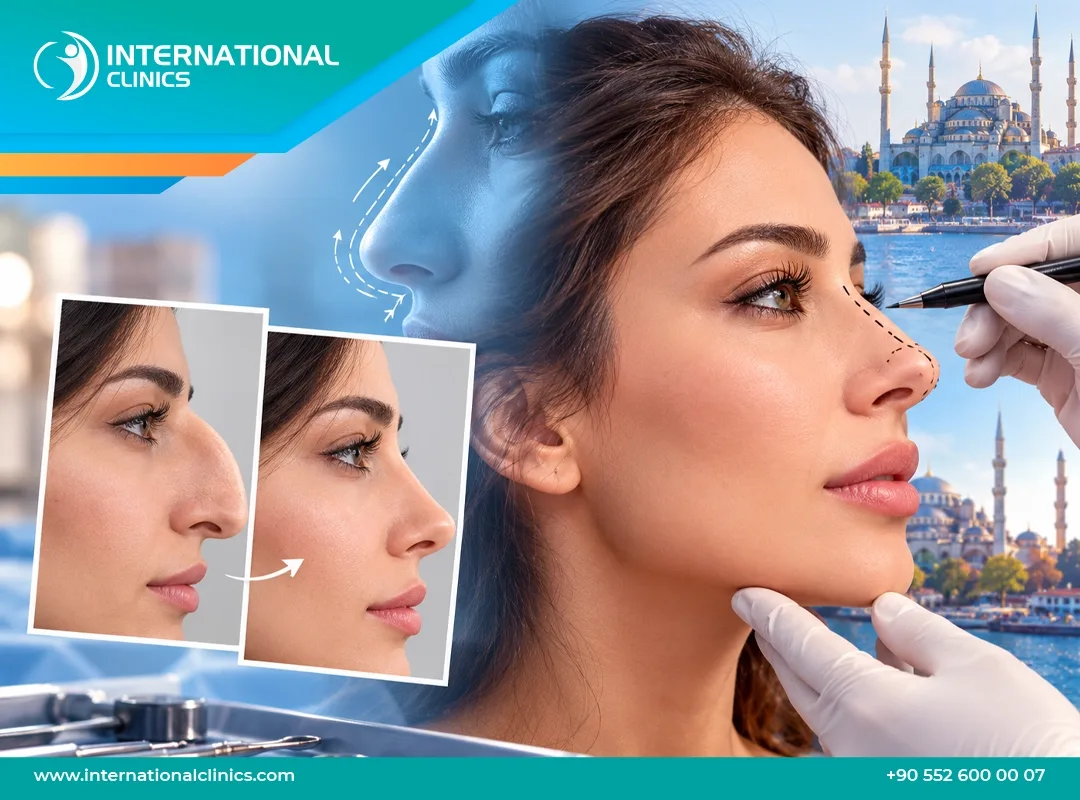
A hawk nose (also written hawked nose, and close to what is called an aquiline nose) is a nose with a high, curved bridge, usually a dorsal hump seen in profile and sometimes a tip that points downward. It is a normal variation, not a disease, so surgery is a personal choice unless the nose also blocks your breathing. Hawk nose rhinoplasty in Turkey costs about $2,500–3,000 (approx. £1,900–2,250) for a first operation through International Clinics, and the final shape takes up to a year to settle.
Hawk nose rhinoplasty lowers a prominent dorsal hump and rebalances the tip with the rest of the face. International Clinics connects patients with contracted surgeons who plan this operation case by case. This guide covers the hawk nose shape and its causes, the surgical steps, the cost, the real risks and a realistic recovery timeline.
Hawk Nose Shape: What It Looks Like and What Causes It
The hawk nose shape is defined by the side view: the bridge rises into a convex curve instead of a straight line. "Hawk nose" is an everyday description rather than a diagnosis; surgeons speak of a dorsal hump and assess the bone, the cartilage and the tip separately. They also look for a false hump, which only looks large because the top of the nose (the radix) is low or the tip lacks projection (Source: Journal of Clinical Medicine, 2025).
| Type | What the surgeon sees | Why it matters |
|---|---|---|
| Isolated hump | A focal bump centred where bone meets cartilage | The rest of the bridge line is smooth |
| Generalized hump | A broad curve across both the bony and cartilage vaults | The whole bridge needs planning, not one spot |
| False hump (pseudohump) | A low radix or a weak tip makes the bridge look high | Removing too much bone would over-lower the nose, so a graft at the radix may be the better answer |
A nasal bump may be inherited or may follow an injury, when bone and cartilage growth or scar tissue changes the bridge. An overdeveloped septal cartilage can also create a hump, and poorly healed nasal fractures can leave lasting irregularities on the bridge (Sources: ASPS, Acta Otorhinolaryngologica Italica, 2013, Journal of Clinical Medicine, 2025).
A hump and a crooked nose often come together. In a 2025 study of 90 patients having a first rhinoplasty, 83% of those with a hump also had a deviation, against 38% of those without one; the study came from one centre and one surgeon, in an Asian population, so the figure needs confirming elsewhere (Source: Journal of Clinical Medicine, 2025).
Related profile types are compared in our guides to the Roman nose, the aquiline nose and the Greek nose.
What is Hawk Nose Rhinoplasty?
Hawk nose rhinoplasty is surgery that reduces the dorsal hump and, when needed, reshapes a downward-pointing tip. The surgeon removes or repositions bone and cartilage to give a smoother bridge that suits your face, not a standard "perfect" nose. Rhinoplasty can treat a hump or a dip on the bridge, the tip, the nostrils and asymmetry, and it can correct structural problems that impair breathing, though ASPS notes that results may not be completely symmetric (Sources: ASPS, ASPS, Cleveland Clinic).
Why Choose Turkey and International Clinics for Hawk Nose Rhinoplasty?
People usually consider Turkey because of price and the number of teams working in rhinoplasty. Neither fact says anything about one particular surgeon, so the points below are what to weigh, and what to verify.
- Surgeon experience: ask for the surgeons name, specialist registration and how many hump reductions he or she performs. The NHS advises checking qualifications, the number of nose operations, complication rates and follow-up arrangements (Source: NHS).
- Techniques: ask which approach is planned for your nose and why, including whether piezoelectric instruments or preservation methods apply to you.
- Cost-effective packages: packages arranged through International Clinics include surgery, hospital fees, transfers and hotel; ask for the list in writing.
- Natural aesthetics: the plan should match your face. Ask for a digital simulation only as a discussion tool, not as a promise.
- Follow-up care: confirm who checks your nose before you fly and who answers after you are home.
- Free consultations: a virtual assessment of your photos and history is offered before you make travel arrangements.
International Clinics is neither a treatment centre nor a hospital broker: it is the link between you and the right surgeon. It selected doctors and institutions, contracted with them against medical quality standards, and prepares a plan for each case. It is a licensed company with international partners, and it is extending its hospital contracts to several countries, starting with the UAE.

Good hump surgery is judged on two things at once, the profile and the airway. The cartilage septum is the central pillar of the nose, and one-stage surgery on the septum and the outer nose has become the standard for a deviated nose (Source: Acta Otorhinolaryngologica Italica, 2013).
Hawk Nose Rhinoplasty Cost in Turkey 2026
A first hawk nose rhinoplasty costs about $2,500–3,000 (approx. £1,900–2,250) through International Clinics, and our overall rhinoplasty range is $2,500–4,500 (approx. £1,900–3,400). The quote depends on whether it is a first operation or a revision and on the work needed on the septum and tip. See the full list in our rhinoplasty costs in Istanbul guide.

| Procedure | Price through International Clinics |
|---|---|
| Primary rhinoplasty (first operation) | $2,500–3,000 (approx. £1,900–2,250) |
| Revision rhinoplasty | $3,500–4,500 (approx. £2,650–3,400) |
| Functional septoplasty | $2,800–3,500 (approx. £2,100–2,650) |
| Non-surgical nose reshaping with filler | $500–1,000 (approx. £400–750) |
For comparison, the NHS puts private nose reshaping in the UK at £4,000 to £7,000, plus consultations and any further surgery or follow-up care. ASPS gives a US average of $7,637, a figure that excludes anaesthesia, operating room and other related costs (Sources: NHS, ASPS).
Ideal Candidates for Hawk Nose Surgery
You may be a good candidate if the hump bothers you, your face has finished growing, you are in good health and your goals are realistic. A careful assessment comes first, and the items below decide your suitability.
- Complete growth: many surgeons wait until the nasal bone stops growing, at around 15 to 16 in girls and somewhat later in boys; our teenage rhinoplasty guide covers younger patients (Source: MedlinePlus).
- General health: you should be physically healthy. The assessment looks for bleeding disorders and obstructive sleep apnea, both of which can change or rule out surgery (Sources: ASPS, AAO-HNSF guideline, 2017).
- Realistic expectations: a surgeon should ask why you want surgery and tell you honestly whether your goal can be achieved (Source: AAO-HNSF guideline, 2017).
- Emotional stability: international guidance asks surgeons to look for body dysmorphic disorder, which can make surgery inappropriate (Source: AAO-HNSF guideline, 2017).
- Prominent hump: the curve on the bridge is the main reason for this operation, once a false hump has been excluded.
- Breathing issues: the surgeon should check your nasal airway before surgery, even if your request is cosmetic (Source: AAO-HNSF guideline, 2017).
- Non-smokers: stop smoking at least 2 to 3 weeks before and after surgery to help healing (Source: MedlinePlus).
- Previous trauma: a nose changed by an old fracture needs a closer look, as such noses often combine a hump with a deviation.
Long-term use of decongestant nasal sprays should also be mentioned at your consultation, because the guideline lists it among the conditions that can change the plan (Source: AAO-HNSF guideline, 2017).
Step-by-Step Procedure for Hawk Nose Correction
The operation usually takes 1 to 3 hours under general anaesthesia or, in some cases, local anaesthesia with intravenous sedation. Cleveland Clinic describes it as usually outpatient, while the NHS describes a stay of 1 or 2 nights, so ask what your team plans (Sources: Cleveland Clinic, NHS).
- General anesthesia: medication keeps you comfortable; the surgeon recommends sedation or general anaesthesia according to the plan (Source: ASPS).
- Surgical incisions: a closed approach hides the cuts inside the nose, while an open approach adds a small cut across the columella, the strip between the nostrils (Source: ASPS).
- Tissue elevation: the skin is lifted off the nasal bones and cartilage to expose the framework (Source: ASPS).
- Hump removal: bone and cartilage are reduced in small steps. Even an apparently large hump may need only a small resection, and most poor results come from taking too much (Source: Indian Journal of Plastic Surgery, 2013).
- Osteotomies when needed: removing a hump often leaves a gap at the top of the bridge, the "open roof", which is traditionally closed by cutting and moving the nasal bones inward (Source: PRS Global Open, 2016).
- Septum correction: a deviated septum is straightened and internal projections are reduced to improve breathing (Source: ASPS).
- Tip refinement: the tip is reshaped when it droops. Some surgeons work on it before the hump, because it is easier to balance the bridge to the tip (Source: Indian Journal of Plastic Surgery, 2013).
- Suture closure: the skin is redraped and the incisions are closed with small stitches (Source: Cleveland Clinic).
- Splint application: a splint supports the new shape during early healing. Routine packing inside the nose is not recommended by the 2017 guideline (Sources: Cleveland Clinic, AAO-HNSF guideline, 2017).
Comparison of Surgical Techniques
The open approach suits major reshaping and the closed approach suits smaller changes, so the choice follows your anatomy; our guide to open vs closed rhinoplasty goes further (Source: Cleveland Clinic).

| Comparison Criteria | Open Rhinoplasty | Closed Rhinoplasty |
| Incision Location | Inside the nose plus a small cut across the columella | Hidden inside the nose |
| Surgical Visibility | Direct view of the framework | More limited view |
| Swelling & Scars | A small external scar, usually discreet | No visible external scar |
| Case Complexity | Major reshaping and complex tips | Minor to moderate reshaping |
| Operative Time | Depends on the work needed; ask your surgeon | Depends on the work needed; ask your surgeon |
| Modification Precision | Depends on the surgeon and the plan, not on the approach alone | Depends on the surgeon and the plan, not on the approach alone |
Preservation Rhinoplasty for a Dorsal Hump
Dorsal preservation lowers the bridge as one unit instead of cutting the hump away, which keeps the top of the cartilage attached to the septum. A 2023 systematic review suggests the greatest benefit in straight noses and traditional surgery in difficult cases or thick skin. One meta-analysis of 5,660 patients it cites reported hump recurrence in 4.18% and revision in 3.48%, yet no level I evidence exists, and most studies were retrospective or uncontrolled. More detail is in our preservation rhinoplasty guide (Source: Facial Plastic Surgery, 2023).
Piezoelectric Instruments
Piezo tools cut bone with ultrasonic vibration. A 2024 meta-analysis of 12 randomized trials found less bruising and pain in the first days than with conventional osteotomy, with similar operating time and no overall difference in the risk of swelling. Our guide to piezo rhinoplasty explains when it is used (Source: Journal of Clinical Medicine, 2024).
Can a Hawk Nose Be Corrected Without Surgery?
Filler cannot remove a hump. It may disguise a small one by building up the areas around it, as a non-surgical nose job does, and most fillers are temporary. The FDA calls accidental injection into a blood vessel the most serious filler risk, because it can cause skin death, stroke or blindness; the chance is low, but the harm can be permanent (Source: FDA).
Pros and Cons of Dorsal Hump Removal
The main gains are a smoother profile and, when the septum is treated, easier breathing. The costs are weeks of visible healing and a real chance of needing further surgery, as this table sets out.
| Pros (Advantages) | Cons (Risks and Drawbacks) |
| Facial Harmony: a straighter side profile that suits the face. | Temporary Swelling: bruising around the eyes for about 3 weeks; swelling can take months to clear. |
| Better Breathing: septal repair can improve airflow, often within six weeks. | Hidden Scars: a small scar with the open approach; poor healing is possible. |
| Boosted Confidence: many patients are pleased, but surgery cannot solve wider worries about appearance. | Minor Bleeding: nosebleeds can occur and are occasionally heavy. |
| Permanent Results: changes to bone and cartilage are lasting, although the nose keeps ageing. | Skin Numbness: changes in skin sensation; the tip may stay numb for months. |
| Quick Recovery: most people return to work within 1 to 2 weeks. | Revision Needs: further surgery is a recognised possibility, not an extreme rarity. |
The general risks also include anaesthesia problems, infection, breathing difficulty, a hole in the septum, skin discolouration, a changed sense of smell and an appearance you are unhappy with. For the wider picture, read our guide to rhinoplasty vs septoplasty (Sources: ASPS, NHS, Cleveland Clinic).
Risks Specific to Removing a Hump

- Saddle nose or scooped bridge: taking too much can leave a dip, and it can also weaken tip support (Sources: Indian Journal of Plastic Surgery, 2013, Acta Otorhinolaryngologica Italica, 2013).
- Open roof: a gap at the top of the bridge after a large hump is removed; surgeons reassess the bridge after the bone cuts and may place a graft (Source: Indian Journal of Plastic Surgery, 2013).
- Inverted V: a visible step where the nasal bones meet the cartilage, which may show only months later and is very hard to correct, so prevention matters (Source: Indian Journal of Plastic Surgery, 2013).
- Polly beak: fullness above the tip, linked to leaving too much cartilage while over-resecting bone (Source: Indian Journal of Plastic Surgery, 2013).
- Remaining hump: too little removal can leave a residual bump, and with preservation methods the hump can come back (Sources: Indian Journal of Plastic Surgery, 2013, Facial Plastic Surgery, 2023).
How Often Is Revision Rhinoplasty Needed?
Cleveland Clinic says about 15% of people need a follow-up operation for small changes. A US cohort of 175,842 septorhinoplasty patients recorded a lower 3.1% after a primary operation and 11.0% after a secondary one, at a median of 1.2 years; it relied on billing codes, so the figures are not directly comparable. Second procedures usually wait for full healing; see our guide to revision rhinoplasty (Sources: Cleveland Clinic, JAMA Facial Plastic Surgery, 2016).
Recovery Timeline and Expectations
Most people return to desk work within 1 to 2 weeks, but the final shape can take up to a year. Our rhinoplasty recovery day by day guide shows the stages in more detail.


- First Week: the external splint stays on for about a week, sometimes two. Pain is usually mild to moderate and eases within a few days to a week (Sources: Cleveland Clinic, NHS).
- Suture Removal: stitches and the splint are dealt with at your first check; your surgeon sets the exact day.
- Bruising Reduction: bruising and swelling around the eyes can last about 3 weeks (Source: NHS).
- Breathing Restoration: breathing improvements after septal repair often appear within six weeks (Source: Cleveland Clinic).
- Work Resumption: plan 1 to 2 weeks off work (Sources: Cleveland Clinic, NHS).
- Light Exercise: light exercise and heavier lifting wait 4 to 6 weeks, as do strenuous sports (Sources: Cleveland Clinic, NHS).
- Third Month: about 90% of the swelling has gone by three months (Source: Cleveland Clinic).
- Final Result: minimal swelling may last up to a year, when the full result can be judged (Sources: Cleveland Clinic, MedlinePlus).
Real Patient Stories and Transformations: What the Outcome Data Show
Personal stories show what is possible, not what is likely, so judge them alongside measured outcomes. Studies of preservation rhinoplasty report patient satisfaction of about 90% to 96%, but most were retrospective or used unvalidated questionnaires, so these numbers are not strong evidence (Source: Facial Plastic Surgery, 2023).
The 2017 guideline asks clinicians to record satisfaction with both appearance and function at least 12 months after surgery. Before you decide, ask the surgeon to show consented photographs of noses like yours at a year or more, and ask for his or her own complication and revision figures, as the NHS suggests (Sources: AAO-HNSF guideline, 2017, NHS).
Your Medical Journey with International Clinics: From Assessment to Follow-up
A trip for hawk nose rhinoplasty is usually planned for about 7 to 10 days, so that the splint check happens before you fly. Through International Clinics the stages are:
- Initial Consultation: a virtual assessment of your photos and medical history before you book flights.
- Transfers: private transfers between the airport, the hotel and the hospital.
- Accommodation: a hotel stay near the contracted hospital while you heal.
- Pre-op Testing: blood tests and a physical examination before surgery.
- Surgical Intervention: the operation is performed by a surgeon contracted by International Clinics, in a contracted hospital.
- Nursing Care: nurses monitor you in the immediate period after surgery.
- Final Assessment: the surgeon checks your nose and confirms when you can fly.
- Continuous Follow-up: you keep a direct line for questions once you are home.
Expert Pro-Tips for Healing After Hawk Nose Surgery
These habits protect the new bridge in the first weeks, and your surgeons written instructions always come first.
- Sleep Position: keep your head raised, especially while sleeping (Source: Cleveland Clinic).
- Cold Compresses: use them around the eyes only if your surgeon recommends them, and never press on the nose.
- Sun Avoidance: avoid excess sun exposure (Source: Cleveland Clinic).
- Stop Smoking: stay off cigarettes for at least 2 to 3 weeks after surgery (Source: MedlinePlus).
- Do Not Blow Your Nose: avoid blowing it during early healing (Source: Cleveland Clinic).
- Soft Diet: choose foods that are easy to chew while your upper lip feels stiff.
- Avoid Glasses: do not let eyeglasses or sunglasses put pressure on the bridge (Source: Cleveland Clinic).
- Skip Gym: avoid heavy lifting and any blow to the face for 4 to 6 weeks (Source: Cleveland Clinic).
- Nasal Hygiene: use saline sprays only as prescribed.
Conclusion: Is Hawk Nose Surgery Right for You?
A hawk nose needs treatment only if it bothers you or blocks your breathing. If you choose surgery, look for a surgeon who assesses the bone, cartilage, tip and airway together, removes conservatively, and speaks plainly about revision. To find out whether your nose suits this operation, send your photos to International Clinics, who will prepare a treatment plan with a contracted surgeon.
Medical review and disclaimer:
This article was reviewed by a specialist physician contracted with International Clinics. It is general health information, not a substitute for medical advice, and results vary between individuals.