- Liposuction in Turkey at a Glance
- What Liposuction Is and What It Is Not
- Cosmetic and Medical Liposuction, Including Lipoedema
- Who Is a Good Candidate for Liposuction in Turkey?
- Who Should Not Have Liposuction
- Which Body Areas Can Liposuction Treat?
- Types of Liposuction in Turkey: VASER, Laser, PAL and Lipo 360
- Tumescent Liposuction
- Suction-Assisted (Traditional) Liposuction
- VASER Liposuction in Turkey (Ultrasound-Assisted)
- Laser Liposuction
- Power-Assisted Liposuction (PAL)
- Water-Assisted Liposuction (WAL)
- High-Definition Liposuction (HD Lipo)
- Lipo 360 in Turkey
- Comparing Liposuction Techniques
- Is One Liposuction Technique Better Than the Others?
- How Much Fat Can Be Removed?
- How Much Does Liposuction Cost in Turkey?
- Liposuction Turkey Cost by Technique
- Liposuction Turkey Cost by Body Area
- Liposuction Turkey vs UK and US Prices
- What Liposuction Packages Usually Include
- Hidden Costs of Liposuction Abroad
- Is Liposuction in Turkey Safe?
- What the NHS Says About Surgery Abroad
- How to Verify a Surgeon and Facility in Turkey
- Red Flags Before You Book Liposuction Abroad
- Questions to Ask Your Liposuction Surgeon
- What Happens on the Day of Liposuction Surgery?
- How Long to Stay in Turkey After Liposuction
- Liposuction Trip Plan, Day by Day
- Flying After Liposuction and Blood Clot Risk
- Liposuction Recovery Timeline
- Pain, Swelling and Numbness After Liposuction
- Compression Garment After Liposuction
- Return to Work, Driving and Exercise
- When Will You See Liposuction Results?
- How Long Do Liposuction Results Last?
- Can Fat Come Back After Liposuction?
- Scars and Skin After Liposuction
- Liposuction Risks and Warning Signs
- Common Side Effects
- Complications That Can Need Treatment
- Rare but Serious Complications
- How Often Do Serious Complications Happen?
- When to Seek Urgent Medical Care After Liposuction
- Liposuction vs Tummy Tuck vs Non-Surgical Fat Reduction
- Liposuction or Tummy Tuck?
- Non-Surgical Fat Reduction
- Liposuction Before and After
- How International Clinics Helps With Liposuction in Turkey
- All Our Liposuction Guides
- Liposuction by Technique
- Liposuction by Body Area
- Liposuction Price and Cost
- Liposuction Recovery and Aftercare
- Liposuction Risks and Safety
- Choosing a Liposuction Surgeon
- Other Liposuction Questions
Liposuction in Turkey costs about $2,500–$4,000 (approx. £1,900–£3,000) on average in 2026, and most patients should plan to stay about 7 to 9 days, including at least 5 to 7 days after surgery before flying home. Lipo in Turkey is real surgery with rare but serious risks, and it shapes stubborn fat without treating excess weight. The surgeon, the facility and the aftercare plan matter more than the headline price. (Sources: NHS (surgery abroad) and Mayo Clinic)
This guide explains what the operation can and cannot do, who suits it, how the techniques compare, what it costs, how to check safety, how to plan the trip and what recovery looks like. Where strong medical sources disagree, it says so. For a wider view of the treatment, see the liposuction treatment page.
Liposuction in Turkey at a Glance
Liposuction in Turkey usually means one operation, about a week of travel and several months of healing, and the table below gives the short answer to each practical question.
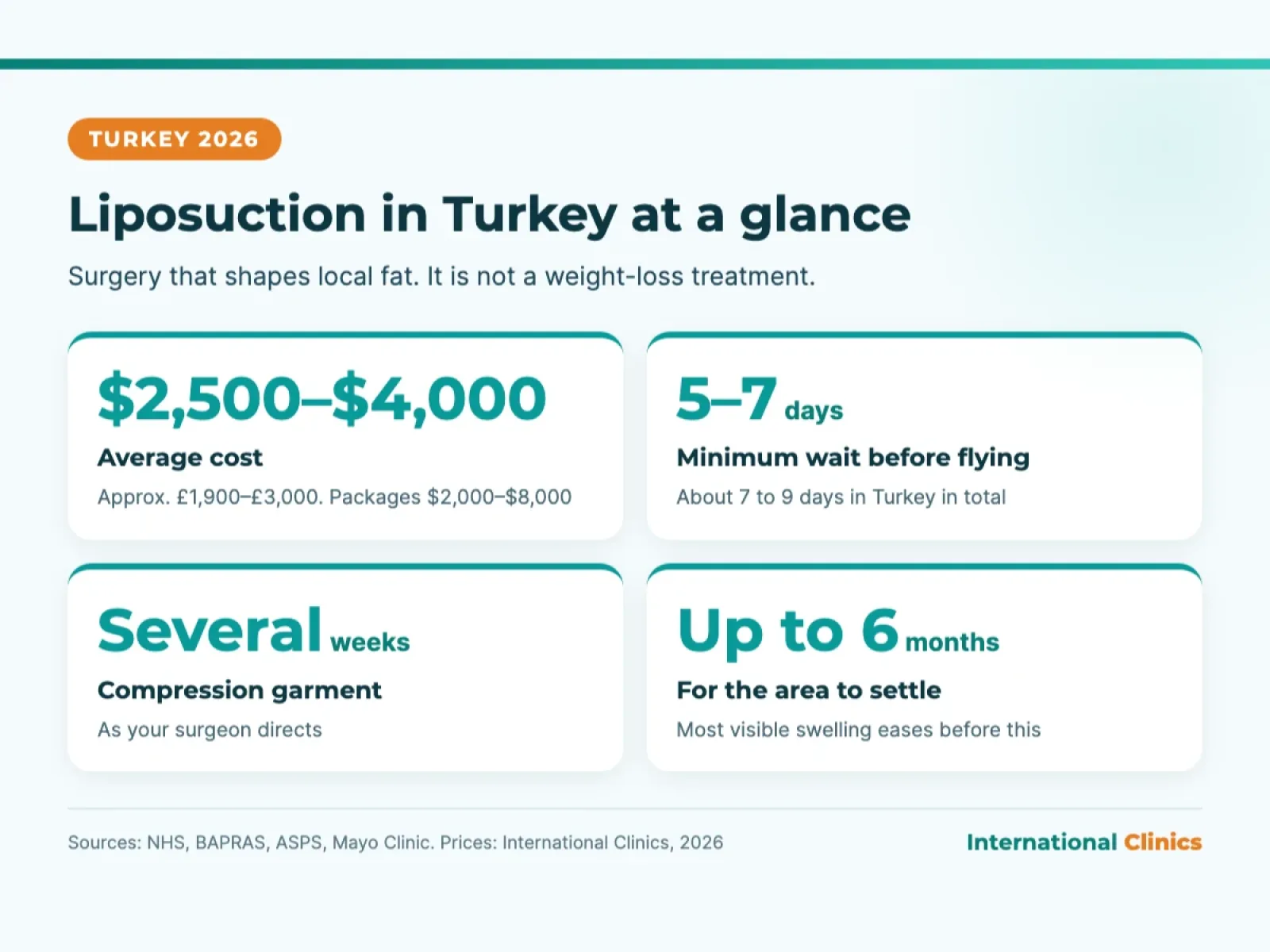
| Question | Short answer |
|---|---|
| Average cost in Turkey | $2,500–$4,000 (approx. £1,900–£3,000) |
| Package range | $2,000–$8,000 (approx. £1,500–£6,000) |
| Operation time | Usually 1 to 3 hours, longer for larger volumes |
| Anaesthesia | Local with or without sedation for small areas, usually general for larger ones |
| Hospital time | Some hours for small volumes, usually overnight for large volumes or combined surgery |
| How long to stay in Turkey | At least 5 to 7 days after surgery before flying, so about 7 to 9 days in total |
| Compression garment | Several weeks, as your surgeon directs |
| Back to work | A few days for small procedures, up to 2 to 3 weeks for extensive surgery or physical jobs |
| Gentle exercise | From around 3 to 4 weeks, strenuous activity later and only when cleared |
| Final shape | The area can take up to 6 months to settle |
| Main caution | It is surgery with rare but serious risks, and it is not a weight-loss treatment |
Medical items in the table come from the sources named here, and every one is explained in its own section below. Prices are International Clinics ranges for 2026. (Sources: NHS, NHS (surgery abroad), Mayo Clinic and ASPS (recovery))
What Liposuction Is and What It Is Not
Liposuction is surgery that uses suction to remove fat from specific areas of the body and to shape those areas, and it is not an overall weight-loss method. People who are overweight can lose more through diet and exercise, or through other kinds of surgery, than through liposuction. (Source: Mayo Clinic)

The surgeon works through small incisions with a thin, hollow stainless steel tube called a cannula, which is connected to a vacuum or a syringe. When you gain weight your fat cells get bigger, whereas liposuction lowers the number of fat cells in the treated area. That is why it changes shape more than it changes the number on the scale. (Sources: ASPS (procedure) and Mayo Clinic)
It has firm limits. It does not remove cellulite or stretch marks, and it does not correct excess skin. Firm, elastic skin usually looks smooth afterward, while thin skin with poor elasticity may look loose and may need separate skin surgery. The articles on liposuction and cellulite and how much weight liposuction removes look at these two questions in more depth. (Sources: Mayo Clinic, MedlinePlus and ASPS)
Demand is high, which is part of why careful selection matters. Liposuction was the second most common surgical aesthetic procedure worldwide in 2024, after eyelid surgery. The same global survey places Turkiye among the countries with the highest proportion of foreign patients, and it reminds readers that aesthetic surgery is actual surgery with risks. (Source: ISAPS)
Cosmetic and Medical Liposuction, Including Lipoedema
Most liposuction is cosmetic, but it also has medical uses. The NHS sometimes uses it for lymphoedema and lipoedema, while cosmetic liposuction is not normally available on the NHS. It can also reduce some types of enlarged male breast tissue, which is covered in the guide to gynecomastia surgery in Turkey. (Sources: NHS and Mayo Clinic)
Lipoedema is an abnormal build-up of fat, usually in the legs, bottom and thighs. There is no cure, and the NHS describes liposuction as an option when symptoms are particularly severe, noting that more than one operation may be needed. UK plastic surgery associations treat lipoedema and cosmetic patients as two distinct groups with very different risk profiles, and they advise a specialist surgeon, a multidisciplinary team and a hospital with high-dependency facilities. If this may apply to you, read about liposuction for lipedema and raise it at the first consultation. (Sources: NHS (lipoedema) and BAAPS and BAPRAS)
Who Is a Good Candidate for Liposuction in Turkey?
A good candidate is a healthy non-smoking adult, near a normal and stable weight, with firm skin and pockets of fat that have not responded to diet and exercise. The main points a surgeon looks for are these: (Sources: ASPS (candidates), Cleveland Clinic and Mayo Clinic)
- Local deposits of fat, with an otherwise stable body weight.
- Firm, elastic skin and good muscle tone.
- Good general health, without a condition that impairs healing.
- No smoking or vaping.
- Specific and realistic goals for the shape of the area.
Sources give different weight limits, so no single number decides. ASPS speaks of adults within 30% of their ideal weight, Cleveland Clinic says you might not be a candidate with a BMI over 25, and the UK expert group calls a BMI under 30 optimal. Treat these as starting points for a discussion, since the surgeon must also examine your skin and fat distribution. Patients with a higher BMI should read the articles on high BMI lipo 360 and mega liposuction limits before asking for a quote. (Sources: ASPS (candidates), Cleveland Clinic and BAAPS and BAPRAS)
Age alone is usually not the deciding factor, although skin may be less firm after 65. Men can have the operation too. Our article on age requirements for liposuction covers this question in more detail. (Source: Cleveland Clinic)
Who Should Not Have Liposuction
Liposuction should wait, or be declined, when it is unlikely to help or when surgery itself is the bigger danger. Warning situations include the following: (Sources: BAAPS and BAPRAS, Cleveland Clinic, Mayo Clinic and MedlinePlus)
- Significant medical conditions that surgery or anaesthesia may aggravate, including poorly controlled heart disease, high blood pressure, diabetes or lung problems.
- Clinically significant anaemia or a clotting disorder.
- Medicines that interact badly with adrenaline or lidocaine.
- Local problems such as certain scars or hernias in the treatment area.
- Being underweight, having poor skin quality or seeking treatment for obesity.
- Psychological contraindications, including severe anxiety or unrealistic expectations.
Which Body Areas Can Liposuction Treat?
Liposuction can treat most areas with local fat, including the abdomen, waist, back, hips, buttocks, thighs, inner knees, calves, ankles, upper arms, chest, chin, neck and cheeks. Results depend on skin quality and fat volume in that area, so each one has its own limits. (Sources: ASPS and MedlinePlus)

Our overview of liposuction areas compares them side by side, and these articles look at each area in detail:
- Midsection: flank liposuction for the sides of the waist and back liposuction.
- Lower body: hip contouring and fat transfer results, thigh and leg liposuction and calf liposuction.
- Upper body: upper body liposuction, lateral chest liposuction and buffalo hump liposuction.
- Face and neck: submental liposuction for a double chin and jowl liposuction.
Types of Liposuction in Turkey: VASER, Laser, PAL and Lipo 360
The main types of liposuction differ in how the fat is loosened before suction, and no technique is proven to suit every patient. Your surgeon should choose according to your goals, the area and any earlier liposuction, so a clinic offering one fixed method for everyone deserves a question. Our comparison of liposuction types and the wider guide to body contouring methods add further background. (Sources: Mayo Clinic and BAAPS and BAPRAS)

Tumescent Liposuction
Tumescent liposuction injects a large volume of solution into the fat before removal, sometimes up to three times the amount of fat to be taken out. The solution contains lidocaine for numbness, epinephrine to narrow blood vessels and an intravenous salt solution. This reduces blood loss and bruising, and lidocaine may be the only anaesthesia needed, although this type generally takes longer. The risk of lidocaine toxicity is the reason doses must be planned carefully. Read how it compares in Smart Lipo vs tumescent liposuction. (Sources: MedlinePlus and Mayo Clinic)
Suction-Assisted (Traditional) Liposuction
Traditional liposuction, or suction-assisted lipectomy, uses a cannula moved by hand under the skin and a high-pressure vacuum to remove fat. Sources describe both this method and tumescent liposuction as the most common type, because the two are usually used together: the fluid prepares the tissue and the suction removes the fat. The liposuction cannula article explains the instrument itself. (Sources: ASPS (procedure), Mayo Clinic and MedlinePlus)

VASER Liposuction in Turkey (Ultrasound-Assisted)
VASER liposuction is a newer form of ultrasound-assisted liposuction (UAL), which uses ultrasound energy under the skin to break down fat before suction. Ultrasound may help in dense, fibrous areas such as the upper back or enlarged male breast tissue. It also carries a specific risk of thermal burn or heat injury, so experience with the device matters. Mayo Clinic notes that VASER can improve skin shaping, but no strong source shows that it is superior overall. See what VASER liposuction is, its pros and cons and VASER before and after results. (Sources: ASPS (procedure), MedlinePlus, Mayo Clinic and ASPS (safety))
Laser Liposuction
Laser-assisted liposuction (LAL), sold under names such as Smartlipo and SlimLipo, passes a laser fibre through a small cut to break down fat, which is then removed with a thin tube. Because the cannula is smaller, surgeons often prefer it for confined areas such as the chin, jowls and face. MedlinePlus calls collagen stimulation a possible advantage that may help prevent skin sag, which is more cautious than the skin-tightening claims in many advertisements. Read more about laser liposuction in Turkey, the expert guide to laser liposuction and Smart Lipo results at 2 months. (Sources: Mayo Clinic, MedlinePlus and Cleveland Clinic)
Power-Assisted Liposuction (PAL)
Power-assisted liposuction uses a thin tube that moves back and forth quickly, so the surgeon can pull out tough fat more easily. It may sometimes cause less pain and swelling and may allow more accurate removal, and a surgeon may choose it for larger volumes or repeat liposuction. A 2026 systematic review linked it with shorter operating times. (Sources: Mayo Clinic and Front Surg, 2026)
Water-Assisted Liposuction (WAL)
Water-assisted liposuction uses a pressurised stream of saline to loosen fat cells, with fluid flowing in and being suctioned out at the same time. A 2026 systematic review reports less early pain and bruising and a quicker return to activity than with traditional liposuction in short-term comparative trials, but it rates this evidence as low certainty, so advertising that describes it as gentler should be read with care. (Sources: ASPS (procedure), BAAPS and BAPRAS and Front Surg, 2026)
High-Definition Liposuction (HD Lipo)
High-definition liposuction is an advanced technique that aims to bring out the anatomical shape of an area, whereas traditional liposuction works on the deeper layer of fat. In a systematic review of 6,964 patients, overall complications were 14.4% and major complications 0.2%. Transient hyperpigmentation (3.8%), seroma (3.3%) and transient soft-tissue fibrosis (2.7%) were reported most often, and the authors note that data on this technique are limited. Costs are explained in the article on high-definition liposuction cost. (Source: Plast Reconstr Surg, 2023)
Lipo 360 in Turkey
Lipo 360 is a common commercial name for treating the whole midsection in one operation, including the abdomen, waist, flanks and back. It describes the extent of treatment, and any of the techniques above may be used for it. Because the risk of complications rises when larger body surfaces are treated, the size of the plan deserves as much attention as the method. Before booking, read whether lipo 360 is dangerous and 360 lipo without a tummy tuck. (Source: Mayo Clinic)
Comparing Liposuction Techniques
The table sets out the differences that are useful in a consultation, and it is a discussion aid, not a ranking. All prices are International Clinics ranges for 2026.
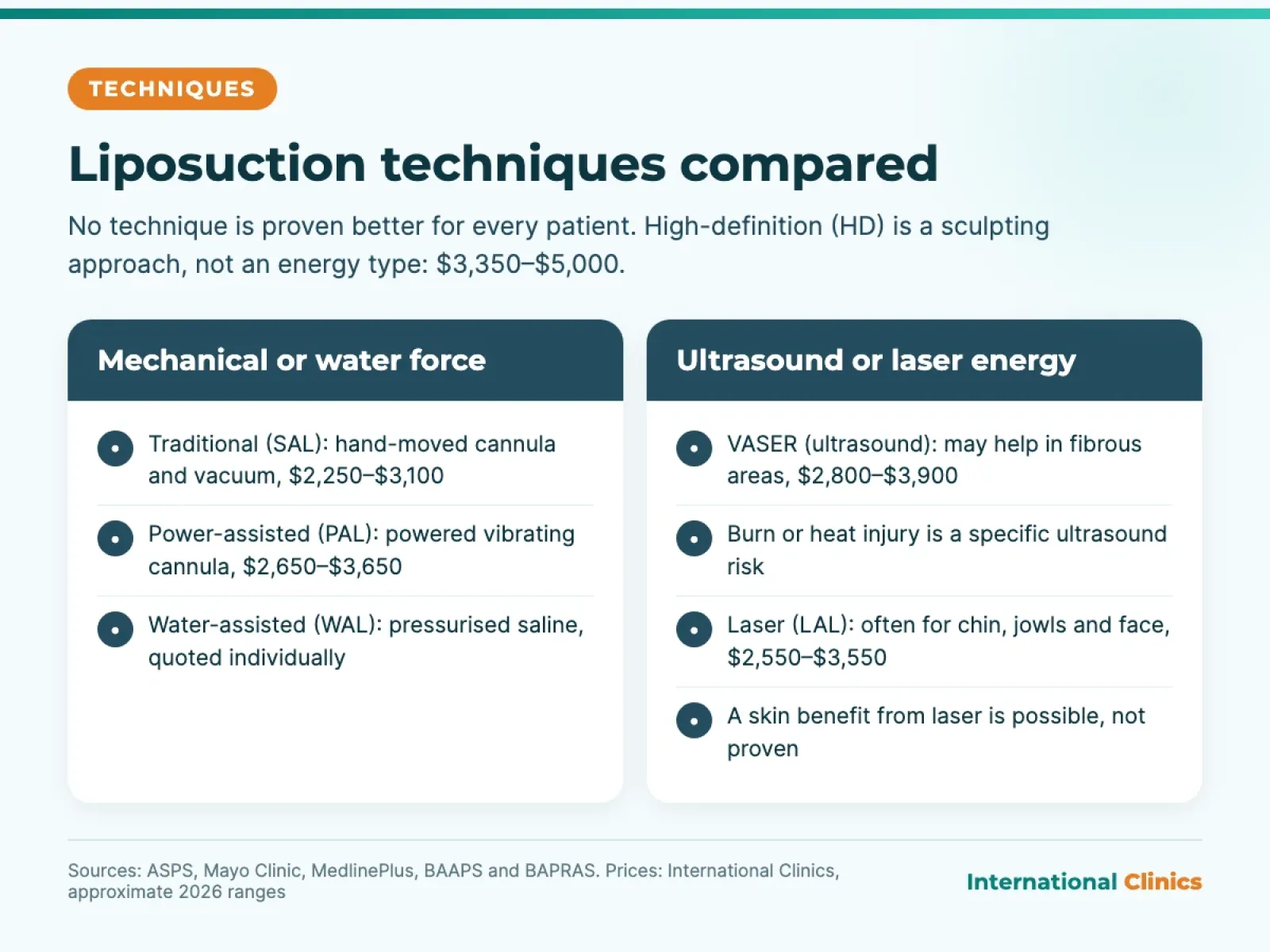
| Technique | How it loosens fat | Where it is often considered | Point to discuss | Cost in Turkey |
|---|---|---|---|---|
| Tumescent | Large volume of lidocaine, epinephrine and salt solution before suction | Often combined with suction methods | Lidocaine dose and fluid balance | Part of the quote |
| Traditional (SAL) | Cannula moved by hand, with vacuum | General body areas | Usually used with injected fluid | $2,250–$3,100 (approx. £1,700–£2,350) |
| UAL and VASER | Ultrasound energy under the skin | Dense, fibrous areas such as the upper back or male chest | Thermal burn risk | $2,800–$3,900 (approx. £2,100–£2,950) |
| Laser (LAL) | Laser fibre through a small cut | Confined areas such as chin, jowls and face | Skin benefit only possible, not proven | $2,550–$3,550 (approx. £1,900–£2,650) |
| Power-assisted (PAL) | Vibrating cannula | Larger volumes or repeat liposuction | Benefits described as possible | $2,650–$3,650 (approx. £2,000–£2,750) |
| Water-assisted (WAL) | Pressurised saline stream | No specific area established | Limited comparative evidence | Quoted individually |
| High-definition (HD) | Detailed sculpting to define anatomy | Patients seeking visible definition | Data on this technique are limited | $3,350–$5,000 (approx. £2,500–£3,750) |
Descriptions in the table come from the medical sources cited above, so ask your surgeon how they apply to your own area. (Sources: MedlinePlus, Mayo Clinic, ASPS (procedure) and Plast Reconstr Surg, 2023)
Is One Liposuction Technique Better Than the Others?
No technique has been proven better for every patient. The UK expert group says that no single liposuction technique suits all patients in all circumstances, and it asks surgeons to weigh overall health, body mass index, the volume to be removed and any added procedures. (Sources: BAAPS and BAPRAS and BAPRAS)
A 2026 systematic review of 13 studies found that none of the methods gave a consistently superior result in total aspirate volume. Differences related mainly to operating efficiency, early recovery and short-term skin tightening, and the authors judged the certainty of the safety evidence to be low. In practice, the surgeon experience with a technique is a stronger question than the name of the device. (Source: Front Surg, 2026)
How Much Fat Can Be Removed?
There is no agreed safe maximum, but about 5 litres of aspirate is the usual upper line for cosmetic liposuction in one operation. ASPS says special considerations are needed when usually more than five liters are suctioned. The UK expert group defines large-volume liposuction as 5 litres or more of total aspirate, notes that some authors use more than 3.5 litres, and says that a limit of 5 litres will usually be adequate for aesthetic goals, with any more treated as a separate surgery. (Sources: ASPS (safety) and BAAPS and BAPRAS)
The same group gives an order of magnitude of 5–8% of body weight, and it stresses that patient weight is probably the most important factor. This is a ceiling for surgeons to consider, not a target for patients. Aspirate is also a mixture of fat, blood and injected fluid, so a litre of aspirate is not a litre of pure fat. See how much fat liposuction can remove for more detail. (Source: BAAPS and BAPRAS)
How Much Does Liposuction Cost in Turkey?
Liposuction in Turkey costs about $2,500–$4,000 (approx. £1,900–£3,000) on average, with packages from $2,000–$8,000 (approx. £1,500–£6,000) depending on the areas, the technique and what is included. The tables below are a summary, and the price pages hold the detail: the full liposuction Turkey cost breakdown and liposuction surgery prices in Turkey.
Liposuction Turkey Cost by Technique
| Technique | Liposuction Turkey cost (USD and approx. GBP) |
|---|---|
| Traditional (suction-assisted) | $2,250–$3,100 (approx. £1,700–£2,350) |
| VASER | $2,800–$3,900 (approx. £2,100–£2,950) |
| Laser | $2,550–$3,550 (approx. £1,900–£2,650) |
| Power-assisted (PAL) | $2,650–$3,650 (approx. £2,000–£2,750) |
| High-definition (HD) | $3,350–$5,000 (approx. £2,500–£3,750) |
Liposuction Turkey Cost by Body Area
| Treatment area | Liposuction Turkey cost (USD and approx. GBP) |
|---|---|
| Abdomen | $2,500–$5,000 (approx. £1,900–£3,750) |
| Arms or thighs | $2,000–$4,500 (approx. £1,500–£3,400) |
| Chin and neck | $1,500–$3,000 (approx. £1,150–£2,250) |
| Upper limb, quoted alone | $1,000–$2,700 (approx. £750–£2,050) |
| Lipo 360 (midsection) | $3,050–$8,000 (approx. £2,300–£6,000) |
| Whole body, several large areas | $5,000–$12,000 (approx. £3,750–£9,000) |
These figures are International Clinics ranges for 2026. Your own quote depends on examination, so ask for it in writing and check its currency. For treatment beyond liposuction alone, see body contouring cost.
Liposuction Turkey vs UK and US Prices
Quoted prices in Turkey are usually lower than UK and US figures, but the figures do not measure the same things. The NHS gives about £3,000 to £8,500 in the UK depending on the provider and body areas. ASPS gives a US average of $4,711, which is the surgeon fee alone and excludes anaesthesia, the operating room and other expenses. (Sources: NHS and ASPS (cost))
| Country | Figure | What it covers |
|---|---|---|
| Turkey | $2,500–$4,000 (approx. £1,900–£3,000) | Typical average, usually quoted as a package |
| United Kingdom | £3,000–£8,500 | Depends on the provider and body areas |
| United States | $4,711 average | Surgeon fee only, without anaesthesia or operating room |
Price is not the only difference between the UK and Turkey. In the UK, the surgeon is responsible for follow-up treatment if you have complications, and independent clinics in England must be registered with the Care Quality Commission. Overseas clinics may not provide follow-up to the same standard, and you may have no local professional to go to, so a saving should be weighed against the cost of solving a problem at home. (Sources: NHS (surgery abroad) and NHS)
What Liposuction Packages Usually Include
Liposuction packages in Turkey generally list surgery, hospital fees and a hotel in one price, and many add airport transfers. Contents vary, so a line-by-line comparison is more useful than the total. ASPS lists the costs that belong in any liposuction bill: anaesthesia fees, hospital or facility costs, medical tests, post-surgery garments, prescriptions and the surgeon fee. (Source: ASPS (cost))
Ask for each of these to be confirmed in writing:
- The name of the operating surgeon and the anaesthetist, and the name of the facility.
- The areas to be treated and the planned technique.
- Pre-operative tests, medicines and compression garments.
- Hospital nights and hotel nights.
- Check-ups in Turkey and follow-up after you fly home.
Hidden Costs of Liposuction Abroad
The largest hidden costs of liposuction abroad are usually those that appear only if something goes wrong. Most health insurance plans do not cover liposuction or its complications, and travel insurance does not normally cover problems arising from surgery. Follow-up care for complications can be expensive at home. Check the clinic or surgeon insurance, what a return trip would cost, and how you would get home in an emergency. (Sources: ASPS (cost), NHS (surgery abroad) and CDC)
Other extras to budget for include flights, additional hotel nights if the surgeon delays your flight, a companion, spare garments and time off work. Your overall budget is a stronger number than the operation price alone.
Is Liposuction in Turkey Safe?
Liposuction in Turkey can be safe for a suitable patient with a qualified plastic surgeon in a properly equipped facility, but no surgery is free of risk in any country. No strong source publishes a Turkey-specific complication rate, so general reassurance has little value and your own checks matter. Read also is liposuction safe for the wider question. (Sources: NHS (surgery abroad) and Cleveland Clinic)
What the NHS Says About Surgery Abroad
The NHS says cosmetic surgery abroad can cost less, but savings should be weighed against the risks because safety standards may not be as high. It warns about overseas clinics that do not provide follow-up treatment, and about websites selling surgery as part of a holiday. A holiday straight after surgery is unrealistic: you need to rest and should not drink alcohol, lie in the sun, go sightseeing or go in the water. (Source: NHS (surgery abroad))
The CDC adds that risk depends on the destination, the facility and your health, and that qualifications, licensing and accreditation rules may differ from those at home. (Source: CDC)
How to Verify a Surgeon and Facility in Turkey
Check who will operate, what they are qualified to do and where they will operate before you pay anything. Both ISAPS and Cleveland Clinic point patients to a board-certified plastic surgeon trained and experienced in the procedure. (Sources: ISAPS and Cleveland Clinic)

- Surgeon: ask for proof of plastic surgery specialty training, professional memberships, years in practice and how many similar procedures they have done. (Source: NHS (surgery abroad))
- Regulation: find out how surgeons and clinics are regulated in Turkey and how standards are enforced. (Source: NHS (surgery abroad)) Also ask to see the facility licence from the Turkish Ministry of Health.
- Facility: check its credentials. International accreditors include Joint Commission International and DNV, although the CDC notes that accreditation does not promise a good outcome. (Source: CDC)
- Hospital access: ask whether the surgeon has hospital privileges. (Source: Cleveland Clinic) Also ask how a patient would be transferred in an emergency.
- Anaesthesia: ask who gives the anaesthetic and who monitors you afterward. A pre-operative anaesthetic assessment before the day of admission is recommended in UK guidance when a general anaesthetic is planned. (Source: BAAPS and BAPRAS)
Red Flags Before You Book Liposuction Abroad
These signs suggest that a patient should stop and look further, however good the price looks: (Sources: NHS (surgery abroad), Mayo Clinic and BAAPS and BAPRAS)
- You speak only to a sales adviser and never to the surgeon who will operate.
- You are asked to pay for a surgeon you have not met or a hospital you have not seen.
- Surgery is offered as part of a holiday, or with a flight home soon after the operation.
- Large volumes or several procedures are planned together, with no mention of added risk.
- A large-volume case is due to return to a hotel the same day, where nobody can monitor for circulatory problems.
- No written plan exists for complications or follow-up.
- The surgeon does not share a language with you, and no one explains the risks clearly.
Also be cautious about any promise of a specific result, because the NHS is clear that results cannot be assured. Our guide to causes of liposuction failure explains what commonly goes wrong. (Source: NHS)
Questions to Ask Your Liposuction Surgeon
The NHS advises two consultations with the treating surgeon before any surgery, with a cooling-off period that is normally two weeks in the UK, so take these questions to the first one: (Sources: NHS (surgery abroad), Cleveland Clinic and ASPS (recovery))
- Am I a candidate, and what would you advise against?
- Which technique will you use, how much do you expect to remove, and why?
- Are you certified in plastic surgery, and how many of these operations have you performed?
- Can I see before and after pictures of this area?
- What are my personal risks, and how would each complication be treated?
- How will you assess my blood clot risk and what will be done about it?
- How long will I wear the pressure garment, and when can I fly?
- Where is my follow-up after I go home, and who pays if I need more surgery?
- What will my body look like a few years after the procedure?
What Happens on the Day of Liposuction Surgery?
On the day of surgery you are examined and marked, given anaesthesia, treated through small cuts and then monitored while you wake up, usually over 1 to 3 hours of operating time. The article on how liposuction is done goes into technique in more depth. The usual order is: (Sources: NHS, BAPRAS and Mayo Clinic)
- Final review: the surgeon checks your history and medicines, and photographs are taken for later comparison. You should already have followed instructions on food, alcohol, smoking and stopping medicines such as blood thinners or anti-inflammatory drugs, which Mayo Clinic says may need to stop at least a week before. (Sources: Mayo Clinic and Cleveland Clinic)
- Marking: the surgeon marks the areas to be treated on your body. (Source: NHS)
- Anaesthesia: small areas may be done under local anaesthesia with or without sedation, and larger ones usually under general anaesthesia. Sources differ on which is typical, as the NHS says usually general while others list both, so the surgeon and anaesthetist decide according to the plan. (Sources: NHS, ASPS (procedure) and Mayo Clinic)
- Infiltration: a solution containing anaesthetic and medicine is injected to reduce blood loss, bruising and swelling. (Source: NHS)
- Fat removal: the surgeon makes small cuts, moves the cannula back and forth, and suctions out the loosened fat. (Sources: NHS and ASPS (procedure))
- Monitoring: the team watches your heart rate, blood pressure and blood oxygen. UK guidance also recommends warming and compression devices on the legs under general anaesthesia and for volumes over 1 litre. (Sources: Mayo Clinic and BAAPS and BAPRAS)
- Closing: excess fluid is drained, cuts are stitched or left to drain, and the compression garment goes on. (Sources: NHS and Mayo Clinic)
- Waking and observation: expect at least a few hours under observation. Small-volume cases may leave the same day, whereas large volumes or combined surgery mean a hospital and usually an overnight stay. (Sources: Mayo Clinic, BAPRAS and Cleveland Clinic)
Do not spend the first night alone. Mayo Clinic advises someone to drive you and stay with you for at least the first night, and the NHS gives the first 24 hours after a general anaesthetic. A survey of fatal outcomes from the 1990s found that many deaths happened during the first night after discharge home, and peak lidocaine levels typically occur 12 to 15 hours after surgery when adrenaline is used, so this is a real safety measure. (Sources: Mayo Clinic, NHS, Plast Reconstr Surg, 2000 and BAAPS and BAPRAS)
How Long to Stay in Turkey After Liposuction
Stay in Turkey for at least 5 to 7 days after liposuction before flying, because the NHS and BAPRAS advise against flying sooner. If it is combined with a tummy tuck, that minimum becomes 7 to 10 days. With arrival, an in-person consultation and tests, a single-area operation usually means about 7 to 9 days in total. This total is a planning estimate, and your surgeon may ask you to stay longer. (Sources: NHS (surgery abroad) and BAPRAS (surgery abroad))
Liposuction Trip Plan, Day by Day
Use this as a template for a straightforward case, and adjust it with your surgeon. The NHS cooling-off advice is hard to follow on a short trip, so it helps to hold the first consultation with the surgeon by video weeks before you travel. That leaves time to change your mind.
| Stage | What should happen |
|---|---|
| Weeks before travel | First consultation with the operating surgeon, medical history, written plan and quote |
| Day 1 | Arrival, in-person consultation, examination, tests and anaesthetic assessment |
| Day 2 | Surgery if you and the surgeon both agree to go ahead |
| Days 3 to 6 | Rest, short walks, garment care and a surgeon check |
| Days 7 to 9 | Final check and flight home if the surgeon agrees, 5 to 7 days after surgery |
| Back home | Follow-up already arranged, with a named contact |
During the rest days, follow the NHS advice on avoiding alcohol, sun, sightseeing and going in the water, and keep walking as the surgical team advises. Plan a return only after the final check, and keep your flight changeable. (Sources: NHS (surgery abroad) and MedlinePlus)
Flying After Liposuction and Blood Clot Risk
Air travel and major surgery both raise the risk of a blood clot, which can be life-threatening, and that is the reason for the waiting period. The risk of deep vein thrombosis (DVT) is also higher with journeys of over 4 hours, overweight or obesity and smoking. BAPRAS adds age over 40, cancer and heart conditions, while the NHS mentions age over 60. (Sources: NHS (surgery abroad), NHS (DVT) and BAPRAS (surgery abroad))
Sources differ on timing. The NHS and BAPRAS give 5 to 7 days for liposuction, while the CDC advises delaying air travel for 10 to 14 days after major surgeries, particularly those involving the chest. Ask your surgeon for a personal date, especially after large-volume surgery, combined procedures or before a long-haul flight. (Sources: NHS (surgery abroad), BAPRAS (surgery abroad) and CDC)
On a journey of 4 hours or more, wear loose clothing, drink plenty of water, avoid alcohol and walk around when possible. Ask whether you need preventive medicine or compression stockings, because a clot can still form weeks after surgery. Watch for the warning signs listed in the risks section after you get home. (Source: NHS (DVT))
Liposuction Recovery Timeline
Most people feel like themselves about two weeks after liposuction, but the treated area can take up to 6 months to settle completely. The timeline varies with the amount of fat removed and the area. Use our liposuction recovery guide, how long recovery takes and results week by week for more depth. (Sources: Cleveland Clinic and NHS)
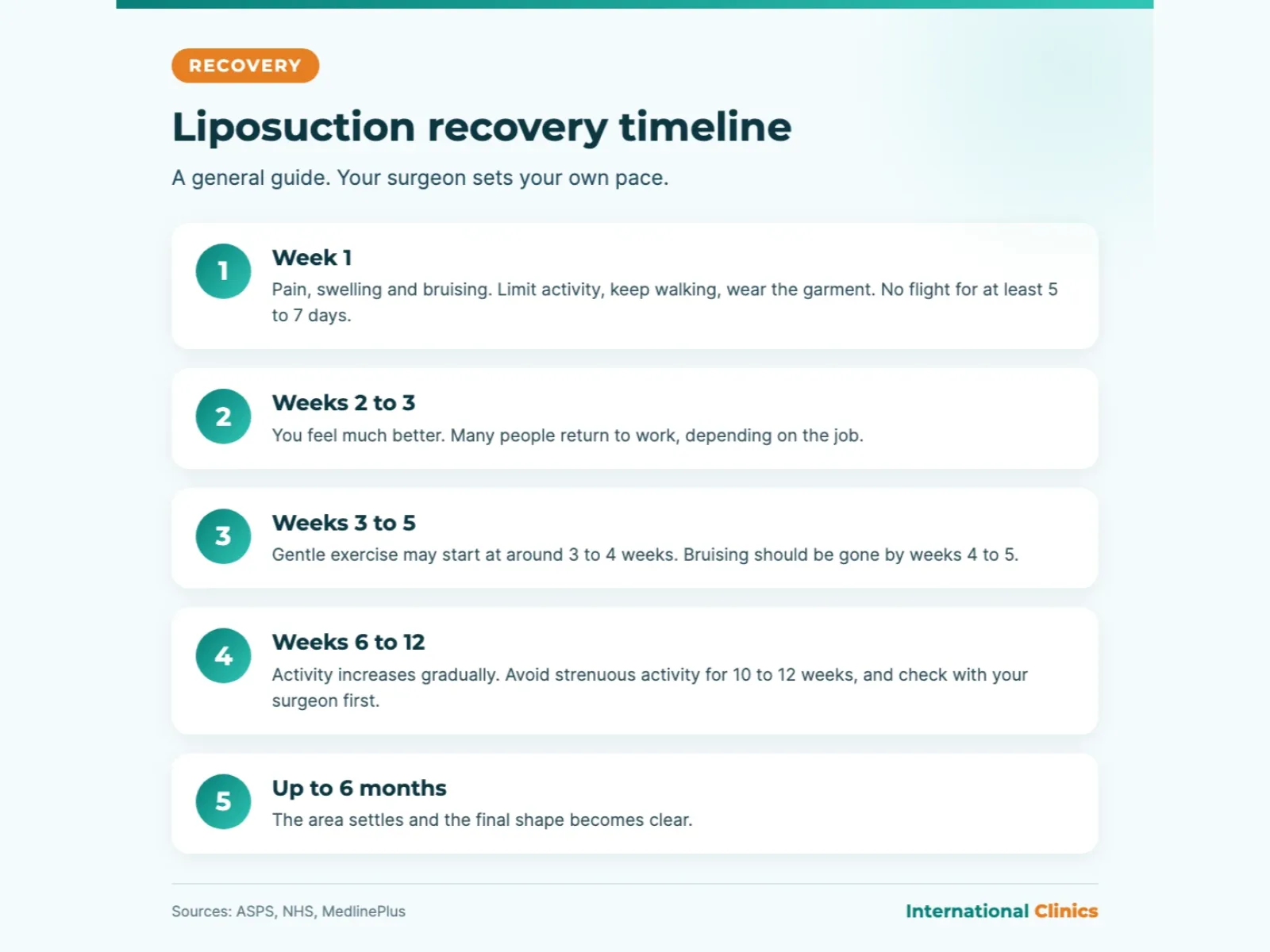
| Period | What to expect |
|---|---|
| Week 1 | Pain, swelling and bruising, with activity sharply limited and short walks |
| Weeks 2 to 3 | You feel much better, and many people return to work depending on the job |
| Around weeks 3 to 4 | Gentle exercise may begin according to the NHS, if your surgeon agrees |
| Weeks 4 to 5 | Bruising should have gone and swelling starts to ease |
| Week 6 onward | Swelling keeps improving, activity increases gradually, and ASPS places gentle exercise here |
| Up to 6 months | The treated area settles and the final shape becomes clear |
The stages follow the ASPS timeline, while gentle exercise at around 3 to 4 weeks and final settling come from the NHS. Your own surgeon may set a different pace. (Sources: ASPS (recovery) and NHS)
Pain, Swelling and Numbness After Liposuction
Expect some pain, swelling and bruising, and expect more of them after larger volumes. Cleveland Clinic describes a burning soreness for a couple of days, while BAPRAS warns of considerable pain after large removals, and MedlinePlus says recovery may be painful. Medicines can help you manage it, as covered in how painful liposuction is. (Sources: Cleveland Clinic, BAPRAS and MedlinePlus)
Numbness should go away in 6 to 8 weeks, though it can last for months and can be permanent. Stitches usually come out after about a week. Swollen ankles are common after work on the legs or ankles, and fluid may leak from the cuts at first. Our articles on nerve pain after liposuction, nausea after liposuction and fluid pockets after liposuction help with those specific problems. (Sources: NHS and Mayo Clinic)
Compression Garment After Liposuction
Wear the compression garment for several weeks, exactly as your surgeon directs, because it reduces swelling and bruising and helps the skin adapt. The NHS says to wear it constantly for several weeks and to take it off only to shower. BAPRAS is more specific, with day and night wear for at least two weeks and then another four to six weeks. (Sources: NHS, BAPRAS and Cleveland Clinic)
Return to Work, Driving and Exercise
You may return to desk work within a few days after a small procedure, and within 2 to 3 weeks after more extensive surgery or for a physical job. The NHS says to discuss driving with your surgeon. (Sources: Cleveland Clinic, Mayo Clinic, BAPRAS, ASPS (recovery) and NHS)
Start walking as soon as possible to help prevent clots. Avoid anything more strenuous for the first couple of weeks, and expect gentle exercise at around 3 to 4 weeks according to the NHS. ASPS is more cautious, placing gentle exercise from week 6, and the NHS advises avoiding strenuous activity for 10 to 12 weeks. Always check with your surgeon before going back to the gym. The articles on what to expect 3 weeks after liposuction and 8 weeks after liposuction describe those stages. (Sources: MedlinePlus, NHS and ASPS (recovery))
When Will You See Liposuction Results?
Your new shape usually starts to appear in the first couple of weeks, becomes more visible at 4 to 6 weeks and can keep changing for up to 6 months. Sources give different ranges for swelling, from a few weeks for most of it to 3 to 6 months for all of it, and both can be true in one patient. Temporary lumps are common while the remaining fat settles, and the article on how to smooth the stomach after liposuction covers this stage. (Sources: MedlinePlus, Mayo Clinic, Cleveland Clinic, NHS and BAPRAS)
How Long Do Liposuction Results Last?
Results generally last a long time if you maintain a stable, healthy weight, although the skin continues to lose firmness with age. No operation can stop later weight gain from changing your shape. Our article on how long liposuction lasts looks at this further. (Sources: NHS, Mayo Clinic and BAPRAS)
Can Fat Come Back After Liposuction?
Removed fat cells do not come back, but the body can still store fat in other places, so your shape can change if you gain weight. Mayo Clinic gives the example of gaining fat around the abdomen no matter which areas were treated. (Sources: Cleveland Clinic and Mayo Clinic)
Two small randomised trials add detail. In 32 non-obese women, the difference in body fat from small-volume liposuction was no longer significant at 1 year: thigh fat stayed reduced, while abdominal fat returned. In a second trial of 36 normal-weight women, treated abdominal fat stayed lower at 6 months, but those who did not train had a significant 10% rise in deeper visceral fat, which exercise counteracted. The trials are small and do not settle every question, but together they make a clear practical case for regular exercise after surgery. (Sources: Obesity, 2011 and JCEM, 2012)
Scars and Skin After Liposuction
You will have scars, although most are very small, and how the skin behaves depends mainly on its elasticity. Skin may look bumpy, wavy or loose if elasticity is poor or removal is uneven, and these changes may be permanent. The article on liposuction scars in men covers scar care. (Sources: Cleveland Clinic and Mayo Clinic)
Liposuction Risks and Warning Signs
Liposuction risks range from common, temporary side effects to rare, life-threatening events, and the risk rises when larger areas or several procedures are treated in one operation. Read the full article on liposuction risks alongside this summary. (Source: Mayo Clinic)
Common Side Effects
After liposuction it is common to have the following effects, most of which fade with time: (Sources: NHS and Mayo Clinic)
- Bruising and swelling, which may last up to 6 months.
- Temporary numbness and irritated nerves.
- Scars and inflammation in the treated area.
- Fluid coming from the cuts, and swollen ankles after leg treatment.
Complications That Can Need Treatment
Some complications can leave lasting problems or need further treatment, including these: (Sources: Mayo Clinic, NHS and ASPS (safety))
- Contour irregularity: bumpy, wavy or uneven skin that may be permanent, and a review gives an incidence of 2.7%. (Sources: Mayo Clinic and Ann Med Surg, 2017)
- Seroma: temporary pockets of fluid under the skin, which may need draining with a needle. (Source: Mayo Clinic)
- Haematoma and bleeding: UK guidance reports bleeding in 0.15% of cases. (Sources: NHS and BAAPS and BAPRAS)
- Infection: reported in about 0.1–0.3% of cases, rare but potentially severe. Necrotising fasciitis, a dangerous deep infection, is rarely reported. (Sources: BAAPS and BAPRAS and Mayo Clinic)
- Burns: heat injury is a specific risk with ultrasound-assisted techniques. (Source: ASPS (safety))
- Revision: some people need or want another operation. (Sources: NHS and ASPS (safety))
Rare but Serious Complications
Rare complications can be fatal, and any surgeon who does not discuss them with you is leaving out an important part of the decision. They include the following: (Sources: Mayo Clinic and NHS)
- Pulmonary embolism and DVT: blood clots in a leg vein can travel to the lungs. UK guidance reports venous thromboembolism in 0.06% of cases. (Sources: NHS and BAAPS and BAPRAS)
- Fat embolism: pieces of fat become trapped in a blood vessel, then gather in the lungs or reach the brain, which is a medical emergency. A review of 38 published cases, including liposuction and fat grafting, found that 76% began within 24 hours and that symptoms appeared up to 13 days after surgery. Twelve of those patients died, which shows severity but gives no measure of how often it occurs. (Sources: Mayo Clinic and Healthcare, 2023)
- Organ perforation: if the cannula goes too deep it may puncture an internal organ, which can require emergency surgery. Mayo Clinic describes this as rare, and we found no reliable pooled rate. (Source: Mayo Clinic)
- Fluid shifts: large volumes can cause possibly life-threatening kidney, heart and lung problems, including fluid in the lungs. (Sources: Mayo Clinic and NHS)
- Lidocaine toxicity: this can cause serious heart and nervous system problems. (Source: Mayo Clinic)
How Often Do Serious Complications Happen?
Figures vary widely by era, setting and reporting method, and none of them is specific to Turkey. In 246,119 cases at accredited US outpatient facilities, confirmed complications were 0.40% (0.63% including reports without notes), venous thromboembolism 0.03% and mortality 0.009%. These data are self-reported and exclude non-accredited facilities, so true rates may be higher. (Source: Aesthet Surg J Open Forum, 2023)
An older North American survey covering 1994 to mid-1998 found 19.1 deaths per 100,000 procedures, with pulmonary thromboembolism the leading cause, and UK guidance cites other analyses in the region of 1 in 5,000. Combined operations and large volumes raise the risk: UK guidance gives wound infection 1%, thrombotic events 0.5% and pulmonary complications 0.3% for combined procedures, and a large-volume analysis reports transfusion for bleeding in 2.89% and pulmonary embolism in 0.18%. (Sources: Plast Reconstr Surg, 2000 and BAAPS and BAPRAS)
When to Seek Urgent Medical Care After Liposuction
Call the local emergency number or have someone take you to an emergency department straight away if you have any of these symptoms, and do not drive yourself: (Sources: NHS (pulmonary embolism) and NHS (DVT))
- Sudden difficulty breathing.
- Pain in your chest or upper back.
- A very fast heartbeat.
- Fainting or collapse.
- Pain and swelling in a leg together with shortness of breath or chest pain.
Contact your surgeon or a doctor urgently, on the same day, for any of these: (Sources: Cleveland Clinic, NHS, NHS (DVT) and NHS (pulmonary embolism))
- Severe or long-lasting pain, or any unexpected symptom.
- Fever or new swelling.
- Fluid or blood leaking from a cut.
- Throbbing pain, swelling or colour change in one leg, usually in the calf or thigh.
- Coughing up blood.
Keep your surgeon and facility contact details with you when you fly home, and tell any doctor who treats you that you recently had liposuction. Symptoms that appear once you are home should still be treated locally first, with no waiting for a reply from Turkey.
Liposuction vs Tummy Tuck vs Non-Surgical Fat Reduction
Liposuction removes local fat through small cuts, a tummy tuck removes loose skin and fat through a long incision, and non-surgical options remove no tissue. Liposuction alone cannot improve loose or sagging skin, so skin quality often decides between the first two. (Sources: Cleveland Clinic, NHS (tummy tuck) and FDA)
Liposuction or Tummy Tuck?
A tummy tuck suits excess loose skin, for example after pregnancy or major weight loss, and it can tighten the abdominal muscles. It is major surgery that usually takes 2 to 5 hours under general anaesthesia, with a few nights in hospital, about 4 to 6 weeks off work and exercise, and a scar across the lower tummy. The two can be combined, but combining them raises risk, and the NHS flying minimum rises to 7 to 10 days. See tummy tuck vs liposuction, comparing liposuction and tummy tuck results and the guide to a tummy tuck in Turkey. (Sources: NHS (tummy tuck), Cleveland Clinic and NHS (surgery abroad))
Non-Surgical Fat Reduction
Non-invasive body contouring does not remove fat or skin from the body. The FDA notes that many procedures bring temporary improvement, that you may need more than one treatment, and that some complications can last a long time, become permanent or need surgery. It suits people who accept a modest and possibly temporary change. You can compare the wider options in body sculpting in Turkey. (Source: FDA)
Liposuction Before and After
Before and after pictures show what a surgeon has achieved in a similar case, but they cannot predict your own result. The most useful comparison is the same area, a similar body type and a follow-up long enough for swelling to settle, since the area can take up to 6 months. Ask to see several, and ask the surgeon who operated on them, because the NHS expects a surgeon to be able to show such pictures. (Sources: NHS (surgery abroad) and NHS)
Most people are satisfied with the outcome, according to MedlinePlus, which also says that liposuction may enhance appearance and self-confidence but will probably not give you your ideal body shape. Keep that balance in mind when looking at any gallery, including our own article on hip results. (Source: MedlinePlus)
How International Clinics Helps With Liposuction in Turkey
International Clinics connects you with a suitable plastic surgeon and medical institution and prepares a treatment plan for your case, without being a treatment centre or a hospital broker. It searched for skilled doctors and reputable hospitals and medical centres, then contracted with them against strict standards covering modern equipment, institutional reputation and surgeon experience.
The company is licensed by the Turkish Ministry of Health and has international partners, and its hospital contracts are expanding across several countries, starting with the UAE. Liposuction is performed by surgeons contracted by International Clinics. In Istanbul, these include Asst. Prof. Ahmet Aydın and MD Bilgehan İlker, whose profiles you can review before a consultation.
The plan is reviewed before you travel. You share your medical history, medicines and photographs, a surgeon assesses whether liposuction suits you at all, and you receive a proposed technique, a realistic scope of treatment and a written quote. The plan should also state your hospital and hotel nights, garments, follow-up and the earliest date your surgeon expects you to fly. If the honest answer is that a tummy tuck, weight loss first or no operation would serve you better, that should be part of the review too.
All Our Liposuction Guides
Every International Clinics article on liposuction is listed here by topic, so you can go straight to the question you have.
Liposuction by Technique
- Types of liposuction and how they differ
- How liposuction is done, step by step
- Body contouring methods compared
- What VASER liposuction is
- VASER liposuction pros and cons
- VASER liposuction before and after
- Laser liposuction in Turkey: advantages and costs
- Laser liposuction in Turkey: expert guide
- Smart Lipo compared with tumescent liposuction
- Smart Lipo before and after at 2 months
- Power-assisted liposuction
- Water-assisted liposuction
- Liposuction cannula types
- 360 lipo without a tummy tuck
- Lipo 360 at a higher BMI
Liposuction by Body Area
- Liposuction areas: complete guide
- Back liposuction
- Flank liposuction
- Hip contouring and fat transfer before and after
- Thigh and leg liposuction
- Calf liposuction
- Upper body liposuction
- Lateral chest liposuction for men and women
- Buffalo hump liposuction in Turkey
- Submental liposuction for the chin
- Jowl liposuction in Turkey
- Liposuction for lipedema
Liposuction Price and Cost
- Cost of liposuction in Turkey by area and technique
- Liposuction surgery prices in Turkey
- High-definition liposuction cost
- Mega liposuction in Turkey: cost and BMI limits
- Body contouring cost
Liposuction Recovery and Aftercare
- Liposuction recovery guide
- How long liposuction recovery takes
- Liposuction results week by week
- What to expect 3 weeks after liposuction
- 8 weeks after liposuction
- How to smooth the stomach after liposuction
- Managing fluid pockets after liposuction
- Treating nerve pain after liposuction
- How painful liposuction is
- Nausea after liposuction
- How long liposuction results last
Liposuction Risks and Safety
Choosing a Liposuction Surgeon
- Causes of liposuction failure to discuss with your surgeon
- Profile of Asst. Prof. Ahmet Aydın, plastic surgeon
- Profile of MD Bilgehan İlker, plastic surgeon
Other Liposuction Questions
- Liposuction treatment page
- Body sculpting in Turkey
- Suction-assisted lipectomy
- Gynecomastia surgery in Turkey
- Tummy tuck in Turkey
- Tummy tuck compared with liposuction
- Liposuction and tummy tuck results
- Does liposuction remove cellulite?
- How much fat liposuction can remove
- How much weight you can lose with liposuction
- Age requirements for liposuction
Medical review and disclaimer:
This article was reviewed by a specialist physician contracted with International Clinics. It is general health information, not a substitute for medical advice, and results vary between individuals.