In this article we have gathered the questions women most often search for online about labiaplasty, also known as labia reduction or labia minora reduction, one of the most requested procedures in female genital cosmetic surgery. You will find prices, the differences between techniques, the effects on sensation, childbirth and sex life, the stages of recovery, the emotional side, and how to choose a doctor and hospital. We start with the five most important questions.
The five most important questions about labiaplasty
1. What is labiaplasty?
Labiaplasty is a delicate cosmetic procedure that reshapes the labia minora or labia majora of the female external genitalia: it removes excess tissue, corrects asymmetry or restores lost volume. The most common form is labia minora reduction, but the term also covers clitoral hood reduction and rejuvenation of the labia majora.
2. How much does labiaplasty cost in Turkey?
Labiaplasty in Turkey through International Clinics starts from $2,100 and rises depending on your case and the options you choose: for example, if clitoral hood reduction or labia majora augmentation with fat is added, or if you choose general anesthesia instead of local (source: International Clinics — Turkey). The final price is confirmed once the surgeon has assessed your case during the consultation.
| What affects the price | Details |
|---|---|
| Type of procedure | Labia minora reduction alone, or combined with clitoral hood reduction or labia majora augmentation |
| Type of anesthesia | Local with sedation, or general |
| Technique | Trim (edge resection), wedge, or a combination |
| Combined procedures | For example vaginoplasty or a tummy tuck in the same session |
For comparison, in the United States the average surgeon’s fee alone for labiaplasty is about $3,919, excluding anesthesia and operating room costs (source: American Society of Plastic Surgeons (ASPS)).
3. Does labiaplasty reduce sensitivity?
Labiaplasty does not usually reduce sensitivity when it is performed by an experienced surgeon: excess skin is removed from the edge of the labia minora, well away from the clitoris and its nerves. Studies show that most women keep the same sensation as before, and many actually report more comfort during sex once rubbing and irritation are gone. Temporary numbness or oversensitivity may occur in the first few weeks and fades as healing progresses. The risk of a permanent change is linked to over-resection or to surgery near the clitoris without adequate experience (source: Cleveland Clinic).
4. How long is the recovery after labiaplasty?
After labiaplasty, most women return to desk work within about a week; visible swelling settles within two weeks, while full healing and the final shape take between 6 weeks and 3 months (source: NHS).
| Stage | What happens |
|---|---|
| Days 1–3 | Swelling and mild pain, managed with painkillers and cold compresses |
| First week | Return to desk work and short walks |
| Weeks 2–3 | Most of the swelling subsides and the stitches dissolve |
| Weeks 4–6 | Return to exercise and sex, once your doctor gives the go-ahead |
| 3–6 months | Final, stable shape and a mature scar |

5. What is the right age for labiaplasty?
Labiaplasty is suitable from the age of 18, because the labia keep growing and changing until puberty is complete; medical bodies advise against surgery before then unless there is a clear medical reason (source: NHS). There is no upper age limit: women can also benefit after childbirth or menopause, as long as their general health is good.
Names, differences and reasons
6. Labiaplasty, labia reduction, labia minora reduction, vaginal rejuvenation: what is the difference between these names?
The same procedure goes by several names. Labiaplasty (sometimes spelled labioplasty) is the medical term for reshaping the labia; labia reduction and labia minora reduction describe its most common form, trimming the inner lips. Labia majoraplasty refers to surgery on the outer lips. Vaginal rejuvenation, on the other hand, is a broad marketing term that usually means tightening the vaginal canal (vaginoplasty) or energy-based treatments such as laser or radiofrequency, and it is not the same as labiaplasty. All of these fall under the umbrella of female genital cosmetic surgery.
7. What is the difference between the labia minora and the labia majora?
The labia majora are the outer folds, rich in fatty tissue; the labia minora are the thin inner folds that surround the vaginal opening and meet at the top to form the clitoral hood. Labia minora reduction corrects inner folds that protrude too much, while labia majora augmentation with fat or filler restores volume to the outer folds when they deflate with age or after major weight loss.
8. What is a normal size for the labia minora? When are they considered large?
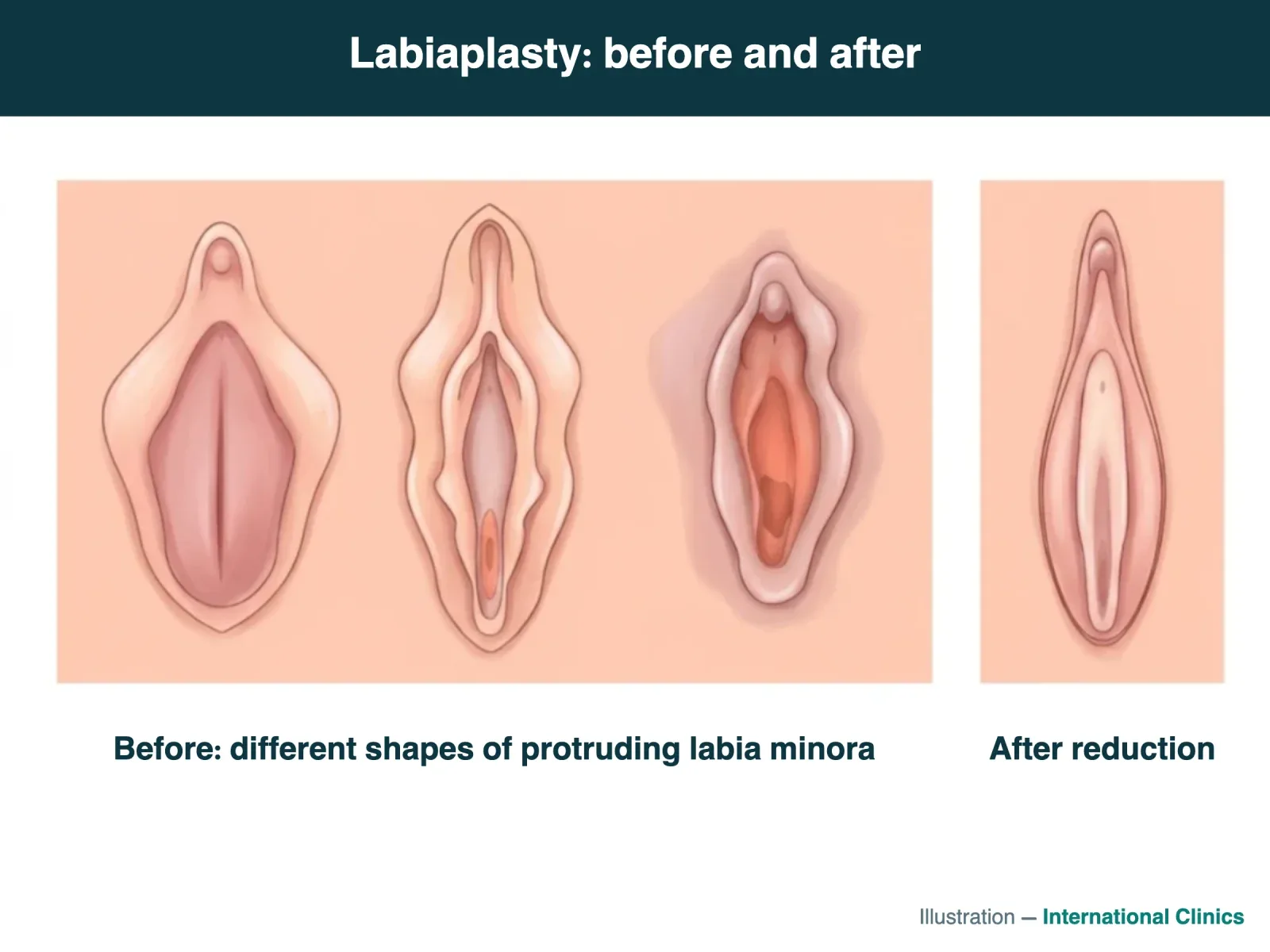
There is no single “normal” size: women vary enormously, and it is perfectly normal for the labia minora to extend beyond the labia majora. That is why the decision is not made with a ruler but on the basis of discomfort: pain in tight clothing, rubbing during sport, pain during sex, or significant distress about their appearance. According to the American College of Obstetricians and Gynecologists (ACOG), it is important to reassure women that this variation is normal before surgery is considered.
9. What are the medical and cosmetic reasons for labiaplasty?
The reasons for labiaplasty are medical and functional on the one hand and cosmetic on the other, and many women have both.
| Medical and functional reasons | Cosmetic reasons |
|---|---|
| Pain or chafing in tight clothing or when cycling | Wanting a more balanced appearance |
| Pain or discomfort during sex | Noticeable asymmetry between the two sides |
| Recurrent irritation and infections because hygiene is difficult | Changes after childbirth or with age |
| Tears or deformity after childbirth | Deflated, lax labia majora |
10. Is labia minora asymmetry a problem? Can it be corrected?
Asymmetry of the labia minora is very common and is not a disease: in most women one side is slightly longer than the other. If the difference is marked and causes physical or emotional discomfort, however, labiaplasty corrects it by removing excess tissue from the longer side or from both. The surgeon aims for harmony, not perfect symmetry, which does not exist in nature.
11. Is labiaplasty the same as vaginoplasty?
No. Labiaplasty deals with the external parts (the labia and the clitoral hood), whereas vaginoplasty, or vaginal tightening, works on the vaginal canal and its muscles. “Female genital cosmetic surgery” is the umbrella term that covers both. If your case calls for it, labiaplasty and vaginoplasty can be performed in the same operation.
Techniques and related procedures
12. How is labiaplasty performed and how long does it take?
Labiaplasty is performed under local anesthesia with sedation or under general anesthesia and takes one to two hours. The surgeon marks the incision lines precisely, removes the excess skin and closes the edges with dissolvable stitches that do not need to be removed. Most patients leave the hospital the same day or after one night.
13. What is the difference between the trim and wedge techniques?
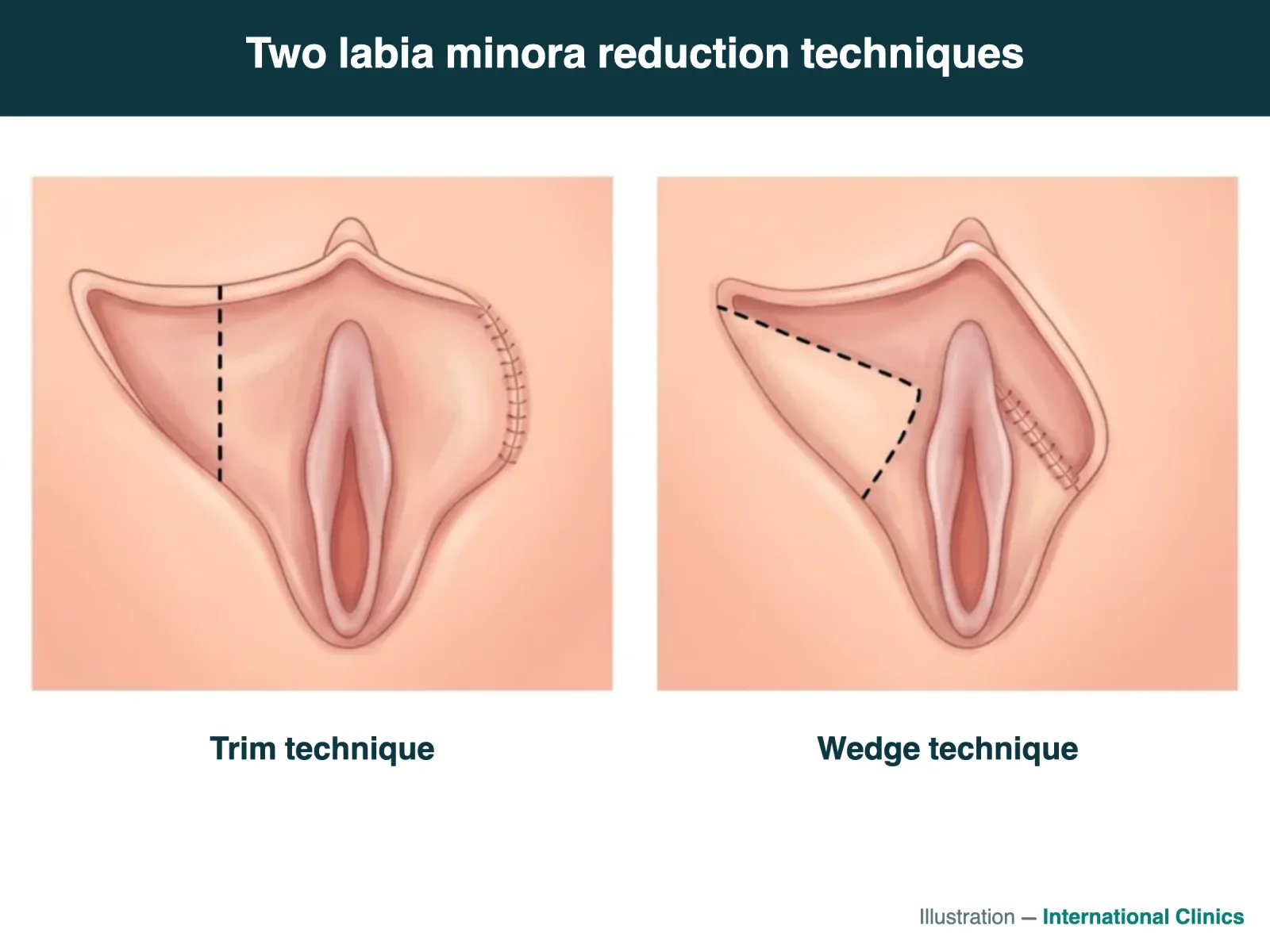
The trim (edge resection) and wedge techniques are the two most widely used methods of labia minora reduction; the surgeon chooses between them based on the shape and color of the labia and the patient’s wishes (source: American Society of Plastic Surgeons (ASPS)).
| Aspect | Trim | Wedge |
|---|---|---|
| How it works | A strip is removed along the entire outer edge | A V-shaped wedge is removed from the central part and the edges are joined |
| Natural edge | Removed (often together with the darker area) | Preserved, with its natural color and contour |
| Scar | Along the edge | A short line across the lip |
| Best for | Marked protrusion and a dark or irregular edge | Women who want to keep the natural look of the edge |
| Note | Predictable result that is easy to control | Slightly higher risk of wound separation; requires more experience |
14. Is laser labiaplasty better than the scalpel?
A laser is not inherently better than a scalpel: in labiaplasty it is simply another cutting tool, and the result depends on the surgeon’s experience and planning, not on the instrument. A laser may reduce bleeding, but if it is not used precisely it can cause small thermal burns in the delicate tissue. What is advertised as “non-surgical laser labiaplasty” is usually a tissue tightening or rejuvenation treatment, which does not actually reduce protruding labia minora.
15. What is clitoral hood reduction and when is it combined with labiaplasty?
Clitoral hood reduction removes excess skin from the fold that covers the clitoris. It is often combined with labia minora reduction when the hood is prominent or redundant, because reducing the labia alone could make the hood look larger and spoil the overall balance. The surgeon performs this step with great care, away from the clitoris itself, to preserve sensation.
16. How is labia majora augmentation with fat or filler performed?
The labia majora are augmented when they deflate or lose firmness with age or after weight loss, using one of two methods:
| Aspect | Fat transfer (your own fat) | Filler (hyaluronic acid) |
|---|---|---|
| Material | Fat taken from the abdomen or thighs | A ready-made product |
| Anesthesia | Local or general, because liposuction is needed | Local |
| How long it lasts | Part of the fat survives permanently | About 12–18 months, then it needs repeating |
| Best for | Women who want a long-lasting result | Women who want a quick, non-surgical treatment |
If the labia majora are very lax, surgical reduction (labia majoraplasty) with removal of excess skin may be needed instead.
17. Can labiaplasty be combined with other procedures?
Yes, labiaplasty is often combined with other procedures in the same session, such as vaginoplasty and clitoral hood reduction, or with “mommy makeover” procedures such as a tummy tuck and breast surgery. Combining procedures means a single anesthetic and a single trip, but it is the surgeon who decides what can safely be combined, based on the length of the operation and your general health.
Recovery and life after surgery
18. Is labiaplasty painful?
You feel no pain during labiaplasty thanks to the anesthesia; afterwards, the pain is mild to moderate for the first three days and is managed with ordinary painkillers and cold compresses. After that, most patients describe a feeling of tightness and discomfort when sitting rather than real pain.
19. When can I have sex again after labiaplasty?
After labiaplasty, you can usually resume sex after 4–6 weeks, once the wound has fully healed and your doctor confirms it at your check-up (source: NHS). Rushing can reopen the wound or cause bleeding. It is also best to avoid tampons, swimming pools and cycling for the same period.
20. Does labiaplasty leave scars?
Labiaplasty leaves a fine scar along the stitch line, but once healed it is almost invisible: labial tissue heals quickly and the scar is hidden in the natural folds. With the trim technique the scar follows the edge; with the wedge technique it is a short line across the lip. Following the hygiene instructions and avoiding friction help keep it fine.
21. Does labiaplasty affect vaginal childbirth?
Labiaplasty neither prevents vaginal childbirth nor makes it more difficult, because the labia are not part of the birth canal. Childbirth can, however, change the area or cause tears, so many surgeons advise women planning a pregnancy soon to wait until their family is complete, or to accept that a small touch-up may be needed later. It is a good idea to tell your obstetrician or midwife about your previous surgery.
22. Can I have labiaplasty if I am a virgin? Does it affect the hymen?
Yes, labiaplasty can be performed on a woman who is a virgin, because it involves only the external labia and does not come near the hymen, which lies at the entrance to the vagina. In this case the surgeon uses a technique that preserves it, so it is important to mention this during your consultation.
23. What are the risks and complications of labiaplasty?
Labiaplasty is generally a safe procedure with a high satisfaction rate, but it carries some risks you should know about (source: Cleveland Clinic):
| Complication | How common | Prevention or treatment |
|---|---|---|
| Swelling and bruising | Common and temporary | Cold compresses and rest |
| Partial wound separation | Uncommon; more frequent with the wedge technique | Avoid friction and early sex; a minor revision is sometimes needed |
| Bleeding or hematoma | Rare | Treated at the check-up |
| Wound infection | Rare | Careful hygiene and antibiotics |
| Over-resection or asymmetry | Rare with an experienced surgeon | Conservative planning; corrective surgery is sometimes needed |
| Change in sensation | Rare | Staying away from the clitoris and its nerves |
24. When is revision labiaplasty needed?
Revision labiaplasty is needed when excess tissue remains, noticeable asymmetry appears, or part of the wound reopens and heals unevenly. The surgeon usually waits 3 to 6 months, until the swelling has gone and the shape has settled, before deciding. The most difficult cases are those of over-resection, because removed tissue does not grow back and correction requires a surgeon with specific experience, which is why careful planning from the start is the best prevention.
Emotional aspects and making the decision
25. How does labiaplasty affect emotional wellbeing and self-confidence?
After labiaplasty, most women report more comfort and greater confidence in their bodies, especially when the motivation was real physical discomfort or constant embarrassment. Surgery does not, however, resolve a general unhappiness with one’s body, which is why the American College of Obstetricians and Gynecologists (ACOG) recommends that doctors make sure expectations are realistic and rule out body dysmorphic disorder before surgery. The right decision is the one you make for yourself, not under pressure from someone else or from unrealistic images.
26. Am I a good candidate for labiaplasty?
You are a good candidate for labiaplasty if you are at least 18, in good health, do not smoke or can stop before and after surgery, and have clear discomfort or a genuine wish to improve the appearance, with realistic expectations. Surgery should be postponed if there is an active infection in the area or during pregnancy.
Labiaplasty in Turkey
27. Why do so many women choose Turkey for labiaplasty?
Many women choose Turkey for labiaplasty because prices are much lower than in Europe, the United States and the Gulf states, with surgeons experienced in female genital cosmetic surgery and internationally accredited hospitals registered with the official “Health Türkiye” medical tourism program. In many cases you can choose a female surgeon, with complete discretion at every stage of your trip. International Clinics is the link between you and the best doctors and hospitals we work with in Turkey.

28. How many days do I need to stay in Turkey for labiaplasty?
For labiaplasty you need to stay in Turkey for 5 to 7 days: one day for tests and the consultation, one for the procedure, and a few days of rest and medical follow-up before you fly home. After you return, your recovery is monitored through photos and direct contact.
29. What does International Clinics offer women considering labiaplasty?
The process begins with a free remote consultation with a medical consultant who speaks your language; your case is presented in complete confidence to the most suitable surgeon, and you receive a clear quote covering the procedure, technique and type of anesthesia. We arrange your appointments, airport transfers and accommodation, and follow-up continues for a full year after you return home.
30. Who is the best surgeon for labiaplasty in Turkey?
There is no single “best” surgeon for everyone: the right one for you is a plastic surgeon experienced in female genital cosmetic surgery who shows you photos of previous cases, explains which technique suits the shape of your labia and plans conservatively for a natural result. This applies to labia minora reduction, clitoral hood reduction and labia majora augmentation alike. Among the doctors we work with in Istanbul who have experience in these procedures:



31. What is the best hospital for labiaplasty in Turkey?
The best hospital for labiaplasty is the accredited facility where your surgeon operates, with a well-equipped operating room, a specialist anesthesia team and complete discretion for the patient. Among the hospitals we work with in Istanbul:
Medical review and disclaimer:
This article was reviewed by a specialist physician contracted with International Clinics. It is general health information, not a substitute for medical advice, and results vary between individuals.