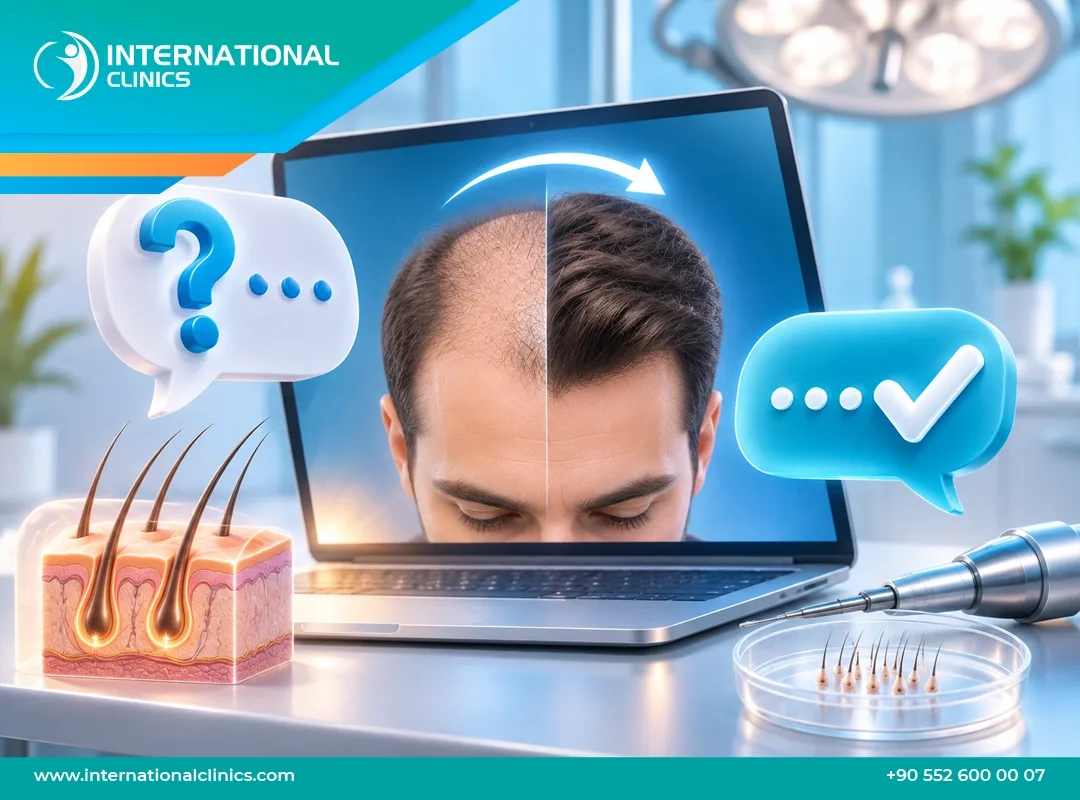
In this article from our “You Ask, We Answer” series, we have gathered the questions people search for most about hair transplant in Turkey, selected from real search data, and answered them from our experience accompanying patients, drawing on medical sources where needed. The list opens with the most-asked questions, and most answers are followed by a link to our detailed article on the topic. To see the hair transplant doctors we work with, visit our hair transplant page.
The Most-Asked Questions About Hair Transplant in Turkey
1. How much does a hair transplant cost in Turkey?
A scalp hair transplant in Turkey through International Clinics costs between $900 and $1,900, depending on the technique and the size of the area to be treated (Source: International Clinics — Turkey).
| Technique or area | Price (USD) |
|---|---|
| FUE hair transplant | 900–1,200 |
| Sapphire FUE | 900–1,500 |
| DHI | 1,100–1,750 |
| Beard and moustache transplant | 800–1,300 |
| Female hair transplant | 1,000–1,600 |
| Eyebrow transplant | 1,000–1,100 |
The UK National Health Service (NHS) estimates the cost of a hair transplant in the UK at between £1,000 and £30,000 (Source: NHS).

For more details, see our article: Hair transplant cost in Turkey.
2. When are the grafts secure after a hair transplant?
The grafts settle into place during the first few days after the procedure, the period when small scabs form and the patient feels tightness and swelling in the scalp (Source: NHS). That is why this stage calls for the greatest care: no scratching or pressing on the transplanted area, and no hair washing until about six days have passed, and then only gently (Source: NHS). At the follow-up visit, the doctor decides when you can return to your usual hair care.
For more details, see our article: Hair transplant recovery timeline.
3. When do hair transplant results appear?
The transplanted hair falls out a few weeks after the procedure. This is normal and does not mean the transplant has failed. New hair starts to grow after about four months, and the final result appears after 10 to 18 months (Source: NHS).
| Stage | What usually happens |
|---|---|
| First few days | Small scabs, tightness and swelling in the scalp |
| 1 to 2 weeks | Most patients return to work |
| After a few weeks | Temporary shedding of the transplanted hair |
| About 4 months | New hair starts to grow |
| 10 to 18 months | The final result appears |
The stages in the table are based on NHS data.

For more details, see our article: Hair transplant before and after: results and stages.
4. Is a hair transplant painful?
The patient feels little or no pain during the procedure, because it is performed under local anaesthetic, often together with a sedative to help them relax (Source: NHS). After the procedure, the scalp feels tight and swollen for a few days (Source: NHS), which is eased with painkillers prescribed by the doctor.
Techniques and How the Procedure Works
5. How is a hair transplant performed?
A hair transplant moves hair follicles from an area with plenty of hair, called the donor area and usually the back of the head, to a thinning or bald area (Source: NHS). The procedure is usually done in one day under local anaesthetic (Source: NHS): the doctor extracts the follicles using one of the two main techniques, FUE or FUT, then implants them in the recipient area at an angle and direction that mimic natural hair (Source: StatPearls).

For more details, see our article: How hair transplants work.
6. What is the difference between FUE, DHI and Sapphire?
In all three techniques, the grafts are extracted the same way, harvested one by one from the donor area. The difference lies in how the implantation site is prepared and the tool used to implant the grafts (Source: International Clinics — Turkey).
| Comparison | Classic FUE | Sapphire | DHI |
|---|---|---|---|
| Implantation method | Channels opened with metal blades, then grafts implanted | Channels opened with sapphire blades, then grafts implanted | Each graft implanted directly with a special pen (Choi pen), with no channels opened beforehand |
| Best suited for | Large areas | Large areas with higher density | Limited areas and the front hairline |
| Price in Turkey | $900–1,200 | $900–1,500 | $1,100–1,750 |
Prices in the table (Source: International Clinics — Turkey).

For more details, see our article: DHI hair transplant in Turkey.
7. What is the difference between FUE and FUT?
In FUT, a thin strip of skin is removed from the donor area, divided into small units containing the follicles, and the wound is closed with stitches, leaving a linear scar that is usually hidden by the hair. In FUE, the follicles are harvested one by one, leaving only small dot-like scars that are hard to notice (Source: NHS). Most hair transplants in Turkey today use FUE and the techniques developed from it.

For more details, see our article: FUE vs FUT.
8. Can a hair transplant be done without shaving?
Yes, in some cases: only small hidden strips of the donor area are shaved, or the hair is left as it is if the technique allows, so the patient can return to daily life without anyone noticing the procedure. However, this option suits limited areas better than extensive baldness, and the doctor decides whether it is suitable after examining the case.
9. How long does a hair transplant take?
A hair transplant is usually done in one day, and the patient returns to the hotel or home the same day (Source: NHS). Very large areas, however, may need more than one session.
10. How many grafts do I need for a hair transplant?
The number of grafts depends on the size of the thinning area, the hair density in the donor area and the density the patient hopes to achieve, so there is no single number that fits everyone. That is why the doctor studies photos of the scalp from the front, top and back before estimating the right number of grafts, and the final price is based on that estimate.
11. Who is a good candidate for a hair transplant?
A good candidate has enough hair in the donor area, good general health and realistic expectations. A hair transplant is not suitable for people with alopecia areata (Source: NHS). Patients should also know that the original hair around the transplanted area may continue to thin over time (Source: NHS), which is why the doctor assesses the pattern and speed of hair loss before the procedure.

12. Is a hair transplant suitable for women?
Yes, in specific cases, such as a receding front hairline, localised thinning or scars, provided the donor area is dense enough. A female hair transplant costs between $1,000 and $1,600 (Source: International Clinics — Turkey).
For more details, see our article: Female hair transplant.
13. Can the beard, moustache and eyebrows be transplanted?
Yes, the same technique is used for beard, moustache and eyebrow transplants: follicles are moved from the back of the head to the thinning area. A beard and moustache transplant costs between $800 and $1,300, and an eyebrow transplant between $1,000 and $1,100 (Source: International Clinics — Turkey).

For more details, see our article: Beard transplant in Turkey.
Choosing the Doctor and Hospital
14. How do I choose a hair transplant centre in Turkey?
A hair transplant is a surgical procedure, so your case should be assessed by a qualified doctor who plans the treatment and oversees it, not by technicians alone (Source: ISHRS). Check the name and experience of the doctor who will perform your procedure, ask for photos of cases similar to yours, and make sure the procedure will take place in a licensed facility. International Clinics is not a medical centre; it is the link between you and the right treatment. We have contracted doctors and hospitals that meet the highest quality standards, and we recommend the best fit for your case after studying your photos.
For more details, see our article: How to choose the best hair transplant clinic in Turkey.
15. Who is the best hair transplant doctor in Turkey?
No single doctor is the best for every patient. The right doctor for you is the one who masters the technique your case needs, whether that is a front hairline transplant, covering a large area or a beard transplant. So choose your doctor based on their experience in hair transplantation specifically and the results of previous cases similar to yours.
To compare the hair transplant doctors we work with, visit our hair transplant page.

16. What is the best hospital for a hair transplant?
The right hospital is the one where your doctor works: licensed, equipped with a sterile operating room and an experienced nursing team, and with a department that receives and assists international patients. In most cases, the hospital is determined after the doctor is chosen.
After the Procedure: Daily Care
17. What should I avoid after a hair transplant?
In the first few days, avoid scratching your scalp or touching or pressing on the transplanted area, and follow your doctor’s instructions on washing and on the bandages, which usually stay on for two to five days. Avoid strenuous exercise for about a month (Source: NHS), and stay away from smoking, as it slows healing.
18. How should I sleep after a hair transplant?
Sleep on your back with your head slightly raised on an extra pillow during the first few days. This reduces swelling and protects the transplanted grafts from rubbing against the pillow. Avoid sleeping on your side or face until your doctor allows it.
19. When can I wash my hair after a hair transplant?
You can wash your hair gently about six days after the procedure (Source: NHS), or as your doctor advises at the follow-up visit. The first wash should follow the method explained by the medical team: lukewarm water and a gentle shampoo, without rubbing the transplanted area or aiming a strong stream of water at it.
20. When can I perform prostration (sujood) in prayer after a hair transplant?
Prostration does not usually put pressure on the transplanted area at the top of the head, but in the first few days care should be taken that the front of the head does not touch the floor if the transplant is along the front hairline, and that long periods of bending forward, which increase swelling, are avoided. The doctor tells each patient when they can return to prostration as usual, depending on where the grafts were placed.
21. When can I return to work and exercise?
Most patients return to work after one to two weeks, and strenuous exercise is postponed for about a month (Source: NHS). Stitches, if any, as in FUT, are removed after 10 to 14 days (Source: NHS).
22. Does transplanted hair fall out?
Yes, most of the transplanted hair falls out a few weeks after the procedure (Source: NHS); this is known as temporary shedding. The follicle itself stays in place and grows new hair after about four months (Source: NHS).
For more details, see our article: Hair transplant recovery and growth timeline.
23. Are hair transplant results permanent?
Grafts are usually taken from the back of the head, an area whose hair resists shedding, so the transplanted hair usually lasts a lifetime (Source: StatPearls). However, the original hair around the transplanted area may continue to thin (Source: NHS), so the doctor may suggest supportive treatment or a later session.
24. What are the risks and disadvantages of a hair transplant?
A hair transplant is generally safe when performed by a qualified doctor, but like any surgical procedure it carries risks (Source: NHS).
| Risk | What you should know |
|---|---|
| Bleeding and infection | Risks of any surgical procedure, reduced by following the aftercare instructions |
| Reaction to the anaesthetic | A possible complication the doctor asks about before the procedure |
| Some grafts not growing | Some transplanted grafts may not grow |
| Scarring | A linear scar with FUT, and small dot-like scars with FUE |
| Continued thinning of the original hair | The hair around the transplanted area may continue to thin |
The risks in the table are based on NHS data.
25. Does PRP help after a hair transplant?
Platelet-rich plasma (PRP) sessions are sometimes used as a supportive treatment after the transplant or to strengthen the original hair. Your doctor decides whether you need them based on your case, and they are not a substitute for a transplant in cases of baldness.
For more details, see our article: How many PRP sessions are needed for hair growth.
Travelling to Turkey and Patient Experiences
26. What does a hair transplant package in Turkey include?
A hair transplant package through International Clinics usually includes airport pick-up, hotel accommodation, transfers between the hotel and the hospital, and post-operative follow-up (Source: International Clinics — Turkey). The price quote you receive before travelling details everything the package includes.
27. Which is better: a hair transplant in Turkey or in Egypt?
Hair transplant prices in Turkey start at a lower level than in Egypt, and Turkey also stands out for its large number of doctors specialising in hair transplantation and their long experience in receiving international patients. Approximate costs vary between countries as follows (Source: International Clinics — Turkey):
| Country | Approximate cost (USD) |
|---|---|
| Turkey (via International Clinics) | 900–1,900 |
| Egypt | 2,000–4,000 |
| UAE | 6,000–12,000 |
| United Kingdom | 8,000–16,000 |
For more details, see our article: Hair transplant in Turkey and Egypt: the differences.
28. Do you have a video explaining the hair transplant procedure?
Yes. This short video from International Clinics shows the steps of a hair transplant in about a minute.
29. Do you have a video of someone who has had a hair transplant?
Yes. In the first clip, a patient from Kuwait shares his hair transplant experience in Istanbul, and the second clip shows the result of a hair transplant after eight months.
Have a question you didn’t find answered here? Send photos of your scalp from the front, top and back to the International Clinics team, and we will present your case to a specialist from our contracted doctors, who will suggest the right technique and estimate the number of grafts and the price.
Medical review and disclaimer:
This article was reviewed by a specialist physician contracted with International Clinics. It is general health information, not a substitute for medical advice, and results vary between individuals.