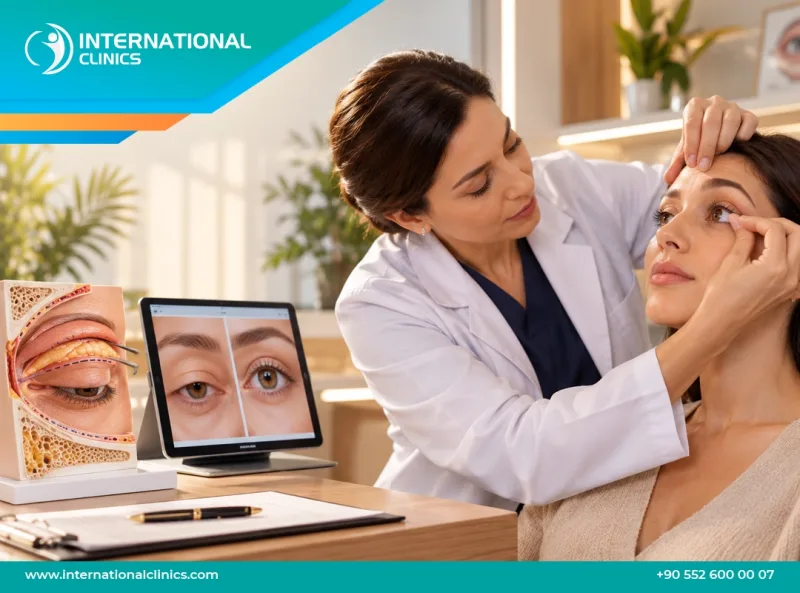
In this article from our «You Ask, We Answer» series, we have gathered the questions people most often search for about upper and lower eyelid surgery in Turkey, selected from real search data, and answered them from our experience guiding patients, drawing on medical sources where needed. The list opens with the five most important questions, and most answers are followed by a link to our detailed article on the subject. To see the doctors we work with, visit our blepharoplasty treatment page.
The Five Most Important Questions About Eyelid Surgery
1. How much does eyelid surgery cost in Turkey?
Eyelid surgery in Turkey through International Clinics starts from $1,500 for the lower eyelids, rising according to the case or the patient's choices. Upper eyelid surgery starts from $1,650, while combining upper and lower eyelids in one session starts from $2,500 (Source: International Clinics — Turkey).
| Procedure | Starting price |
|---|---|
| Upper eyelid surgery | $1,650 |
| Lower eyelid surgery | $1,500 |
| Upper and lower eyelids together | $2,500 |
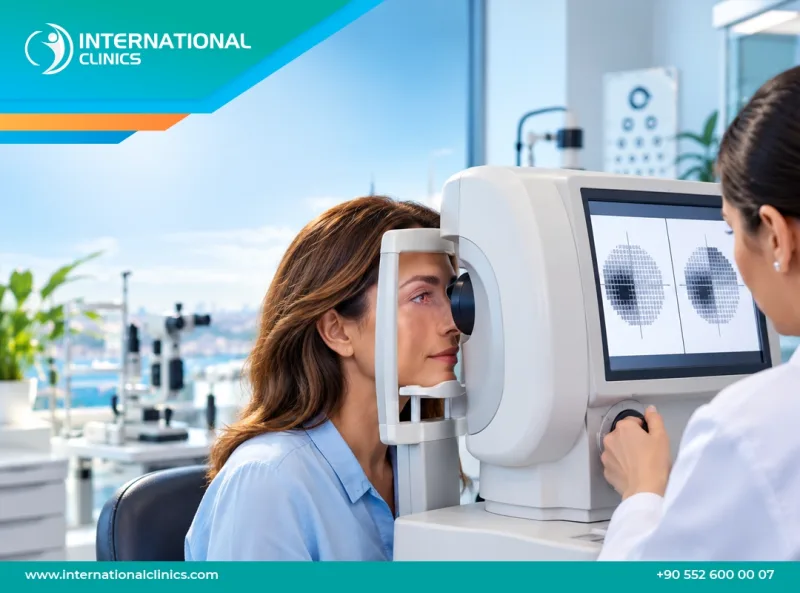
For comparison, the average surgeon's fee alone for upper eyelid surgery in the United States is about $3,359, excluding anaesthesia and operating room fees (Source: American Society of Plastic Surgeons (ASPS)), and in the UK the operation costs between £2,000 and £6,000 (Source: NHS).

For more details, see our article: Upper eyelid surgery cost in Turkey.
2. What is eyelid surgery (blepharoplasty)?
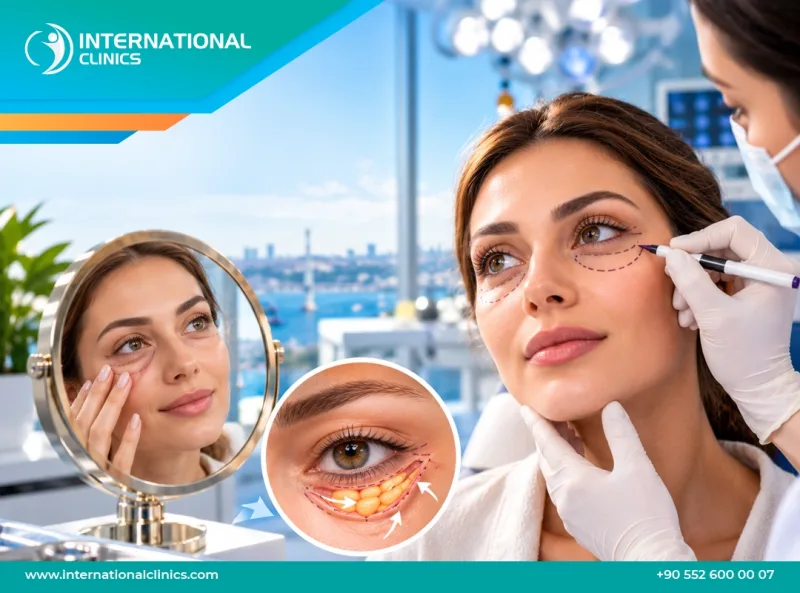
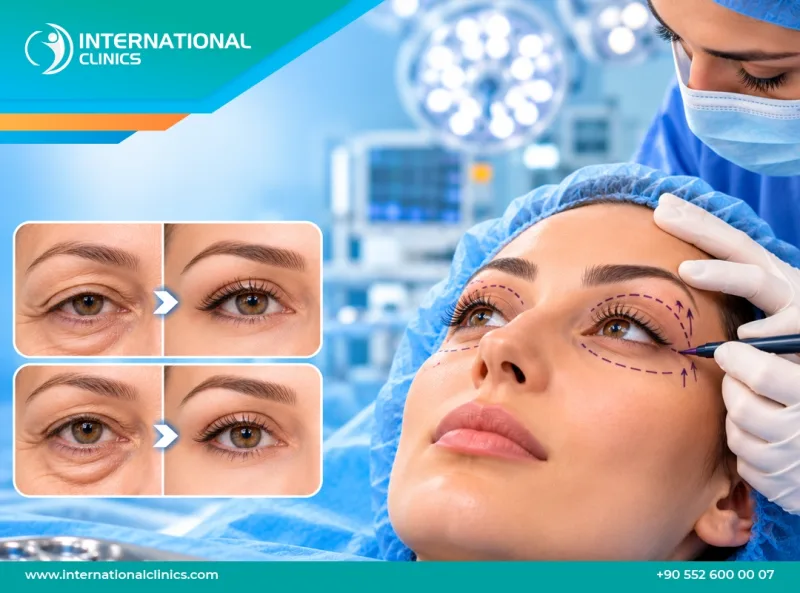
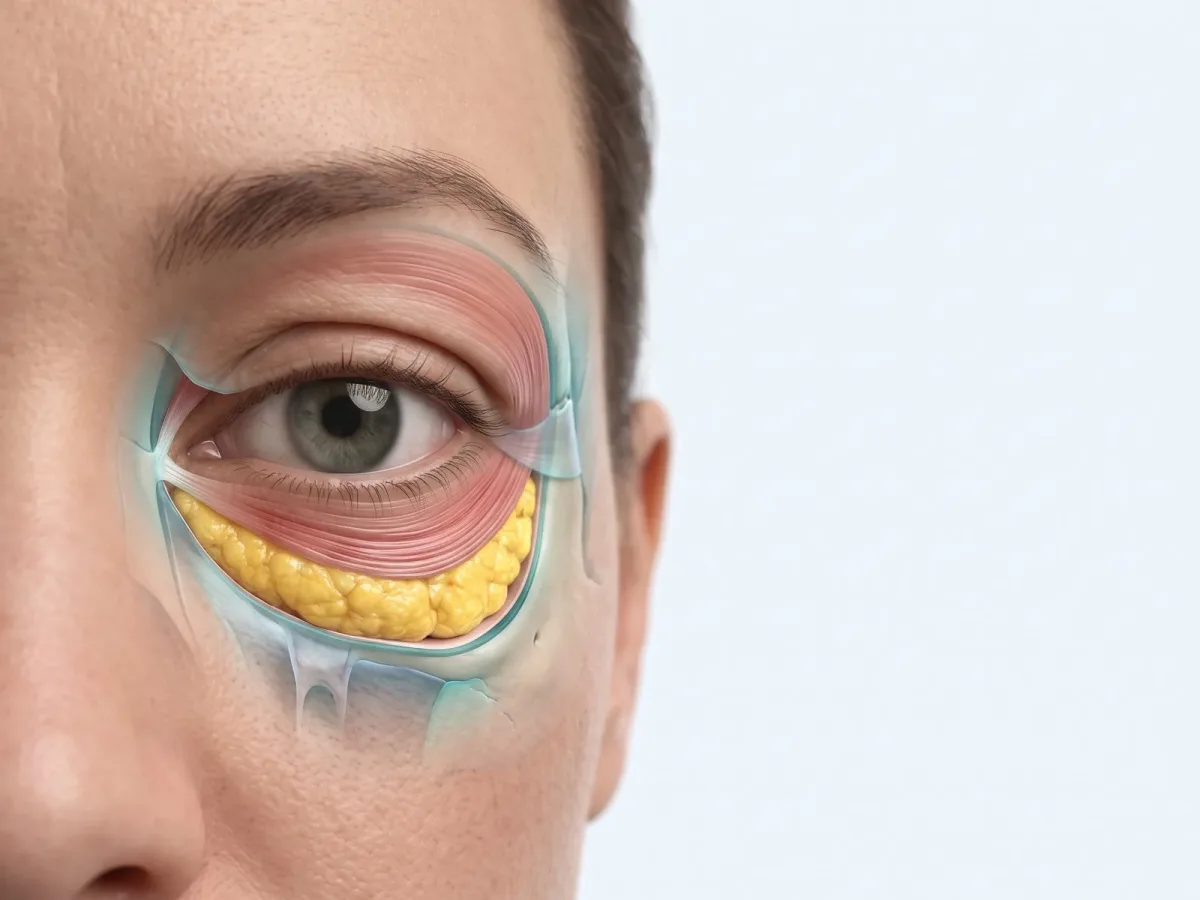
Eyelid surgery, also called an eyelid lift or blepharoplasty, is an operation that removes excess skin, fat or muscle from the eyelids, treating a sagging upper lid that weighs the eye down and puffiness or «bags» under the eyes (Source: NHS). It can be purely cosmetic, or functional when drooping skin blocks part of the field of vision (Source: American Academy of Ophthalmology (AAO)).

For more details, see our article: Blepharoplasty (eyelid surgery) explained.
3. What is the difference between upper and lower eyelid surgery?
Upper eyelid surgery treats the excess skin that hangs over the eye, making it look heavy and tired, and the surgeon hides the incision in the natural eyelid crease. Lower eyelid surgery treats puffiness and bags under the eye, with the incision either just below the lashes or inside the eyelid, leaving no visible mark on the skin.
| Comparison | Upper eyelid | Lower eyelid |
|---|---|---|
| Problem treated | Excess, sagging skin above the eye | Puffiness and bags under the eye |
| Incision site | In the natural eyelid crease | Below the lashes or inside the eyelid |
| What is removed or adjusted | Excess skin and a little fat or muscle | Fat is removed or repositioned; a little skin may be removed |
| Starting price | $1,650 | $1,500 |

For more details, see our article: Blepharoplasty in Turkey.
4. How long is recovery after eyelid surgery?
Most patients need about two weeks off before returning to work. Swelling and bruising usually settle within the first two weeks, redness may take several weeks to fade completely, and the scar stays pink and tight for a few months before fading (Source: NHS). Stitches or adhesive strips are usually removed within a week of surgery.

5. When will I see the results of eyelid surgery?
The improvement shows once most of the swelling has gone, after about two weeks: the eyelid looks lighter and the eyes look fresher. The final result emerges gradually over a few months, as the last mild swelling disappears, the skin settles and the scar fades (Source: American Society of Plastic Surgeons (ASPS)).
Before the Operation
6. Who is a good candidate for eyelid surgery?
A good candidate is in good general health, does not smoke or is willing to stop before and after surgery, has no eye condition that rules out surgery, and has realistic expectations. People with dry eyes, thyroid disease, high blood pressure or diabetes need a careful assessment beforehand (Source: Mayo Clinic).
7. Can eyelid surgery be combined with a brow lift or facelift?
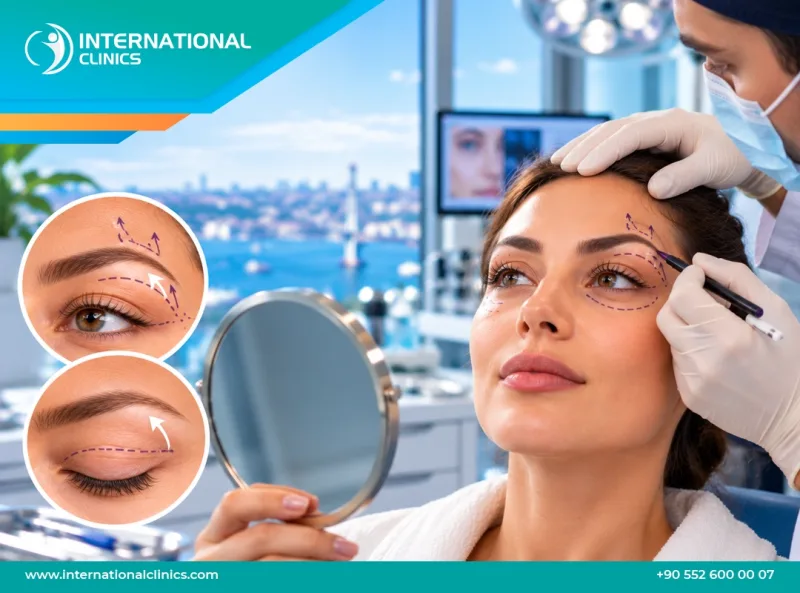
Yes, and it is common. A heavy upper eyelid is sometimes caused by a drooping brow rather than excess skin alone, in which case a brow lift is combined with eyelid surgery. The surgeon decides this on examination and explains the right plan and price before you make any decision.
8. What is the difference between droopy eyelid skin and eyelid ptosis?
Droopy eyelid skin (dermatochalasis) is excess skin over an eyelid that otherwise works normally, and it is treated with blepharoplasty. Ptosis is weakness of the muscle that lifts the eyelid, so the lid margin itself drops over the pupil; it is treated with a different operation that tightens the muscle. That is why the surgeon checks the position of the lid margin before choosing the right procedure (Source: American Academy of Ophthalmology (AAO)).
For more details, see our article: Upper eyelid ptosis surgery and its cost.
9. Does health insurance cover eyelid surgery?
Insurance does not usually cover cosmetic surgery. Upper eyelid surgery may be covered when drooping skin blocks part of the field of vision, as shown by a visual field test (Source: American Academy of Ophthalmology (AAO)). Conditions vary from insurer to insurer, so check with yours before you travel.
10. How do I prepare for eyelid surgery?
- Send clear photos of your eyes and tell the medical adviser about any medicines you take, especially blood thinners such as aspirin and warfarin.
- Stop smoking several weeks before surgery, as it slows wound healing.
- Do not stop any medicine on your own; follow your surgeon's instructions.
- Arrange about two weeks off and bring sunglasses for the first days.
(Source: NHS)
The Operation
11. How is eyelid surgery performed?
On the upper eyelid, the surgeon makes an incision in the natural crease, removes the excess skin together with a little fat or muscle where needed, and closes the wound with fine stitches. On the lower eyelid, the surgeon works through an incision just below the lashes or from inside the eyelid, removes or repositions the excess fat, tightens the eyelid muscles and tendons if needed, and then closes the wound. Thin adhesive strips are applied afterwards to support the eyelid for up to a week (Source: NHS).
12. Is eyelid surgery painful, and what anaesthesia is used?
The operation is not painful while it is being done, as it is performed under local anaesthesia with sedation or under general anaesthesia, depending on the extent of surgery and the surgeon's preference (Source: NHS). Afterwards, patients feel tightness and mild discomfort, eased by simple painkillers and cold compresses in the first days.
13. How long does eyelid surgery take, and do I stay in hospital?
The operation takes roughly 45 minutes to two and a half hours, depending on whether the upper eyelids, the lower eyelids or both are treated, and most patients go home the same day (Source: NHS).
14. What is laser eyelid surgery, and is it better?
In laser eyelid surgery, the surgeon uses a laser instead of a scalpel to make the incision; the steps of the operation stay the same: removing excess skin and fat and closing the wound. The laser may reduce bleeding slightly, but it is not better in itself, because the result depends more on the surgeon's experience and careful planning than on the tool. Laser skin resurfacing improves fine wrinkles around the eyes but does not replace surgery when there is excess skin.
15. Can eyelids be lifted without surgery?
Some non-surgical treatments improve the look of the eyes to a limited and temporary degree, such as Botox to lift the tail of the brow slightly, fillers for the hollow under the eye, and energy-based skin-tightening devices. But true excess skin and obvious fat bags can only be removed with surgery.
16. Does eyelid surgery leave a scar?
It leaves a fine line that usually hides in the natural upper eyelid crease; it may look tight and visible for a few months before fading (Source: NHS). When lower eyelid surgery is done from inside the eyelid, no visible mark is left on the skin.
After the Operation and Results
17. What do the eyes look like after eyelid surgery?
In the first days there is swelling, bruising and tightness around the eyes; the eyes may water, feel dry or be sensitive to light, and vision may be slightly blurred because of the ointment. Swelling usually peaks on the second and third days and then eases day by day. Sleeping with your head raised on two pillows and using cold compresses help.
18. When can I shower and wash my face after eyelid surgery?
Surgeons usually allow a shower after a day or two, provided you avoid aiming water directly at the eyes, do not rub the eyelids, and clean them gently in the way and with the ointment they prescribe. Timing depends on the type of stitches and on your surgeon's instructions, which come first.
19. When can I return to work, exercise, contact lenses and make-up?
| Activity | Approximate timing |
|---|---|
| Office work | After about two weeks |
| Driving | After a few days, once vision is no longer blurred and your surgeon agrees |
| Light walking | From the first day |
| Strenuous exercise | After several weeks, with your surgeon's approval |
| Contact lenses and make-up | Once the wounds have healed, usually after two weeks |
(Source: NHS, American Society of Plastic Surgeons (ASPS))
20. How long do the results of eyelid surgery last?
The results are usually long-lasting: lower eyelid results rarely need to be redone, while some sagging may return to the upper eyelids over the years because the face keeps ageing (Source: American Society of Plastic Surgeons (ASPS)). Sun protection and not smoking help preserve the result.
Risks
21. What are the risks of eyelid surgery?
Eyelid surgery is generally safe when performed by an experienced surgeon, but like any operation it has risks (Source: Mayo Clinic):
| Risk | What to know |
|---|---|
| Dry, irritated eyes | Common and usually temporary; treated with lubricating drops |
| Difficulty closing the eye fully | Usually temporary; rarely needs treatment |
| Lower eyelid turning outwards | A rare complication that may need corrective surgery |
| Uneven eyelids or visible scars | Assessed once the swelling has gone |
| Bleeding or infection | Rare; following instructions reduces the risk |
| Loss of vision | Very rare, caused by bleeding behind the eye; it is an emergency |
22. What are the signs of a failed eyelid surgery?
Signs that call for a visit to your surgeon include being unable to close the eye once the swelling has gone, the lower lid margin turning outwards, a clear and persistent difference between the two eyelids, severe dryness that does not improve, or excess skin remaining as it was. The result should not be judged before the swelling has gone, which takes a few months.
Sudden severe pain, rapidly increasing swelling or reduced vision after surgery are an emergency: go to the emergency department immediately.
23. Is eyelid surgery dangerous?
For most patients it is not a dangerous operation: it is superficial and does not touch the eye itself, it is often done under local anaesthesia, and patients go home the same day. Serious complications are rare, and choosing an experienced surgeon and having an eye examination before surgery reduce them further (Source: Mayo Clinic).
Eyelid Surgery in Turkey
24. Why do so many people choose Turkey for eyelid surgery?
Because costs in Turkey are much lower than in Europe and the United States, with high quality: the hospitals we work with hold international accreditations and are registered with Health Türkiye, the official medical tourism programme, and the surgeons have long experience in eyelid surgery. International Clinics is the link between you and the best contracted doctors and hospitals in Turkey.

25. How many days do I need to stay in Turkey after eyelid surgery?
About 5 to 7 days is usually enough: one day for tests and the operation, then the first days of rest until the follow-up visit and removal of stitches or strips. Your surgeon decides when it is right for you to travel.
26. What does International Clinics offer eyelid surgery patients?
Your journey begins with a free remote consultation with medical advisers who speak your language: you send photos of your eyes, your case is presented to the right doctor, and you receive a clear price quote showing what it includes. Once you are back home, your follow-up continues for a full year.
27. Who is the best eyelid surgeon in Turkey?
No single doctor is «the best» for every patient. The right doctor for you is one with long experience in eyelid surgery, who understands the shape of your eyes and what you want, and shows you real photos of cases similar to yours. Among our contracted doctors experienced in this operation:


28. Which is the best hospital for eyelid surgery in Turkey?
The best hospital for you is the internationally accredited hospital where your surgeon operates, with modern operating rooms and an experienced anaesthesia team. Among our contracted hospitals in Istanbul:
Videos
29. Do you have a video explaining eyelid surgery?
Yes. This video from International Clinics shows the stages of eyelid surgery.
30. Do you have a video of someone who has had eyelid surgery?
Yes. In this short video, Giordano shares his experience of eyelid surgery in Istanbul.
Medical review and disclaimer:
This article was reviewed by a specialist physician contracted with International Clinics. It is general health information, not a substitute for medical advice, and results vary between individuals.