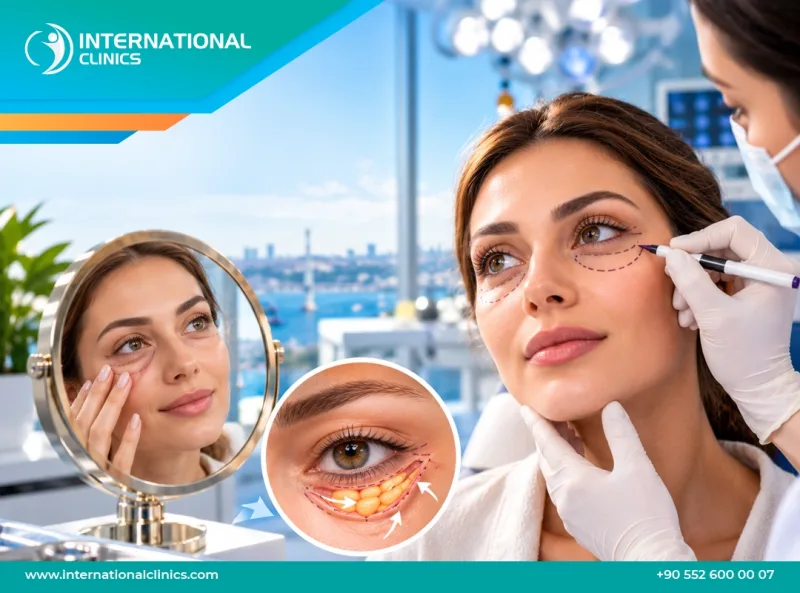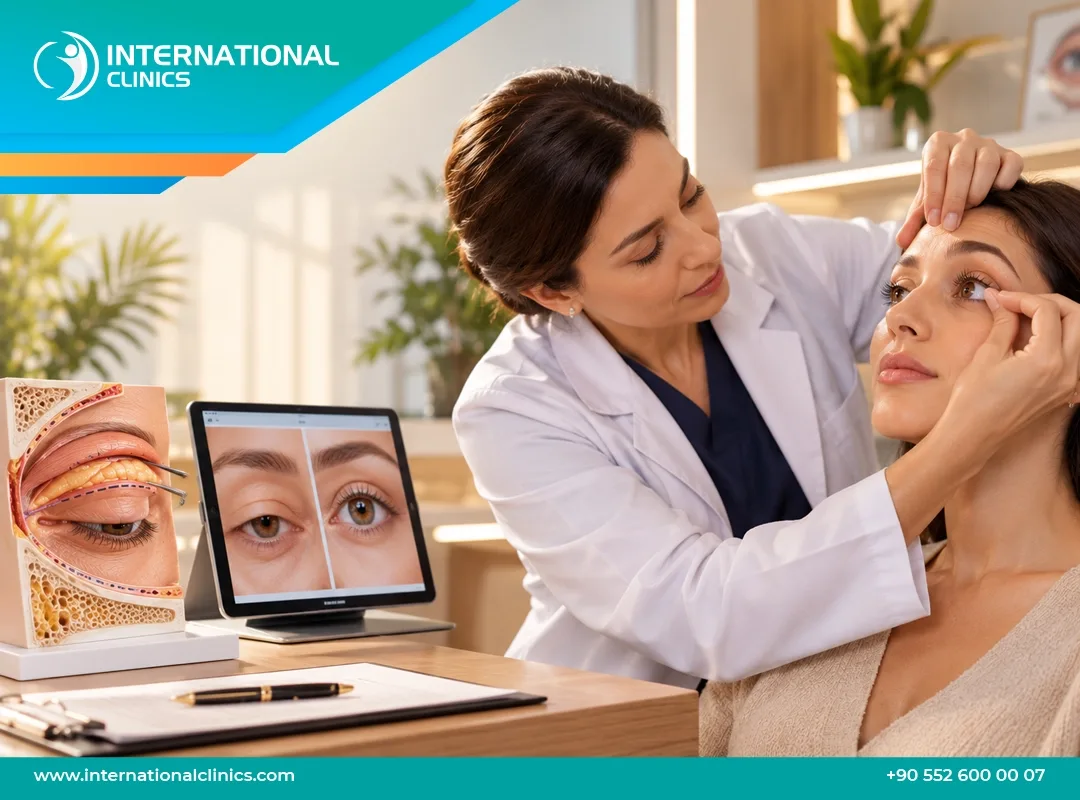
Upper eyelid ptosis surgery (ptosis repair) costs $1,500–3,000 (approx. £1,150–2,250) through International Clinics in Turkey, depending on the technique, whether one or both eyes are treated and whether excess skin is removed at the same time. Ptosis repair is not the same as a blepharoplasty: it tightens or reattaches the muscle that lifts the eyelid, under local anaesthesia, as an outpatient procedure (Source: AAO).
Understanding the true value behind the upper eyelid ptosis surgery cost matters for patients who want both better vision and a balanced look. Safety and the surgeons experience with eyelid muscles count more than the price. With International Clinics, you get a written plan and a clear price for your case before you travel.
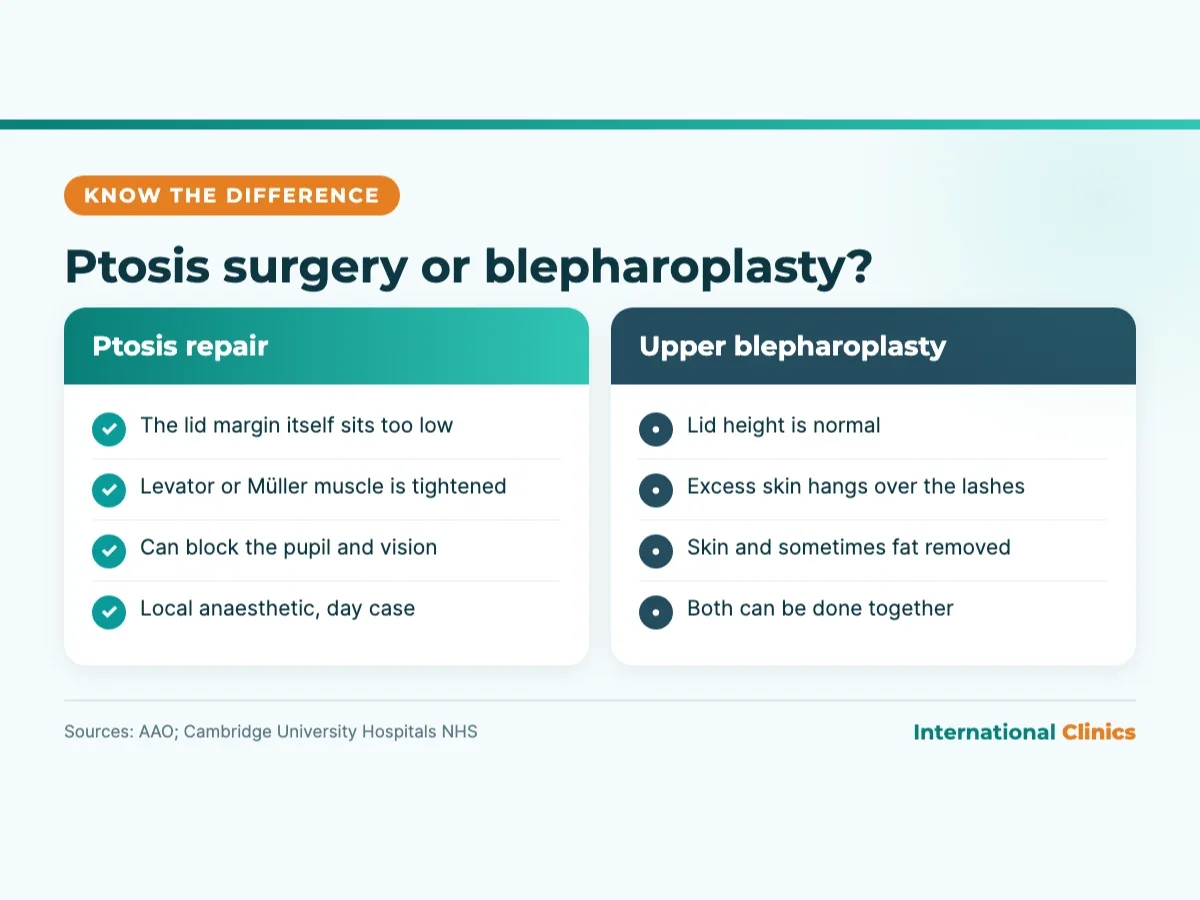
Ptosis or Excess Skin? Ptosis Surgery vs Blepharoplasty
Ptosis means the upper eyelid itself droops over the eye; it can be slight or can cover the pupil and block vision (Source: AAO).
Excess upper eyelid skin (dermatochalasis) is different: the lid margin sits at a normal height, but a fold of skin hangs over the lashes. That is treated with an upper blepharoplasty, which removes skin and sometimes a little fat or muscle (Source: AAO).
Many older patients have both, and the operations can be combined. The difference matters for the price: a skin-only operation is covered in our guide to upper blepharoplasty cost, while ptosis surgery works on the lifting muscle and needs a surgeon experienced in eyelid muscle surgery. A ptosis that was not detected before a blepharoplasty can also become more obvious after it (Source: AAO).
What is the Actual Cost of the Procedure?
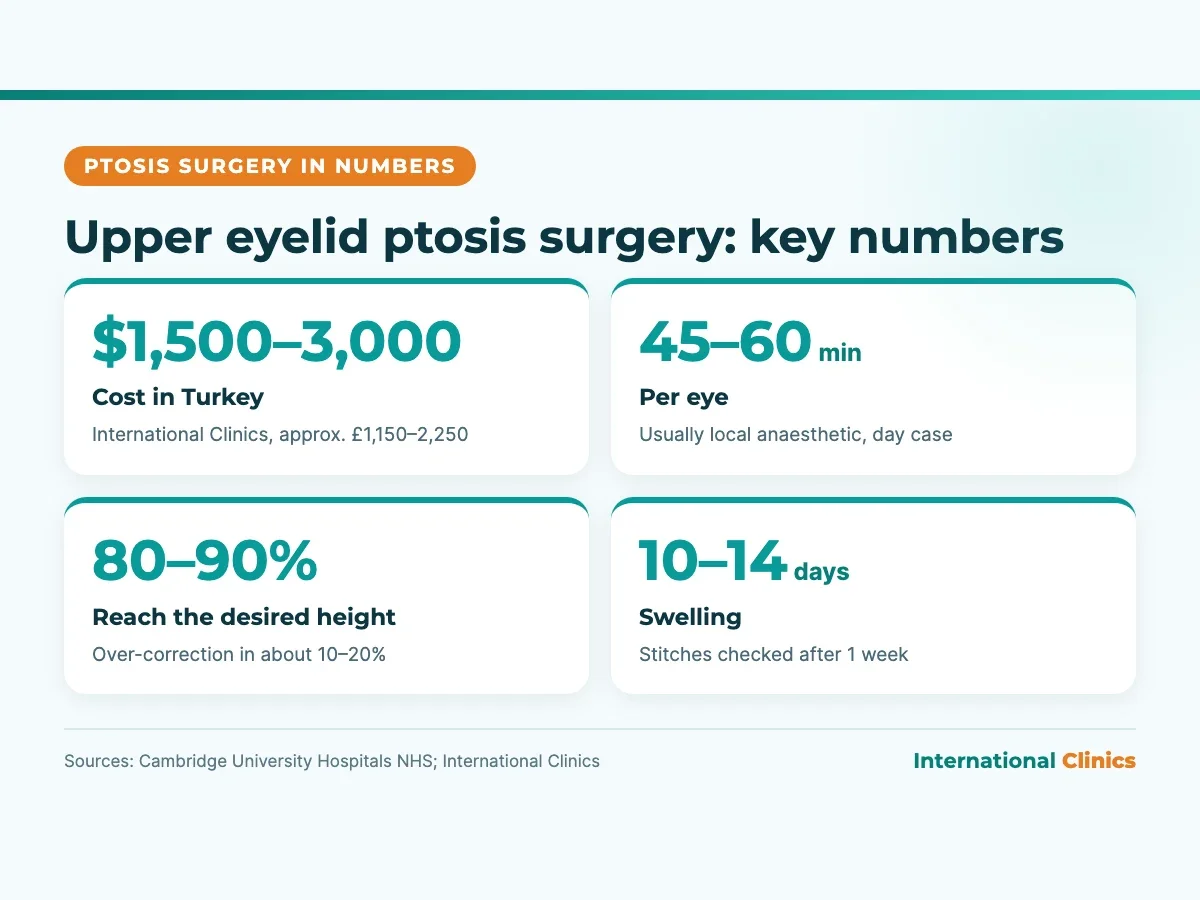
Through International Clinics in Turkey, upper eyelid ptosis surgery costs $1,500–3,000 (approx. £1,150–2,250). The final quote depends on:
- one eye or both eyes;
- the technique (levator advancement through the skin crease or Müller muscle surgery from inside the lid);
- whether excess skin or a low brow is treated in the same operation;
- revision surgery after a previous eyelid operation, which is more complex.
The package includes consultations, medical fees, accommodation and transfers. Ask for the quote in writing and check whether pre-operative tests are included.
Why Choose Turkey for This Procedure?
The main reasons patients consider Turkey for ptosis repair are price, short waiting times and the possibility of planning the operation and recovery in one trip.
Competitive pricing: $1,500–3,000 (approx. £1,150–2,250) through International Clinics, against the higher private prices shown in the comparison table below.
Experienced surgeons: the operation is performed by a plastic surgeon contracted by International Clinics; ask about their experience with ptosis, not only with blepharoplasty.
Equipment: surgery in hospitals selected for modern equipment and operating rooms.
Comprehensive care: packages cover accommodation, transfers and check-ups during your stay.

Quality standards: International Clinics contracts only with hospitals and surgeons that meet its medical quality standards.
No waiting: scheduling usually within weeks rather than waiting lists.
Natural results: the aim is a lid height and contour that match the other eye, while restoring function.
Medical tourism, carefully: recovery comes first; the NHS advises avoiding sun, swimming and sightseeing straight after surgery (Source: NHS).
International Clinics is neither a treatment centre nor a hospital broker: it is the link between you and the right surgeon. It searched for skilled doctors and reputable hospitals, contracted with them against high medical standards, and prepares a treatment plan for each patient.
Medical Conditions Requiring Surgical Intervention
Ptosis is often a medical problem, not only a cosmetic one. In adults it usually develops when the levator muscle stretches or separates from the eyelid, from ageing, an eye injury or as a side effect of some eye surgeries; rarely, it is caused by other diseases or tumours, so a new droop needs a full eye examination, sometimes with blood tests and imaging (Source: AAO).
Long-term contact lens wear and trauma are other causes of adult ptosis, and rarely a neurological problem (Source: Cambridge University Hospitals NHS).
These are the situations in which ptosis surgery is usually considered:
Vision obstruction: the lid blocks the upper field of vision or covers the pupil.
Eye strain: constant effort to keep the eyes open, with head tilting or chin lifting.
Brow and forehead ache: heavy lids are linked to headaches and brow aches from overworked forehead muscles (Source: AAO).
Congenital ptosis: present at birth from a levator muscle problem; in children it can lead to amblyopia ("lazy eye"), astigmatism or crossed eyes, so they need regular eye exams (Source: AAO).

Age-related laxity: stretching of the levator tendon over the years (aponeurotic ptosis).
Nerve damage: nerve or muscle disease, which needs diagnosis before any surgery is planned.
Previous trauma: repair after an injury to the eyelid.
Asymmetrical appearance: one lid clearly lower than the other.
Tests Before Ptosis Surgery
The examination measures how far the lid has dropped and how strong the lifting muscle is, because that decides the operation. In a 2023 study, a levator function of 10 mm or more was considered good, and a phenylephrine eye-drop test was used: patients whose lid rose by at least 1 mm after the drop had Müller muscle surgery, while non-responders had levator advancement (Source: Romanian Journal of Ophthalmology, 2023).
A visual field test shows how much the droop affects sight. It is what NHS services and insurers look at when they decide whether surgery is functional; read more in our guide to the visual field test for blepharoplasty.
How the Surgical Procedure is Performed
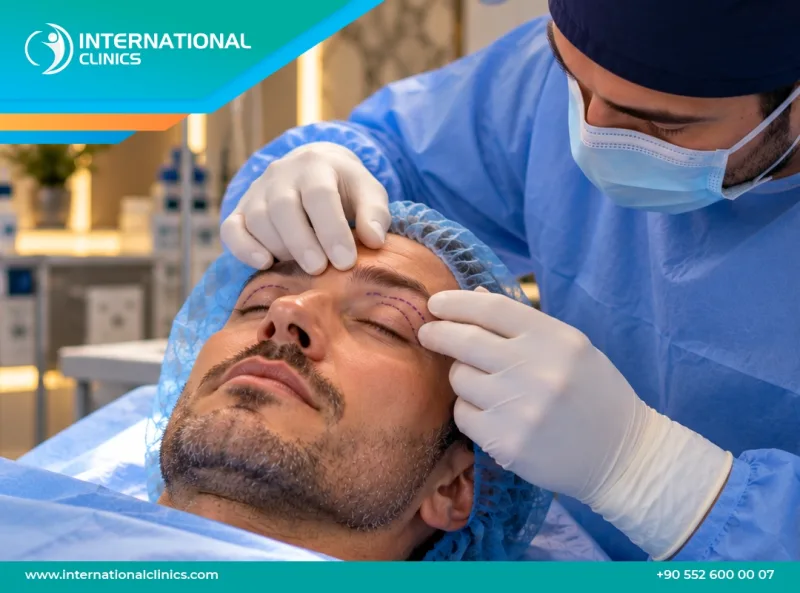
Ptosis surgery is usually done as a day case under local anaesthetic, which lets the surgeon check and adjust the lid height during the operation. A small incision is made in the eyelid crease and the lifting muscle is shortened to raise the lid; occasionally the incision is made inside the lid. It takes on average 45 minutes to 1 hour for each eye (Source: Cambridge University Hospitals NHS).
Initial consultation: lid height, levator function, eye health and dry eye are assessed.
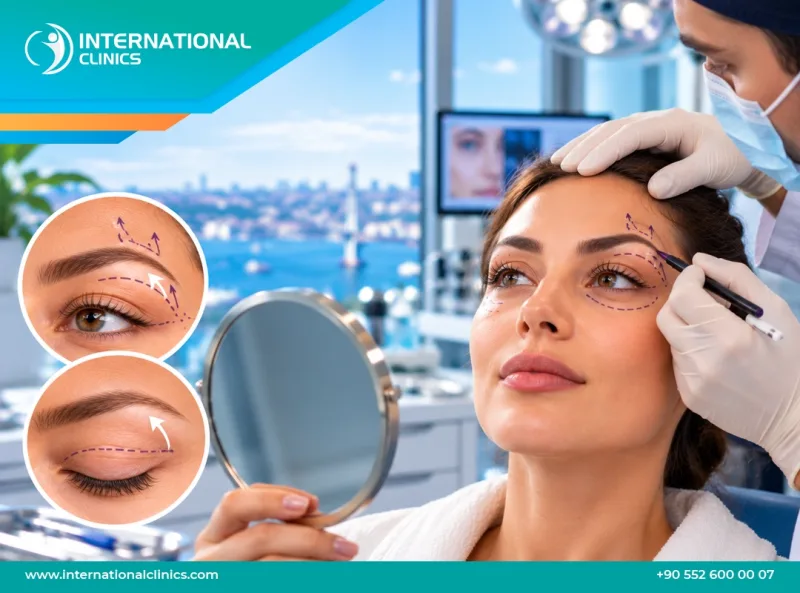
Surgical mapping: the incision line is marked in the natural crease.
Local anaesthesia: numbing eye drops and an injection; you stay awake so the lid height can be checked.
Incision: a small cut in the crease, or an approach from inside the lid.
Muscle adjustment: the levator muscle is shortened or reattached to lift the lid.

Tissue removal: excess skin or fat is removed only if needed.
Suturing: self-dissolving stitches are commonly used (Source: Cambridge University Hospitals NHS).
Immediate observation: a pressure pad is usually worn overnight.
Levator advancement, Müller muscle surgery or a brow (frontalis) sling
For mild to moderate ptosis with good muscle function, surgeons choose between Müller muscle-conjunctival resection (MMCR), done from inside the lid, and levator advancement through the skin crease. In a 2023 retrospective study of 82 eyes, success was 91.7% with MMCR and 72.2% with levator advancement, and MMCR took about 20 minutes against 45; the groups were not randomised, so the comparison is limited (Source: Romanian Journal of Ophthalmology, 2023).
When the levator is very weak, as in some children with congenital ptosis, the eyelid can be attached to other lifting muscles, usually the forehead (frontalis) muscle (Source: AAO).
Is there a non-surgical option?
A prescription eye drop containing oxymetazoline may help some adults with acquired ptosis. It has to be used daily to keep working and does not work for every type, such as ptosis from injury or nerve problems (Source: AAO).
Global Price Comparison
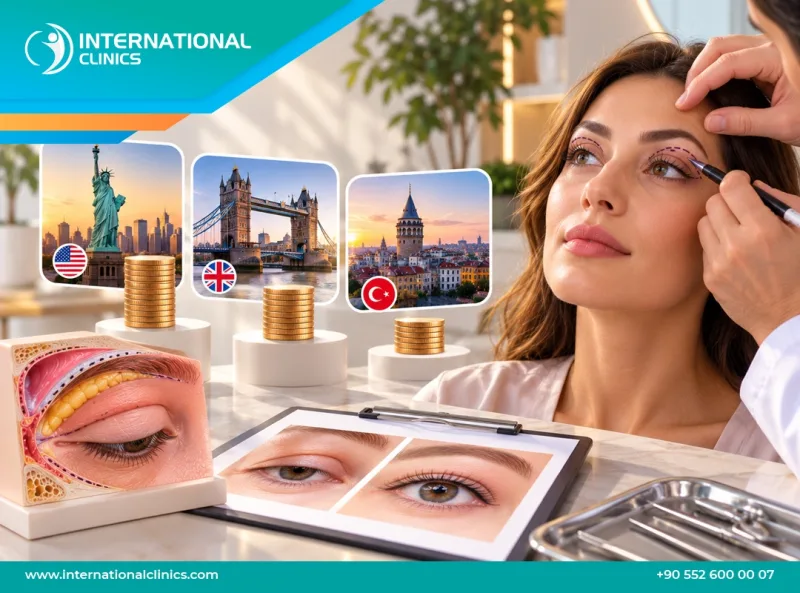
Ptosis surgery costs most in North America and least in Turkey. The figures below are typical prices published on social media platforms; there is no official average for ptosis repair, so treat them as orders of magnitude.
| Country | Estimated Average Cost | Inclusions Provided |
| United States | 4,000 - 6,000 USD (Source: social media platforms) | Usually surgery only, no accommodation |
| United Kingdom | 3,500 - 5,500 USD (Source: social media platforms) | Private fees; NHS treatment only when strict criteria are met |
| Turkey | $1,500–3,000 (approx. £1,150–2,250) through International Clinics | Consultations, medical fees, accommodation and transfers |
| Canada | 4,000 - 5,500 USD (Source: social media platforms) | Surgeon and facility fees |
| Germany | 3,000 - 5,000 USD (Source: social media platforms) | Surgeon and facility fees |
Add flights, extra nights and time off work before comparing. The NHS warns that travel insurance does not normally cover problems caused by surgery abroad, so ask how follow-up and complications are handled (Source: NHS).
Does Insurance or the NHS Cover Ptosis Surgery?
On the NHS, ptosis surgery must meet strict criteria based on how severe the droop is and how much it affects vision, shown with a visual field test; cosmetic surgery is not available on the NHS (Source: Cambridge University Hospitals NHS).
Private insurers apply similar rules: drooping upper eyelids have to restrict the peripheral visual field significantly, documented with photographs and visual fields, and a statement of how the lids interfere with daily activities helps (Source: AAO).
If your case does not meet these criteria, or you prefer not to wait, surgery is paid privately. Find out more about how to qualify for eyelid surgery.
Pros and Cons of the Surgery
Ptosis surgery achieves the desired lid height in about 80–90% of cases; over-correction (a lid set too high) occurs in roughly 10–20%, while under-correction is rare (Source: Cambridge University Hospitals NHS).
| Advantages (Pros) | Risks (Cons) |
| Clearer vision: a wider upper field of vision when the lid was blocking it. | Temporary swelling: bleeding, bruising and swelling are common. |
| Rested look: eyes look more open and alert. | Dry eyes: the eye may not close fully at first, causing dryness that usually settles. |
| Long-lasting: results usually last for years. | Scarring: a fine scar in the crease; none with the inside approach. |
| Facial symmetry: lids at a matching height. | Asymmetry risk: uneven height or contour, or the other lid starting to droop. |
| Less forehead strain: no need to raise the brows to see. | Rare serious risks: infection, and very rarely severe bleeding affecting vision. |
These risks are listed in NHS patient information for adult ptosis correction; discuss them with your surgeon before you decide (Source: Cambridge University Hospitals NHS).
Recovery Timeline and Aftercare
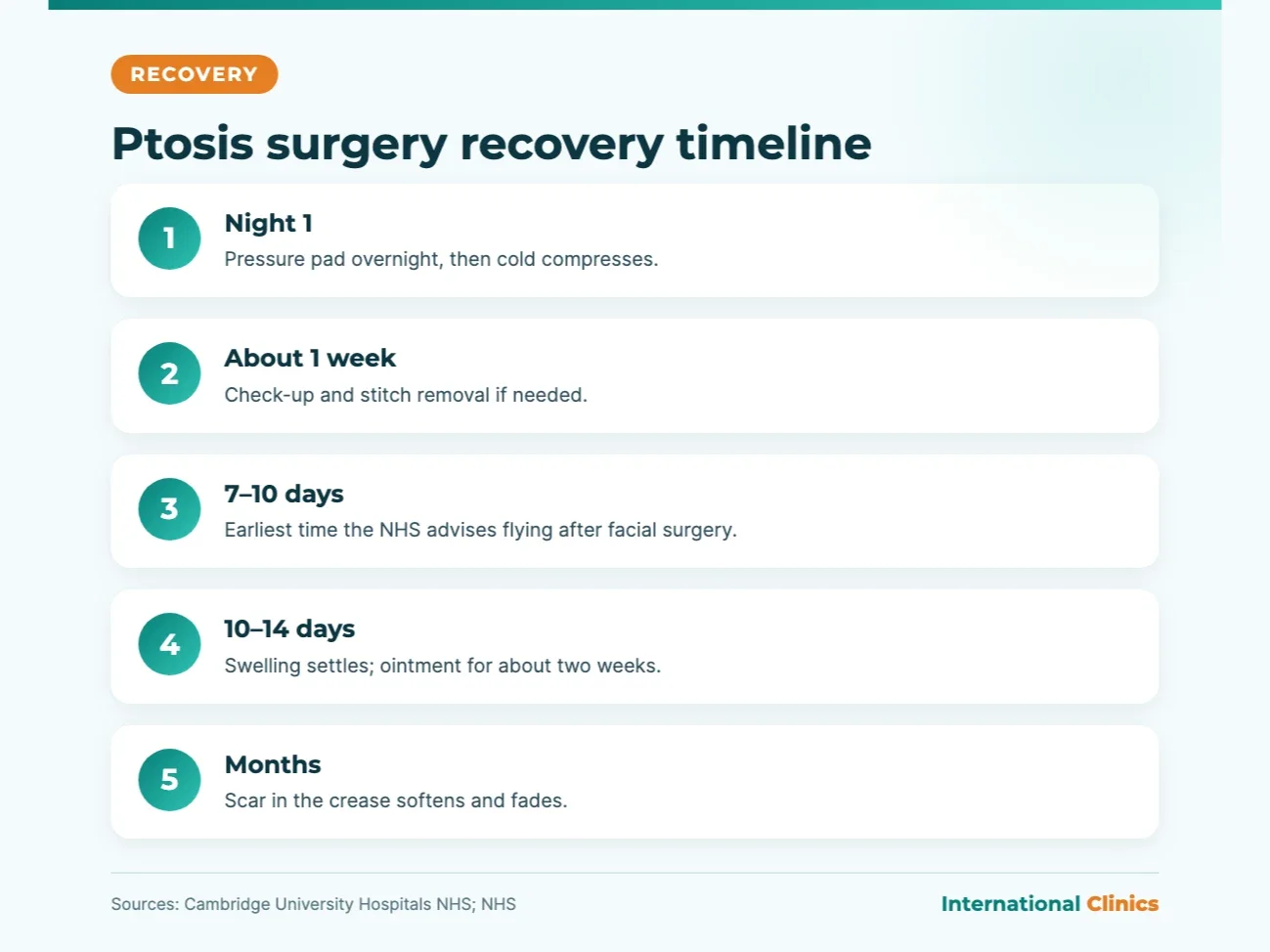
Swelling typically lasts about 10 to 14 days, stitches are often removed at a visit after one week, and antibiotic ointment and lubricants are used for about two weeks; you may drive the next day if your vision is not affected (Source: Cambridge University Hospitals NHS).
First 24 hours: a pressure pad overnight, then cold compresses and rest with the head raised.
First week: return for a check and, if needed, stitch removal.
Days 7–10: the NHS advises waiting 7 to 10 days after facial cosmetic procedures before flying (Source: NHS).
Second week: swelling and bruising settle; ointment and lubricants continue.
First month: the lid height becomes easier to judge as swelling goes down.
Following months: the scar in the crease softens and fades.
Long term: ageing continues after surgery, so discuss with your surgeon what would happen if the lid dropped again.
Ongoing care: attend follow-ups and report pain, worsening vision or a lid that does not close.
Real Patient Success Stories: What Success Means in Ptosis Surgery
We do not publish anonymous testimonials here. Success after ptosis surgery means a lid that clears the pupil, sits at a height and curve that match the other eye, and closes well enough to protect the eye. Because over-correction happens in roughly 10–20% of cases, a small adjustment is part of normal practice rather than a failure (Source: Cambridge University Hospitals NHS).
To see how eyelid surgery changes a face in real life, browse our celebrity blepharoplasty before and after photos, and ask your surgeon for photos of their own ptosis patients with a similar starting point.
Comprehensive Guarantees and Booking: What Is and Is Not Guaranteed
No surgeon can guarantee an exact lid height. What you can expect in writing is the plan, the price and how a revision would be handled. Booking through International Clinics covers the practical steps:
Free consultation: a preliminary evaluation from your photos.
Customised plan: the technique and the expected cost, in writing.
All-inclusive packages: hotel and transfers in Istanbul.
Airport transfers: transport from the airport on arrival.
Interpreters: help with communication where needed.
Selected hospitals: surgery in hospitals contracted by International Clinics against its quality standards.
Post-op checks: follow-up visits during your stay.
Revision policy: ask how an over- or under-correction would be managed and what it would cost.
To compare surgeons, read our guide to choosing an eyelid and brow lift surgeon in Turkey.
Pro-Tips
Preparing well makes the recovery smoother. Before surgery, tell the surgeon about all medicines and supplements, especially aspirin and other blood thinners (Source: AAO).
Elevate head: sleep with extra pillows in the first nights.
Ice packs: cold compresses for early swelling.
Rest eyes: take breaks from screens if your eyes feel dry.
Wear sunglasses: protect the healing lids from sun and wind.
Avoid makeup: keep cosmetics away from the incision until your surgeon allows them.
Use drops: apply the prescribed ointment and lubricants.
Skip workouts: avoid heavy lifting and strenuous exercise until cleared.
Attend follow-ups: never skip your scheduled checks.
Conclusion
Upper eyelid ptosis surgery costs $1,500–3,000 (approx. £1,150–2,250) through International Clinics in Turkey. It is a muscle operation, different from removing excess skin, and the right technique depends on how strong your levator muscle is. Around 80–90% of patients reach the desired lid height after one operation, and a small adjustment is sometimes needed. International Clinics connects you with plastic surgeons and hospitals it has contracted against high medical standards; it is a licensed company with international partners, expanding its hospital contracts to several countries, starting with the UAE. Contact International Clinics to send photos of your eyes and receive a written plan and quote.
Medical review and disclaimer:
This article was reviewed by a specialist physician contracted with International Clinics. It is general health information, not a substitute for medical advice, and results vary between individuals.