- How to Qualify for Eyelid Surgery?
- Am I a Candidate for Eyelid Surgery? A Quick Self-Check
- Health Conditions That Can Delay or Rule Out Eyelid Surgery
- Is There an Age Limit for Eyelid Surgery?
- How to Qualify for Eyelid Surgery in Turkey?
- How to Qualify for Eyelid Surgery in Canada?
- How to Qualify for Eyelid Surgery in NHS?
- How to Qualify for Eyelid Surgery Through Insurance in the US
- Eyelid Surgery Procedure
- How Doctors Decide: Guidelines and References Behind These Criteria
To qualify for eyelid surgery you need to be a healthy adult, ideally a non-smoker, with realistic goals, no serious eye condition and an eyelid problem that blepharoplasty can actually fix; you are a good candidate when the surgeon confirms excess skin or fat rather than a drooping brow or ptosis (Source: ASPS).
To qualify on the NHS or through insurance, the eyelids must also impair your vision, which is proved with visual field tests and photographs, because the NHS does not pay for eyelid surgery done for cosmetic reasons (Source: Guys and St Thomas NHS).
Your eyelids have a big impact on not just how you look, but also how you see, in both practical and cosmetic ways.
If your eyelid has a cosmetic problem, you can search for a solution in the world of plastic surgery, depending on the underlying cause and symptoms of the issue.
The goal of eyelid surgery or blepharoplasty is to improve the eye region by removing or repositioning excess skin and fat, including sagging upper-lid skin that may hang low in the field of vision.
Thus, the surgery can help enhance vision as well as appearance. Youve most likely heard about eyelid surgery if youre looking at cosmetic surgery possibilities.
However, how can you qualify for this surgery and how can you determine whether youre a good candidate? Let’s find out!
How to Qualify for Eyelid Surgery?
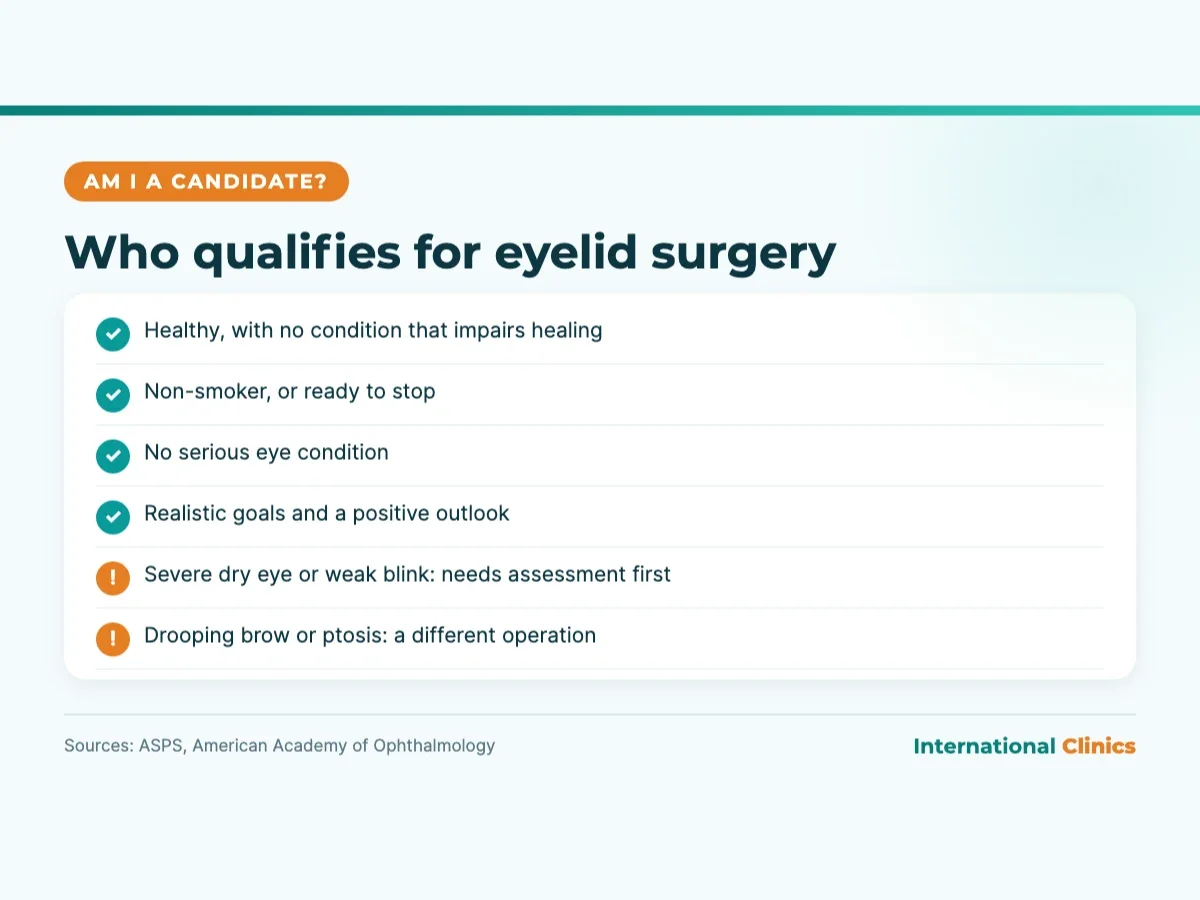
To qualify for eyelid surgery or blepharoplasty, the American Society of Plastic Surgeons lists four criteria: being healthy without medical conditions that can impair healing, being a non-smoker, having a positive outlook and realistic goals, and having no serious eye conditions (Source: ASPS).
The surgeon also checks your eyes: dry eyes, a weak blink and unrealistic expectations are relative contraindications, and people with Graves’ (thyroid) eye disease need special caution (Source: American Academy of Ophthalmology).
Most of the other requirements surgeons apply have to do with health and with finding the true cause of the problem.
Here you should remember that your eyelids are a component of your face, so the surgeon looks at the brow and forehead as well as the lids.
In many cases, the skin and eyebrows on the forehead relax, giving the appearance of a sagging top lid.
A drooping eyelid can also be caused by a stretched upper eyelid muscle. “Eyelid ptosis” is the term for this condition, and it requires a different surgical treatment from blepharoplasty (Source: ASPS).
Patients also might show signs of aging or inherited changes in their eyelids: loose eyelid skin and prominent fat pads are usually noticed from the fourth decade of life, sometimes earlier (Source: StatPearls).
In any case, you may be a suitable candidate for blepharoplasty if you have any of the following conditions:
- Droopy eyelid: Excess upper-lid skin (dermatochalasis) that hangs over the lashes and can narrow peripheral vision. If the lid margin itself droops, that is ptosis and needs ptosis repair instead.
Malar bags: Swellings on the upper cheek (malar bags or festoons) are not the same as eyelid fat bags, so the surgeon must assess whether lower blepharoplasty can help or another treatment is needed.
Uneven Eyelids: Loss or accumulation of fat can cause uneven upper or lower eyelids.
Dark circles: Bulging lower-lid fat can cast a shadow that looks like a dark circle; dark circles caused by skin pigmentation are not treated by surgery.
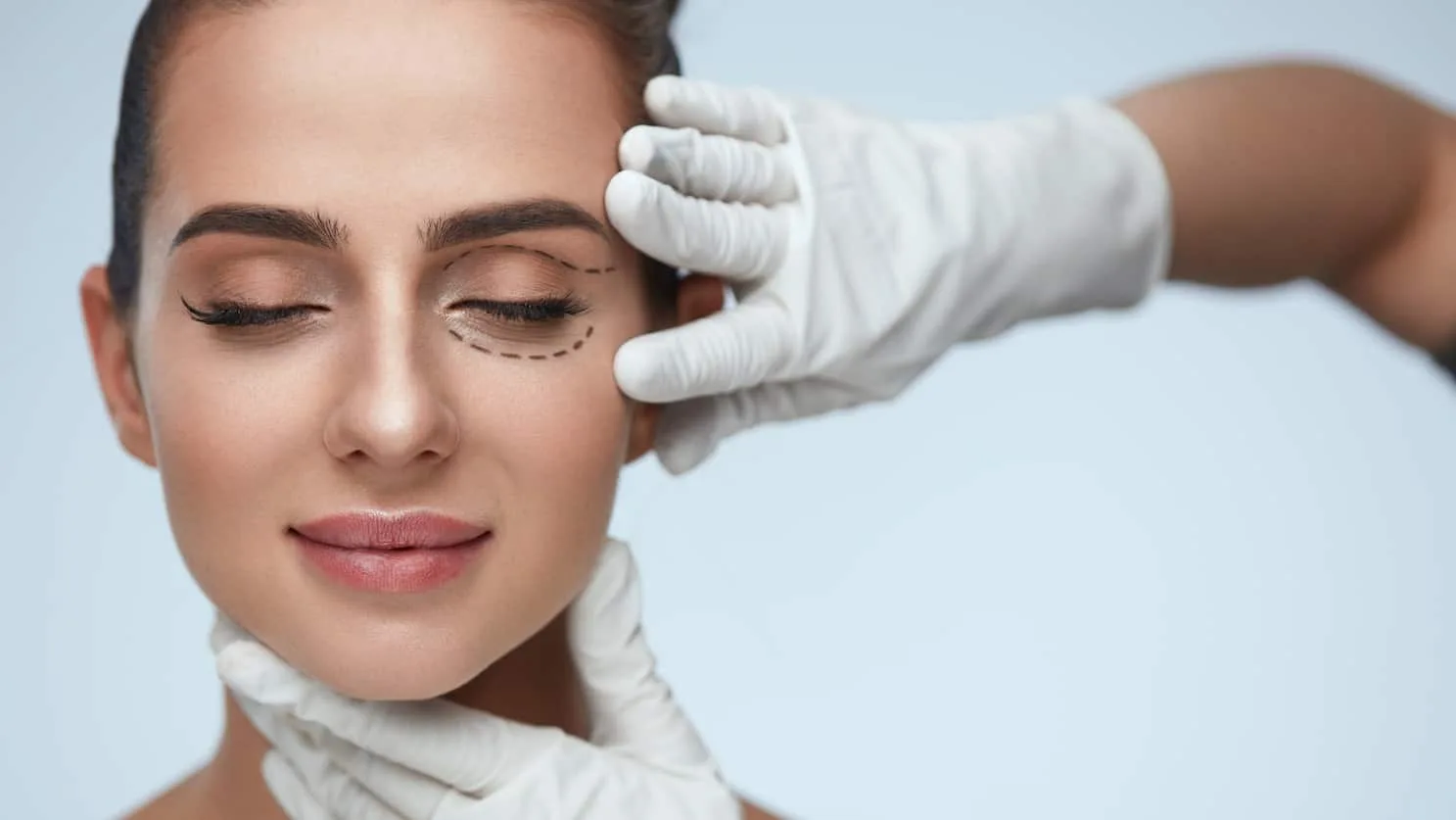
Excess skin: Extra sagging skin surrounding your eyes that gives the appearance of aging or fatigue.
If you want to see what realistic changes look like on well-known faces, browse our celebrity blepharoplasty before and after photos.
Am I a Candidate for Eyelid Surgery? A Quick Self-Check
You are probably a candidate for eyelid surgery if most of these statements are true for you; a surgeon’s examination is still what decides:
- Your upper lids look hooded, or skin rests on your lashes.
- You have puffy bags under the eyes caused by fat rather than fluid that comes and goes.
- You are in good general health, and long-term conditions such as diabetes or high blood pressure are well controlled.
- You do not smoke, or you are ready to stop around the operation.
- You do not have severe dry eye or another serious eye disease.
- You can stop or adjust blood-thinning medicines if your doctors agree.
- You want a fresher look, not a different face.
Health Conditions That Can Delay or Rule Out Eyelid Surgery
Some conditions do not rule you out automatically but must be assessed and controlled first. Blood thinners and supplements that increase bleeding, such as aspirin, NSAIDs, fish oil, vitamin E, ginkgo, warfarin or clopidogrel, need a plan before surgery, and surgeons also screen for body dysmorphic disorder (Source: American Academy of Ophthalmology).
Chronic illnesses such as diabetes, heart disease, high blood pressure or thyroid disease matter because they can affect healing and anaesthesia; your surgeon may ask for a report from your own doctor before deciding. You need an eye examination and a general health check before surgery, and your team must know every medicine and supplement you take (Source: Cleveland Clinic).
Is There an Age Limit for Eyelid Surgery?
There is no fixed upper age limit: suitability depends on health, not on the date of birth. Loose eyelid skin usually becomes noticeable from the fourth decade of life, so most people who have blepharoplasty are in their 40s or older, while younger adults may need it when the problem runs in the family (Source: StatPearls).
In older people, removing skin that blocks the upper field of vision can bring a practical benefit: patients with visual field obstruction may have a higher risk of falls (Source: American Academy of Ophthalmology).
How to Qualify for Eyelid Surgery in Turkey?
To qualify for eyelid surgery in Turkey, you need the same things as anywhere else: good general health, no serious eye condition and an eyelid problem that surgery can fix. Because the operation is paid privately, no visual field threshold is needed for cosmetic surgery, but the surgeon still examines your eyes and may ask for tests.
Many patients who choose blepharoplasty in Turkey have functional problems like drooping skin that limits their field of vision, while others have cosmetic concerns like extra skin on the upper eyelids that affects their look.
Because of the additional skin, some people have trouble with reading or driving, which interferes with their day-to-day activities. Surgeons also often conduct a visual field test for blepharoplasty for an in-depth assessment.
Long-term conditions such as diabetes, heart disease, high blood pressure or thyroid problems do not automatically disqualify you, but they must be stable, and you should bring recent reports from your own doctor to the consultation.
When planning surgery abroad, also allow enough time to recover before flying home; our guide to blepharoplasty in Turkey explains how long to stay. Healthy skin and realistic expectations matter as much as age.
Remember that while this procedure can help with bags under the eyes and sagging lids, it does not fix wrinkles, fine lines, skin discoloration or drooping eyebrows. For prices, see the upper blepharoplasty cost guide and our guide to under-eye bag removal surgery cost.
How to Qualify for Eyelid Surgery in Canada?
In Canada, health coverage is organised by each province, so ask your family doctor or ophthalmologist what documentation your provincial plan needs; as elsewhere, purely cosmetic eyelid surgery is paid privately. Medically, the assessment is the same: the surgeon checks whether the problem is in the lids or the brows.
Brow lift or eyelid surgery could be suggested if there is a disorder affecting the upper eyelids accompanied by drooping of the eyebrows.
A brow lift could be suggested if the sagging eyebrows are accompanied by hooding and extra skin on the upper eyelids.
Procedures like Botox, chemical peels, or laser resurfacing can reduce wrinkles if you have deep crows feet.
To address hollowness around the bony rim beneath the eye, fat injections, also known as fat grafting, or fillers may be used.
If surgery is necessary to correct the upper eyelid, the incision that removes extra skin and fat is placed in the upper eyelids natural fold (Source: NHS).
When the incision heals, the scar usually sits in the natural curve of the lid, although it may look red and feel tight for a few months.
To refine the upper lid shape, a small amount of fat from the upper eyelid is sometimes removed or repositioned.
How to Qualify for Eyelid Surgery in NHS?
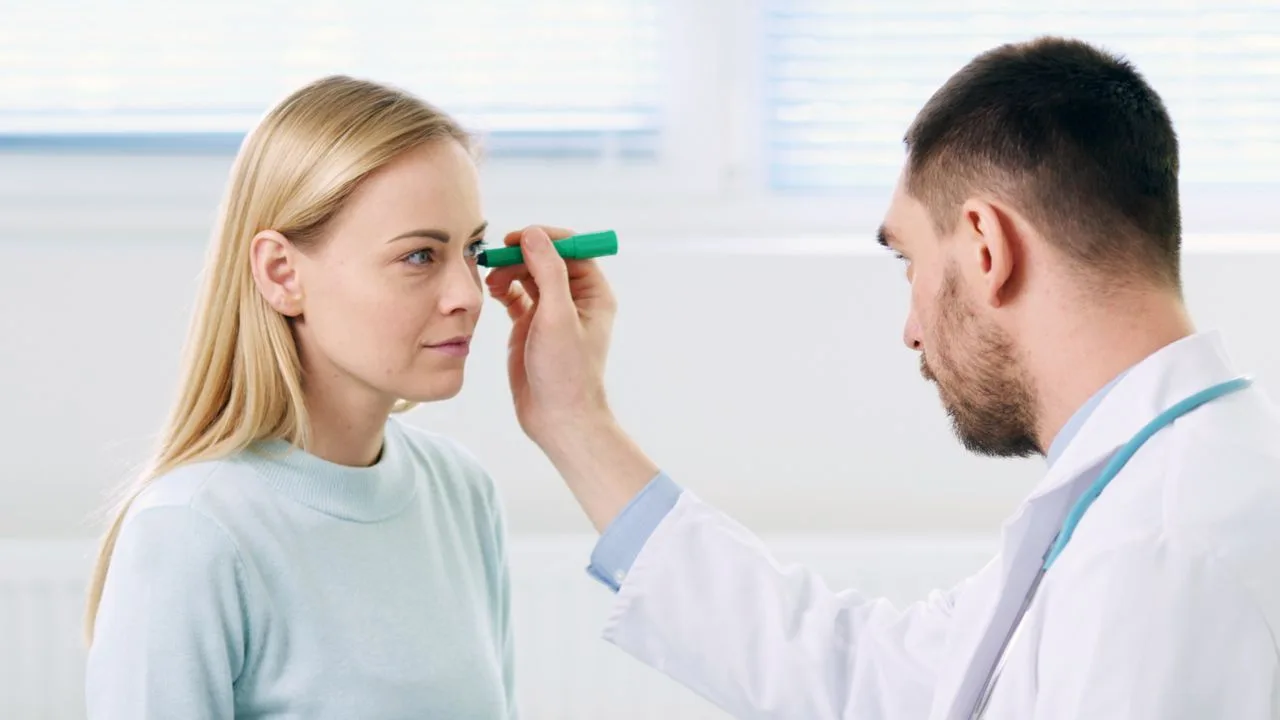
To qualify for eyelid surgery on the NHS, excess eyelid skin must affect your vision; blepharoplasty is not available on the NHS for cosmetic reasons, and the expected benefit is better peripheral vision (Source: Guys and St Thomas NHS).
If the extra skin is impairing your vision, it can be done on the NHS. If it is for cosmetic purposes, it cannot be performed on the NHS, and private surgery in the UK may cost £2,000 to £6,000 (Source: NHS).
We must first distinguish between the rules set by the NHS or insurance companies and the basic standards that your surgeon will consider. Local NHS commissioners publish their own criteria, so the exact wording varies by area.
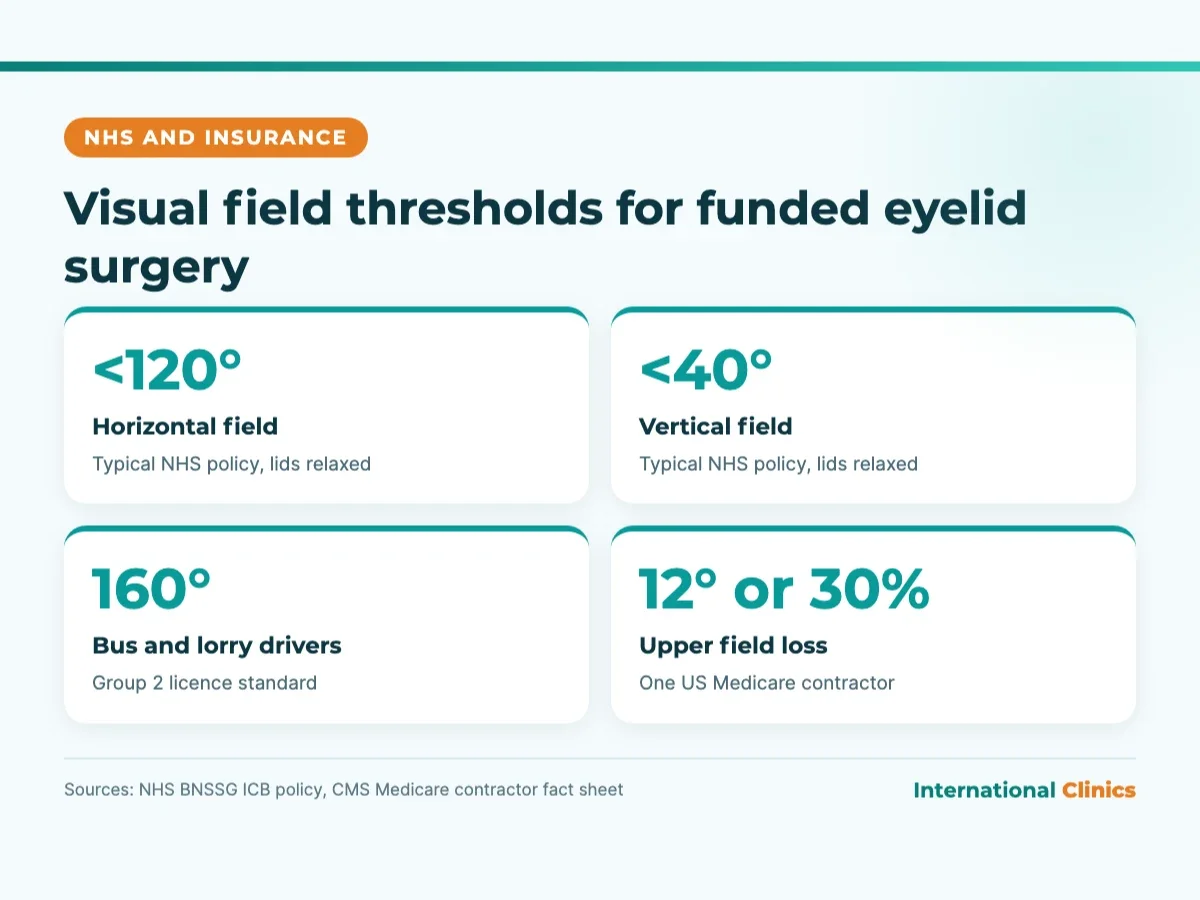
One typical policy approves upper-lid blepharoplasty or brow lift when drooping tissue persistently reduces the visual field to less than 120° horizontally and 40° vertically with the eyelids relaxed, and the operation is expected to improve vision. Group 2 bus and lorry drivers, who need 160° horizontally, are approved on that basis (Source: NHS BNSSG ICB).
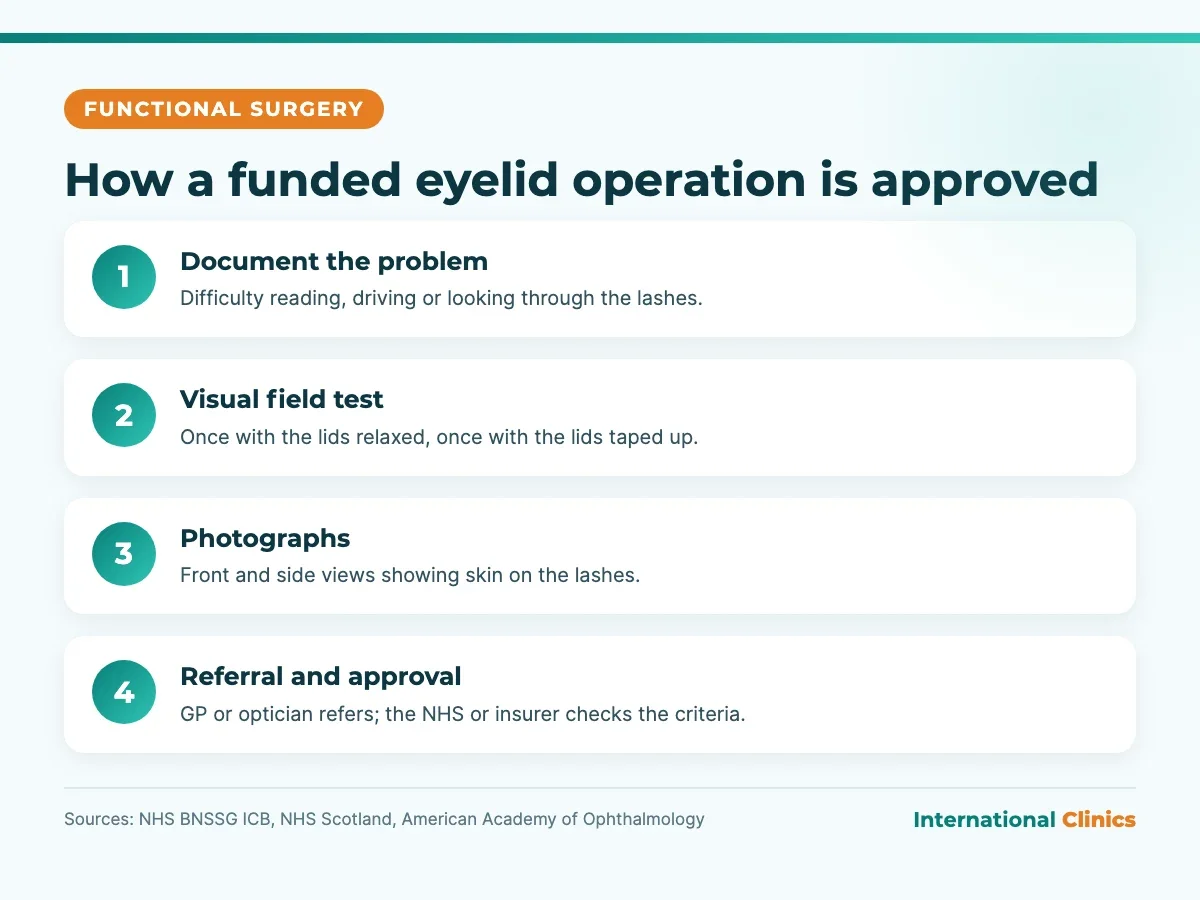
To prove this, the hospital or optician takes photographs and performs visual field tests, ideally twice: first with the upper lids taped up and then without (Source: NHS BNSSG ICB).
In Scotland, blepharoplasty is not routinely provided and is considered only when all criteria are met: excess skin must restrict the visual field, the visual field test must be done before referral, and surgery is not considered when tiredness or ageing is the main concern. Lower-lid surgery may be considered as part of treating an ectropion (Source: NHS Scotland).
How to Qualify for Eyelid Surgery Through Insurance in the US
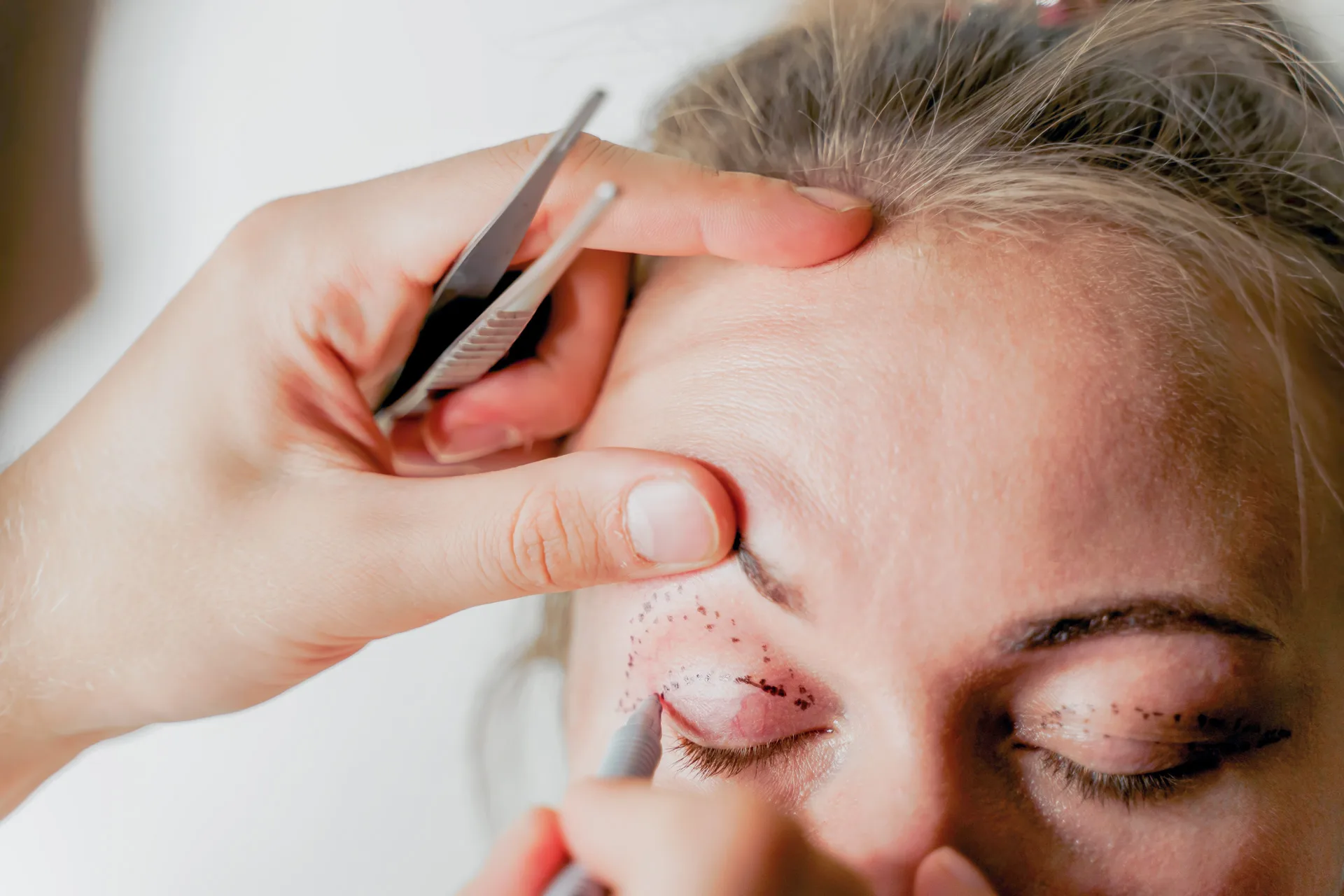
US insurers pay only for functional blepharoplasty, and most health insurance does not cover cosmetic eyelid surgery, but removing redundant skin that covers the eyelashes may be covered (Source: ASPS).
Medicare contractors publish local coverage rules. One contractor’s fact sheet requires documented complaints such as difficulty reading or looking through the lashes, and visual field tests showing at least a 12-degree or 30 percent loss of the upper field with the lids at rest, plus testing with the lids taped up to show the operation can correct it (Source: CMS Medicare contractor fact sheet).
The same fact sheet notes that visual field studies are not required when the indication is entropion or ectropion, and that ptosis must be tested with the true lid taped in its correct position. Criteria differ between insurers, so ask for the written policy before testing (Source: CMS Medicare contractor fact sheet).
For a step-by-step explanation of taped and untaped testing, read our guide to the visual field test for blepharoplasty above. If your lid margin droops, see our guide to upper eyelid ptosis surgery cost.
Eyelid Surgery Procedure
Once you qualify, eyelid surgery usually takes about 45 minutes to 2.5 hours under local or general anaesthetic, and most people go home the same day (Source: NHS).
Various techniques are used, depending on the patients main concerns and on whether the upper lids, the lower lids or both are treated.
As for any eye surgery preparation, eyelid surgery involves careful planning and special attention because of the delicate nature of the eye region.
You will arrange the date of your procedure as soon as a specialist surgeon has approved you for surgery.
Some patients have a general anaesthetic, while many have a local anaesthetic, often with sedation given through a vein (Source: Cleveland Clinic).
Tell the team about any blood-thinning medicines, such as aspirin, warfarin or apixaban, well before the operation (Source: NHS).
Your surgeon will make the incisions and remove the extra skin and fat from the eyelids once the anaesthetic has taken effect.
In lower lid surgery, fat is often repositioned rather than removed, and the surgeon may support the muscles and tendons of the lid.
Depending on whether your surgeon is operating on the lower eyelids, the upper eyelids, or both, the process varies significantly.
To restore drooping lids, upper eyelid surgery typically involves removing extra skin, and occasionally some fat as well.
Your upper or lower eyelid incisions are then closed, and you are taken to a recovery area before going home.
How Doctors Decide: Guidelines and References Behind These Criteria
The criteria in this article come from four kinds of rules: surgeons’ candidate criteria (health, smoking, eye health, expectations), the ophthalmic assessment of lid height, brow position and dry eye, NHS commissioning policies for functional surgery, and insurer or Medicare rules based on visual field loss. A surgeon applies the first two to everyone; the last two decide only who pays. If you are unsure which applies to you, start with an eye examination and a consultation with a plastic or oculoplastic surgeon.
You can read also:
PRP vs Filler for Under Eyes: Which is Best for Dark Circles & Eye Bags?
What Is Good for Dry Eyes Syndrome?
Upper Blepharoplasty Cost: Affordable Eyelid Surgery
International Clinics is the link between you and plastic surgeons it has contracted to high medical standards. You can send photos of your eyelids and any eye-test results for an initial assessment by a contracted surgeon, who will tell you whether blepharoplasty, ptosis repair or a brow lift fits your case.
Medical review and disclaimer:
This article was reviewed by a specialist physician contracted with International Clinics. It is general health information, not a substitute for medical advice, and results vary between individuals.