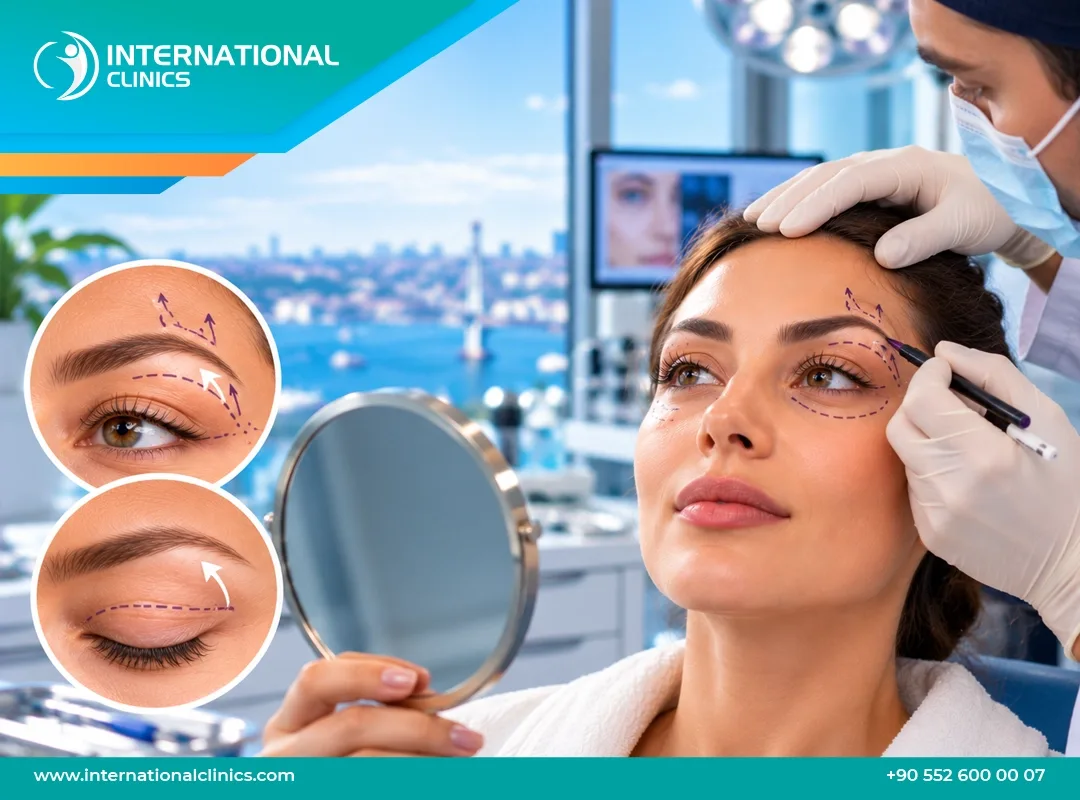
The best eyelid and brow lift surgeon in Turkey for you is not the one with the boldest advertising but one whose credentials you can verify: a specialist in plastic, reconstructive and aesthetic surgery (or an ophthalmologist trained in oculoplastic surgery) who is a member of the national plastic surgery society, operates in a licensed hospital, does eyelid and brow surgery regularly, and explains whether you need a blepharoplasty, a brow lift or both. ISAPS advises checking board certification or its national equivalent, membership of the national plastic surgery society and the accreditation of the hospital (Source: ISAPS).
Many people search for the best eyelid and brow lift surgeon in Turkey because they want to restore a fresher, more rested look around the eyes or to lift heavy lids that block their upper vision. This guide shows how to judge a surgeon, which questions to ask, which red flags to avoid and what the combined surgery and recovery involve. Through International Clinics you reach surgeons contracted by International Clinics, so the same checklist applies to them as to anyone else.
What distinguishes the Best Eyelid and Brow Lift Surgeon in Turkey?
What distinguishes a good eyelid and brow lift surgeon is verifiable training, regular experience with this exact operation, an honest assessment of what you need, and clear aftercare, rather than a title such as "best". ISAPS warns that choosing a doctor who is not trained in the procedure you want is a risky decision, and it notes that its own membership is open only to surgeons already accepted by their national plastic surgery society (Source: ISAPS).
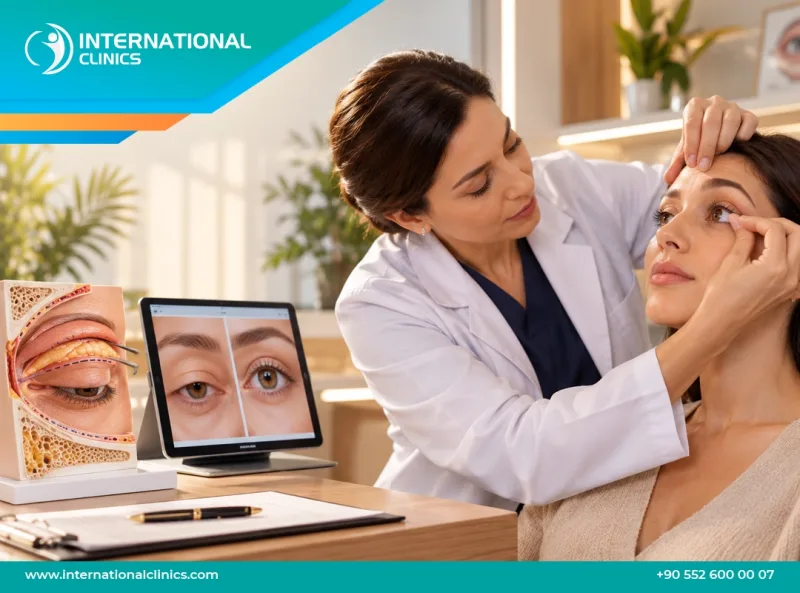
The most important skill is diagnosis. Hooded upper lids can come from loose eyelid skin (dermatochalasis), a drooping lid margin (ptosis) or a brow that has dropped; each needs a different operation, and EyeWiki of the American Academy of Ophthalmology notes that brow position must be examined because a low brow can make the upper lid look worse and may need a brow lift at the same time (Sources: EyeWiki (AAO), EyeWiki (AAO)).
Criteria for Selecting the Best Surgeon for Your Eyes
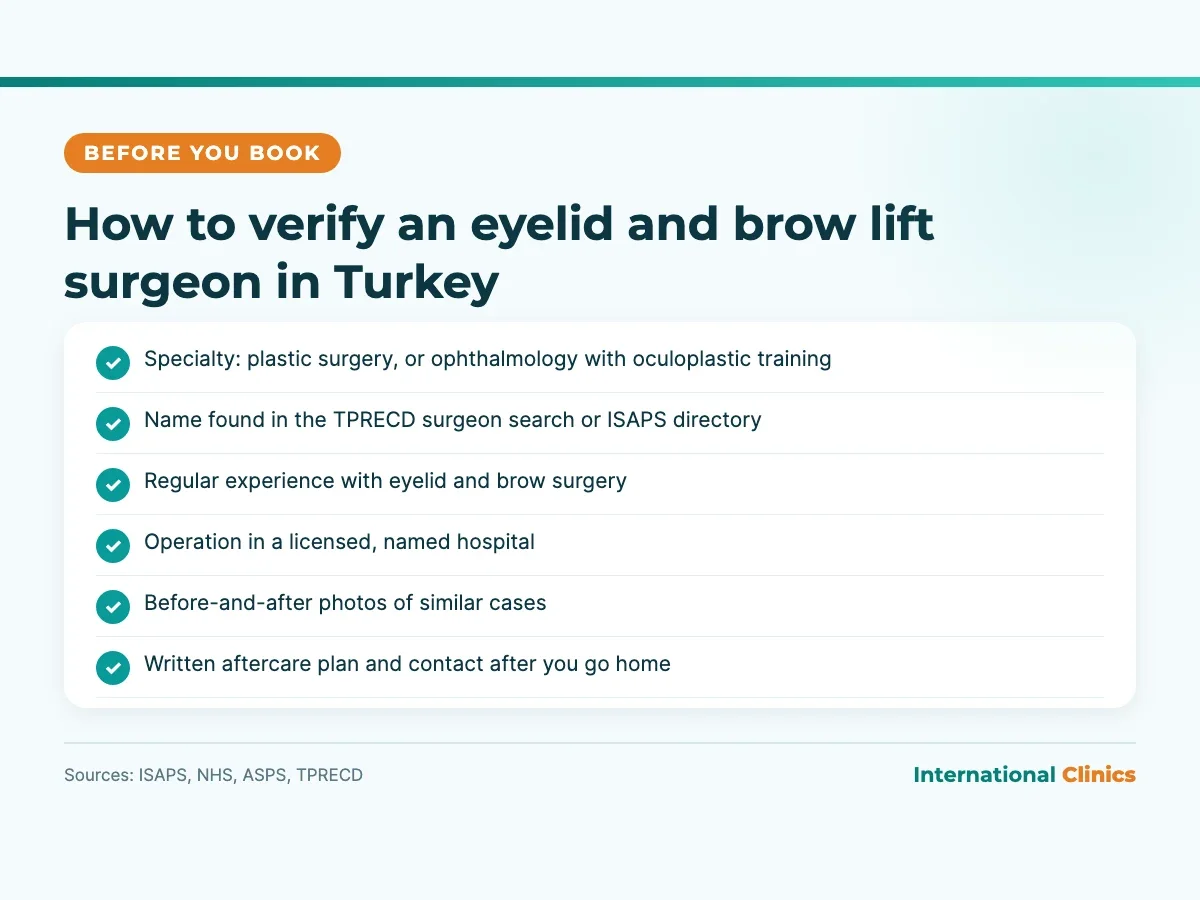
Selecting an eyelid and brow lift surgeon in Turkey requires a few checks that you can do yourself before you travel. Use the following criteria, which follow ISAPS, NHS and ASPS advice (Sources: ISAPS, NHS):
Certifications: A specialist title in plastic, reconstructive and aesthetic surgery, or ophthalmology with oculoplastic training for eyelid-only surgery. Ask for the specialty and where the surgeon trained.
Society membership: In Turkey, the Turkish Society of Plastic, Reconstructive and Aesthetic Surgeons (TPRECD) runs a public "find a plastic surgeon" search on its website, and ISAPS lists its members in an online directory (Source: TPRECD).
Specialized experience: Ask how many eyelid and brow procedures the surgeon performs and how many of your type (upper lids, lower lids, brow lift, revision).
Advanced techniques: The surgeon should explain which brow lift technique suits your forehead and hairline (endoscopic, coronal or hairline) and why, rather than offering one method to everyone.
Artistic vision: Ask to see how the planned crease height, brow height and amount of skin removal fit your face, keeping a natural, not surprised, look.

Success record: Before-and-after photos of the surgeons own patients with a similar starting point, taken in the same light and angle, are more useful than a large number of photos.
Positive reviews: Reviews help, but read them with care; ISAPS suggests asking for contact details of recent patients who had similar procedures.
Comprehensive care: A written aftercare plan, stitch removal date and a named contact for complications after you return home.
Absolute transparency: Honest consultations about results and surgical risks, and the chance to speak directly with the surgeon, not only with a sales coordinator (Source: ISAPS).
The NHS adds simple questions for any surgeon: how many of this procedure they have done, what their qualifications are, which professional associations they belong to, what the most common complications are and who provides aftercare, and it advises not to pay for a procedure until you have had a consultation (Source: NHS).
Questions to Ask an Eyelid and Brow Lift Surgeon Before You Book
The quickest way to judge a surgeon is to ask the questions the American Society of Plastic Surgeons recommends and to see how clearly they are answered (Source: ASPS):
- Were you specifically trained in plastic surgery, and for how many years?
- Do you have privileges to perform this procedure in a hospital, and in which one will my operation take place?
- Am I a good candidate, and which technique do you recommend for me?
- Where and how will you perform my procedure, and under what anaesthesia?
- What are the risks and how are complications handled?
- How long a recovery should I expect, and what help will I need?
- What are my options if I am dissatisfied with the result?
- Can I see before-and-after photos of this procedure, and what results are reasonable for me? (Source: ASPS)
When Should You Consider Eyelid and Brow Surgery?
You should consider eyelid and brow surgery when the changes bother you or limit your vision and a surgeon confirms which structure is responsible. Typical reasons are listed below; the operation that fixes each one differs (Sources: ASPS, EyeWiki (AAO)):
Drooping eyelids: Loose upper eyelid skin that forms folds and, in some people, limits the upper field of vision.
Lower puffiness: Fat bags under the eyes that give a tired look.
Descending brows: A brow that has dropped and hoods the upper lids.

Deep wrinkles: Horizontal forehead lines and frown lines between the brows, which a brow lift addresses.
Facial asymmetry: A visible difference in brow or lid height between the two sides.
Elasticity loss: Ageing skin and supporting tissues that relax over time.
Functional issues: Heavy lids that make it hard to keep the eyes open or that block side or upper vision.
Psychological impact: Feeling that you look tired or older than you feel.
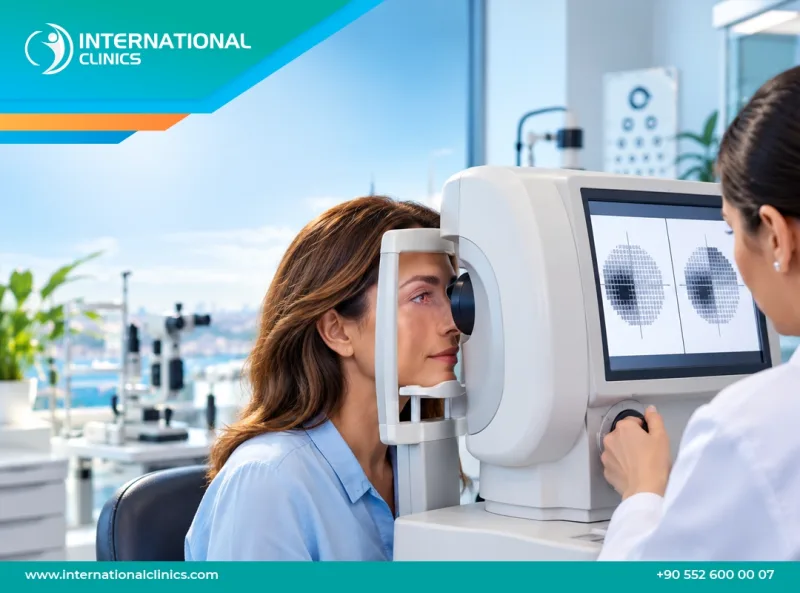
If the lids limit your vision, ask for an eye examination and a visual field test for blepharoplasty before surgery: it documents how much the lids block your upper field, and functional disability is documented by external photographs and visual field testing with and without eyelid taping (Source: EyeWiki (AAO)).
Brow Lift, Blepharoplasty or Both?
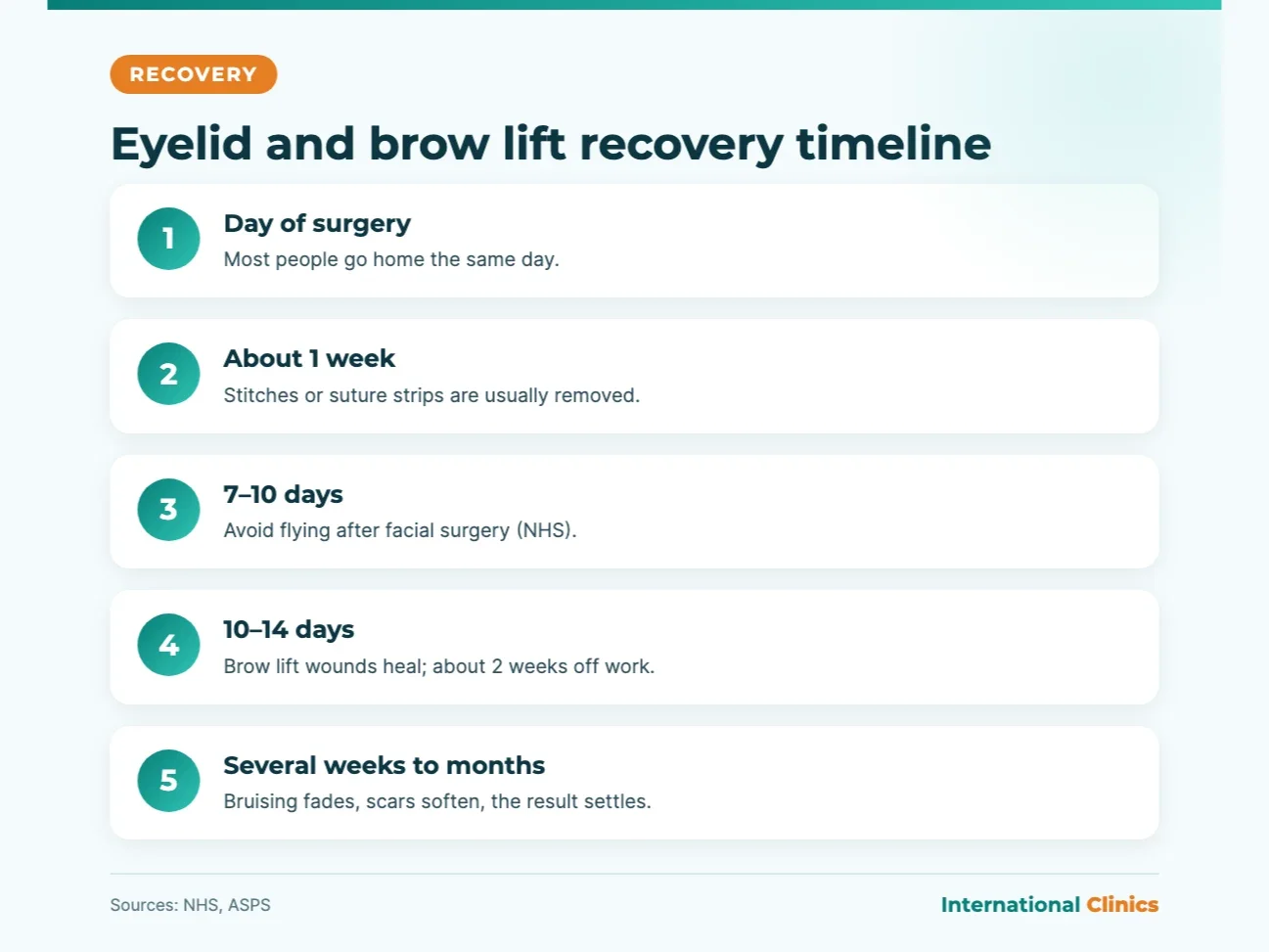
Blepharoplasty removes excess eyelid skin and fat; a brow lift raises a low brow and smooths forehead and frown lines. A brow lift is often combined with upper or lower eyelid surgery, and patients with significant brow ptosis may need brow lifting at the same time as blepharoplasty, because removing lid skin alone can pull a low brow even lower (Sources: ASPS, EyeWiki (AAO)).
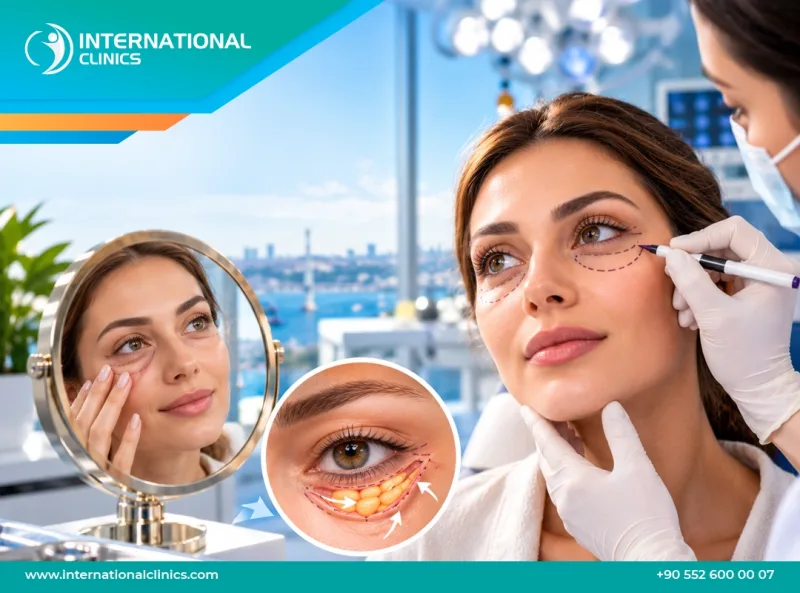
A simple test at the mirror helps you prepare for the consultation: lift your brows gently with your fingertips to where they feel natural. If most of the hooding disappears, the brow is a large part of the problem; if loose skin still hangs over the lid, blepharoplasty is needed. Only an examination can confirm it, and a good surgeon explains this choice rather than selling the operation you asked for. To see what eyelid surgery can and cannot change, look at our celebrity blepharoplasty before and after photos.
Surgical Steps for Natural and Harmonious Results
Eyelid and brow surgery follows a set sequence, from assessment to discharge. Eyelid surgery usually takes about 45 minutes to 2 and a half hours, can be done under local or general anaesthetic, and most people go home the same day (Source: NHS).

Initial consultation: Health assessment, eye examination and a discussion of your goals and expectations.
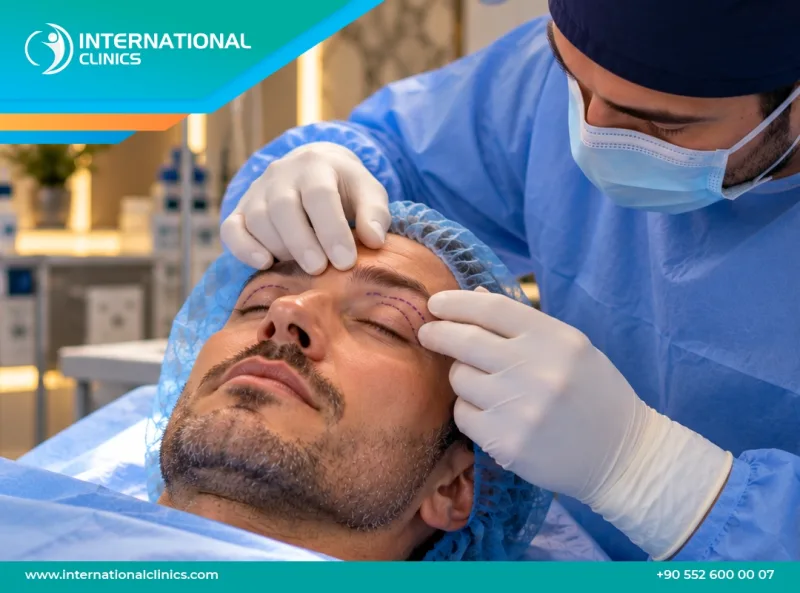
Surgical planning: Precise skin markings that define the crease and the amount of skin to remove.
Applying anesthesia: Local anaesthetic with sedation or general anaesthesia; for a brow lift ASPS describes intravenous sedation or general anaesthesia.
Creating incisions: In the natural upper lid crease, just below the lower lashes or inside the lower lid, and in or near the hairline for a brow lift.
Removing excess: Careful removal or repositioning of skin, muscle and fat, conservative enough to avoid a hollow look.
Lifting brows: Releasing and repositioning the forehead tissues so the brow sits at a natural height.
Cosmetic suturing: Closing the incisions with fine sutures, skin adhesive or clips.
Medical monitoring: Observation in a recovery room before discharge (Sources: ASPS, EyeWiki (AAO)).
Techniques Utilized by the Best Surgeon
An experienced eyelid and brow lift surgeon chooses the technique to fit your anatomy, and can also tell you when a non-surgical option is enough. ASPS describes three brow lift approaches: endoscopic (small incisions in the hairline and a camera), coronal (an ear-to-ear incision in the hair-bearing scalp) and anterior hairline, used for women with a very high forehead so the hairline is not raised (Source: ASPS).
| Medical Technique | Primary Application | Key Advantage |
| Traditional Surgery (Blepharoplasty) | Removing excess eyelid skin and fat bags | Long-lasting correction of hooding and bags |
| Endoscopic Lift | Raising the brows and smoothing the forehead | Small incisions hidden in the hairline |
| Thread Lift | Raising the brows in milder cases | No incisions, but the lift is modest and usually shorter-lived than surgery |
| Botox Injections | Softening dynamic wrinkles around the eyes and forehead | No incision; effect is temporary and needs repeating |
| Fractional Laser | Tightening thin skin and treating pigmentation | Resurfacing that can complement surgery |
| Plasma Technology (Plexr) | Mild skin tightening of the eyelids without surgery | Short recovery, but evidence is limited and it does not replace surgery for marked hooding |
Choosing the suitable technique with your surgeon matters more than the newest device. Skin resurfacing and brow lifting are often added to blepharoplasty when the problem involves more than the eyelid skin (Source: EyeWiki (AAO)).
Pros and Cons of Eyelid and Brow Lifting
Eyelid and brow lifting can give a more rested look and, in some people, better upper vision, but both are operations with real risks. ASPS lists dry eyes, difficulty closing the eyes, numbness, visible scarring, a possible need for revision and a very rare risk of vision loss for eyelid surgery, and facial nerve injury, hair loss around incisions, an elevated hairline and asymmetry for brow lifts (Sources: ASPS, ASPS).
| Advantages (Benefits) | Disadvantages (Risks and Drawbacks) |
| Youthful Appearance: A fresher, more rested eye area. | Temporary Swelling: Bruising and swelling, worst in the first week and fading over several weeks. |
| Improved Vision: A wider upper field when heavy lids were blocking it. | Eye Dryness: Dry or irritated eyes, usually temporary and treated with lubricating drops. |
| Hidden Scars: Incisions placed in the natural crease or the hairline, which usually fade. | Anesthesia Risks: As with any surgery, reactions to anaesthesia, bleeding, infection and blood clots. |
| Sustainable Results: Long-lasting results, although ageing continues. | Gradual Recovery: About 2 weeks off work and several weeks before bruising fully fades. |
| Confidence Boost: Many patients feel more comfortable with how they look. | Minor Asymmetry: Uneven lids or brows that may need a revision. |
Discussing these factors with your surgeon is vital. The NHS lists common effects (puffy, numb eyelids, watery or irritated eyes, bruising, scarring), occasional ones (blurred or double vision, uneven eyes) and rare ones (injury to eye muscles, ectropion, bleeding into the eye socket and vision impairment) (Source: NHS).
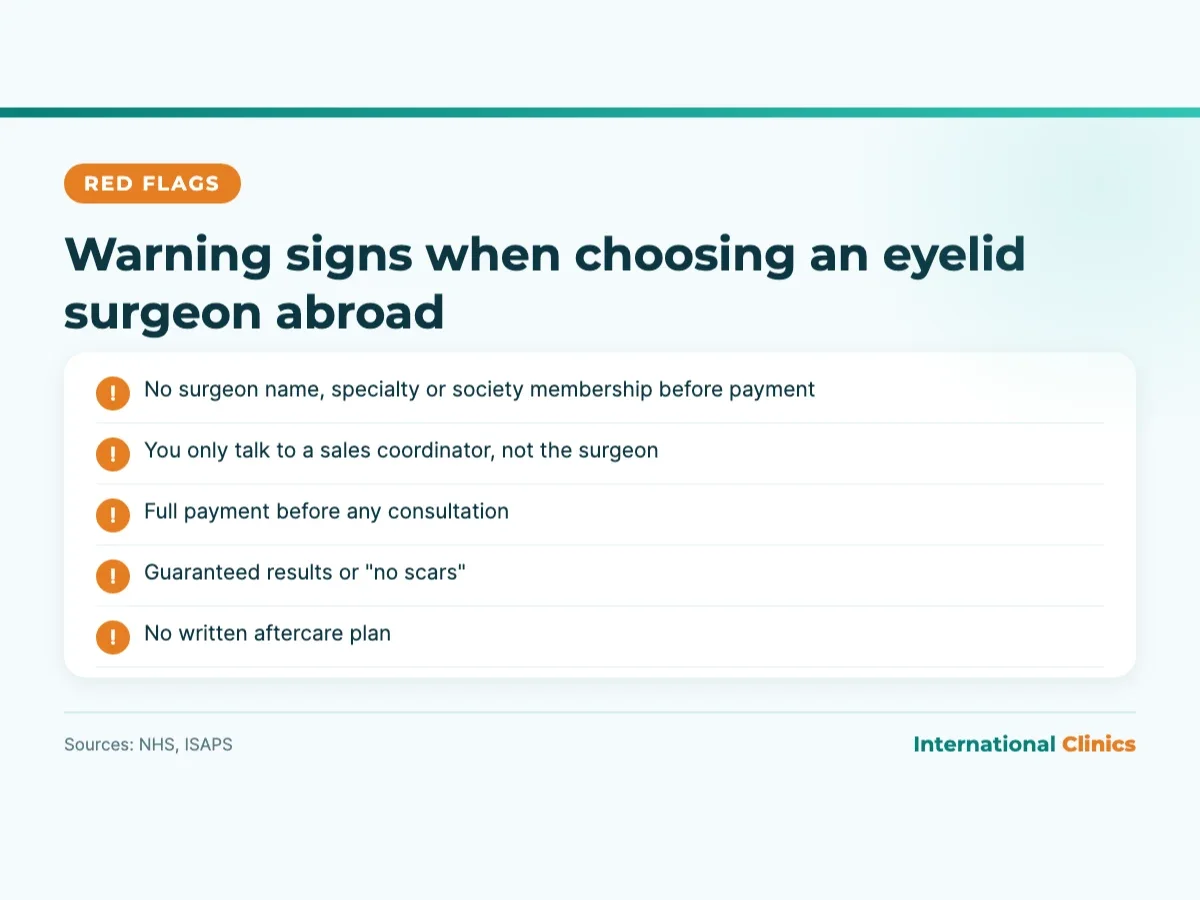
Red Flags When Choosing an Eyelid Surgeon in Turkey
Walk away, or at least ask more questions, if you notice any of the following. They come from NHS and ISAPS advice for people having cosmetic surgery abroad (Sources: NHS, NHS, ISAPS):
- You cannot find out the surgeons name, specialty or society membership before paying.
- Only a sales coordinator or travel agent speaks to you, and you meet the surgeon for the first time on the day of surgery.
- You are asked to pay in full before any consultation, or pushed by a discount that ends today.
- The surgeon and team cannot communicate with you clearly in a language you understand.
- Results or "no scars" are guaranteed, or risks are dismissed.
- There is no written aftercare plan or contact for complications after you go home (Sources: NHS, ISAPS).
Recovery Stages and Downtime Timeline
Most people take about 2 weeks off work after eyelid surgery; suture strips are usually removed within about a week, and bruising and redness may take several weeks to fade. After a brow lift, initial wound healing takes 10 to 14 days and full recovery several months (Sources: NHS, ASPS).
Day One: Cold compresses in the first days to reduce swelling, as advised by your surgeon.
First Week: Stitches or suture strips are usually removed within about a week.
Strict Rest: Avoid lifting, bending, straining and exercise in the early days.
Sleeping Position: Keep your head elevated to limit swelling.
Second Week: Most bruising and swelling settle, though some may last several weeks.
Sun Protection: Wear dark sunglasses and protect the incisions from the sun until healing is complete.
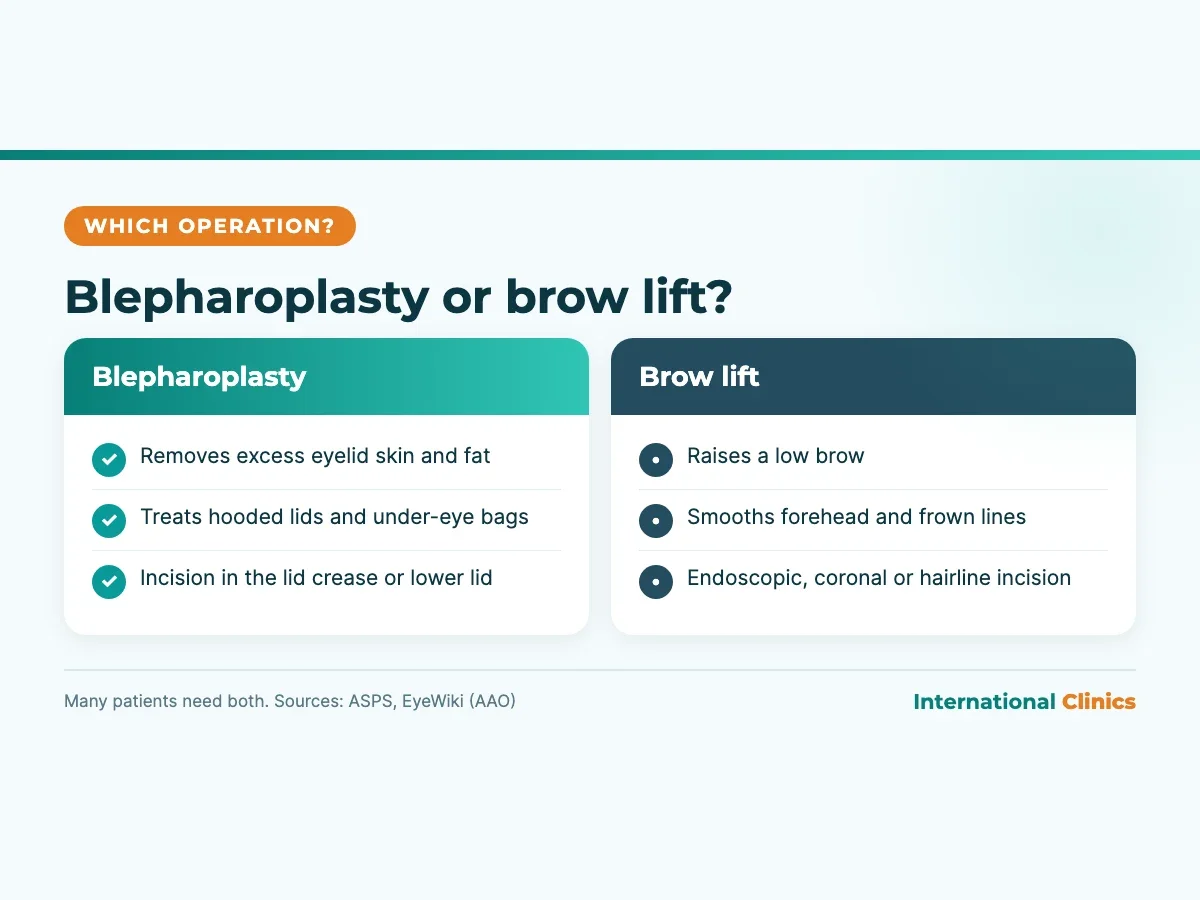
Work Return: Usually after about 2 weeks for eyelid surgery and 10 to 14 days for a brow lift, depending on your job.
Final Result: The final shape settles over several months as swelling fades and scars soften (Sources: NHS, ASPS, EyeWiki (AAO)).
For travellers, timing matters: the NHS advises avoiding flying for 7 to 10 days after facial procedures because air travel after surgery raises the risk of blood clots, so plan your stay in Istanbul around your surgeons check-up and stitch removal (Source: NHS).
Cost of Eyelid and Brow Lift Surgery in Turkey
Upper eyelid surgery (upper blepharoplasty) through International Clinics costs about $1,650–2,800 (approx. £1,250–2,100); a brow lift or a combined operation is quoted after the surgeon has assessed your photos, because the technique changes the work involved. For the full price breakdown see our guide to upper eyelid surgery cost in Turkey, and for the brow side our page on brow lift in Turkey.
Real Patient Success Stories at Our Clinics Partner Hospitals
We do not publish anonymous written testimonials that cannot be checked. Instead, here is a short video in which an International Clinics patient describes his own blepharoplasty experience in Istanbul:
One patients experience does not predict your result. Ask your surgeon for photos of patients with a starting point similar to yours, taken at least several months after surgery when the swelling has settled.
Your Treatment Journey with International Clinics
International Clinics is neither a treatment centre nor a hospital broker: it is the link between you and the right surgeon and hospital. We searched for skilled surgeons and reputable hospitals, contracted with them against strict standards of medical quality, and prepare a treatment plan for each patient. The journey usually includes:
Free Consultation: An online evaluation of your photos and medical history before you travel.
Airport Reception: Transfers between the airport, hotel and hospital.
Hotel Accommodation: A hotel near the hospital for the days of surgery and check-ups.
Personal Translator: An interpreter, so you can speak directly with the surgeon and medical staff.
Comprehensive Tests: Preoperative tests and an eye examination before surgery.
Equipped Rooms: Surgery in licensed hospitals with modern equipment.
Continuous Care: Follow-up visits in Istanbul and a contact for questions after you return home.
Ask for the name of your surgeon, the hospital and a written list of what is and is not included before you book. You can also read our complete guide to blepharoplasty in Turkey.
Expert Tips to Maintain Your Surgical Results
Follow your surgeons written instructions; these general tips match the aftercare advice of EyeWiki and the NHS (Sources: EyeWiki (AAO), NHS):
Hydrate Well: Drink enough fluids and eat well while you heal.
Elevate Head: Sleep with your head raised in the first days to limit swelling.
Avoid Sun: Wear sunglasses and protect the scars from the sun.
Skip Makeup: Do not put make-up on the incisions until your surgeon says they have healed.
Cold Compresses: Use them in the early days, as instructed.
Lubricating Drops: Use the prescribed drops or ointment for dry eyes.
Avoid Strain: No heavy lifting, bending or strenuous sport in the early recovery period.
Medical Follow-up: Do not miss any follow-up appointment, and seek help at once for loss of vision, double vision, bleeding, severe swelling or pain (Source: EyeWiki (AAO)).
Conclusion
Finding the best eyelid and brow lift surgeon in Turkey comes down to checks you can make: specialist training, society membership you can verify, regular experience with eyelid and brow surgery, an honest diagnosis of whether you need a blepharoplasty, a brow lift or both, a licensed hospital and written aftercare. Be wary of guarantees and pressure, and plan your trip around recovery rather than sightseeing (Sources: ISAPS, NHS).
Through International Clinics you can send your photos for an initial assessment by a surgeon contracted by International Clinics and receive a written plan and quote. International Clinics is a licensed company with international partners and is expanding its hospital contracts across several countries, starting with the UAE.
Medical review and disclaimer:
This article was reviewed by a specialist physician contracted with International Clinics. It is general health information, not a substitute for medical advice, and results vary between individuals.