Michael Jackson Nose: First Nose Job, Before Surgery and What He Said
Medical Summary
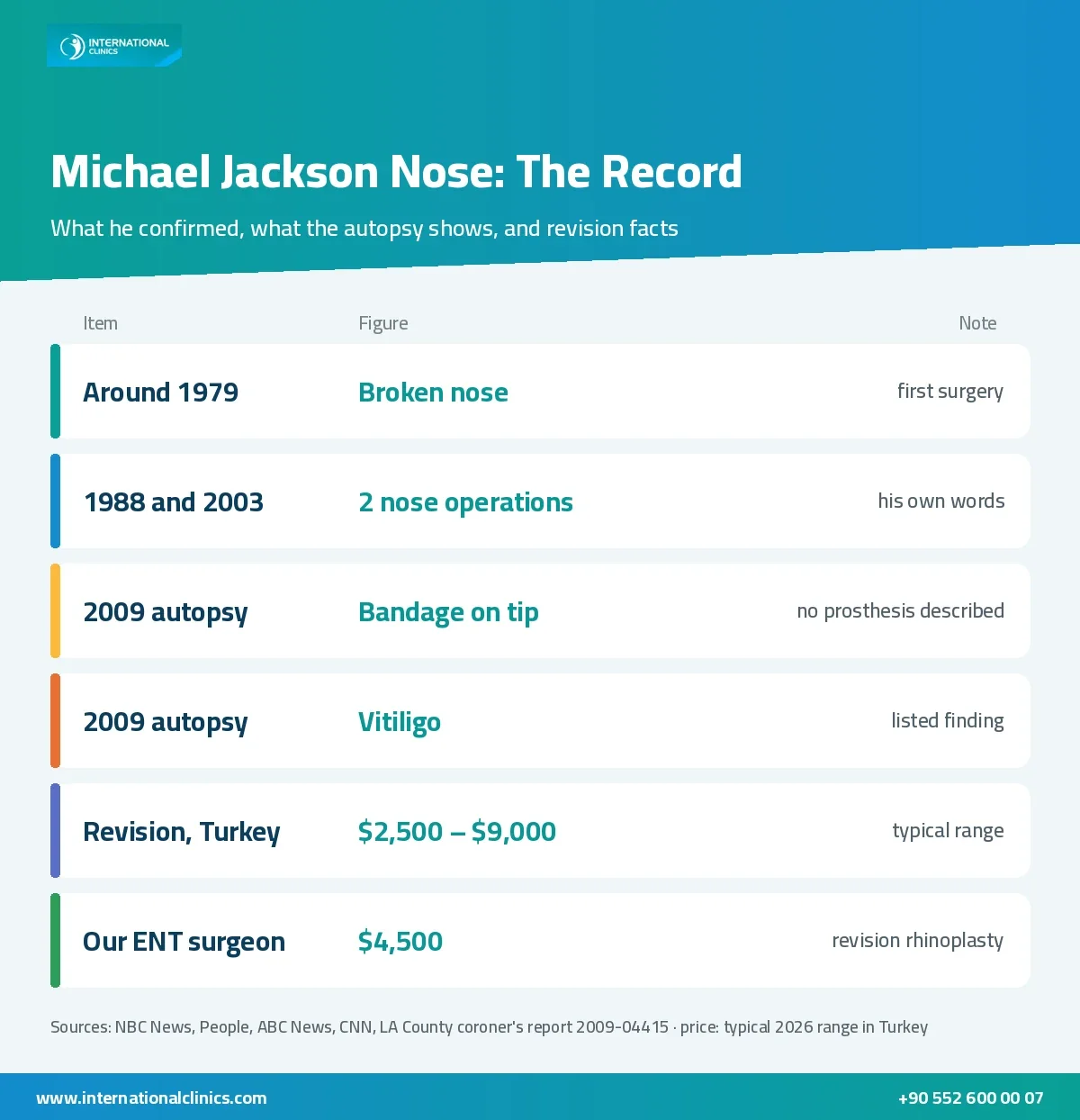
Michael Jackson’s first nose job followed a broken nose: his biographer told NBC News that he broke it in a fall on stage when he was about 19, and Jackson himself admitted to 2 nose operations, in Moonwalk (1988) and again in 2003, when he said they helped him breathe and hit higher notes.
Reports of dozens of operations and of a prosthetic nose were never confirmed; his dermatologist said in 2009 that the nose was attached and rebuilt with fillers, and the coroner’s report describes a bandage on the nose tip, small scars at both nostrils and vitiligo.
Revision rhinoplasty in Turkey typically costs $2,500 to $9,000.
Michael Jackson’s first nose job followed an injury: according to his biographer, he broke his nose in a fall on stage when he was about 19, in the late 1970s, and the first nose surgery repaired it. Before surgery his nose was wider and rounder than the narrow nose of his later career (Source: NBC News).
The Michael Jackson nose story has two layers: what he said himself and what others have claimed. Jackson said publicly that he had 2 nose operations: in his 1988 autobiography Moonwalk he wrote that he had his nose altered twice, and in a 2003 documentary he said the operations were to help him breathe and hit higher notes. His biographer said the first followed a fall on stage that broke his nose. Reports of many more procedures and of a prosthetic nose were never confirmed by him, and his 2009 autopsy report describes a bandage on the tip of his nose rather than a prosthesis (Sources: People, ABC News and LA County Coroner autopsy report).
This article separates confirmed facts (his own statements, the coroner’s report) from speculation, and uses his case only to explain what revision rhinoplasty involves. Opinions from people who never treated him are labelled as unconfirmed.
Michael Jacksons Nose Before Surgery
Before surgery, in his Jackson 5 years, Michael Jackson had a wider, rounder nose than the narrow one of his later career, and people close to him said its size was a sore point. Family friend and musician Bobby Taylor told NBC News in 2003 that young Michael’s nose was often the centre of family attention and that “Michael, he hated his nose” (Source: NBC News).
His dermatologist, Arnold Klein, gave a similar account on CNN in 2009: “people made fun -- or family members -- of the size of his nose. He was very sensitive to that.” Klein also said that, in his own opinion, there was originally not much wrong with Jackson’s nose (Source: CNN).
Michael Jacksons First Nose Job and the Broken Nose
Michael Jackson’s first nose job followed a broken nose. Biographer J. Randy Taraborrelli told NBC News that Jackson “had the first nose job as a result of falling on stage and breaking his nose when he was about 19” and that “it wasn’t for, you know, a vanity purpose. It was a medical procedure.” NBC links the first subtle changes in his face to the period of his 1979 album Off the Wall (Source: NBC News).
How old was he? About 19, according to his biographer; Jackson himself never gave a date in the sources we read, and later accounts disagree on the exact year, so the first operation is best described as late 1970s rather than a confirmed date. In Moonwalk (1988) he confirmed that his nose had been altered twice by then (Source: People).
What He Said About His Nose Surgeries
Jackson said he had 2 nose operations and denied most other facial surgery. These are the statements he made himself, as reported by the press:
Year
Where
What he said
1988
Autobiography Moonwalk
He had his nose altered twice and added a cleft to his chin, “but that is it”
1993
Interview with Oprah Winfrey
Confirmed a nose job; said he could count his procedures “on two fingers”; denied surgery on his cheekbones, eyes or lips; said he had vitiligo
2003
Documentary Living with Michael Jackson
Said he had had only 2 operations on his nose, to help him breathe more easily and hit higher notes, and denied surgery on his lips, cheeks, chin or eyes
“I’ve had my nose altered twice, and I recently added a cleft to my chin, but that is it.” — Michael Jackson, Moonwalk (1988), as quoted by People.
The 1993 statements come from his interview with Oprah Winfrey, in which TIME notes he “confessed to having a nose job” and revealed his vitiligo; the 2003 statements come from the documentary Living with Michael Jackson, as reported by ABC News (Sources: People, TIME and ABC News).
Two Admitted Surgeries vs Later Reports
How many nose jobs did Michael Jackson have? The confirmed number is the one he gave: 2 nose operations. Everything above that number comes from reports and outside opinions, not from him or his medical records:
In 2003 a Beverly Hills plastic surgeon who, NBC News noted, had never treated Jackson gave his opinion that the total number of facial procedures was “well over 50”. This is his estimate (Source: NBC News).
The same year, a nasal specialist who had never examined him in person told ABC News, after looking at photographs, that she believed something had gone wrong inside his nose. This is unconfirmed (Source: ABC News).
Online summaries and forums still repeat estimates of “ten or more” or “dozens” of procedures; none of them cites a medical record.
None of these is a medical record. The honest answer is that he admitted 2, and any higher number is an estimate.
Why Did Michael Jackson Change His Nose?
Why did Michael Jackson change his nose? The reasons on the record fall into two groups: an injury and breathing, in his own and his biographer’s words, and sensitivity about its size, in other people’s words.
Medical, in his own words: a broken nose after a fall (his biographer’s account), then breathing. In 2003 he said the operations were to help him breathe more easily so he could hit higher notes (Sources: NBC News and ABC News).
Personal, in other people’s words: a family friend and his dermatologist described remarks about the size of his nose when he was young, and said he was sensitive about it (Sources: NBC News and CNN).
Some commentators have gone further and offered psychological explanations. We do not repeat them here: no one diagnosed him publicly, and guessing at a person’s mental health from photos is not evidence.
Prosthetic Nose and Nose Collapse: What the Record Shows
There is no confirmed evidence that Michael Jackson wore a prosthetic nose, although it is the most persistent rumour. The people who actually treated or examined him said something different:
His dermatologist, 2009: Arnold Klein told CNN that “contrary to what people said, he could not take off his nose. His nose was attached.” He said the nose had become “far too thin”, that “there was a total collapse of the cartilage”, and that he had rebuilt it with hyaluronic acid fillers to make it look normal again and to “regain the breathing, you know, passages of his nose” (Source: CNN).
Photos in court, November 2002: ABC News reported that at a California court appearance his nose was covered by a small transparent bandage; the reason was not explained by him (Source: ABC News).
His ex-wife, 2013: testifying at a civil trial, Debbie Rowe said Jackson complained of painful scars in his nose, and that on two occasions a plastic surgeon he consulted only put tape on him, because the surgeon said he could not find the scars Jackson thought were there. This is her testimony, not a medical record (Source: CNN).
Did Michael Jackson’s nose fall off?
No source shows that it did. The “nose fell off” story usually traces back to the prosthetic rumour, and the best-known interview on the subject is Klein’s 2009 CNN interview, in which he said the opposite: the nose was attached and could not be taken off (Source: CNN).
A real nasal prosthesis is something different: a removable artificial nose made for people who have lost all or part of the nose, most often after surgery for cancer and, less often, after trauma. It is usually held on with adhesive or anchored to implants (Source: Archives of Plastic Surgery, 2022).
What “nose collapse” means medically
Nothing in the public record says what caused the collapse Klein described. Medically, a collapsed nasal bridge is called a saddle nose deformity: the middle of the nose sags because its support has broken down. Causes include nasal trauma, previous nasal surgery and cocaine use, and surgeons rebuild it with cartilage grafts from the septum, ear or rib; fillers can only correct mild cases, temporarily, and cannot fix breathing problems (Source: Cleveland Clinic).
Filler “rebuilding” of the kind Klein described is known today as a non-surgical nose job (nonsurgical rhinoplasty). It usually uses hyaluronic acid, typically lasts up to about six months, cannot make a nose smaller or narrower, and carries rare but serious risks, including vascular complications, tissue necrosis and vision loss (Source: Cleveland Clinic).
What the Autopsy Report Says About His Nose
The autopsy report describes unobstructed nasal passages, a bandage on the tip of the nose and small scars at both nostrils, and no nasal prosthesis. The Los Angeles County coroner’s autopsy report (case 2009-04415) is the public medical record of his body at death. On his nose, it records that “the oronasal passages are unobstructed” and that “a bandage is present on the tip of the nose” (the investigator at the hospital noted “a small piece of gauze” there), and it lists small scars at the outer edge of each nostril (the alae nasi), 3/5 inch on the right and 5/8 inch on the left (Source: LA County Coroner autopsy report).
The report does not describe a nasal prosthesis anywhere: the only prostheses it lists are two implanted dental prostheses. It also does not say what caused the nostril scars. An anesthesiologist who reviewed the report for the Associated Press said several of the scars it lists appeared to be from plastic surgery or a medical procedure, which is his reading, not a finding of the report (Sources: LA County Coroner autopsy report and AP).
Vitiligo, Not Surgery, Changed His Skin
His lighter skin is a separate story from his nose: it was caused by vitiligo, a diagnosis confirmed at autopsy. In his 1993 interview with Oprah Winfrey, Jackson said he had vitiligo (Source: TIME).
The coroner’s report lists “Vitiligo” among its findings, describing focal depigmentation of the skin, particularly over the chest, abdomen, face and arms. At a 2013 trial, the doctor who performed the autopsy confirmed that he had “vitiligo, a skin pigmentation disease”, so that “some areas of the skin appear light and others appear dark” (Sources: LA County Coroner autopsy report and CNN).
The U.S. National Institute of Arthritis and Musculoskeletal and Skin Diseases describes it simply:
“Vitiligo is a chronic (long-lasting) autoimmune disorder that causes patches of skin to lose pigment or color.” — NIAMS, National Institutes of Health.
In vitiligo the immune system destroys melanocytes, the cells that make skin pigment. It affects over 1% of people worldwide and is not contagious, and when it is widespread some patients choose depigmentation therapy, which lightens the remaining pigmented skin to match the white patches (Sources: Cleveland Clinic and NIAMS).
Klein said on CNN in 2009 that Jackson’s vitiligo had been confirmed by biopsy, that he “began to get a totally speckled look over his body”, and that they used creams to even out his colour and destroy the remaining pigment cells (Source: CNN).
Michael Jackson Nose Before and After: A Sourced Timeline
In short: a wider nose before surgery, a first nose job in the late 1970s after a broken nose, a second operation by 1988, and a much narrower nose in later years, with everything beyond his 2 admitted nose jobs unconfirmed.
Year
Event
Status
Late 1970s (about age 19)
Broke his nose in a fall on stage; first nose surgery
His biographer’s account (NBC News)
1988
Moonwalk: nose altered twice, cleft added to chin
His own words
1993
Oprah interview: confirmed a nose job; said he had vitiligo
His own words
2002
Small bandage on his nose at a November court appearance (ABC News)
Photographed; reason not explained
2003
Said he had 2 nose operations, for breathing and singing (ABC News, NBC News)
His own words
2009
Dermatologist: cartilage had collapsed, nose rebuilt with fillers
His dermatologist’s account (CNN)
2009
Autopsy: bandage on nose tip, scars at both nostrils, vitiligo
Coroner’s report
Various
“Dozens” of nose jobs, prosthetic nose, nose “falling off”
Unconfirmed reports
What His Case Shows About Revision Rhinoplasty
A nose operated on more than once is a recognised surgical situation, and the American Society of Plastic Surgeons defines it plainly:
“Revision rhinoplasty applies to any patient who has previously undergone rhinoplasty one or more times and desires improvement in the appearance and often the function of the nose.” — American Society of Plastic Surgeons.
What medical sources say about it:
It is harder than a first operation. ASPS notes that revision rhinoplasty has a higher revision rate than primary rhinoplasty (Source: ASPS).
Revisions are not rare. Cleveland Clinic says about 15% of people need a follow-up (revision) surgery to make small changes after their first rhinoplasty (Source: Cleveland Clinic).
Support material may be missing. Because septal cartilage is often deficient after earlier surgery, surgeons often take cartilage from the ear (see rhinoplasty with ear cartilage) and occasionally the rib, and narrowed internal valves may need cartilage “spreader grafts” (see internal nasal valve and septum surgery) (Source: ASPS).
Waiting matters. It can take up to a year to recover fully from rhinoplasty, about 90% of the swelling settles by three months, and the full result is not visible until the swelling has gone, so a revision is planned only after the nose has healed completely (for what each stage looks like, see rhinoplasty recovery photos day by day) (Source: Cleveland Clinic).
Breathing comes first. The NHS lists permanent breathing difficulty and damage to the cartilage wall between the nostrils among the occasional risks of nose reshaping, which is why revision surgery usually aims to rebuild support, not to make the nose smaller still (Source: NHS).
Revision rhinoplasty in Turkey typically costs $2,500 to $9,000 (typical published prices in Turkey in 2026), with most packages between $3,000 and $8,000 depending on how complex the case is. Prices are usually higher than for a first operation because the surgery is more complex and often needs cartilage grafts.
Item
Typical cost
Revision rhinoplasty in Turkey
$2,500 – $9,000
Most packages
$3,000 – $8,000
Revision rhinoplasty, listed by our ENT surgeon in Istanbul
Video from the International Clinics YouTube channel: a patient’s rhinoplasty in Turkey and her feedback.
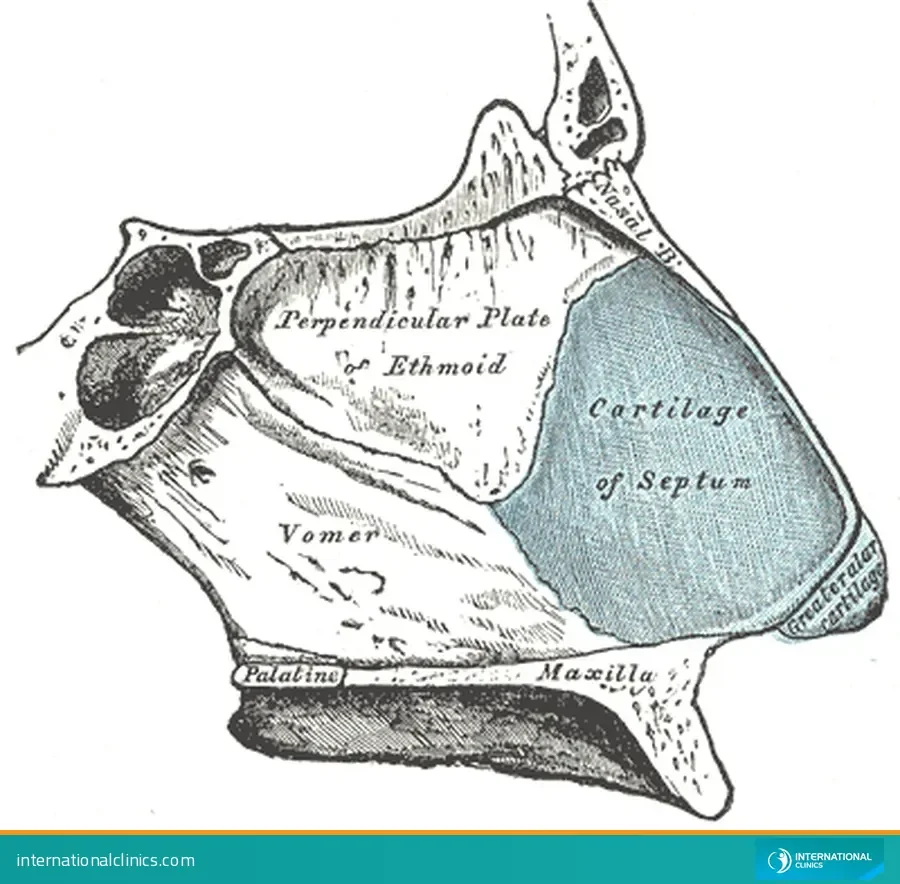
Featured image background: Michael Jackson’s star on the Hollywood Walk of Fame by Alexis Doine, CC0, via Wikimedia Commons. Interior illustration: Gray’s Anatomy (Henry Vandyke Carter), public domain, via Wikimedia Commons.
Medical review and disclaimer:
This article was reviewed by a specialist physician contracted with International Clinics. It is general health information, not a substitute for medical advice, and results vary between individuals.
According to his biographer J. Randy Taraborrelli, his first nose surgery followed a fall on stage that broke his nose when he was about 19, and it was a medical procedure rather than a vanity operation. Jackson himself said in 2003 that his 2 nose operations were to help him breathe more easily so he could hit higher notes.
How many nose surgeries did MJ have?
Michael Jackson said he had 2 nose surgeries: he wrote in Moonwalk (1988) that he had his nose altered twice and repeated the figure in the 2003 documentary Living with Michael Jackson. Higher numbers are estimates from people who never treated him, such as a Beverly Hills surgeon who told NBC News in 2003 that he believed the total of facial procedures was well over 50, and they have never been confirmed.
Why did Michael Jackson's nose cartilage collapse?
The cause in his case was never documented publicly. His dermatologist, Arnold Klein, said in 2009 that there was a total collapse of the cartilage and that the nose had become far too thin. Medically, a collapsed nasal bridge (saddle nose) can follow nasal trauma, previous nasal surgery or cocaine use, and revision surgery often needs cartilage grafts from the ear or rib because septal cartilage is often deficient.
Why did Michael Jackson wear tape on his nose?
He did not explain it publicly in the sources we read. A small transparent bandage was seen on his nose at a court appearance in November 2002, and the 2009 coroner's report notes a bandage on the tip of his nose. His ex-wife Debbie Rowe testified in 2013 that he complained of painful scars in his nose and that a surgeon he consulted twice only put tape on him. Guesses by doctors who never examined him remain unconfirmed.
When did MJ break his nose?
In the late 1970s, when he was about 19. His biographer J. Randy Taraborrelli told NBC News that Jackson broke his nose in a fall on stage at that age and that his first nose job was a medical procedure to repair it. Jackson did not give an exact date himself, and later accounts differ on the year.
Did Michael Jackson have his nose reconstructed?
His dermatologist said so. Arnold Klein told CNN in 2009 that he rebuilt Jackson's nose with hyaluronic acid fillers because it had become far too thin and its cartilage had collapsed, to make it look normal again and restore the breathing passages, and that the nose was attached, not removable.
Why did Michael Jackson have a prosthetic nose?
There is no confirmed evidence that he had one. His dermatologist said in 2009 that his nose was attached and could not be taken off, and the coroner's autopsy report describes unobstructed nasal passages, a bandage on the tip of the nose and small scars at both nostrils; the only prostheses it lists are dental implants. Real nasal prostheses are mainly made for people who lost the nose to cancer surgery or trauma.
How risky is a revision rhinoplasty?
Revision rhinoplasty is more complex than a first operation. ASPS notes it has a higher revision rate than primary rhinoplasty and that surgeons often need cartilage from the ear or rib because septal cartilage is often deficient. The NHS lists permanent breathing difficulty and damage to the septum among the occasional risks of nose surgery, and Cleveland Clinic says full recovery from rhinoplasty can take up to a year.
What did Michael Jackson's nose look like before surgery?
In his Jackson 5 years his nose was wider and rounder than the narrow nose of his later career. A family friend told NBC News that young Michael hated his nose, and his dermatologist said people, including family members, made fun of its size and that he was very sensitive to it.
Did Michael Jackson have vitiligo?
Yes. Jackson said so in his 1993 interview with Oprah Winfrey, and the Los Angeles County coroner's autopsy report lists vitiligo, with depigmented skin particularly over the chest, abdomen, face and arms. Vitiligo is a chronic autoimmune condition in which the immune system destroys the cells that make skin pigment; it is not contagious.
×
Get a Free Consultation
Our commitments to you
Reliable care at accredited, contracted institutions
A clear price agreed before you travel, with no hidden costs
Full medical support with professional interpreters
Clear treatment plans and follow-up to international standards
Personal assistance throughout your treatment journey
Complete confidentiality for all your medical information