- Boob Job Cost Turkey: 2026 Price at a Glance
- How Much Is a Boob Job in Turkey in Pounds?
- Boob Job Turkey Price by Implant Type and Technique
- Prices listed by our plastic surgeon in Istanbul
- What Is Included in a Boob Job Package in Turkey?
- What is usually not included
- Boob Job Cost UK vs Turkey
- Hidden and Long-Term Costs of Breast Implants
- Implant replacement and follow-up surgery
- Travel insurance, time off work and flights home
- Breast Implant Safety: What the FDA and ASPS Say
- Common complications
- BIA-ALCL: a rare lymphoma linked to implants
- Breast implant illness (BII)
- What Makes the Price Go Up or Down?
- Is a Cheaper Boob Job in Turkey Worth It?
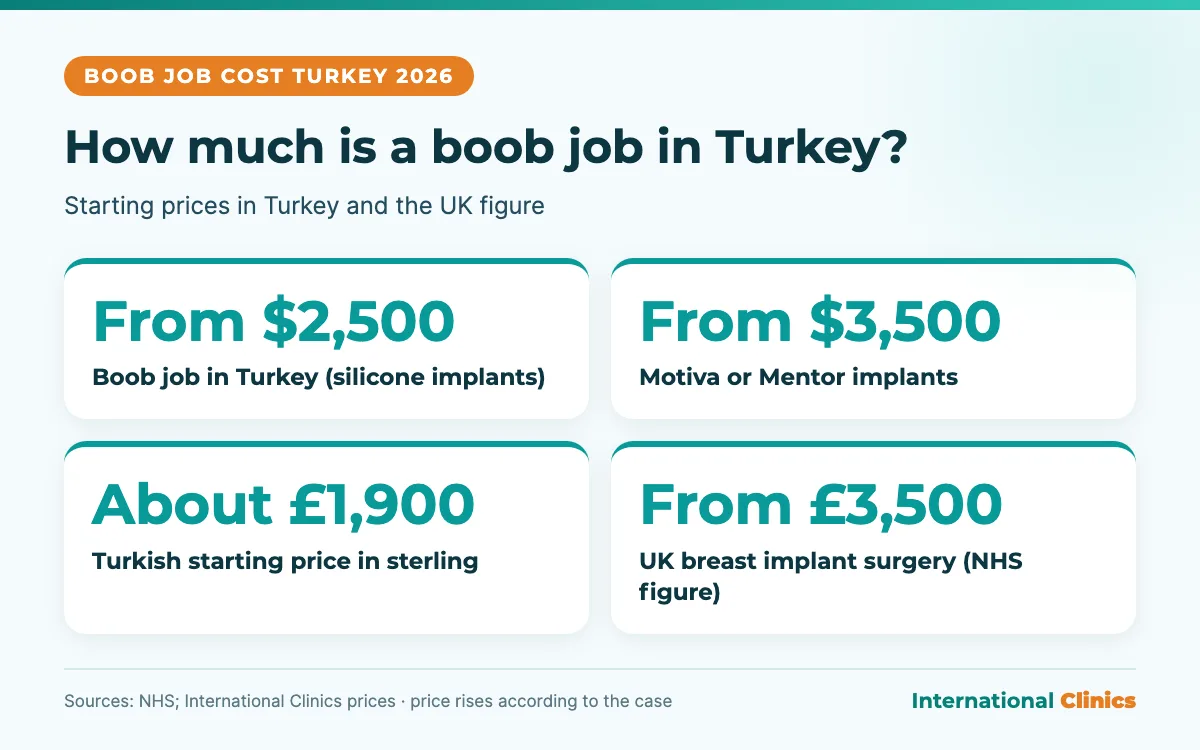
How much is a boob job in Turkey? Typical published prices for breast augmentation in Turkey in 2026 run from $2,500 (roughly £1,900), and at International Clinics a boob job starts from $2,500 with silicone implants and from $3,500 with Motiva or Mentor implants. The price depends mainly on the implant brand, the surgeon and what the all-inclusive package covers.
The boob job cost in Turkey is typically From $2,500 (about £1,900) in 2026, usually as an all-inclusive package covering the surgery, implants, hospital stay, hotel and transfers. In the UK, the NHS puts breast implant surgery at around £3,500 to £8,000, and that figure does not usually include consultations or follow-up care. The final boob job cost in Turkey depends mainly on the implant type, the surgeon and how many nights the package covers (Source: NHS).
Boob Job Cost Turkey: 2026 Price at a Glance
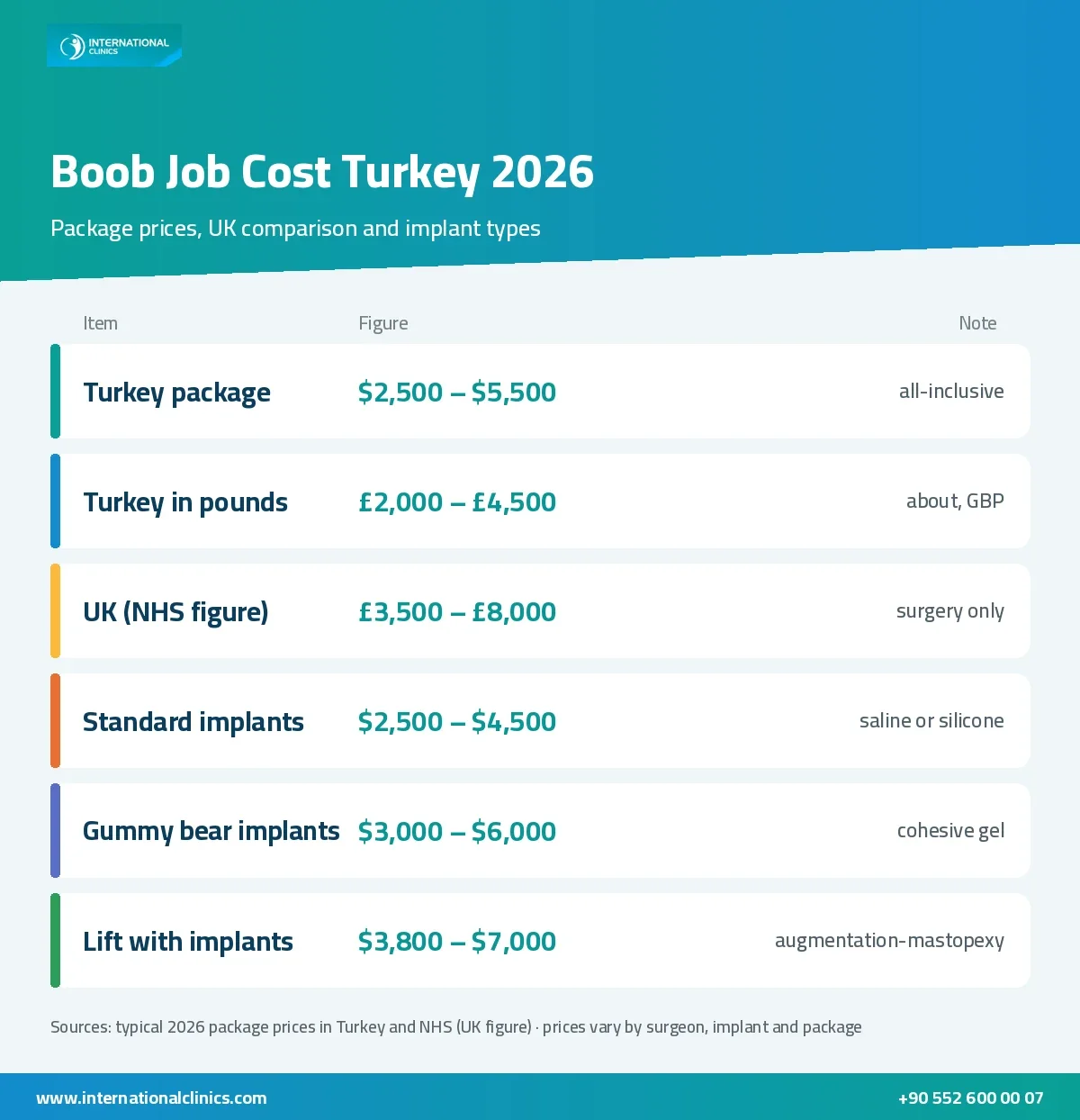
A breast augmentation package in Turkey usually costs less than surgery alone in the UK. The table below summarises typical 2026 prices in Turkey, the prices listed by our Istanbul plastic surgeon, and the UK figure for comparison. Prices are in US dollars unless shown in pounds; pound figures use a rate of about $1.33 to £1.
| Item | Typical cost |
|---|---|
| Boob job package in Turkey (USD) | From $2,500 (typical published prices, 2026) |
| Boob job package in Turkey (GBP) | About about £1,900 |
| Breast implant surgery in the UK (NHS figure) | £3,500 – £8,000, usually excluding consultations and follow-up |
| Standard implants (saline or silicone), Turkey | From $2,500 with silicone implants at International Clinics |
| Gummy bear implants (cohesive gel), Turkey | Usually towards the top of the range; ask which brand and gel the quote includes |
| Fat transfer breast augmentation (no implants), Turkey | From $2,000 |
| Breast lift with implants (augmentation-mastopexy), Turkey | A lift starts from $3,500 and implants from $2,500; the combined price depends on the case |
How Much Is a Boob Job in Turkey in Pounds?
In pounds, a boob job in Turkey costs about £1,900, which is the sterling equivalent of the package price starting from $2,500 at about $1.33 to the pound. At International Clinics the $2,500 starting price is roughly £1,900. Many Turkish hospitals quote in US dollars or euros, so the amount you pay in pounds moves with the exchange rate between your quote and your payment date. Ask for the final price in writing, in the currency you will pay in, before you send a deposit.
Boob Job Turkey Price by Implant Type and Technique
The technique and the implant are the biggest single drivers of the price. How the main options compare in Turkey:
- Standard implants (saline or silicone): within the package price starting from $2,500; at International Clinics from $2,500 with silicone implants and from $3,500 with Motiva or Mentor implants.
- Gummy bear implants (high-strength cohesive gel): form-stable silicone implants, usually quoted towards the top of the range; the brand decides the price (Source: ASPS).
- Fat transfer breast augmentation (no implants): prices start from $2,000, because liposuction is part of the operation.
- Breast lift with implants (augmentation-mastopexy): a lift starts from $3,500 and implants from $2,500; the combined price depends on the case, because 2 procedures are combined.
Premium teardrop (anatomical) implants often cost more than basic round implants. The NHS notes that silicone implants are the most common type used in the UK, while saline implants are more likely to fold, rupture or go down over time (Source: NHS).
In the United States, saline implants are FDA-approved for breast augmentation from age 18 and silicone implants from age 22. A leaking saline implant deflates and the body absorbs the salt water, while a leaking silicone implant does not collapse, which is why silicone implants need imaging checks (Source: ASPS).
For cohesive gel implants, see gummy bear implants; for the implant-free option, see fat transfer breast augmentation cost.
Prices listed by our plastic surgeon in Istanbul
As a real example inside these ranges, the profile of Asst. Prof. Ahmet Aydın, a plastic, reconstructive and aesthetic surgeon in Istanbul, lists these procedure prices:
| Procedure (listed price) | Price |
|---|---|
| Breast augmentation with silicone implants | From $2,500 |
| Breast augmentation with Motiva or Mentor implants | From $3,500 |
| Breast lift with implants | Depends on the case |
| Breast implant removal | $3,200 |
The difference between the 2 implant brands, $800 for the same operation, shows how much the implant choice alone can move the final quote.
What Is Included in a Boob Job Package in Turkey?
An all-inclusive boob job package in Turkey usually covers the operation, the implants, 1 to 2 hospital nights, a recovery hotel and transfers, but not flights. Unlike UK prices, which usually quote the surgery alone, most Turkish hospitals sell breast augmentation as one package. A standard all-inclusive package covers:
- Medical fees: the surgeons fee, anaesthetist, operating theatre and pre-operative blood tests.
- Implants: FDA-approved or CE-marked brands.
- Hospital stay: typically 1 to 2 nights.
- Accommodation: 4 to 6 nights in a recovery hotel.
- Transfers: airport, hotel and hospital transport.
- Post-operative essentials: initial pain medicines, medical garments and a compression support bra.
What is usually not included
Flights are almost never included and must be booked separately. Ask in writing who pays for extra hotel nights, a companions stay, follow-up scans and any corrective surgery, and whether the hospital or surgeon carries insurance that covers you. The NHS also advises asking in advance what happens if complications arise, where follow-up appointments will take place and what it would cost to return for more surgery (Source: NHS).
Boob Job Cost UK vs Turkey
A boob job in Turkey usually costs less than in the UK, and the Turkish price is normally a package while the UK figure usually covers the surgery and hospital only.
| Factor | Turkey | UK |
|---|---|---|
| Typical price | From $2,500 (about £1,900), package | £3,500 – £8,000, usually excluding consultations and follow-up |
| What the price covers | Surgery, implants, hospital, hotel and transfers | Surgery and hospital; consultations and aftercare often extra |
| Extra costs | Flights, extra nights, travel to and from check-ups | Follow-up surgery you may need in the future |
| On the NHS | — | Not usually, except in some circumstances such as very uneven or absent breasts |
The NHS also points out that youll have to pay for any follow-up surgery you may need in the future, so compare the full cost over the life of your implants, not just the headline price (Source: NHS).
Hidden and Long-Term Costs of Breast Implants
The main long-term costs of breast implants are future replacement or removal surgery and, for silicone implants, imaging scans to check for silent rupture.
Implant replacement and follow-up surgery
Breast implants do not last a lifetime. The NHS says some women may need further surgery after about 10 years, either because of problems with the implants or because their breasts have changed (Source: NHS).
The US Food and Drug Administration (FDA) is direct about what this means for your budget:
"You should assume that you will need to have additional surgeries (reoperations) because breast implants are not lifetime devices and complications can occur."
— U.S. Food and Drug Administration, Things to consider before getting breast implants.
The FDA adds that people with silicone gel implants may be advised to have regular MRI or ultrasound scans to check for rupture, which may not be covered by insurance (Source: FDA).
For silicone implants, the FDA recommendation reported by the American Society of Plastic Surgeons is a first MRI or ultrasound scan five to six years after surgery and then every two to three years, even without symptoms (Source: ASPS).
Removal on its own is a separate operation, listed at $3,200 by our surgeon; see breast implant removal.
Travel insurance, time off work and flights home
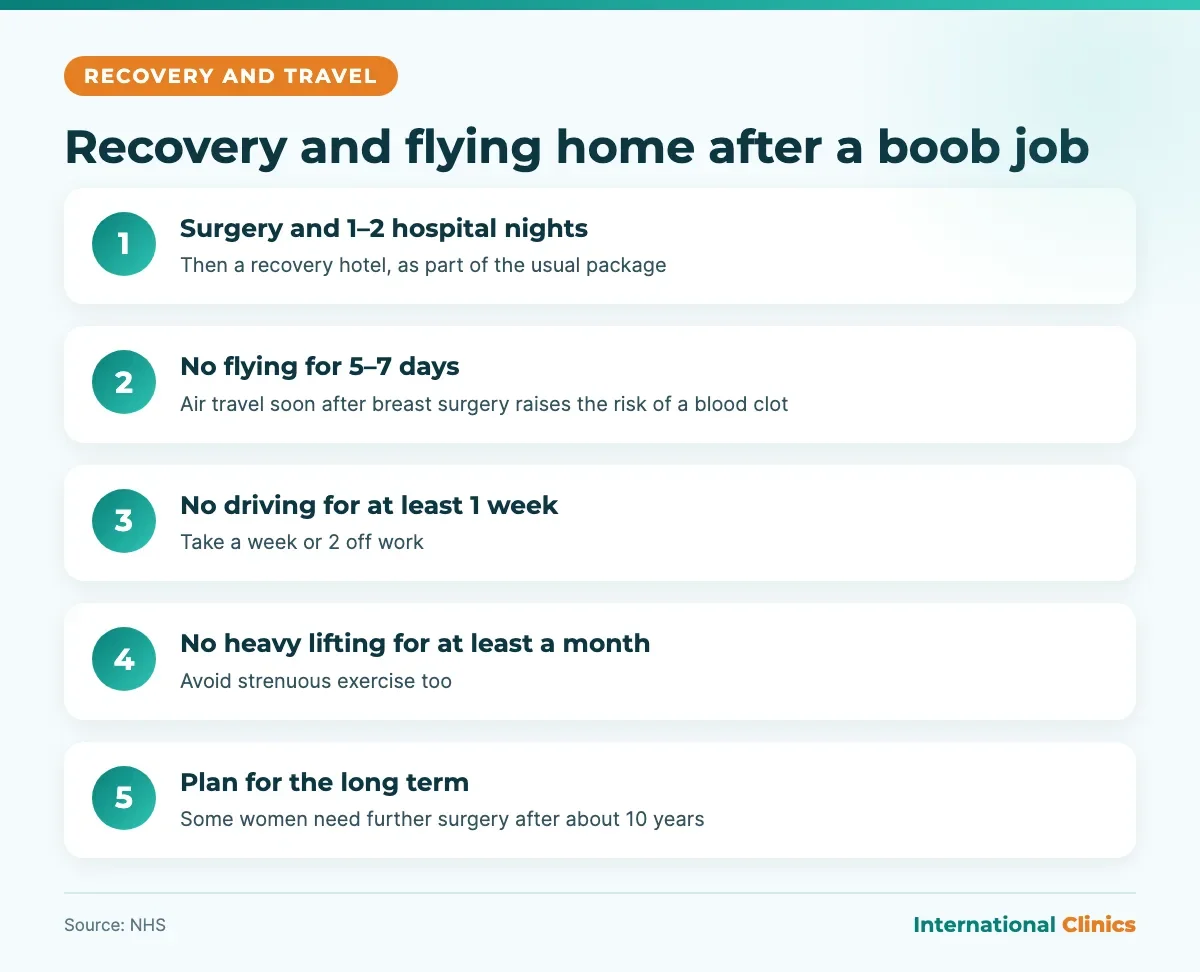
Plan for about a week in Turkey and one to two weeks off work in total, and check that your insurance covers complications.
- Travel insurance: the NHS warns that travel insurance does not normally cover things going wrong in surgery, so check what the hospitals or surgeons insurance covers (Source: NHS).
- Time off work: the NHS advises taking a week or 2 off work, not driving for at least 1 week and avoiding heavy lifting or strenuous exercise for at least a month (Source: NHS).
- Flying home: the NHS recommends not flying for 5 to 7 days after breast surgery, so your hotel nights need to cover that period (Source: NHS).
Swelling settles gradually over the first weeks; see breast augmentation swelling day by day for what to expect once you are home.
Breast Implant Safety: What the FDA and ASPS Say
Breast implants are approved medical devices, but they are not lifetime devices, and every patient should know the main risks before paying for a boob job in Turkey or anywhere else (Source: FDA).
Common complications
The FDA lists capsular contracture (hardening of the breast as scar tissue tightens around the implant), rupture and implant malposition among the local complications that occur in at least 1 percent of patients, and some of them need a further operation (Source: FDA).
- Bleeding, haematoma, fluid collection (seroma) and infection.
- Changes in nipple or breast sensation and persistent pain.
- Implant leakage or rupture, wrinkling of the skin over the implant and a wrong implant position.
- Poor scarring and the possibility of revision surgery (Source: ASPS).
The NHS adds rippling, creasing and rotation of the implant, and a possible reduction in breast milk when breastfeeding (Source: NHS).
BIA-ALCL: a rare lymphoma linked to implants
Breast implant-associated anaplastic large cell lymphoma (BIA-ALCL) is not breast cancer: it is a T-cell lymphoma that can develop in the breast or the scar tissue (capsule) around an implant, and treatment involves removing the implant and the capsule (Sources: FDA and FDA).
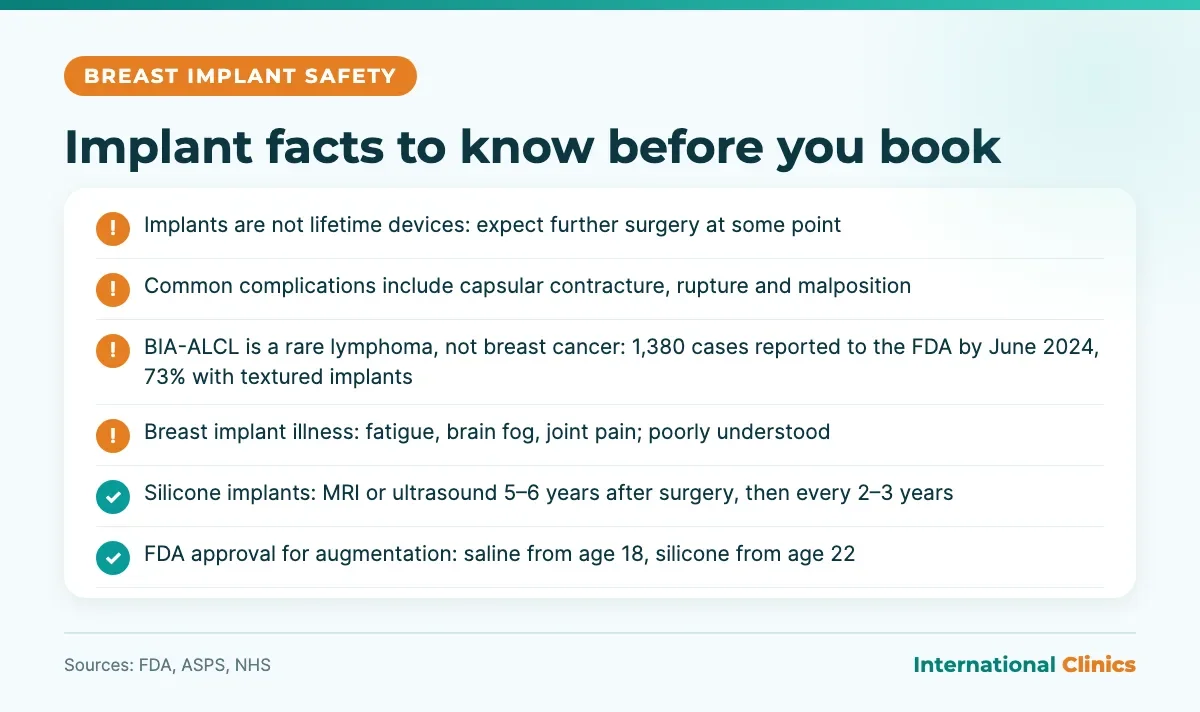
By 30 June 2024 the FDA had received reports of 1,380 BIA-ALCL cases and 64 deaths worldwide. Textured implants were involved in 1,010 of the cases (73%), the median time from the implant to diagnosis was 8 years, and the most common sign was a fluid collection (seroma) causing swelling. These reports cannot show how common the disease is, because not every case is reported (Source: FDA).
Persistent swelling, pain or a lump around an implant, even years later, should be checked by a doctor. The American Society of Plastic Surgeons also lists breast implant-associated squamous cell carcinoma and other very rare cancers in the capsule among the risks (Sources: FDA and ASPS).
Breast implant illness (BII)
Some people with implants report symptoms such as fatigue, memory problems, "brain fog", rash and joint or muscle pain, often called breast implant illness. These symptoms are poorly understood and may not meet the criteria for a specific disease; in some reported cases they improved after the implants were removed without replacement (Sources: FDA, FDA and ASPS).
Before surgery, US patients review and sign an FDA patient decision checklist with the implanting surgeon. Ask your surgeon in Turkey to go through the same risks with you, including the implant brand and surface (smooth or textured) you will receive (Source: FDA).
What Makes the Price Go Up or Down?
The implant brand, the surgeon, the hospital and any combined procedures make the biggest difference to the final price. Our guide to breast augmentation in Turkey explains the procedure, implant choices and recovery in detail.
- Implant brand and shape: premium teardrop (anatomical) implants usually cost more than round silicone or saline implants.
- Surgeon experience: high-volume plastic surgeons with international certification charge higher fees.
- City and hospital: prices differ between Istanbul, Izmir and Antalya and between hospitals, so compare written quotes for the same implant brand.
- Combined procedures: adding a lift, liposuction or a mummy makeover in Turkey raises the total but costs less than separate trips; see also breast lift in Turkey.
Is a Cheaper Boob Job in Turkey Worth It?
A lower price can be worth it only if the safety checks are the same as you would expect at home. The NHS says cosmetic surgery abroad can cost less than in the UK, but you need to weigh the potential savings against the potential risks (Source: NHS).
Before paying a deposit:
- Have a consultation with the surgeon who will operate, not only with a sales coordinator.
- Check the surgeons training, the organisations they belong to and how many breast augmentations they have done.
- Choose a JCI-accredited hospital and a surgeon registered with the Turkish Society of Plastic, Reconstructive and Aesthetic Surgeons.
- Find out what happens, and who pays, if there are complications after you return to the UK.
For other operations and how to choose a hospital, see our guide to plastic surgery in Turkey.
For what the weeks after surgery look like, read breast augmentation recovery; if sagging is the main concern, compare how much a breast lift costs.
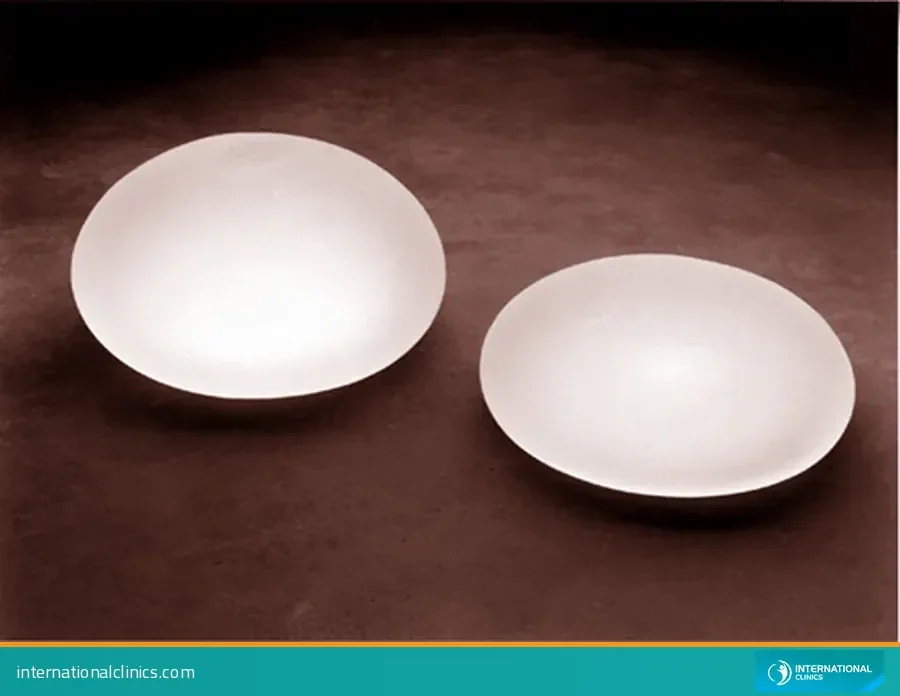
Implant photo: U.S. Food and Drug Administration, public domain, via Wikimedia Commons. Featured image background: Istanbul panorama from Galata Tower by Ilya saffarian Tousi, CC0, via Wikimedia Commons.
Medical review and disclaimer:
This article was reviewed by a specialist physician contracted with International Clinics. It is general health information, not a substitute for medical advice, and results vary between individuals.