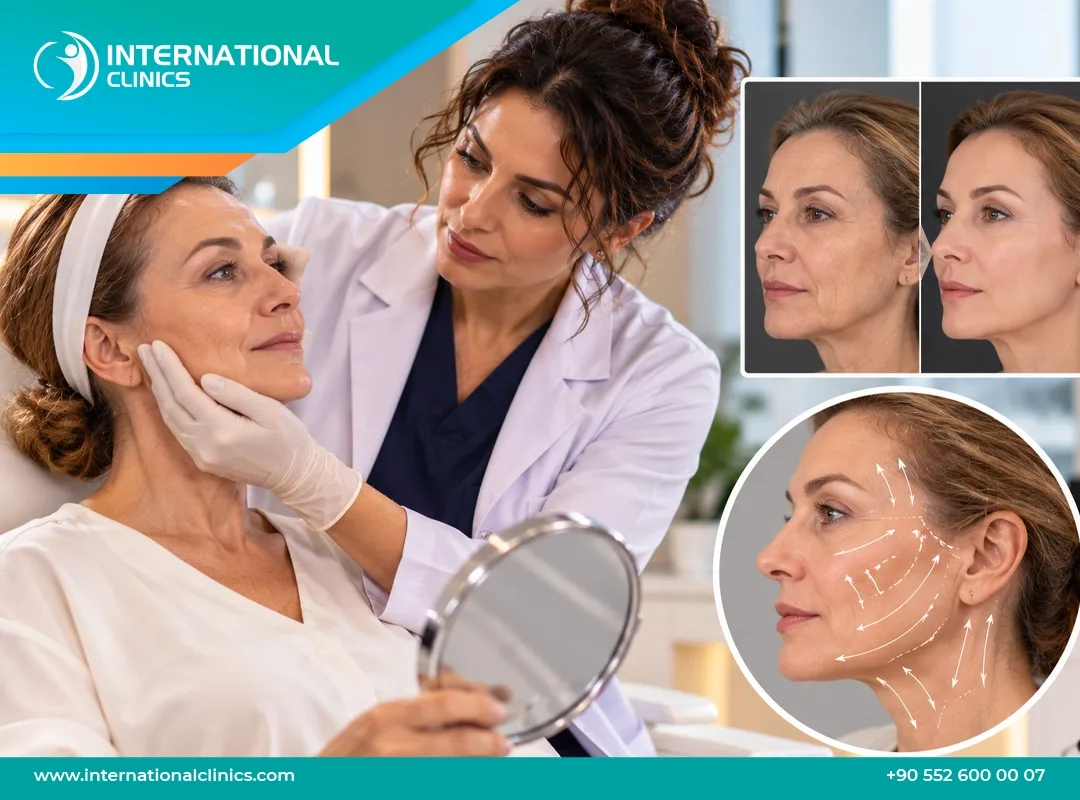
- What Is a Facelift?
- Types of Facelift
- Who Is a Good Candidate for a Facelift?
- Facelift by age
- Facelift vs Non-Surgical Options
- How to Choose the Right Type of Facelift
- How Is a Facelift Done?
- Recovery After a Facelift
- Facelift Scars and How Long Results Last
- How to lower the risks
- Risks of a Facelift
- Why Have a Facelift in Turkey?
- How Much Does a Facelift Cost in Turkey?
- What Is Included in a Facelift Package in Turkey?
- Facelift With Other Procedures
- Final Thoughts
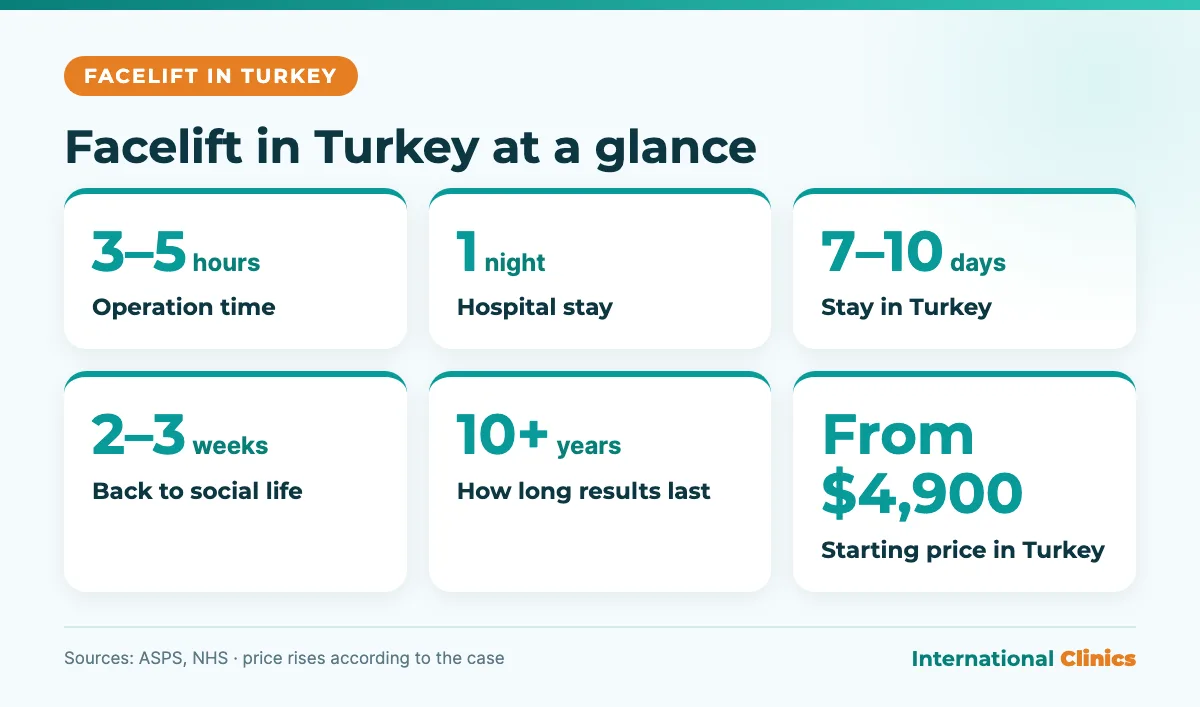
A facelift in Turkey (rhytidectomy) starts from $4,900, or from $6,900 with a neck lift, and the price rises according to the case and the technique, such as an SMAS or deep plane facelift. It is done in accredited hospitals in Istanbul by experienced plastic surgeons, usually as a package that includes the operation, one night in hospital, tests, hotel and transfers. Most patients stay in Turkey for 7–10 days and return to social life after about 2–3 weeks, with results that typically last 10 years or more.
This guide explains what a facelift does, the main techniques, who is a good candidate, how the operation and recovery work, the risks, and what a facelift costs in Turkey compared with the UK and USA.
What Is a Facelift?
A facelift is an operation that lifts and tightens the sagging tissues of the lower face and neck. Through incisions hidden around the ears and in the hairline, the surgeon lifts the deeper muscle layer of the face (the SMAS, superficial musculo-aponeurotic system), repositions fat, and removes excess skin. The result is a sharper jawline, a smoother neck and softer folds around the mouth, while still looking like yourself.
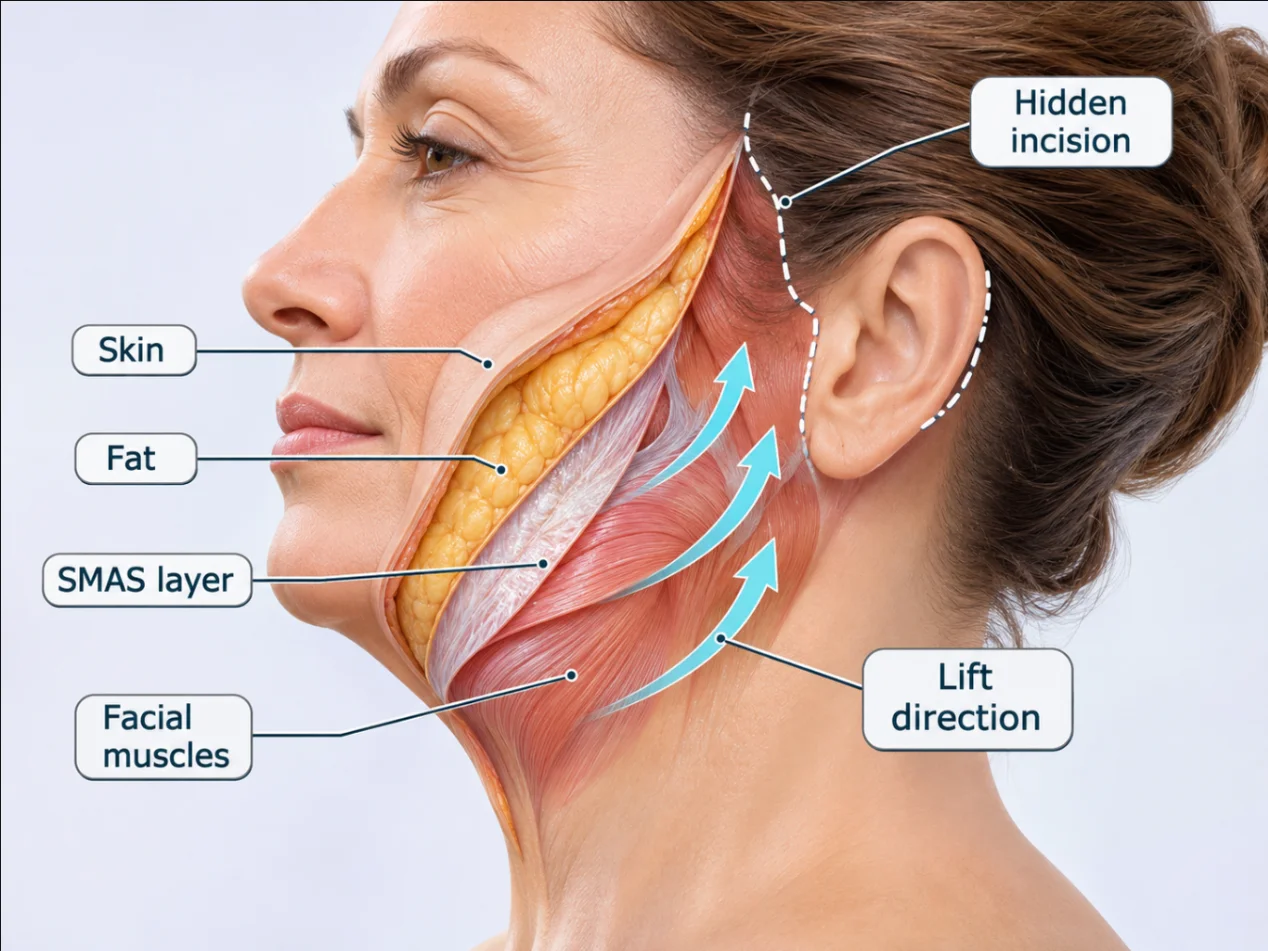
A facelift treats sagging, jowls and loose neck skin. It does not change fine surface wrinkles, sun damage or hollow eyes, so surgeons often combine it with eyelid surgery, a brow lift, fat grafting or skin treatments.

Types of Facelift
The right technique depends on how much sagging you have, where it is, and the quality of your skin.
- Mini facelift: shorter incisions in front of the ears; for early jowls and mild sagging, usually in people in their 40s. Shortest recovery.
- SMAS facelift: the surgeon tightens the SMAS layer and removes excess skin; the most widely used technique for moderate sagging of the lower face.
- Deep plane facelift: the surgeon releases and lifts the SMAS and the deeper tissues together as one unit, which gives a strong, natural-looking lift of the cheeks, jowls and neck; suited to moderate to advanced sagging.
- Mid-facelift: lifts the cheek area to soften the under-eye hollows and the folds between the nose and mouth.
- Neck lift: often combined with a facelift to tighten loose neck skin and the neck muscles.
- Thread lift (non-surgical): dissolvable threads give a mild, temporary lift for about 1–2 years; it is not a substitute for surgery when sagging is significant.
Who Is a Good Candidate for a Facelift?
A facelift usually suits adults, most often aged 45–70, who:
- have sagging cheeks, jowls along the jawline or loose skin and bands on the neck;
- are in good general health, with controlled blood pressure and diabetes;
- do not smoke, or can stop smoking at least 4–6 weeks before and after surgery;
- have a stable weight;
- have realistic expectations: a fresher, rested look rather than a different face.
Facelift by age
- Late 30s to mid-40s: early jowls and a softer jawline; non-surgical treatments or a mini facelift are usually enough.
- 45–60: the most common age for an SMAS or deep plane facelift, often with a neck lift; skin is still elastic, so results are natural and long-lasting.
- 60–70 and over: a full facelift with neck lift, sometimes combined with eyelid surgery and fat grafting; good general health matters more than age itself.
People in their late 30s or early 40s with mild changes may get enough improvement from fillers, threads or a mini facelift. A plastic surgeon decides after examining you, usually first through a free remote consultation with photos.
Facelift vs Non-Surgical Options
Many people first ask whether fillers, threads or energy devices can replace a facelift. They can help at an early stage, but they work differently:
| Option | What it does | How long it lasts | Best for |
|---|---|---|---|
| Dermal fillers | Restore lost volume in cheeks, temples and lips | About 6–18 months | Volume loss without much sagging |
| Thread lift | Dissolvable threads give a mild lift | About 1–2 years | Early jowls in people in their late 30s to 40s |
| Radiofrequency or ultrasound (HIFU) | Heat stimulates collagen and mild tightening | About 1 year, with top-ups | Mild laxity and skin quality |
| Botox | Relaxes muscles that cause lines and neck bands | About 3–4 months | Expression lines, not sagging |
| Surgical facelift | Lifts the deep layer and removes excess skin | 10 years or more | Moderate to advanced sagging of the face and neck |
If you have clear jowls, loose neck skin or deep folds that reappear soon after fillers, repeated non-surgical treatments often cost more over the years than a single facelift, and give a weaker result.
How to Choose the Right Type of Facelift
Your surgeon chooses the technique after examining your face, but these points guide the choice:
- Where is the sagging? Mostly jowls and jawline suit a mini or SMAS facelift; cheeks and folds around the mouth suit a mid-facelift or deep plane facelift; loose neck skin and bands need a neck lift as well.
- How much sagging? Mild changes suit a mini facelift; moderate to advanced sagging usually needs an SMAS or deep plane facelift.
- Skin quality: thin, sun-damaged skin may benefit from fat grafting or skin treatments alongside the lift.
- Recovery time: a mini facelift has the shortest downtime; deep plane and full facelifts need a little more time before social events.
- Previous surgery: a second (revision) facelift needs a surgeon experienced in secondary cases.
Sending clear front, side and three-quarter photos of your face and neck, without make-up, lets the surgeon suggest the right technique and price before you travel.
How Is a Facelift Done?
A facelift is usually done under general anaesthesia, or sedation for a mini facelift, and takes about 3–5 hours. The main steps are:
- Marking: the surgeon marks the incisions in the temple hairline, in front of and behind the ear, and sometimes under the chin.
- Lifting the deeper layer: the SMAS, or the deep plane, is lifted and fixed higher with sutures to reshape the jawline and cheeks.
- Neck tightening: loose neck muscles are tightened, and fat may be removed or redistributed.
- Removing excess skin: the skin is laid back without tension, the excess is trimmed, and the incisions are closed with fine stitches.
- Dressing: a light head bandage is applied, and small drains may be placed for a day.
Most patients spend one night in hospital and go back to the hotel the next day.
Recovery After a Facelift
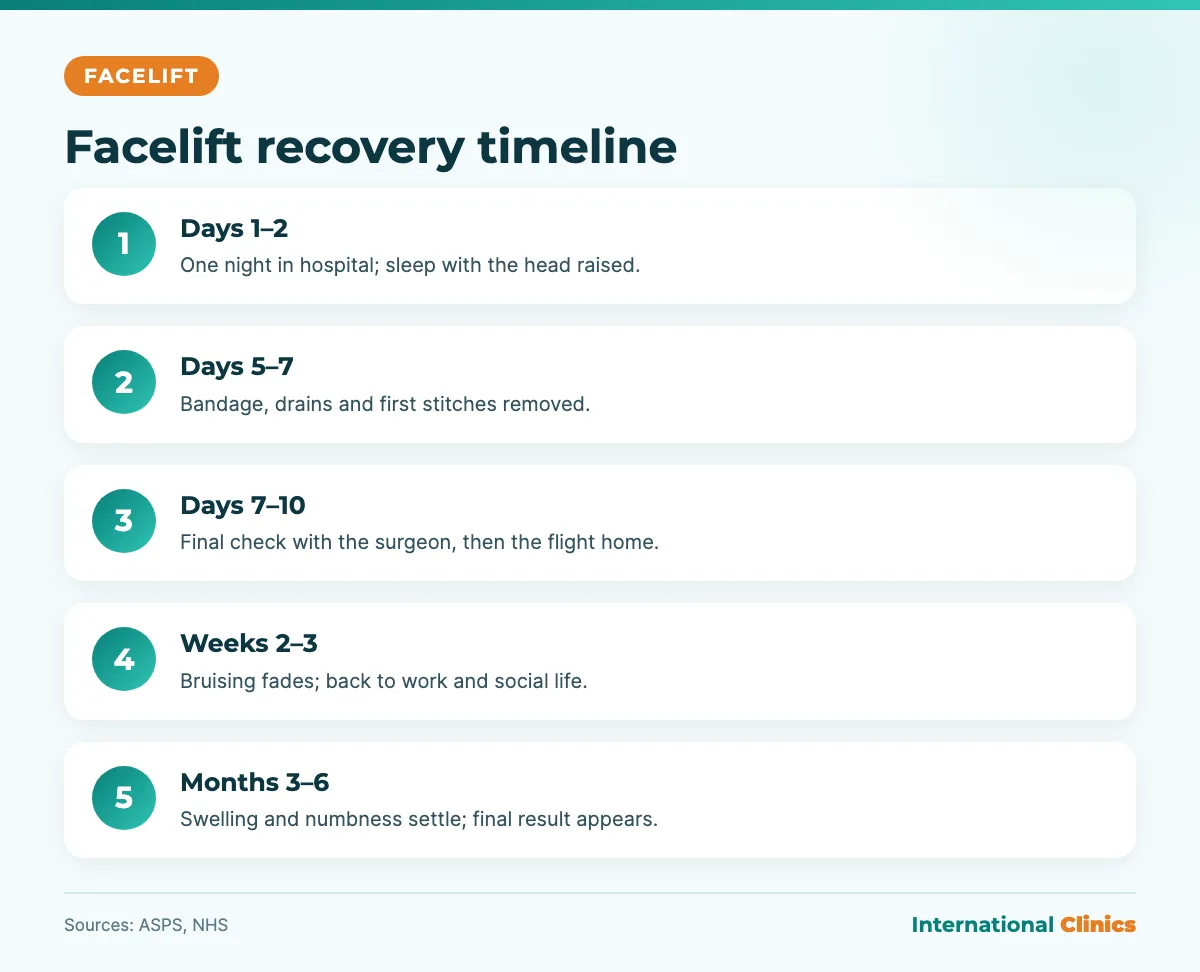
A typical recovery timeline is:
- Days 1–2: one night in hospital; swelling and tightness, controlled with medicine; sleep with the head raised.
- Days 5–7: drains and bandage removed; first stitches removed; most international patients fly home after 7–10 days.
- Weeks 2–3: most bruising fades; back to desk work and social life, with light make-up.
- Weeks 4–6: return to exercise as advised by your surgeon.
- Months 3–6: remaining swelling and numbness settle and the final result appears.
Scars sit in the natural creases around the ear and in the hairline, and usually fade to fine lines within a year. Protecting your skin from the sun, not smoking and keeping a stable weight help the result last 10 years or more.

Facelift Scars and How Long Results Last
Facelift incisions run in the temple hairline, follow the natural crease in front of the ear, curve behind the earlobe and end in the hairline behind the ear. For a neck lift, a short incision under the chin may be added. Healed scars are usually thin and pale and hard to notice, even with the hair tied back.
To help scars heal well, keep the wounds clean, avoid sun on them for several months, use silicone gel if your surgeon recommends it, and do not smoke. Results usually last 10 years or more; the face keeps ageing naturally, but it stays younger-looking than it would have without surgery.
How to lower the risks
- Stop smoking and nicotine products at least 4–6 weeks before and after surgery.
- Control blood pressure before the operation, as high blood pressure raises the risk of haematoma.
- Stop aspirin, anti-inflammatory painkillers and supplements such as fish oil, vitamin E and ginkgo when your surgeon advises.
- Choose a qualified plastic surgeon working in an accredited hospital.
- Follow aftercare instructions: head raised, no bending or heavy lifting for 2 weeks, and all follow-up visits.
Risks of a Facelift
A facelift is generally safe when done by an experienced plastic surgeon in an accredited hospital, but like any surgery it has risks:
- Haematoma: a collection of blood under the skin, the most common early complication; controlling blood pressure lowers the risk.
- Temporary numbness of the cheeks and ears, which usually improves over months.
- Facial nerve weakness: rare and usually temporary.
- Infection, poor scarring or hair loss near the incisions.
- Asymmetry or a result that needs a small touch-up.
Seek medical help quickly if one side of the face swells suddenly or becomes very painful after surgery.
Why Have a Facelift in Turkey?
Turkey, and Istanbul in particular, has become one of the main destinations for facial plastic surgery. The main reasons patients give are:
- Experienced plastic surgeons: many Turkish surgeons perform facelifts every week, including deep plane and revision cases.
- Accredited hospitals: modern private hospitals with international accreditation and full intensive care support.
- Lower total cost: the starting price of a whole package in Turkey is often lower than the surgeons fee alone in the USA or UK.
- Short waiting times: surgery can usually be scheduled within a few weeks of the consultation.
- Organised travel: hotel, transfers and interpreters are arranged, so you can focus on recovery.
The most important step is choosing a qualified plastic surgeon rather than the lowest price. Check the surgeons specialty, experience with your chosen technique and real before-and-after results.
How Much Does a Facelift Cost in Turkey?
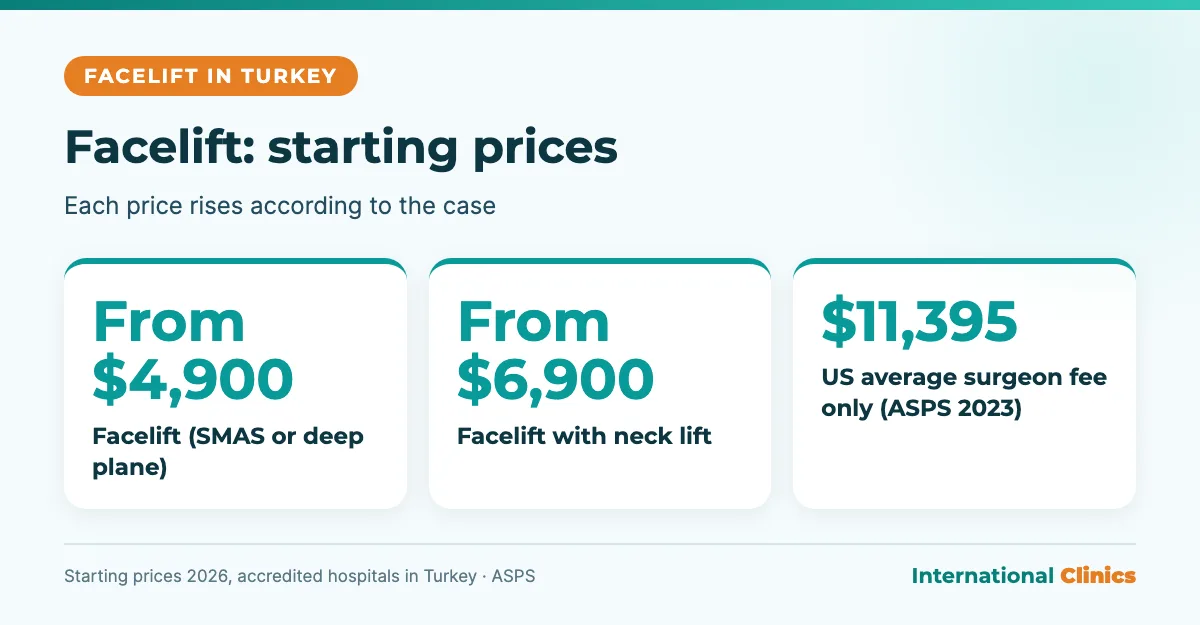
A facelift in Turkey starts from $4,900, and from $6,900 when a neck lift is added; the price rises according to the case, the technique, combined procedures such as a neck lift or eyelid surgery, and the hospital chosen. For comparison, the American Society of Plastic Surgeons reports an average surgeons fee of $11,395 for a facelift in the USA (2023), which does not include anaesthesia, operating room or hospital costs.
| Procedure | Starting price in Turkey |
|---|---|
| Facelift (SMAS or deep plane) | From $4,900 |
| Facelift with neck lift | From $6,900 |
Each price rises according to the case. Packages usually include the operation, hospital stay, tests, medicines, hotel and transfers, with follow-up for one year after surgery.
International Clinics is the link between patients and accredited hospitals and experienced plastic surgeons in Turkey. It arranges a free remote consultation so a surgeon can review your photos, recommend the right technique and confirm the price before you travel.

What Is Included in a Facelift Package in Turkey?
Packages arranged through International Clinics with accredited hospitals in Istanbul usually include:
- a free remote consultation and a personalised treatment plan before you travel;
- pre-operative blood tests, ECG and anaesthesia assessment;
- the operation by your plastic surgeon, anaesthesia and operating room costs;
- one night in hospital, medicines and the first dressings;
- hotel accommodation for the recovery period;
- VIP transfers between the airport, hotel and hospital;
- an interpreter or patient coordinator in your language;
- post-operative checks, stitch removal and follow-up for one year after surgery.
Flights and personal expenses are not usually included. Ask for the full package details in writing before you book.
Facelift With Other Procedures
Many patients combine a facelift with other procedures in the same session to refresh the whole face:
- Eyelid surgery for heavy upper lids or under-eye bags;
- Brow lift for a low or heavy brow;
- Fat grafting to restore lost volume in the cheeks and temples;
- Neck lift for marked neck bands and loose skin.
Final Thoughts
A facelift in Turkey can take years off the lower face and neck with natural-looking, long-lasting results, at a fraction of UK and US prices. Choosing the right technique and an experienced plastic surgeon in an accredited hospital matters more than the price, so start with a consultation and share clear photos of your face and neck.