
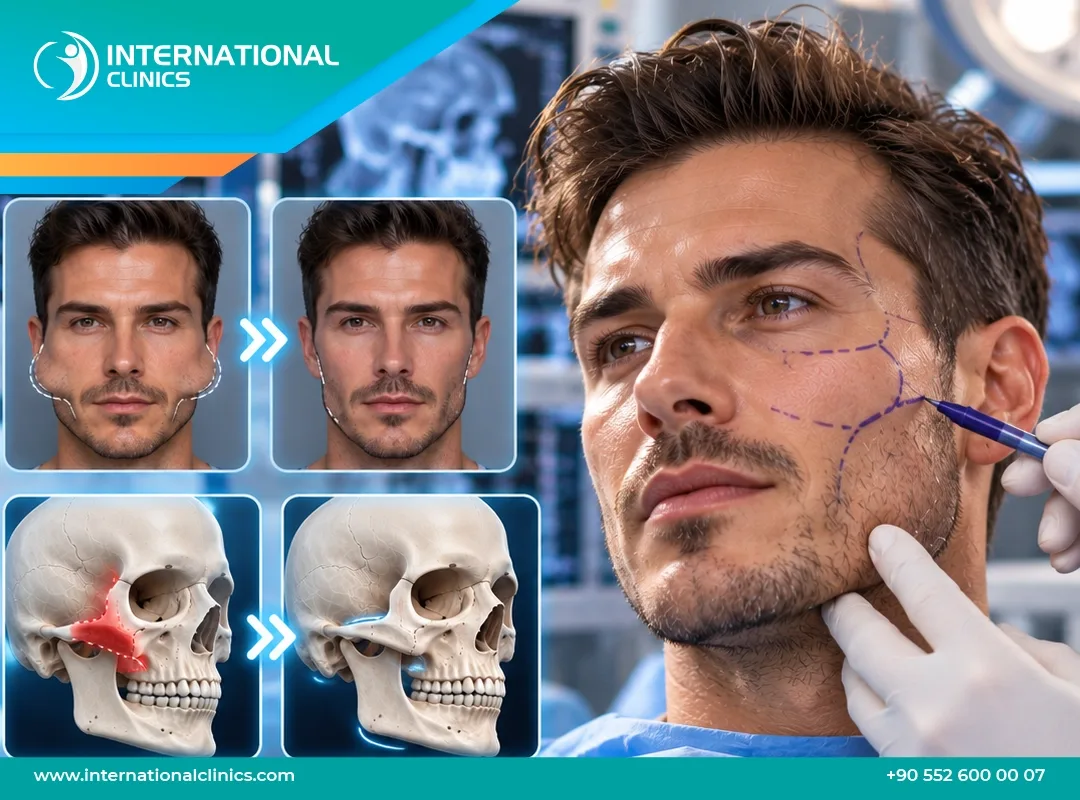
The cheekbone surgery cost in Turkey on this page ranges from 2,500 to 4,500 EUR: cheek augmentation with permanent cheek implants costs 2,500 to 3,500 EUR, and cheekbone reduction surgery (bone shaving or repositioning) costs 3,000 to 4,500 EUR. The price of a cheek augmentation package in Turkey depends on the technique, the implant material and what the package includes; cheek implants are a permanent procedure, usually placed through an incision inside the mouth or under the eyelid (Source: Cleveland Clinic).
Many international patients look for information on the Cheekbone Surgery Cost in Turkey (Cheekbone Surgery) to achieve balanced facial contours. This procedure requires surgical precision and a good understanding of facial anatomy, so the choice of surgeon matters as much as the price, and International Clinics plans it with a plastic surgery team in a hospital setting.
Average Cost of the Procedure
The average Cheekbone Surgery Cost in Turkey ranges between 2,500 and 4,500 Euros, depending largely on whether the technique involves bone reduction or implant augmentation. The package price covers the surgeon’s fees, anaesthesia, pre-operative medical evaluations and hospital accommodation; the International Clinics reference package price is 3,500 EUR, and the final quote is confirmed after the surgeon reviews your photos and, for bone surgery, your scans.
For other procedures that change the shape of the face, compare buccal fat removal cost in Turkey, which slims the cheeks, and V-line jaw surgery in Turkey for the lower face.
Cheek Implants and Cheek Augmentation in Turkey: Your Options
Cheek augmentation in Turkey can be done with permanent cheek implants, with your own fat (fat transfer) or with temporary dermal fillers, while a wide face is treated with cheekbone reduction surgery. The right option depends on whether you want more volume or less width, and on how long you want the result to last.

Cheek Implants (Malar and Submalar)
Cheek implants increase the projection of the cheekbones and add fullness where the face looks flat or sunken (Source: ASPS).
They are usually made of medical-grade silicone or porous polyethylene. Submalar implants improve a sunken look, malar implants create a more defined, angular cheekbone, and both can be combined; the operation usually takes up to an hour, and most patients go home the same day (Source: Cleveland Clinic).
Fat Transfer to the Cheeks
Fat transfer uses your own fat, taken by liposuction and injected into the cheeks, so there is no implant, but part of the fat is reabsorbed and a second session is sometimes needed. A systematic review of 43 studies and 4,577 patients found that on average about 42% of the injected volume of standard fat grafts remained after a median follow-up of 12 months, with a complication rate of 2.27%, mostly asymmetry (Source: JPRAS Open systematic review).
Cheek Fillers
Dermal fillers are approved for volume augmentation of the cheeks, but some are absorbed over time, so treatments must be repeated; the most serious risk is accidental injection into a blood vessel, which can cause tissue death, vision problems including blindness, or stroke (Source: FDA).
Fillers are temporary, lasting roughly six months to several years, while implants are permanent (Source: Cleveland Clinic).
See cheek filler before and after and facial fillers cost for this non-surgical option.
Cheekbone Reduction (Reduction Malarplasty)
Cheekbone reduction narrows a wide midface by cutting, moving inwards and fixing the cheekbone (zygoma) and its arch, usually through the mouth. In a series of 114 patients operated on through an incision inside the mouth, the average operation took about one hour; complications were 3 cases of non-union of the bone, 2 of cheek drooping, 4 of temporary difficulty opening the mouth and 1 of numbness that recovered within 6 months (Source: J Craniofac Surg, 114 patients).

A related bone operation is described in our guide to zygomatic osteotomy.
Why Choose This Destination?
Patients choose Turkey for cheekbone surgery mainly because package prices are often lower than in Western Europe or the USA and surgery can be scheduled quickly; the price should never be the only reason, so check the surgeon and the hospital as carefully as the cost.
Evaluating the Cheekbone Surgery Cost in Turkey shows these practical benefits for international patients:
Surgical Expertise: Plastic surgeons who perform facial contouring; ask how many cheek operations they do each year.
Advanced Technology: 3D imaging and CT scans help plan bone surgery and implant size.
Competitive Pricing: Package prices are often lower than in many European or American clinics.
Comprehensive Care: Packages that combine the medical and travel arrangements.
Accredited Facilities: Ask for the accreditation details of the hospital where you will be operated on.
Short Wait Times: Surgery can usually be scheduled within weeks rather than months.
Medical Tourism: Recovery days in Istanbul before you fly home.
Natural Results: Planning focused on facial balance rather than maximum change.

These points help you judge whether the Cheekbone Surgery Cost in Turkey is good value for you.
Key Factors Influencing the Final Price
The final Cheekbone Surgery Cost in Turkey depends mainly on the type of procedure (implants or bone reduction), the implant material, the length of surgery and the hospital stay. Placing implants is usually a shorter, outpatient operation, while reshaping the bone takes more planning and operating time.
Understanding the Cheekbone Surgery Cost in Turkey requires looking at these factors:
Procedure Type: Augmentation with implants differs in price from reduction of the bone.
Implant Material: Silicone and porous polyethylene implants differ in cost.
Surgeon Experience: Experienced specialists may charge higher fees.
Facility Standard: The hospital and type of room affect the total price.
Anesthesia Method: General anaesthesia requires an anaesthesia team and monitoring.
Surgical Duration: Combined or complex operations take more operating time.
Pre-op Testing: Blood tests and, for bone surgery, CT scans are part of the package.
Post-op Care: Medicines and follow-up visits add to the final cost.
Reviewing these variables helps you estimate your own Cheekbone Surgery Cost in Turkey.
Surgical Steps Involved
Cheekbone surgery is performed under anaesthesia through incisions inside the mouth or, for some implants, under the eyelid; the implant is fitted and secured to the cheekbone, or the bone is cut and repositioned, and the incisions are closed with stitches (Source: Cleveland Clinic).
Patients undergoing this cosmetic procedure go through these steps:
Initial Consultation: Assessing the face and agreeing realistic goals.
Medical Imaging: CT scans to study the bone before reduction surgery.
Anesthesia Application: General anaesthesia, or local anaesthesia with sedation for some implant procedures.
Incision Placement: Incisions are usually made inside the mouth; some implants are placed through the lower eyelid.
Bone Reshaping: For reduction, the cheekbone is cut, moved inwards and fixed with plates and screws.
Implant Fixation: For augmentation, the implant is placed on the cheekbone and secured.
Incision Closure: The incisions are closed with stitches; those inside the mouth are usually dissolvable.
Post-op Monitoring: Observation in the recovery room before discharge or an overnight stay.
Rigid fixation of the bone matters: in the 114-patient reduction series, two of the three non-unions were caused by pressure on the operated area after surgery and one by faulty fixation of the bone segment (Source: J Craniofac Surg, 114 patients).
Detailed Price Breakdown
The price breakdown below shows how the Cheekbone Surgery Cost in Turkey is built up, from the operation itself to anaesthesia, hospital accommodation and medicines. International Clinics gives the list of included services in writing before you travel.


Reviewing this breakdown clarifies the Cheekbone Surgery Cost in Turkey for prospective patients.
| Procedure / Service Type | Estimated Average Cost (Euros) | Additional Clinical Notes |
| Cheekbone Reduction Surgery (Bone Shaving) | 3,000 - 4,500 | Contouring and repositioning of prominent cheekbones. |
| Cheekbone Augmentation (Permanent Implants) | 2,500 - 3,500 | The final price depends on the chosen implant material. |
| Anesthesia & Pre-Surgical Testing | 300 - 500 | Required for safety before surgery. |
| Hospital Accommodation (One Night) | 200 - 400 | Includes nursing care and monitoring. |
| Medications & Initial Recovery Supplies | 100 - 250 | Pain relievers, antibiotics and special mouthwashes. |
This breakdown helps you budget for your Cheekbone Surgery Cost in Turkey.
Cheek Augmentation Turkey Package: What Is Included
A cheek augmentation package in Turkey usually includes the surgeon’s and anaesthesia fees, the implants, tests, the hospital stay, medicines, transfers and hotel nights. Before paying, ask for the full cost in writing, including aftercare, and ask what happens if complications occur or more surgery is needed, because travel insurance usually does not cover problems arising from surgery (Source: NHS).
Pros & Cons of the Procedure
The main advantages of cheekbone surgery are a lasting change in cheek shape and scars hidden inside the mouth; the disadvantages are swelling, recovery time and risks such as infection, implant shifting and numbness. It is important to weigh both before proceeding.
Analysing these aspects helps you judge the Cheekbone Surgery Cost in Turkey as an informed patient.
| Advantages (Benefits) | Disadvantages (Risks & Drawbacks) |
| Enhanced Symmetry: Better balance between the cheeks and the rest of the face. | Temporary Swelling: Redness and swelling that usually take several weeks to a month to settle. |
| Defined Cheekbones: More projection where the cheeks look flat or sunken. | Anesthesia Risks: Uncommon but possible reactions to anaesthesia. |
| Natural Results: A well-sized implant placed on the bone can look natural. | Temporary Numbness: Changes in sensation of the cheek or upper lip, usually temporary. |
| Hidden Scars: Incisions inside the mouth leave no visible facial scar. | Potential Infection: Infection is possible and may require antibiotics or removal of the implant. |
| Increased Confidence: Many patients feel more comfortable with their facial profile. | Asymmetry Risk: Implant shifting or uneven healing may need a revision. |
The risks of facial implants include anaesthesia risks, bleeding, infection, changes in skin sensation, injury to deeper structures such as nerves, hardening of the tissue around the implant, lasting pain, implant shifting, uneven contour, unfavourable scarring and the possible need for revision surgery (Source: ASPS).
Implants are permanent but can be removed at any time if needed (Source: Cleveland Clinic).
Recovery Timeline
Most people return to work and regular activities about one week after cheek implants, while redness and swelling generally take several weeks to a month to disappear; with incisions inside the mouth, a liquid diet for up to a week or a special rinse may be needed, and you should avoid sleeping on your face for a few weeks (Source: Cleveland Clinic).

Recovery from bone reduction takes longer: in the 114-patient series, soft-tissue sagging and deeper wrinkles seen right after surgery resolved within 3 to 4 months (Source: J Craniofac Surg, 114 patients).
A typical timeline after cheekbone surgery in Turkey:
First Week: Rest, prescribed medicines and short walks while swelling is at its peak.
Dietary Restrictions: Liquid or soft food for up to a week when the incisions are inside the mouth.
Cold Compresses: Cold packs, as instructed, to reduce swelling and bruising.
Oral Hygiene: The prescribed mouthwash after meals to keep the incisions inside the mouth clean.
Second Week: Return to desk work after about a week for implants; longer after bone surgery.
Sleeping Position: Sleep on your back with the head raised, not on your face, for a few weeks.
First Month: Swelling settles; avoid heavy lifting and contact sports until your surgeon allows them.
Final Results: Visible once the swelling has gone: about a month after implants and 3 to 4 months or more after bone reduction.
Following your surgeon’s instructions supports a smooth recovery.
How Long to Stay in Turkey and When You Can Fly
Plan to stay in Istanbul for about 7 to 10 days. The NHS advises not flying for 7 to 10 days after facial cosmetic procedures, because air travel after major surgery raises the risk of blood clots (Source: NHS).
Real Patient Transformations
Patient experiences help you see what cheek implants or cheekbone reduction can realistically change, but they are not a promise of your own result. People with a flat midface usually ask about implants or fat transfer, while people with wide, prominent cheekbones ask about reduction, so compare cases similar to your own face.
When you look at before-and-after photos, compare pictures taken from the same angles and in the same light, and ask how long after surgery they were taken. The NHS advises having two consultations with the surgeon and asking to see before-and-after pictures of their own work (Source: NHS).
Comprehensive Clinic Packages
A cheekbone surgery package at International Clinics combines the operation and the travel arrangements, so you know before you travel what is included.

These services are included in the Cheekbone Surgery Cost in Turkey package:
Transfers: Airport, hotel and hospital transfers.
Hotel Accommodation: Hotel rooms during your recovery days.
Free Consultations: Evaluations before and after the operation with your plastic surgeon.
Language Translation: A medical interpreter for clear communication with the staff.
Medical Testing: Blood tests and imaging before surgery.
Post-Op Medications: Prescribed painkillers and antibiotics.
Follow-Up Care: Check-ups to monitor healing before you fly home.
Implant Documentation: Written details of the implant material and model used.
An all-inclusive package makes the total cost easier to plan.
Expert Pro-Tips
These practical tips help you plan your Cheekbone Surgery in Turkey and its cost; your surgeon’s own instructions always come first.
Surgeon Selection: Ask for before-and-after photos of patients with similar facial structures.
Total Transparency: Tell your surgeon about all medicines and supplements to lower the risk of bleeding.
Budget Planning: Add flights, extra hotel nights and personal expenses to the package price.
Comfortable Clothing: Pack shirts that button down the front.
Travel Companion: Bring someone to help you during the first days.
Nicotine Cessation: Stop smoking before and after surgery, because smoking slows healing.
Realistic Expectations: Final results appear only after the swelling has gone.
Patience Matters: Do not judge your appearance in the first week, when swelling is at its peak.
Following these tips makes the trip and recovery easier.
Conclusion
In conclusion, the Cheekbone Surgery Cost in Turkey (Cheekbone Surgery) on this page is 2,500 to 4,500 EUR, depending on whether you choose cheek implants or cheekbone reduction. Implants add permanent volume with about a week of downtime; fat transfer and fillers are alternatives with less predictable or temporary results; bone reduction narrows a wide face but needs a longer recovery. If you are considering cheek augmentation or reduction, International Clinics can arrange a free consultation to discuss your goals and the right option for your face.
Medical review and disclaimer:
This article was reviewed by a specialist physician contracted with International Clinics. It is general health information, not a substitute for medical advice, and results vary between individuals.

