
- What is a Penile Glans Enlargement?
- Penis Head Enlargement
- Why Do You Need Penile Glans Enlargement?
- How to Make Your Penis Head Bigger
- Techniques Used for Penis Head (Glans) Enlargement
- Hyaluronic Acid (HA) Filler Injections
- Glans Augmentation With Autologous Fat Transfer
- Steps of Penile Glans Enlargement
- Anesthesia
- Glans Enlargement
- Recovery
- Preparing for Penis Head Enlargement
- Risks of Glans Augmentation
- Permanent Glans Enlargement
- Glans Enlargement Cost
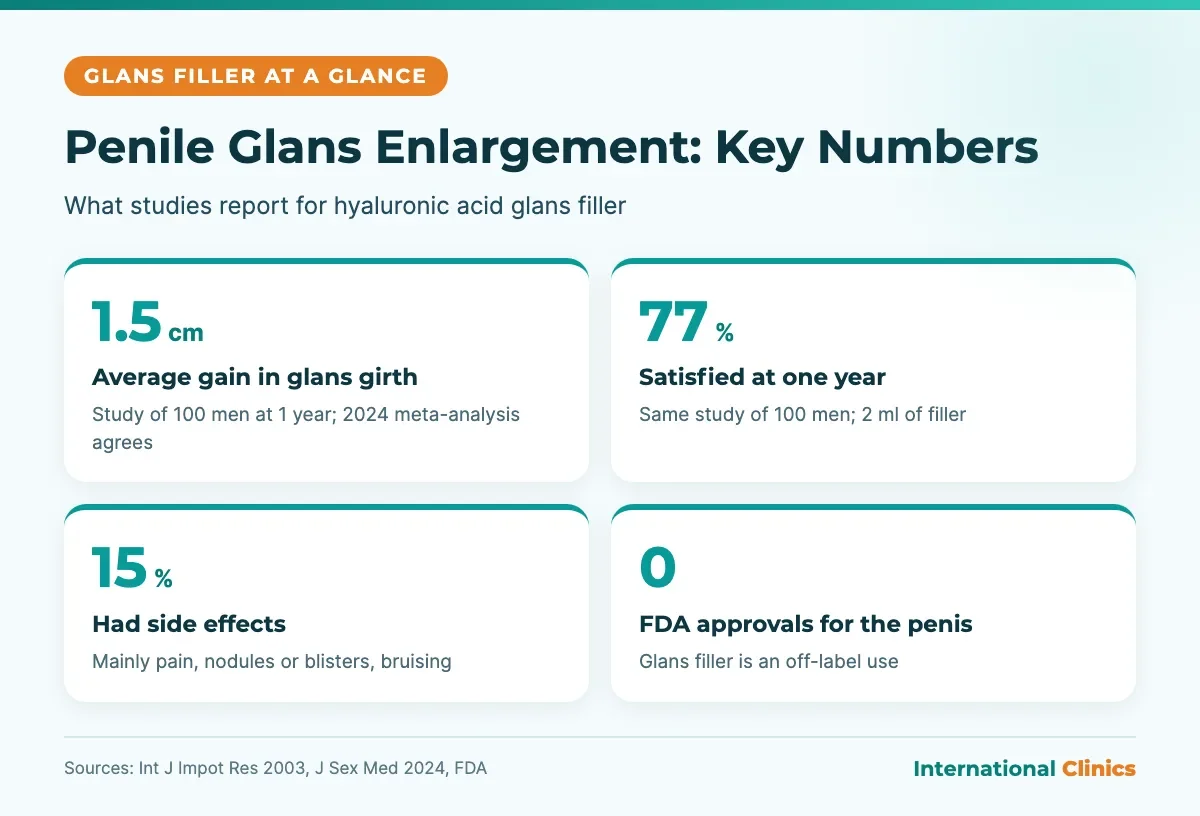
Penile glans enlargement (glans enhancement) makes the penis head bigger, most often with hyaluronic acid filler injected under the skin of the glans. In studies the head grew by about 1.5 cm in circumference, but the result is temporary, the use is off-label, and it carries real risks such as nodules, pain and changes in sensitivity (Sources: Int J Impot Res, 2003 and J Sex Med, 2024).
How much you enjoy or “desire” to engage in sexual activities can depend on how you feel about the health or size of your penis.
Feeling good about your body supports sexual confidence, and some men focus that concern on the glans, the head of the penis, which is referred to as the "glans penis". A large penis head is not a medical requirement, and a glans that looks small is usually normal.
Dissatisfaction with the size of your penis glans can affect your self-esteem. Most men who ask for enlargement have a normal-sized penis: the European Association of Urology (EAU) gives a mean erect circumference of about 11.7 cm and strongly recommends against fillers or fat injection for men with penile dysmorphic disorder, an excessive preoccupation with a normal penis (Source: EAU Guidelines).
Soft tissue fillers based on hyaluronic acid are the most studied way to enhance the glans. Most of the published data come from small series, many of them from one research group, so the evidence is limited (Source: World J Mens Health, 2015).
It is a personal decision to enhance or change your penis. Temporary hyaluronic acid filler avoids the risks of implants and permanent fillers and can be dissolved if needed, but it is not risk-free and in the United States the penis is not among the FDA-approved uses of dermal fillers, so glans filler is an off-label use (Source: FDA).
Discover another option: Penuma® Procedure
What is a Penile Glans Enlargement?
Penile glans enlargement, also known as penis head enlargement or penis augmentation, is a procedure that aims to increase the size—and sometimes reduce the sensitivity—of the glans (head of the penis). It is typically performed using dermal fillers (especially hyaluronic acid) or surgical techniques. Many men seek this procedure due to concerns about a small glans size or hypersensitivity that may contribute to premature ejaculation (PE). Penile glans enlargement is a cosmetic procedure, and international experts advise a full assessment and careful counselling on its limits and complications first, because long-term data are lacking (Source: ICSM 2024, Sexual Medicine Reviews).
Enlarging the penis head with hyaluronic acid fillers involves adding volume to the glans. The results are temporary, can be repeated to extend their duration, and are reversible, as the filler can be dissolved with the enzyme hyaluronidase if needed (see does filler dissolve?). In the original study of 100 men, 77% were satisfied one year after the injection (Source: Int J Impot Res, 2003).
Another natural injectable option is fat transfer, which can last longer once the fat has settled, although part of it is reabsorbed. The AUA states that fat injection for penile girth has not been shown to be safe or effective, and the EAU notes that long-term data are insufficient (Sources: AUA and EAU Guidelines).
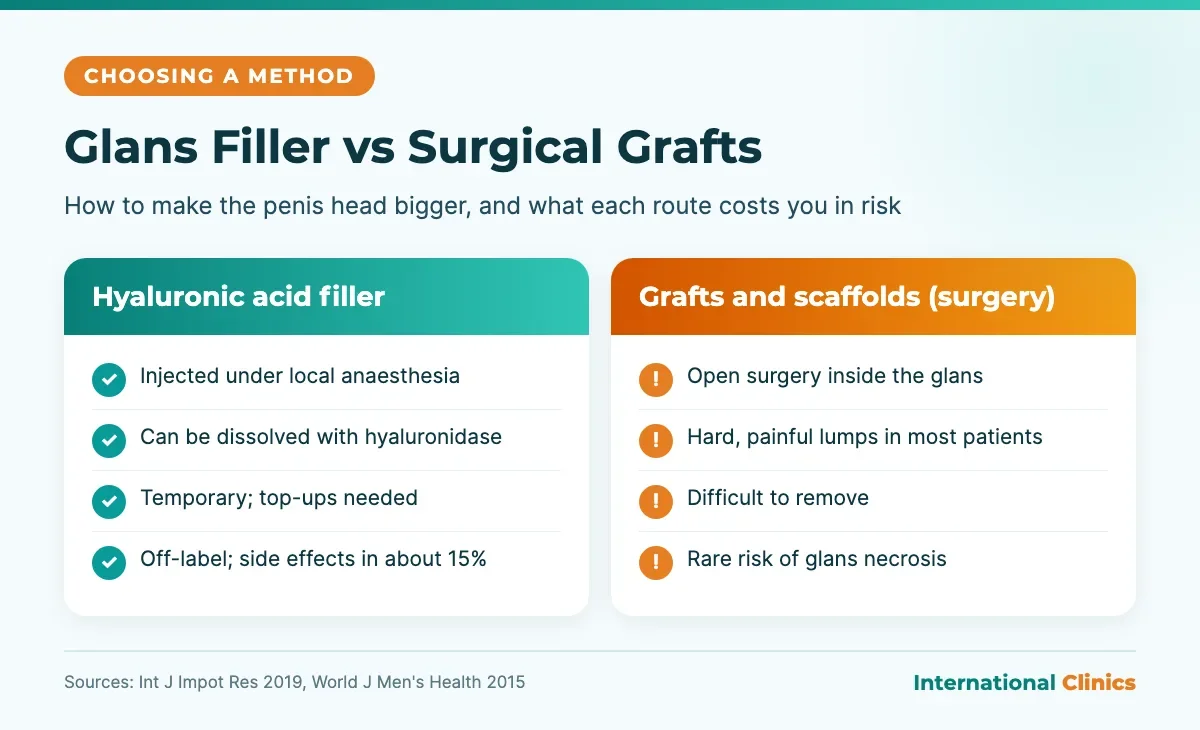
Surgical options, such as implants, aim at a longer-lasting increase in penis head size; however, potential risks have limited their widespread use. Longer-lasting augmentation of the glans is also attempted through autologous grafts (natural body tissue). Grafts and scaffolds placed inside the glans have formed hard, painful lumps over time in most patients, are difficult to remove, and the dissection can damage blood supply and cause glans necrosis in a few patients (Source: Int J Impot Res, 2019).
Major medical organizations have not endorsed these procedures because long-term data are limited, and they are often considered experimental (Source: Transl Androl Urol, 2020).
Penis Head Enlargement
Glans enlargement augments the size and form of the “glans” or head of the penis. Clearly, the goal here is to make your penis look more cosmetically attractive in case you already have a small penile head.
The methods described for enlarging the penile glans are dermal filler injections, fat transfer and surgical grafts or implants; hyaluronic acid filler is the most widely used and the only one that can be dissolved (Source: Int J Impot Res, 2019).
Dermal fillers and fat transfer add volume under the skin of the glans, while grafts or implants are placed surgically inside it and carry a higher risk of lumps and removal surgery.
The surgeons experience and skill level, along with the particular demands and preferences of the patient, will determine which technique is best.
Using a fine needle or cannula, your doctor places the glans enlargement filler just beneath the skin’s surface to make the glans bigger. In the first human study, 2 ml of hyaluronic acid gel was injected (Source: Int J Impot Res, 2003).
The glans form is usually preserved and no scars are left behind by this enlargement-thickening technique. A slightly uneven surface is a known limitation, although the small folds tend to disappear during erection (Source: World J Mens Health, 2015).
The filler can reduce the sensitivity of the glans. The EAU rates hyaluronic acid glans injection as effective in decreasing penile sensitivity, with a modest increase in ejaculation time, but recommends using it only with caution for premature ejaculation because established treatments exist and more safety data are needed (Source: EAU Guidelines, ejaculation disorders).
Related Article:
How Long Do Penile Implants Last?
Penis Enlargement Surgery Cost

Why Do You Need Penile Glans Enlargement?
The glans can be thickened or increased by injecting a filler. In this instance, enlargement and thickening have the same meaning. Men who have had girth enhancement of the shaft sometimes ask for glans enlargement afterwards, because the head can look small next to a thicker shaft (Source: Int J Impot Res, 2003).
The following are the most common justifications to seek a glans thickened or enlarged:
- Aesthetic improvement: for men who perceive their glans as small or disproportionate compared to the penile shaft.
- Premature ejaculation (PE): to reduce sensitivity and help increase the time to orgasm, although this is not a first-line treatment.
- Asymmetry correction: to create a more balanced and symmetrical appearance of the glans.
- Overall penile enhancement: for those seeking to improve the overall size and visual harmony of the penis.
- Quality of sexual life concerns: when a smaller glans negatively affects sexual confidence or satisfaction
How to Make Your Penis Head Bigger
The most popular methods for penis head enlargement today are Hyaluronic Acid (HA) fillers and fat transfer, as they do not need open surgery, although both have risks and fillers are used off-label. Longer-lasting enlargement is attempted with implants or autologous grafts, though these methods are surgical and carry higher risks. Some men also try to get a bigger penis head with exercises or traction devices; however, they have minimal effect on the glans itself and mainly influence penile length rather than head size. No pills or creams make the penis head bigger. If you are still comparing methods, see penis enlargement injections for shaft girth fillers.
Techniques Used for Penis Head (Glans) Enlargement
Hyaluronic Acid (HA) Filler Injections
When Hyaluronic Acid fillers are injected into the glans, they increase volume and enhance shape. These injectable fillers may also reduce sensitivity, which can help some men with premature ejaculation. HA fillers offer a biocompatible, non-surgical, and reversible solution with short downtime and no visible scars, but they are not FDA-approved for the penis (Source: FDA).
There are two main techniques for injecting HA fillers into the glans:
- Fanning technique: the filler is injected through one or two entry points and distributed in a fan-like pattern along the glans to achieve even volume.
- Multiple puncture technique: Several small injections are made on the sides of the glans to ensure balanced filler distribution. This method allows precise control over specific areas, making it suited to targeted shaping.
Results are temporary because the gel is slowly absorbed, but they can be repeated. In the developers’ series most men still saw more than half of the volume at one year, and in 38 men followed for five years the circumference gain had fallen by about 15%; other filler products and techniques may last less (Source: World J Mens Health, 2015).
In a study involving 100 patients who self-reported having a small penis, the average glans circumference was 9.1 cm before treatment and about 1.5 cm larger one year after hyaluronic acid injection. The study reported 77% patient satisfaction, discoloration from swelling that settled within two weeks, and no serious complications (Source: Int J Impot Res, 2003).
A 2024 meta-analysis of 13 studies confirmed a similar gain of about 1.5 cm in glans circumference, but side effects occurred in about 15% of men, mainly pain, blisters or nodules and bruising (Source: J Sex Med, 2024).
However, guidelines remain cautious about glans augmentation for PE: the EAU gives only a weak recommendation to use it with caution because it may cause serious complications, which is why expert consultation matters (Source: EAU Guidelines, ejaculation disorders).
Glans Augmentation With Autologous Fat Transfer
Penile augmentation with autologous fat transfer involves harvesting fat from the patient’s own body, purifying it, and injecting it into the glans to enhance volume and girth. This technique uses your own tissue, so allergic reactions are not expected, and it may improve self-confidence. The procedure is typically performed under sedation or general anesthesia, using fine cannulas for precise placement.
Fat injection results are less predictable because part of the fat is reabsorbed, and most published data concern the shaft rather than the glans. The AUA considers fat injection for penile girth a procedure that has not been shown to be safe or effective (Source: AUA).
Steps of Penile Glans Enlargement
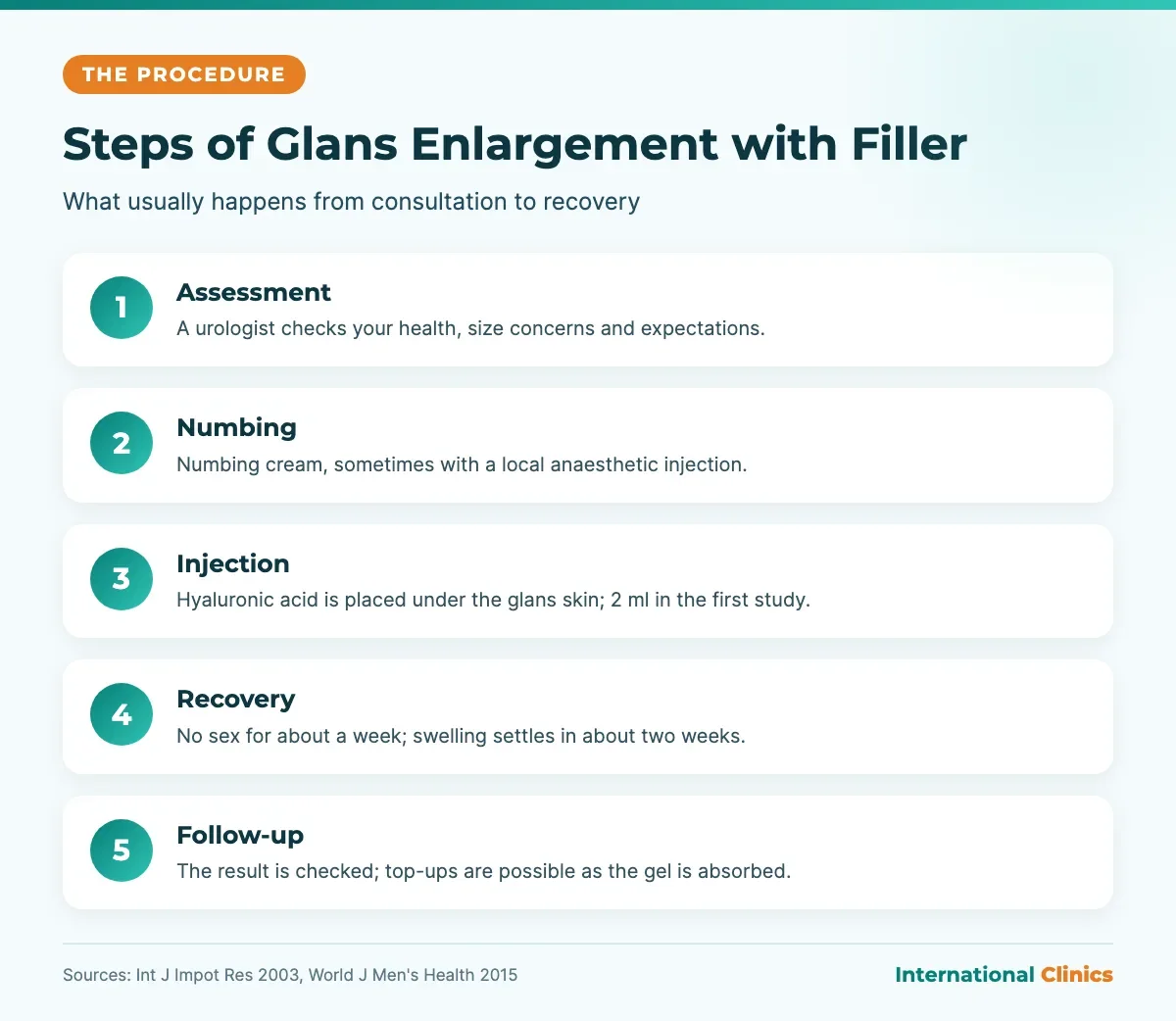
Enlarging the penile glans goes through different stages or steps. However, these steps can’t be generalized because there are many “methods” to achieve the enlargement. In any case, the steps generally involve the following:
Anesthesia
Filler glans augmentation is usually done under local anaesthesia: a numbing cream is applied first, and some men also need a local anaesthetic injection. General anaesthesia or sedation is mainly used for fat transfer or surgical methods (Source: World J Mens Health, 2015).
Glans Enlargement
By adding a natural substance beneath the skins surface, the glans gain a larger mass but without changing in form.
If your doctor chooses the filler method, there are only needle entry points. The glans gets bigger as a result: in the first human study the circumference grew by about 1.5 cm from an average of about 9.1 cm (Source: Int J Impot Res, 2003).
Recovery
During the healing phase, you should stay away from sexual activity or masturbation for about one week, or longer if your doctor advises, so the filler can settle evenly. Swelling and discoloration usually settle within about two weeks (Source: Int J Impot Res, 2003).
Related Article: Best Penile Implant Size Options also Discover How to Increase Penis Size?

Preparing for Penis Head Enlargement
You can largely decrease the chance of your treatment going wrong and enhance the outcome of glans enlargement by being well-prepared. Your doctor will go through the following things with you in the first consultation:
Pay close attention to your health before the procedure. Like any other surgery, enlarging the penile glans requires good health without acute or severe chronic disorders.
Surgery should be rescheduled if there is a fever or herpes infection at the time of the procedure. These conditions must be mentioned right away. Let your doctor know about any medications or materials you are known to be intolerant of to lower the risks of allergies or reactions.
Patients with diabetes or high blood pressure require careful medication adjustments from the physician. Never stop prescribed blood thinners on your own: the doctor who prescribed them decides whether they can be paused or replaced.
Tell your doctor about anti-inflammatory painkillers and herbal supplements, because some of them can increase bruising; you may be asked to avoid them for a few days before and after the treatment.
Because smoking constricts blood vessels, it can slow healing, which matters most after fat transfer or surgery. Your doctor may ask you to stop smoking for several weeks before and after the procedure.
If your main concern is sensitivity rather than size, start with our guide on how to reduce sensitivity of the glans naturally.
Read More: Benefits of Penis Botox

Risks of Glans Augmentation
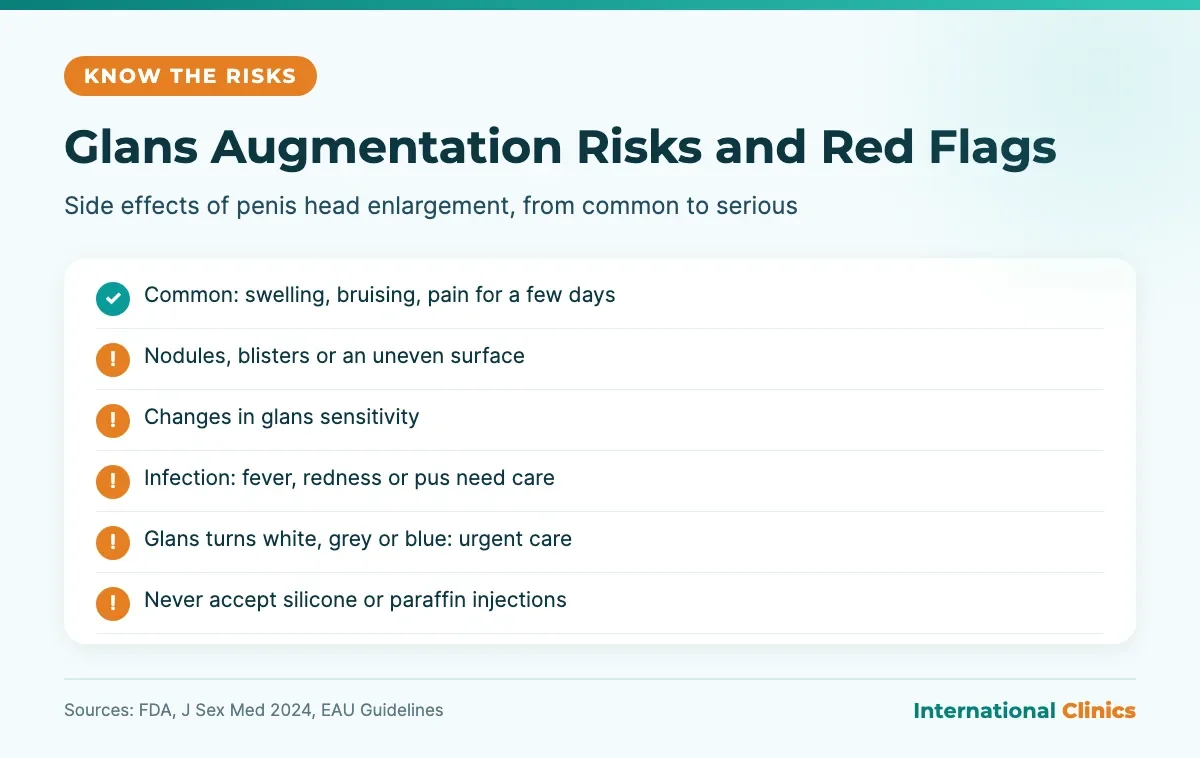
Glans enlargement or thickening has real risks, and they depend on the method. Implanted grafts or scaffolds formed hard, painful lumps over time in most patients and were difficult to remove (Source: Int J Impot Res, 2019).
With hyaluronic acid filler, side effects were seen in about 15% of men in a 2024 meta-analysis: pain in about 8%, blisters or nodules in about 4% and bruising in about 3% (Source: J Sex Med, 2024).
Possible problems include:
- Asymmetrical penile skin surface
- Discoloration
- Hematomas
- Bleeding
- Swelling
- Pain, blisters or nodules (lumps)
- Infection
- Changes in glans sensitivity
- Rarely, injection into a blood vessel, which can block blood flow and cause tissue death
The FDA calls accidental injection into a blood vessel the most concerning risk of any dermal filler. Seek urgent care if the glans becomes very painful or turns white, grey or blue after an injection (Source: FDA).
In the glans, injection that is too superficial, too large in volume or into a vessel can cause ischemic necrosis; with hyaluronic acid it is treated with hyaluronidase, but this enzyme does not work on other fillers, and fillers of unknown nature or poor purity cause more complications (Source: World J Mens Health, 2015).
Related Article:
Permanent Glans Enlargement
Permanent glans enlargement cannot be reliably guaranteed. However, non-surgical procedures such as dermal fillers (especially hyaluronic acid) can provide temporary thickening that may last for years in some men by injecting volume beneath the skin of the glans; top-ups are usually needed (Source: World J Mens Health, 2015).
Surgical options, including grafts or scaffolds placed inside the glans, aim at a more long-lasting increase in girth, but they carry higher risks, including hard painful lumps, irregular contours and, rarely, glans necrosis (Source: Int J Impot Res, 2019).
Silicone sleeve implants such as Penuma® sit under the skin of the shaft and are attached at the glans, so they increase shaft girth rather than the head itself; the EAU considers Penuma experimental and strongly recommends against it for girth enhancement (Source: EAU Guidelines).
Because of these concerns, many clinical guidelines still classify glans augmentation—particularly for sensitivity reduction or premature ejaculation—as experimental, recommending careful patient selection and thorough counseling due to the risk of functional complications (Source: ICSM 2024, Sexual Medicine Reviews).
Never accept permanent injections such as liquid silicone, paraffin or petroleum jelly: they cause chronic foreign-body reactions that can lead to infection and gangrene, and the EAU strongly recommends against them (Source: EAU Guidelines).
Glans Enlargement Cost
Glans enlargement cost depends on the method, the filler brand and how many millilitres are injected, and on whether it is done alone or together with shaft enlargement. In the United States, quotes are usually considerably higher than in Turkey and vary widely between clinics.
Nonetheless, in other countries such as Turkey, the cost is often lower than $5000. Remember that many factors play a role in determining the final cost, including the nature or complexity of the case. Ask what product is used, how many millilitres are included and whether follow-up visits and hyaluronidase are covered.
Permanent glans enlargement cost:
The cost of permanent glans enlargement is hard to define, because no method is reliably permanent. Dermal Fillers need touch-ups to keep the result, so budget for repeat sessions. Fat Transfer is a larger procedure under sedation and usually costs more, and results vary due to fat reabsorption. For full penile enlargement prices, see penis enlargement surgery cost.

Medical review and disclaimer:
This article was reviewed by Assoc. Prof. Dr. Zülfü Sertkaya. It is general health information, not a substitute for medical advice, and results vary between individuals.