- Penis Enlargement Injection
- Types of Injections for Penile Growth
- Pros of Penis Enlargement Injections
- Better Penile Shape
- Higher Sexual Satisfaction
- Premature ejaculation Prevention
- Limited Downtime
- Cons of Penis Enlargement Injections
- PRP Penile Injection
- Are Male Enlargement Injections Permanent, and How Long Do They Last?
- Risks and Side Effects of Penis Enlargement Injections
- Silicone, Paraffin and Other Dangerous Penile Injections
- Who Should Not Have Penile Filler
- Cost of Penis Enlargement Injections
- What determine the prices of penis enlargement injections:
- Factors that affect price of penis enlargement:
- How much does penis filler cost?
Male enlargement injections (penis filler) cost about $1,400 to $2,000 per session in Turkey, while typical published prices in the United States in 2026 are about $3,500 to $7,500. The price depends mainly on the filler used and how many millilitres you need. Hyaluronic acid filler adds girth, not length, and the result is temporary.
Are you considering penis enlargement injections, like a lot of men throughout the globe?
Before you book male enlargement injections, it helps to know what they can realistically change. They mainly add girth and can improve how you feel about your appearance, but they do not lengthen the penis and they are not a treatment for erection problems. If you are still comparing methods, our guide on how to increase penis size sets out the options.
Depending on an individual’s suitability, a non-surgical penis enlargement procedure using hyaluronic acid treatments may address the appearance of penile asymmetry.
The procedure can enhance the perceived thickness and size of the penis in its flaccid and erect states, although the gain is usually smaller when erect. In a study that followed 38 men for one year, flaccid girth was 2.44 cm larger than before, but erect girth only 0.80 cm (Source: Asian Journal of Andrology, 2022).
In the United States these procedures typically range from $3,500 to $7,500 per session, though actual costs vary with the filler type, the volume injected, the clinic location and the provider’s expertise.
It remains a personal decision to enhance or change your penis shape. Temporary soft tissue fillers can be a reasonable first step for men who want more girth without an operation such as the Penuma implant and without permanent fillers, as long as they accept that the result fades and that injections carry their own risks.
Related Article:
Penis Enlargement Surgery Cost

Penis Enlargement Injection
A penis enlargement injection is a non-surgical cosmetic treatment in which a filler is injected under the skin of the penile shaft to increase girth. Penile enhancement injections most often use hyaluronic acid; other soft tissue fillers and your own fat are also used, and platelet-rich plasma (PRP) is sometimes offered, although PRP is not a volumising filler.
Injections for penile enhancement mainly target girth (circumference), these procedures generally do not increase length.
The fillers add volume and can stimulate collagen production, providing temporary girth enhancement. Results vary depending on the substance used, HA is popular for its biocompatibility and temporary effects, while PLA promotes gradual, longer-lasting collagen stimulation.
Penile enhancement injections use fillers like hyaluronic acid (HA), sometimes combined with platelet-rich plasma (PRP), to increase penile girth non-surgically, offering a less invasive alternative to surgery for improved shape and confidence.
Many men prefer this option because it avoids an operation and usually costs less than surgery, although it has its own risks, described below.
These injections fall into two main categories: synthetic fillers and naturally sourced fillers, such as hyaluronic acid. Each type has its own advantages and limitations. Non-absorbable fillers such as polymethylmethacrylate (PMMA) are permanent, while absorbable fillers such as hyaluronic acid are gradually broken down by the body.
However, permanent materials are much harder to correct: they cannot be dissolved if lumps, irregularity or migration occur. The European Association of Urology strongly recommends against using silicone, paraffin and petroleum jelly (Vaseline) for penile girth enhancement, because they cause chronic foreign-body reactions that can progress to severe infection and gangrene (Source: EAU Guidelines).
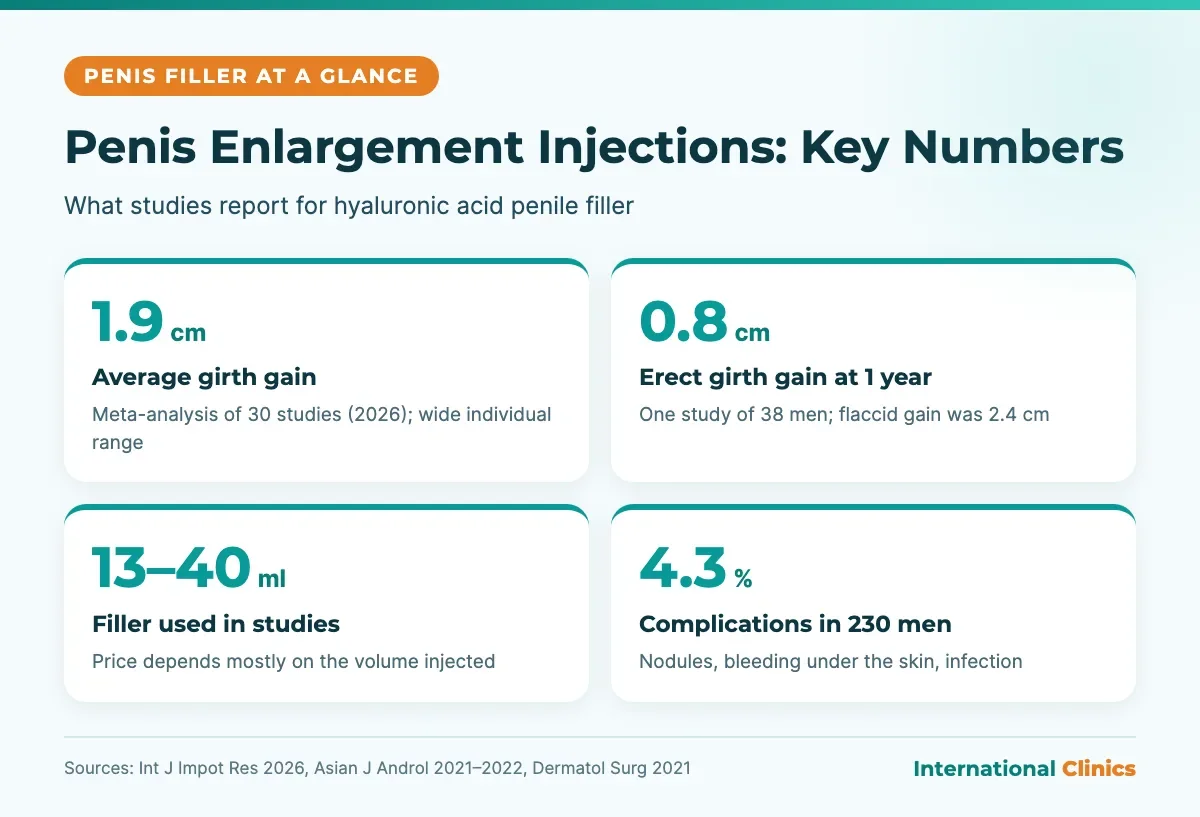
Natural fillers, especially hyaluronic acid, are widely preferred. Hyaluronic acid is absorbable and reversible: it can be dissolved with an enzyme, hyaluronidase, if a nodule forms or the outcome is not what was planned (see does filler dissolve?). Although its results are temporary compared to permanent fillers, its complications in published series have mostly been mild (Source: Asian Journal of Andrology, 2021).
Hyaluronic acid is a naturally occurring component of the skin and connective tissue. The EAU guideline summarises studies reporting girth increases of 1.4 to 3.78 cm with hyaluronic acid and patient satisfaction of 78 to 100%, with infrequent, mild and temporary side effects, but it rates this evidence as low level and recommends counselling patients extensively about risks and benefits (Source: EAU Guidelines).
In terms of volume, published studies used about 13 to 40 ml of filler in total, depending on penis size and desired results (Sources: Dermatologic Surgery, 2021 and Asian Journal of Andrology, 2021).
Because the penis changes shape and size during sexual activity, poor technique can lead to lumping or migration of the filler. In one series, men with a long foreskin had more swelling and gel migration after the injection, which is why some surgeons recommend circumcision first (Source: Asian Journal of Andrology, 2021).
It’s important to note that changing penis size always involves altering its anatomy or structure. No pills, creams, or topical treatments can provide lasting enlargement.
Surgery is not a proven gold standard either. The AUA considers fat injection for girth and division of the suspensory ligament for length to be procedures that have not been shown to be safe or effective, and the EAU classes grafts and the Penuma implant as experimental for girth enhancement (see also penile lengthening) (Sources: AUA and EAU Guidelines).
Related articles:
Types of Injections for Penile Growth
Different types of penile enhancement injections are available to add volume by different techniques; fillers like HA add volume and stimulate collagen, providing temporary girth enhancement with results lasting months to years, depending on the substance, while PLA offers gradual, longer-lasting collagen stimulation.
Injections for penile growth include:
- Hyaluronic Acid (HA):
The most studied and most commonly used penis injection: it provides immediate volume, is biocompatible and can be dissolved. It is gradually absorbed, so the gain fades: in a series of 230 men, the average girth gain was 2.66 cm at one month and 1.80 cm at six months (Source: Asian Journal of Andrology, 2021).
- Poly-L-Lactic Acid (PLA):
When injecting the penis with PLA, it stimulates the body’s own collagen production and results develop gradually over time. Studies report girth gains of about 1.2 to 2.4 cm, and in randomized trials that compared the two, hyaluronic acid gave slightly more girth and higher sexual satisfaction at 12 weeks than PLA (Sources: EAU Guidelines and Annals of Medicine & Surgery, 2023).
- Calcium Hydroxylapatite (CaHA):
A bone-like mineral compound that also stimulates collagen formation. Published data on calcium hydroxylapatite in the penis are very limited, and unlike hyaluronic acid it cannot be dissolved with an enzyme, so ask your doctor why it is being proposed.
- Silicone / PMMA:
Synthetic materials used for long-lasting or permanent results. Liquid silicone injections, like paraffin and petroleum jelly, can cause granulomas, migration and severe tissue damage that is difficult to remove, and the EAU strongly recommends against them (Source: EAU Guidelines).
Injectable silicone is not approved by the FDA for any aesthetic procedure. PMMA is a permanent, non-absorbable filler: small studies report girth gains, but it cannot be dissolved, and the FDA approves non-absorbable fillers only for nasolabial folds and cheek acne scars (Source: FDA).
- Fat Injections (Fat Transfer):
Uses the patient’s own fat, harvested from areas such as the abdomen or thighs and injected into the penis to increase girth. Because it is natural tissue, the risk of allergic reaction is low. However, fat survival rates vary, and some of the injected fat may be reabsorbed by the body, which can affect long-term results and may require touch-up sessions. The AUA considers fat injection for penile girth a procedure that has not been shown to be safe or effective, and the EAU notes that long-term data are insufficient (Sources: AUA and EAU Guidelines).
- The P-Shot (Priapus Shot) – Platelet-Rich Plasma (PRP):
The P-Shot uses platelet-rich plasma (PRP) extracted from the patient’s own blood. It is often used alone or combined with fillers with the aim of supporting tissue health and erectile function. There is no good evidence that PRP increases penile size, and the EAU states that intracavernous PRP for erectile dysfunction should be used only within clinical trials (Source: EAU Guidelines, erectile dysfunction).
Pros of Penis Enlargement Injections
Most people notice a measurable improvement in penile girth after this treatment. A 2026 meta-analysis of 30 studies found an average girth gain of about 1.9 cm after injectable fillers, but the expected range for an individual man was wide, from about 0.3 to 3.5 cm (Source: Int J Impot Res, 2026).
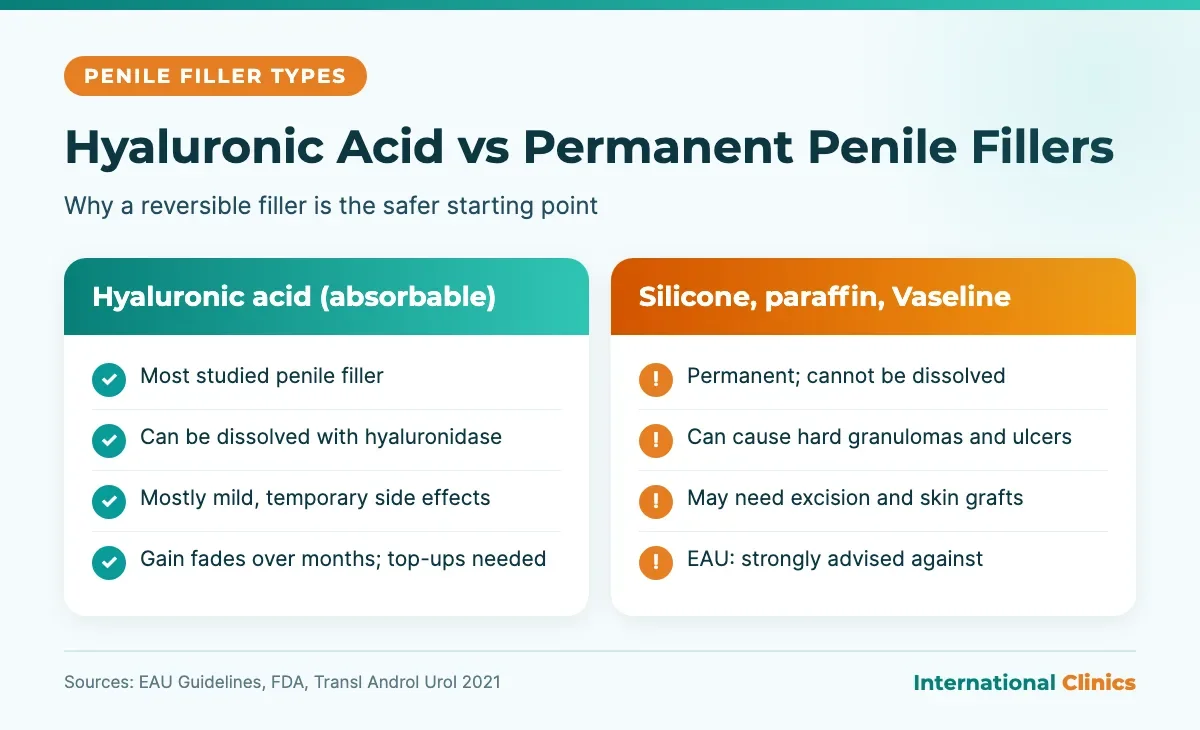
How much changes depends on the amount of filler used and on your starting anatomy. The main advantages are:
Better Penile Shape
Penis fillers are used to increase girth. For many men that cosmetic change is enough to improve how they feel about their body, which is the honest reason most of them are here. The EAU notes that fillers improved genital self-image and self-esteem in studies (Source: EAU Guidelines).
Higher Sexual Satisfaction
Although the procedure is mostly “cosmetic” in nature, some men (and their partners) say that the extra girth makes them feel more sexually satisfied afterward, at least from a psychological point of view. In trials, hyaluronic acid gave higher sexual satisfaction at 12 weeks than PLA (Source: Annals of Medicine & Surgery, 2023).
The effect has limits: according to the EAU guideline, fillers did not improve self-confidence or satisfaction with the sexual relationship (Source: EAU Guidelines).
Premature ejaculation Prevention
Some men report that filler placed around the glans reduces sensitivity, and that this delays ejaculation. This is an inconsistent effect and not an established treatment for premature ejaculation, which has its own established therapies. Do not choose this procedure for that reason.
A 2024 meta-analysis of glans hyaluronic acid injections for premature ejaculation called the evidence controversial and reported side effects in about 15% of men, mainly pain, nodules or blisters (about 4%) and bruising (Source: J Sex Med, 2024).
Limited Downtime
Most men return to their normal daily routine soon after treatment, because the healing period is short. The procedure itself is done as an outpatient under local anaesthesia, usually through a thin cannula, and the penis is often wrapped in an elastic bandage for a period afterwards (Source: Asian Journal of Andrology, 2021).

Cons of Penis Enlargement Injections
Many people are less excited about this treatment because the results are temporary (unless they choose permanent injections, which are riskier). Dermal fillers ultimately naturally disappear from the body, and the process can be “undone” if you choose.
Doctors generally advise avoiding sexual activity for one to two weeks after the procedure, so the tissue can settle and the filler can stabilise; some published protocols ask for four weeks without intercourse. Follow the interval your own surgeon gives you (Source: Asian Journal of Andrology, 2021).
Some bruising or swelling in the first few days is common and usually settles on its own.
Other drawbacks are that the gain is smaller in erection than when flaccid, that penile use is off-label in the United States because the penis is not among the FDA-approved uses of dermal fillers, and that men with erection problems need a different treatment, such as medicines or a penile implant in Turkey, rather than a cosmetic filler (Source: FDA).
PRP Penile Injection
Men looking for rejuvenation and augmentation can think about platelet-rich plasma (PRP) therapy to achieve this goal.
PRP penile injection is an experimental application of platelet-rich plasma, used with the aim of treating conditions affecting the penis and improving sexual function.
This kind of platelet-rich plasma therapy is also called PRP Penile Injections or Priapus Shot® (P-Shot®). It is marketed as improving sexual performance and erectile dysfunction and even as enlarging penile girth, but none of these claims is established.
To activate growth factors, concentrated platelets are injected into the penile tissue after a tiny volume of blood is drawn to separate the platelets.
A 2023 systematic review and meta-analysis of four studies covering 283 men found that hyaluronic acid produced significantly greater penile girth than poly-L-lactic acid (P=0.01) and significantly higher sexual satisfaction at twelve weeks (P=0.0004), with no difference between the two in satisfaction with appearance at four weeks (P=0.79) and no difference in pain. All four trials came from one country, and follow-up was too short to judge long-term effects (Source: Annals of Medicine & Surgery, 2023).
The P-Shot’s efficacy in treating penile-related disorders has not been adequately demonstrated in studies, and it should be presented as experimental rather than established. The EAU says current evidence is insufficient to recommend PRP for erectile dysfunction in clinical practice (Source: EAU Guidelines, erectile dysfunction).
Supporters say these injections promote blood flow to the penis and tissue healing, but randomized trials in erectile dysfunction have given mixed results, and one 2023 trial found no difference between PRP and placebo (Source: EAU Guidelines, erectile dysfunction).

Are Male Enlargement Injections Permanent, and How Long Do They Last?
Hyaluronic acid fillers are not permanent. The body gradually absorbs the gel and part of the gain fades within months: in a series of 230 men the average girth gain fell from 2.66 cm at one month to 1.80 cm at six months (Source: Asian Journal of Andrology, 2021).
In a smaller study that followed men for one year, a measurable gain was still present at 12 months, but erect girth was only about 0.8 cm larger than before. Men who want to keep the result usually need top-ups, and that recurring cost belongs in your budget from the start, not as a surprise later (Source: Asian Journal of Andrology, 2022).
Poly-L-lactic acid is designed to last longer because it works by stimulating your own collagen, but long-term penile data are limited. Silicone and PMMA are the genuinely permanent options, and permanent materials are the ones specialists are most cautious about for this area, because they cannot be dissolved if the result is uneven; for silicone, paraffin and petroleum jelly the EAU recommendation against use is strong (Source: EAU Guidelines).
The trade-off is the whole decision in one line: reversible means temporary, and permanent means you live with whatever you get. For a first procedure, most surgeons steer patients toward the reversible option for exactly that reason.
Risks and Side Effects of Penis Enlargement Injections
This is the part most clinic pages leave short, so it is worth being direct about it. Penile filler is an elective cosmetic procedure on sensitive tissue, and it carries real risks.
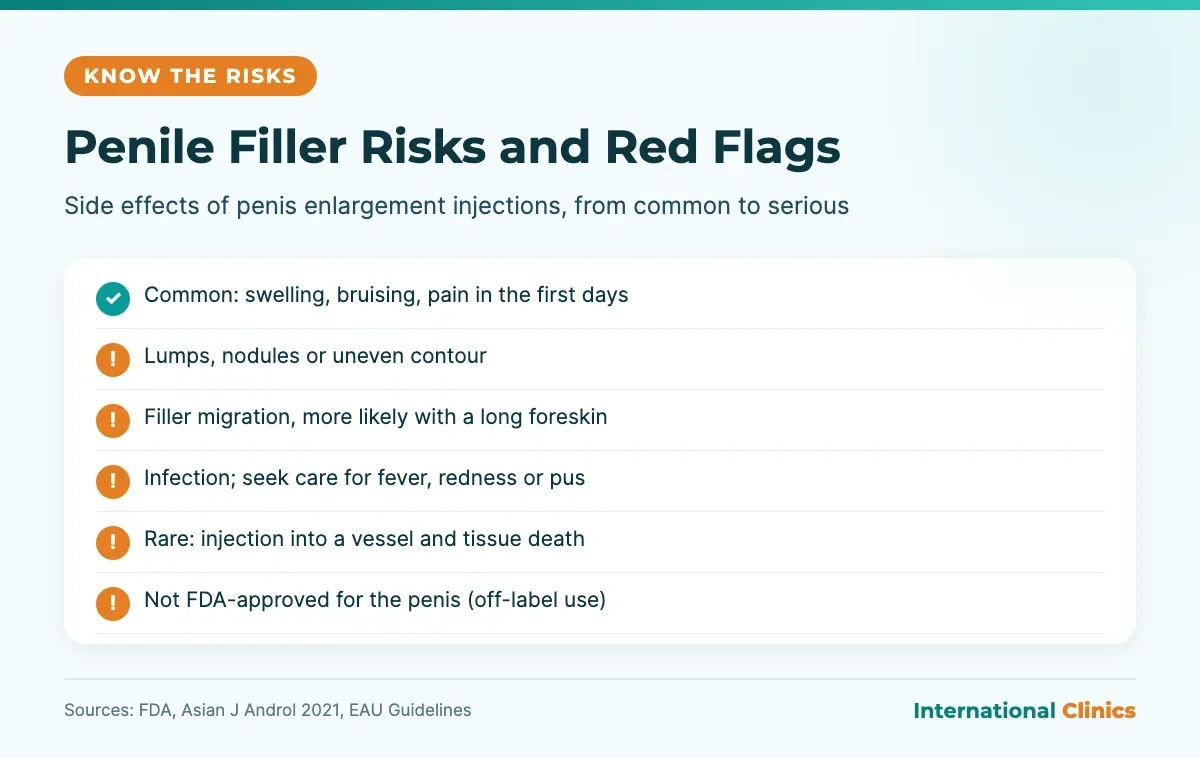
Common and usually temporary: swelling, bruising, soreness, and lumpy or uneven contours as the filler settles or breaks down.
In a series of 230 men treated with hyaluronic acid, 4.3% had complications such as bleeding under the skin, nodules and infection. Nodules were the most frequent (2.2%): small ones were treated with massage and larger ones removed, and both infections occurred in men with diabetes (Source: Asian Journal of Andrology, 2021).
Uncommon but serious: infection, chronic inflammation, granulomas (firm nodules of scar tissue), tissue death (necrosis), and damage to blood vessels or nerves that can affect erections. Permanent and synthetic fillers carry these risks more than reversible hyaluronic acid does, and are far harder to correct if something goes wrong.
The most concerning risk of any dermal filler is accidental injection into a blood vessel, which can block blood flow and cause tissue death (Source: FDA).
Rarely, filler can travel to the lungs: a review of 14 cases of filler-induced pulmonary embolism after genital injections, most of them with silicone, reported that seven patients died (Source: J Cosmet Laser Ther, 2022).
Regulatory position: fillers used for penile augmentation lack long-term safety studies and specific regulatory approval for this anatomical area, even where the same product is approved for facial use. In the United States, the FDA-approved uses of dermal fillers cover areas such as facial wrinkles, lips, cheeks, chin and the back of the hand, not the penis, and injectable silicone is not approved for any aesthetic procedure (Source: FDA).
Silicone, Paraffin and Other Dangerous Penile Injections
Never accept injections of liquid silicone, paraffin, petroleum jelly or mineral oil. These substances cause sclerosing lipogranuloma, a hard, inflamed mass that can lead to skin ulcers, necrosis, infection, deformity and painful erections, often appearing one to two years after the injection. The granulomas do not go away on their own, and treatment usually means removing the affected tissue and reconstructing the skin with grafts or flaps (Source: Translational Andrology and Urology, 2021).
Who Should Not Have Penile Filler
Most men who ask for enlargement have a normal-sized penis; the EAU guideline gives a mean erect circumference of about 11.7 cm and strongly recommends against fillers or fat injection for men with penile dysmorphic disorder, an excessive preoccupation with a normal penis (Source: EAU Guidelines).
International experts also advise a full assessment and careful counselling on benefits, limits and possible complications before any penile augmentation, because long-term data are lacking (Source: ICSM 2024, Sexual Medicine Reviews).
None of this means the procedure is unusable. It means the choice of material, the experience of the injector and a realistic expectation matter more here than in almost any other filler procedure — and that a reversible filler is the safer starting point.
Cost of Penis Enlargement Injections
Male enlargement injection costs vary widely: typical published prices in the United States in 2026 are about $3,500 to $7,500 per session, and in Turkey a standalone session costs about $1,400 to $2,000. What you pay inside that band is driven mostly by the material used and how many millilitres your anatomy and goals call for.
The price of penis filler procedures may include the procedure itself, as well as additional costs such as consultations, follow-up visits, and any necessary post-treatment care. Some clinics charge a flat fee per treatment regardless of volume, plus the cost of the filler used.
What determine the prices of penis enlargement injections:
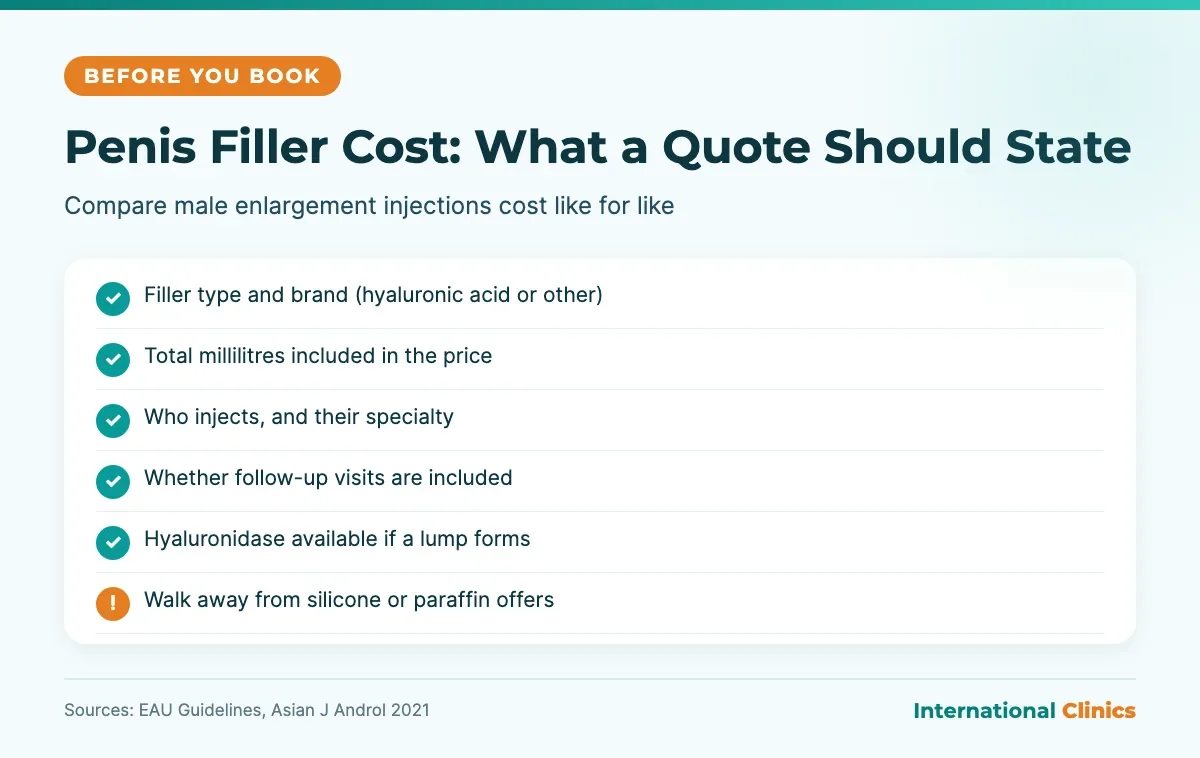
Prices depend on factors such as the type of filler, the volume required (measured in millilitres), the clinic’s location (U.S. vs. international), the provider’s expertise, and whether the procedure is a single session or part of a package.
At your appointment, the doctor will review all available filler types and brands and recommend the appropriate volume. Hyaluronic acid is priced per millilitre or per syringe, and syringe sizes differ between products, so always ask how many millilitres are included in a quote; published studies used about 13 to 40 ml in total.
Factors that affect price of penis enlargement:
1. Volume Required: The amount of filler determined by the desired degree of enlargement and directly affects price.
Estimated Cost by amount of filler and girth increase:
- A modest girth change needs less filler, so it sits at the lower end of the price range.
- A larger change needs more millilitres, sometimes over more than one session, so it costs more.
- No honest clinic will promise you inches. Fillers add circumference, not length, and the result depends on your starting anatomy.
2. Average cost by type of injection
Treatment Type | What to know about the price |
Hyaluronic Acid (HA) Fillers | Most quotes; priced by volume (ml) |
PMMA Fillers | Permanent and cannot be dissolved; not advised as a first choice |
Platelet-Rich Plasma (PRP) | Priced separately; not a volumising filler |
Fat Transfer | Quoted per case |
3. Clinic Location: Prices vary sharply by country. A session in the United States typically sits in the $3,500 to $7,500 band, while Turkey runs about $1,400 to $2,000 for a standalone treatment — which is why so much of this work is done as medical travel.
Average cost by country
Country | Approximate cost per session | What is usually included |
Turkey | $1,400 – $2,000 standalone | Filler and procedure; packages add hotel nights, transfers and the consultation |
United States | $3,500 – $7,500 (typical 2026 published prices) | Procedure only; consultation, follow-ups and top-ups are often billed separately |
Figures for other countries move too quickly to quote reliably, so ask any clinic for a written quote that states the filler brand, the number of syringes and whether follow-ups are included.
4. Single Session vs. Package: Some clinics offer packages that include multiple sessions, consultations, follow-ups, and extra treatments like PRP or Botox. All-inclusive packages in Turkey generally run $2,500 to $3,500
All-inclusive penile enlargement injection packages in Turkey:
Different comprehensive packages are available in Turkey, often bundled with pre-op tests, surgeon’s fees, anesthesia, hotel stays (usually three to four nights), airport transfers, interpreters, and post-op follow-ups, with prices varying by clinic and procedure type.
How much does penis filler cost?
Penis filler costs vary widely depending on location and how much material is used. In the United States a session generally runs $3,500 to $7,500; in Turkey a standalone treatment is closer to $1,400 to $2,000.
The total cost depends on several factors, including the type of filler used (e.g., hyaluronic acid), provider expertise, the number of sessions, and what is included in the quoted price.
Turkey is one of the more affordable destinations for international patients. All-inclusive packages there generally run $2,500 to $3,500 and cover the procedure itself, three to four nights in a partner hotel, airport and clinic transfers, and the consultation.
related topic: How Do Penile Implants Work?
Medical review and disclaimer:
This article was reviewed by Assoc. Prof. Dr. Zülfü Sertkaya, urologist and andrologist (FEBU). It is general health information, not a substitute for medical advice, and results vary between individuals.