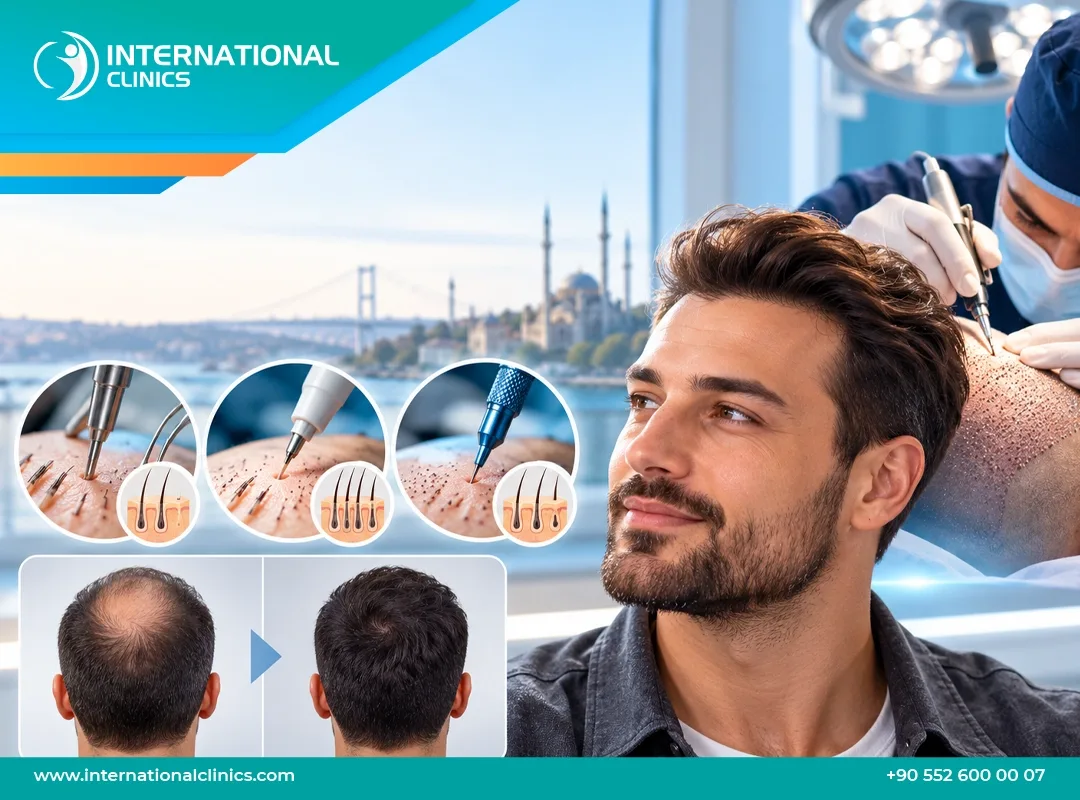
- Understanding Hair Transplant Procedures in Turkey: FUT, FUE, DHI and Sapphire FUE
- Follicular Unit Transplantation (FUT)
- Follicular Unit Extraction (FUE)
- Direct Hair Implantation (DHI)
- Sapphire FUE: what the sapphire blade changes
- Average Cost of Hair Transplant in Turkey (2026) by Technique
- How Much Does FUE Hair Transplant Cost in Turkey in 2026?
- A Schedule of Hair Transplant Techniques: Benefits and Costs
- FUE vs DHI vs Sapphire FUE: Which Is Worth the Extra Cost?
- Detailed Breakdown of Hair Transplant Cost in Turkey
- How Many Grafts Do I Need, and How Does It Affect the Cost?
- Hair Transplant Packages in Turkey: What Is Included and What Is Not
- Hair Transplant Cost in Turkey vs. US, UK, and Australia in 2026
- Hair transplant prices in Istanbul vs. Antalya
- Insurance and Financing Options for Hair Transplant Surgery Cost in Turkey
- Insurance Coverage
- Financing Options
- Travel and Accommodation Expenses for Hair Transplants in Turkey
- Do hair transplant packages include hotel and transportation?
- Conclusion: Choosing a Technique and a Package
- Hair Transplant in Turkey: Before and After Photos and Reviews
Hair transplant cost in Turkey depends above all on the technique and on what the package includes: in 2026 the price runs from about $1,200 for FUT to $1,500–$3,000 for FUE, $2,000–$4,000 for DHI and $2,500–$3,500 for Sapphire FUE. This page compares those techniques and the package contents; for the overall price and the cost by graft count (for example 2000 or 5000 grafts), see how much is a hair transplant in Turkey.
Most Turkish clinics quote all-inclusive packages that already cover the hotel, VIP transfers, translation and post-op medication, so the quote usually covers the treatment and the stay in Turkey, while flights, extra nights and travel insurance are normally paid separately.
Take a close look: Why do people choose Turkey for hair transplant?

Understanding Hair Transplant Procedures in Turkey: FUT, FUE, DHI and Sapphire FUE
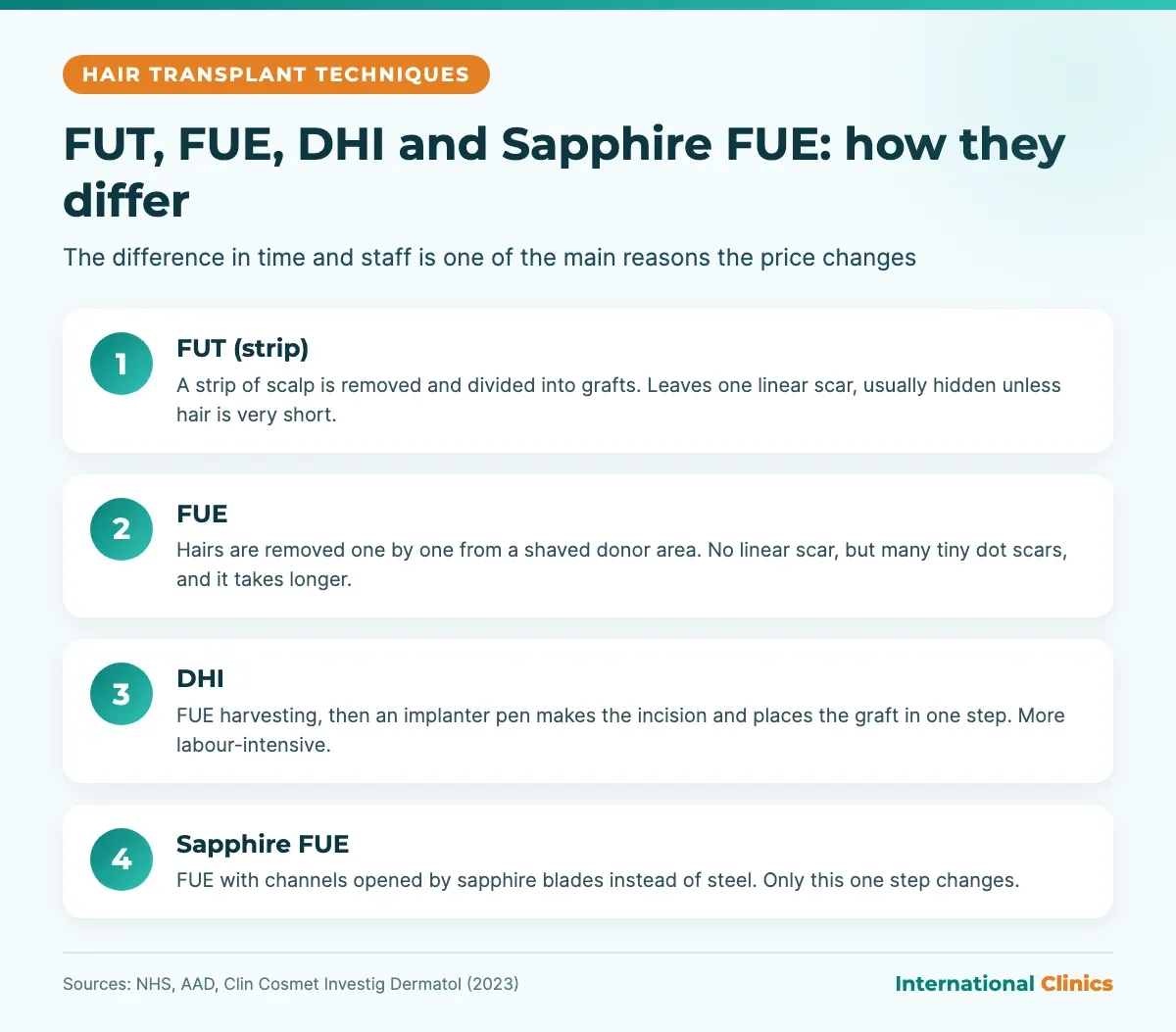
Almost every hair transplant quote in Turkey names one of four techniques: FUT, FUE, DHI or Sapphire FUE. They differ in how the grafts are taken from the donor area and how they are placed, and that difference in time and staff is one of the two biggest drivers of the final price, alongside the amount of hair to be moved. The NHS describes the two ways of harvesting: FUT removes a strip of scalp, while FUE removes hairs one at a time from a shaved donor area (Source: NHS).
| Technique | How grafts are harvested | How grafts are placed | Typical trade-off |
|---|---|---|---|
| FUT (strip) | A strip of scalp is removed and divided into grafts | Into small cuts made in the thinning area | One linear scar, usually hidden unless the hair is cut very short |
| FUE | Individual hairs are removed one by one from a shaved donor area | Into small cuts (channels) made beforehand | No linear scar, but many tiny dot scars; takes longer |
| DHI | The same one-by-one harvesting as FUE | With an implanter pen that makes the incision and inserts the graft in one step | More labour-intensive and usually priced higher |
| Sapphire FUE | The same one-by-one harvesting as FUE | Into channels opened with sapphire blades instead of steel | The blade changes one step only; evidence of a better result is limited |
The table summarises the NHS description of FUT and FUE, the American Academy of Dermatology note that removing hairs one by one takes more time but avoids a long, narrow scar, and the published descriptions of implanter and sapphire-blade techniques cited below (Source: NHS, AAD).
FUT Hair Transplant Turkey: Premium Results [2026]
Related article:
- Afro-Hair Transplants in Turkey: Natural Curls hair
- Hair Transplant Recovery Timeline: What to Expect Week by Week
- How hair transplants work: Guide to Process, Results & Recovery [2026]
- How to sleep after a hair transplant (Day 1-30)
- Full Body Laser Hair Removal Cost in Turkey and USA in 2026
Follicular Unit Transplantation (FUT)
FUT, the strip method, is the lower-cost option in Turkey, at about $1,200 to $1,800. The NHS explains that a thin strip of scalp with hair is removed from the back of the head, divided into pieces of 1 to 4 hairs and placed into tiny cuts in the scalp; the donor site is stitched closed and leaves a scar that is usually hidden unless the hair is very short (Source: NHS).
FUT is offered less often than FUE today, but it still has a place. A 2018 review in the Journal of Cutaneous and Aesthetic Surgery notes that FUT typically yields high-quality grafts and scores higher when multiple sessions of hair transplantation are required (Source: J Cutan Aesthet Surg).
Related article:
3-Month PRP for Hair Loss: Before and After with pictures

Follicular Unit Extraction (FUE)
FUE involves the extraction of individual hair follicles from the donor area, one at a time, and transplanting them into the recipient area. According to the NHS, the back of the head is shaved first, and the many small scars left behind are less noticeable than a strip scar (Source: NHS).
FUE avoids the long, narrow scar, but removing hairs one by one takes a lot more time, which is part of why it is priced above FUT (Source: AAD).
"Less scarring" does not mean no scarring. The International Society of Hair Restoration Surgery (ISHRS) states that there is no such thing as scarless surgery in hair transplantation (Source: ISHRS).

Direct Hair Implantation (DHI)
DHI is a variation of FUE: the grafts are harvested in the same way, but they are placed with an implanter pen (often marketed as a Choi implanter), which directly implants the extracted follicles into the recipient area without the need for channels made in a separate step.
A 2023 practical guide to the sharp implanter method explains that the incision and the graft insertion take place simultaneously, lists a shorter operation time and less crushing of grafts than forceps among its advantages, and describes the method as labour-intensive and expensive compared with forceps placement. It also warns that inexperienced use can lower graft survival, so the result still depends on the team rather than on the pen (Source: Clin Cosmet Investig Dermatol).
For a full guide to the technique, see DHI hair transplant in Turkey.

Sapphire FUE: what the sapphire blade changes
Sapphire FUE is standard FUE harvesting in which the recipient channels are opened with sapphire blades instead of steel ones, and in Turkey it is usually priced at about $2,500 to $3,500. The evidence that the blade itself improves the result is limited and mixed: a 2021 mathematical model found that a 30° sapphire blade caused the least tissue injury of the blade shapes it compared, while a 2023 split-scalp study in 12 patients found that handmade razor blades caused significantly less tissue damage than sapphire blades, and a 2026 observational study of 1,000 patients reported higher graft survival with sapphire than with steel blades (94.7% vs 88.9%) without randomisation. No large randomised trial has settled the question (Source: J Cosmet Dermatol, J Craniofac Surg, J Maxillofac Oral Surg).
More on the technique: Sapphire FUE hair transplant in Turkey.
“You may be a candidate for hair replacement surgery if you: Are in good health. Have realistic expectations about hair replacement results. Still have areas of thick hair growth on your scalp.”
Average Cost of Hair Transplant in Turkey (2026) by Technique
In 2026 hair transplant cost in Turkey ranges between about $1,500 and $4,000 for FUE, DHI and Sapphire FUE packages, and FUT starts at around $1,200. This is much cheaper than a private hair transplant in the UK, which the NHS says can cost anywhere between £1,000 and £30,000, and hair transplants are not available on the NHS because they are cosmetic surgery (Source: NHS).
For the 2026 package tiers at a glance and the price by graft count, see hair transplant cost by graft count.
In Turkey, the hair transplant price varies depending on important factors including:
- The number of grafts needed
- The clinic’s reputation and location
- The surgeon’s expertise
- The technique used
- What’s included in the package
How Much Does FUE Hair Transplant Cost in Turkey in 2026?
In Turkey, FUE technique typically costs around $1,500 to $3,000, depending on the clinic and number of grafts. FUE is the technique most clinics in Turkey quote by default, and Sapphire FUE and DHI are sold as more expensive variations of it.
How is it different from other techniques? FUE falls in the mid-range compared to other methods. It is slightly more expensive than the traditional FUT technique, which costs about $1,200 to $1,800, but still cheaper than DHI ($2,000 to $4,000) or Sapphire FUE, which usually costs between $2,500 and $3,500 in Turkey.
A Schedule of Hair Transplant Techniques: Benefits and Costs
| Hair Transplant Technique | Average Cost in Turkey | Benefits and trade-offs |
|---|---|---|
| FUT Hair Transplant | $1,200 - $1,800 | Lower cost; good-quality grafts, useful when several sessions are planned; leaves one linear scar |
| FUE Hair Transplant | $1,500 - $3,000 | No linear scar (many tiny dot scars instead); the donor area is shaved; takes longer than FUT |
| DHI Hair Transplant | $2,000 - $4,000 | Implanter pen makes the incision and places the graft in one step; more labour-intensive |
| Sapphire Hair Transplant | $2,500 - $3,500 | FUE with channels opened by sapphire blades; studies on the benefit are few and mixed |
The trade-offs in the table follow the NHS and AAD descriptions of strip and one-by-one harvesting, the 2018 review on FUT graft quality, the 2023 guide to the implanter method and the two sapphire-blade studies above (Source: NHS, J Cutan Aesthet Surg, Clin Cosmet Investig Dermatol).
FUE vs DHI vs Sapphire FUE: Which Is Worth the Extra Cost?
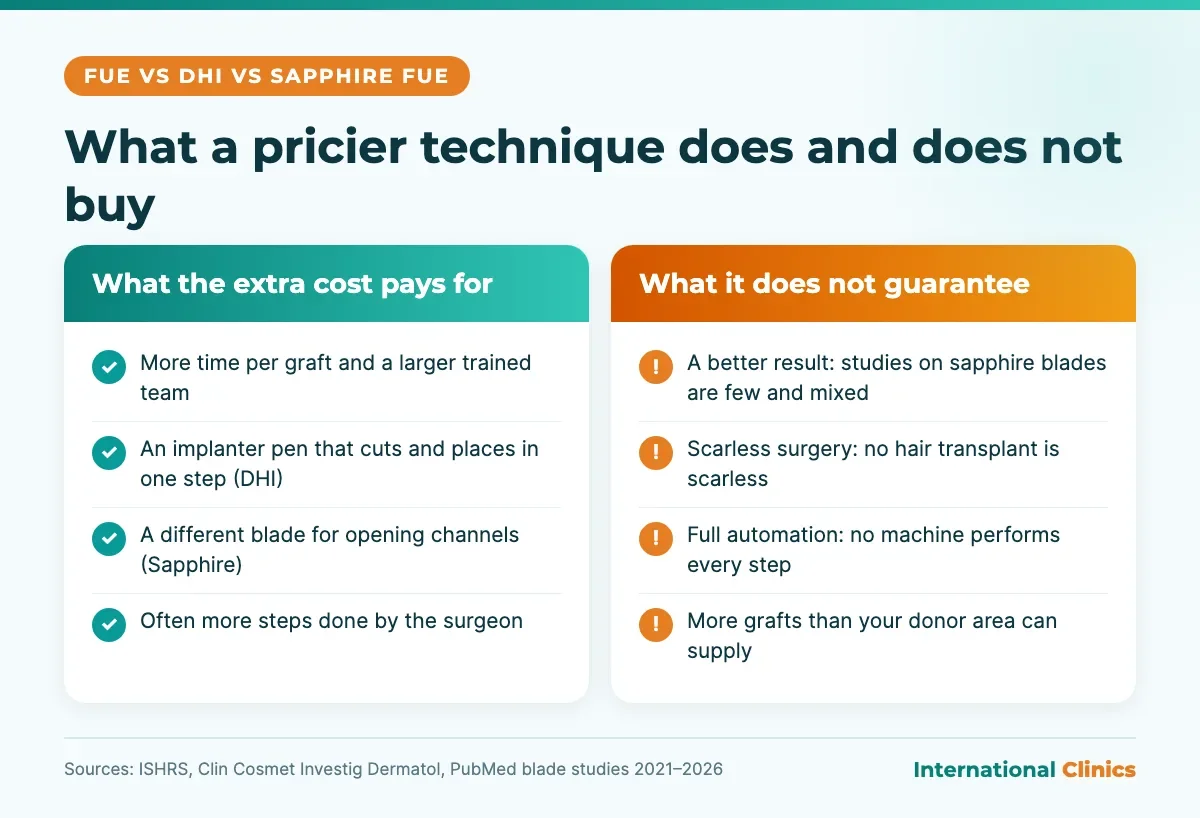
A more expensive technique pays for more time, more staff or a different instrument, not for a guaranteed better result. Which one suits you depends on your type of hair loss, how much donor hair you have, whether you can shave the donor area and how short you wear your hair; the outcome depends mostly on the surgeon and on your own donor hair.
- Choose by your donor area first: the American Academy of Dermatology says you need enough healthy hair to move and the ability to grow hair in the thinning area, and a dermatologist checks both at the consultation (Source: AAD).
- FUT vs FUE: the strip leaves one scar that matters only with very short haircuts; FUE leaves many tiny scars and needs the donor area shaved (Source: NHS).
- DHI: the implanter makes and fills each site in one movement, which takes a trained team, and the published guide rates it as more expensive than forceps placement (Source: Clin Cosmet Investig Dermatol).
- Sapphire FUE: the blade affects only the step of opening the channels, and the few published studies disagree on whether it causes less tissue damage (Source: J Cosmet Dermatol, J Craniofac Surg, J Maxillofac Oral Surg).
- Who does the work: whatever the technique, the ISHRS says a licensed provider knowledgeable in hair restoration must perform all surgical incisions or excisions (Source: ISHRS).
| Your situation | Technique often discussed | Question to ask the clinic |
|---|---|---|
| You wear your hair very short | FUE, DHI or Sapphire FUE (no linear scar) | How much of the donor area will be shaved? |
| You may need several sessions over the years | FUT may be considered | How will you keep donor hair in reserve for later? |
| You are offered DHI at a higher price | DHI | Who will load and use the implanters, and is the doctor present for every step? |
| You are offered Sapphire FUE at a higher price | Sapphire FUE | What exactly changes apart from the blade? |

Detailed Breakdown of Hair Transplant Cost in Turkey
Budgeting for a hair transplant in Turkey means looking at what really changes the final price: the technique, the amount of hair to be moved, who performs each step and what the package includes.
In short, the aspects that affect hair transplant prices in Turkey include:
- Graft numbers: the graft count is a medical estimate set after a scalp assessment. Many Turkish clinics quote one package price for a full session, so the graft count changes the plan more than the price at those clinics (see the next section).
- Technique type: FUT, FUE, DHI and Sapphire FUE are priced differently, as shown above. Be careful with claims about robots or artificial intelligence: the ISHRS says no machine can currently perform all aspects of hair restoration surgery automatically (Source: ISHRS).
- Clinic reputation: renowned practices and well-known surgeons usually charge higher fees for their time and experience, but more affordable options exist.
- Location factors: prices also differ between cities; see the Istanbul vs Antalya comparison below.
- Support therapies: PRP (platelet-rich plasma) is often an add-on. The American Academy of Dermatology says PRP can be given before a hair transplant to improve results, that treatment is repeated monthly for the first three months and then every three to six months, and that it is not a permanent solution (Source: AAD).
- Custom personalization: for those wanting private hospital suites, nurse assistants or a personal translator, extra service charges may apply; ask which of these the package already includes.
- Rare case complexity: occasionally, scarring, earlier surgery or other unusual situations need a more complex plan or a repair procedure, which can be priced separately.
How Many Grafts Do I Need, and How Does It Affect the Cost?
The number of grafts you need depends on how large the thinning area is and how much healthy donor hair you have, and each graft holds 1 to 4 hairs. Only a scalp examination can confirm it, and a large area may need 2 or more sessions on different days (Source: NHS).
At clinics that bill per graft, the price for one graft in Turkey typically ranges between $0.50 and $2, depending on the clinic and technique used. Quotes for 2,000 to 5,000 grafts are common, but a bigger number is not automatically better: a 2018 review describes about 2,500 grafts as an upper limit for FUE in one session and warns that the safe donor limit is being breached in many clinics (Source: J Cutan Aesthet Surg).
The price for 1,000 to 6,000 grafts, and how flat-rate packages handle it, is explained on our main page on how much a hair transplant costs in Turkey, so it is not repeated here.
Graft count is also what sets the price of other follicular-unit procedures, not just scalp work: an eyebrow transplant in Turkey uses grafts from the same donor area and is priced the same way.
Hair Transplant Packages in Turkey: What Is Included and What Is Not
Hair transplant Turkey packages bundle the treatment and the stay into one price, which makes the trip easier to plan for international patients. What matters is to read exactly what each package includes, because two quotes for the same technique can cover very different things.
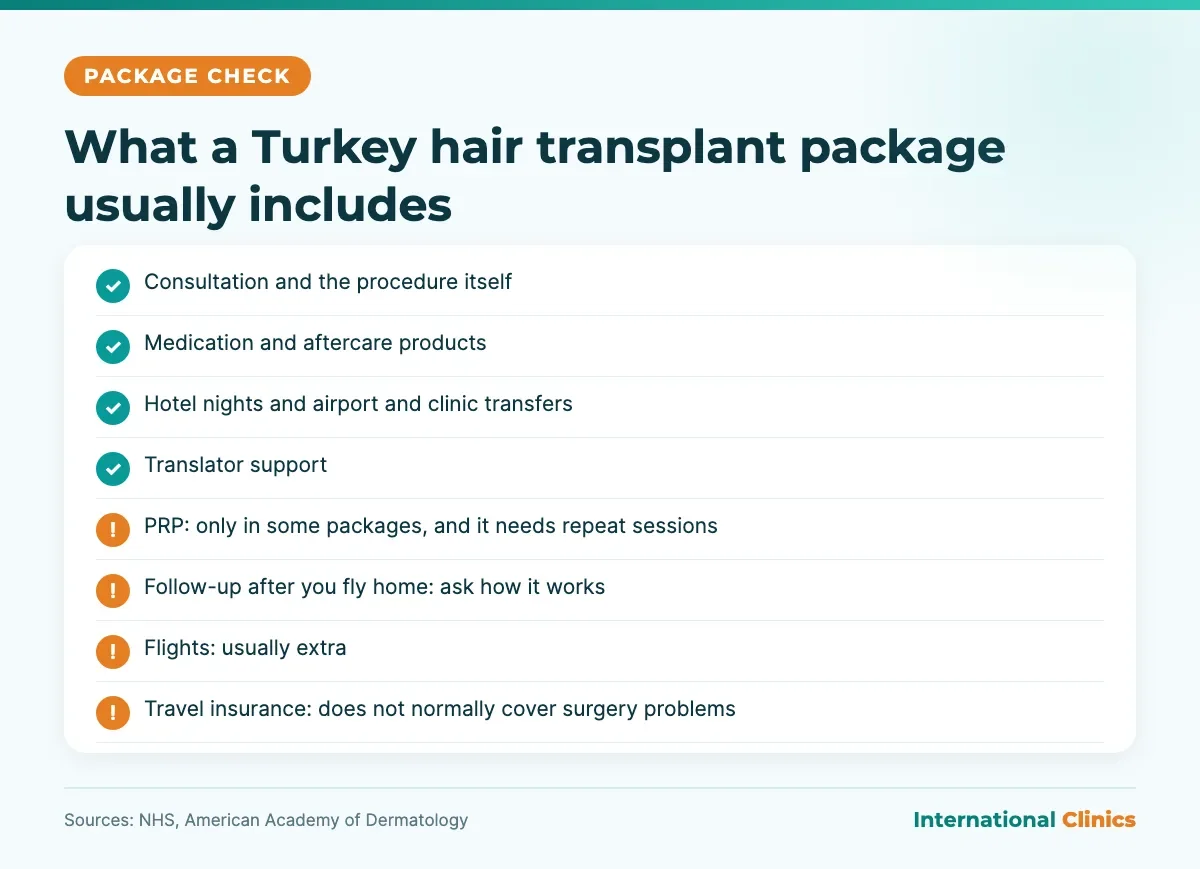
What do Turkish hair transplant packages include?
| Item | Usually included? | What to check |
|---|---|---|
| Consultation | Yes, often free | That a doctor assesses your hair loss before a price is confirmed |
| Surgical procedure | Yes | The technique, the estimated graft count and who performs each step |
| Medications | Yes | Pain relievers, antibiotics and aftercare products |
| Hotel accommodation | Usually | How many nights, and the price of extra nights or a companion |
| Transportation | Usually | Airport transfers and transport between the clinic and hotel |
| Medical equipment | Often | Medical pillow and cap for the first nights |
| PRP treatment | Sometimes | How many sessions, since PRP is normally repeated |
| Post-op follow-up | Some clinics | How the clinic follows your progress after you fly home |
| Flights and travel insurance | No | What your insurance covers if something goes wrong |
- Free Consultation: many clinics offer free consultations to assess suitability for the procedure.
- Surgical Procedure: includes the cost of the hair transplant based on the number of grafts and technique used.
- Post-Op Care: some clinics include follow-up appointments for recovery.
- Medications: includes prescription medications like pain relievers and antibiotics.
- PRP Treatment (Optional): some packages may include platelet-rich plasma therapy.
- Hotel Accommodation: many clinics offer hotel stays for international patients.
- Transportation: includes airport transfers and transport between the clinic and hotel.
- Medical Equipment: includes items like a medical pillow and cap for recovery.
Before you pay for any package, the NHS advises meeting the surgeon in a consultation, being cautious of websites selling cosmetic surgery as part of a holiday, and checking what your travel insurance covers, because it does not normally cover you if things go wrong in surgery (Source: NHS).
The package is not the only cost. The NHS also advises understanding the cost of aftercare and of any future procedures you might need, and the other extras to budget for are listed on our page on extra hair transplant costs in Turkey (Source: NHS).
Related Article:
PRP Hair Loss Treatment Cost: [2026 Price Guide + Insurance Coverage]

Hair Transplant Cost in Turkey vs. US, UK, and Australia in 2026
Turkey is usually much cheaper than the United States, the UK or Australia, mainly because of lower staff and running costs. For the UK, the NHS puts a private hair transplant at £1,000 to £30,000 and confirms that hair transplants are not available on the NHS because they are cosmetic surgery (Source: NHS).
The NHS also says surgery abroad can cost less than in the UK, but that the saving should be weighed against the risks and the cost of any aftercare or further surgery (Source: NHS).
A detailed comparison with American prices is on hair transplant cost in the USA vs Turkey.
Hair transplant prices in Istanbul vs. Antalya
The cost of hair transplant in Istanbul is around $1,800 to $4,000, while in Antalya it’s slightly cheaper, averaging $1,500 to $3,000. Istanbul has more clinics to choose from, while Antalya combines treatment with a resort setting. International Clinics is based in Istanbul.
Related:
How to Regrow Thinning Hair in Female: Surgical, Non-Surgical and Natural Options
prp facial before and after one treatment

Insurance and Financing Options for Hair Transplant Surgery Cost in Turkey
Hair restoration for pattern hair loss is treated as cosmetic surgery, so insurers and public health systems rarely pay for it. The NHS, for example, states that hair transplants are not available on the NHS because they are cosmetic surgery (Source: NHS).
Patients therefore usually pay themselves, in full or through a payment plan or a loan.
Insurance Coverage
- Cosmetic exclusion: almost all insurers classify hair restoration as elective cosmetic surgery and do not cover it, in Turkey or at home.
- Reconstructive exception: transplants that repair burn or trauma scarring are occasionally treated differently from cosmetic cases; ask your insurer in writing before you travel.
- Travel insurance: the NHS warns that travel insurance does not normally cover you if things go wrong in surgery, so ask the clinic what insurance it holds (Source: NHS).
Financing Options
- Medical loans: some banks and lenders offer personal or medical loans; compare the total cost of credit, and never feel pushed to borrow before you have decided.
- Clinic payment plans: some clinics offer instalment plans; ask for the full terms, the deposit and the refund rules in writing.
- Time to decide: the NHS says you should be offered a cooling-off period after any consultation with a practitioner (Source: NHS).

Travel and Accommodation Expenses for Hair Transplants in Turkey
Some key elements to remember when budgeting for medical travel and accommodation expenses in Turkey while having a hair transplantation include:
- Airfare: flight costs vary based on origin and season, and flights are usually not part of the package.
- Lodging: the package normally includes a set number of hotel nights; staying longer or upgrading is paid separately.
- Airport Transfers: most clinics include arrival and departure transport by private driver.
- Meals: some hotels include breakfast; budget for other meals yourself.
- Caregiver costs: if bringing a companion, keep in mind their flight, hotel, food and activity expenses.
- Time off work: the NHS says the procedure usually takes a day without an overnight stay, bandages can usually be removed after 2 to 5 days, and you may need 1 to 2 weeks off work (Source: NHS).
Do hair transplant packages include hotel and transportation?
Yes, most hair transplant packages in Turkey do include hotel accommodation and VIP transportation.
Typically, the package covers airport pickup, a hotel stay (usually 3 to 4 nights in a 4 or 5-star hotel), clinic transfers, translator support, the hair transplant procedure itself and post-op medications. Some premium packages in Turkey may also include sightseeing options or extra follow-up care.
Conclusion: Choosing a Technique and a Package
In Turkey, the technique is the clearest difference between hair transplant prices: FUT is the cheapest, FUE sits in the middle, and DHI and Sapphire FUE cost more. The higher price buys more time, staff or a different instrument, not a guaranteed better result, so compare quotes on the technique, the estimated graft count, who performs each step and exactly what the package includes. Results take time to judge: the NHS says new hair usually appears after about 4 months and the full results should be seen after 10 to 18 months (Source: NHS).
For the procedure itself, candidates and choosing a clinic, see our full guide to hair transplant in Turkey; women considering surgery can read about female hair transplant.
Book a free consultation with the International Clinics team for a personalised quote based on your hair loss, the technique that suits you and the graft count you actually need.
Related hair transplant types:
- Beard hair transplant technique
- Hair transplant before and after - International Clinics
- How many PRP sessions are needed for hair growth? Full PRP benefits
- FUT Hair Transplant Turkey: Premium Results [2026]
- How Much Is a Hair Transplant in USA vs Turkey Prices [2026]?
- FUE Hair Transplant Turkey 2026: technique and results
- Hair Replacement Options for Women: Non-Surgical & Permanent Solutions
- Turkey vs. Mexico Hair Transplant: Cost, Techniques, and Results Compared
- Full Body Laser Hair Removal Cost in Turkey and USA in 2026
Hair Transplant in Turkey: Before and After Photos and Reviews
The photo gallery on this page shows before-and-after results of hair transplant patients. Results vary between individuals: the American Academy of Dermatology says the transplanted hair falls out between 2 and 8 weeks after surgery, which is normal, and most patients see results 6 to 9 months after surgery (Source: AAD).
Medical review and disclaimer:
This article was reviewed by a specialist physician contracted with International Clinics. It is general health information, not a substitute for medical advice, and results vary between individuals.