
- Hair Transplant Turkey: What You Need to Know
- How Much Does a Hair Transplant in Turkey Cost?
- What an all-inclusive package usually covers
- Hair Transplant Techniques in Turkey: FUE, Sapphire FUE and DHI
- FUE vs FUT: the two ways grafts are harvested
- Who Is a Good Candidate for a Hair Transplant?
- Are Turkey Hair Transplants Actually Good?
- How to choose the best hair transplant in Turkey
- Questions to ask before you book a hair transplant
- Is Turkey Safe to Get a Hair Transplant?
- What Happens on Hair Transplant Day?
- Hair Transplant Recovery Timeline
- Aftercare in the first weeks
- How Long Do Turkey Hair Transplants Last?
- Why transplanted hair sheds before it grows
- Hair Transplant in Turkey vs Other Countries
- Sources
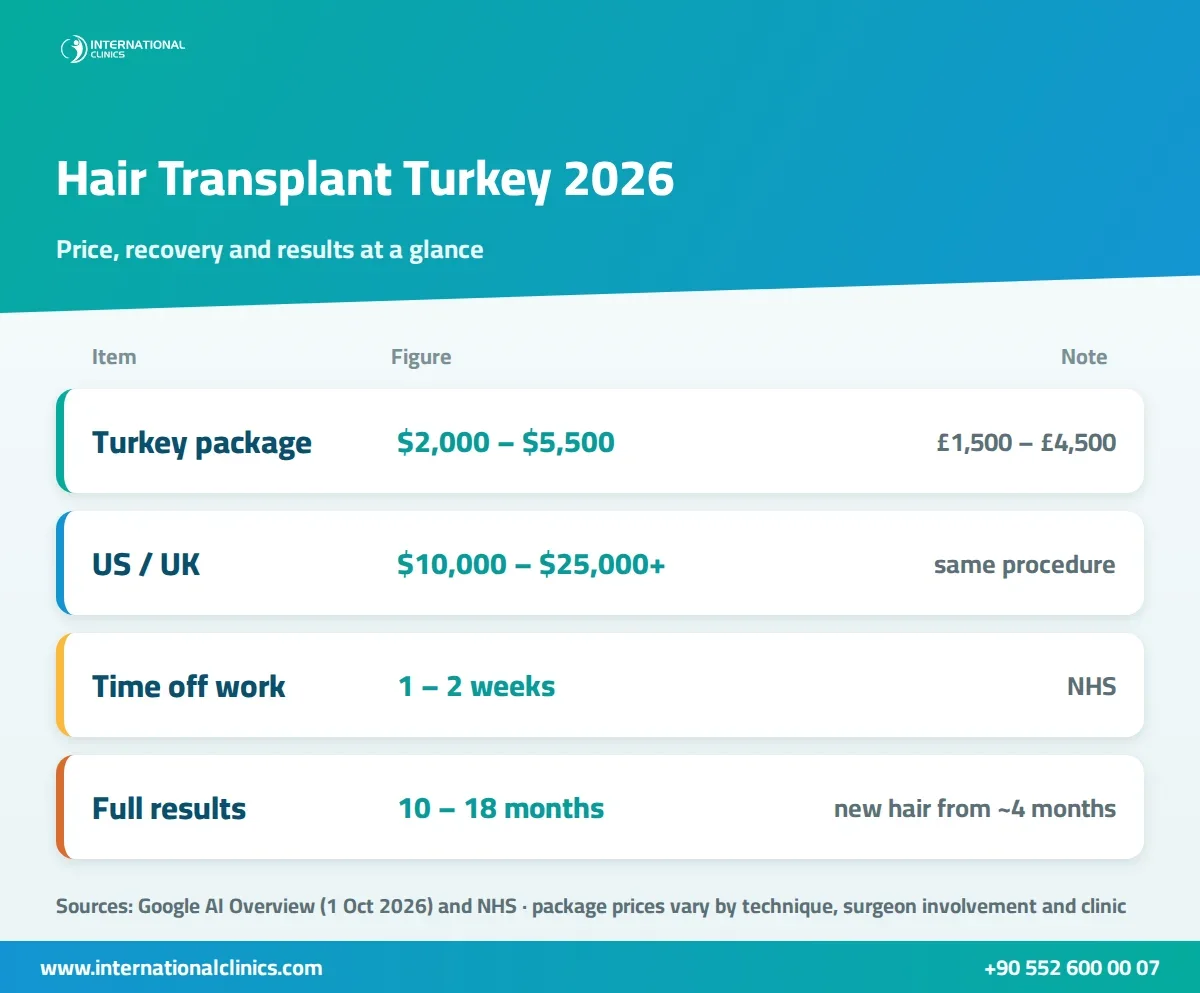
Hair transplant Turkey packages typically cost between $2,000 and $5,500 (£1,500–£4,500) for an all-inclusive package, compared with $10,000–$25,000+ in the US or UK. Most packages cover the procedure, 3 to 4 nights in a hotel, airport transfers, medications and translation, and the main techniques offered are FUE, Sapphire FUE and DHI.
Hair Transplant Turkey: What You Need to Know
A hair transplant is a procedure that moves hair from a dense donor area, usually the back or sides of the head, to an area that is thin or bald. Turkey has become one of the most popular destinations for it because of package pricing that bundles surgery, hotel and transfers into a single fee.
| Item | Typical figure |
|---|---|
| Package price in Turkey | $2,000 – $5,500 (£1,500 – £4,500) |
| Comparable price in the US or UK | $10,000 – $25,000+ |
| Hotel nights usually included | 3 – 4 nights |
| Procedure length | Usually one day, no overnight stay |
| Time off work | 1 – 2 weeks |
| New hair starts to appear | After about 4 months |
| Full results | After 10 – 18 months |
How Much Does a Hair Transplant in Turkey Cost?
A hair transplant in Turkey typically costs $2,000 to $5,500 (£1,500 to £4,500) for an all-inclusive package. The final price depends mainly on the technique, how directly the surgeon is involved and the clinics reputation, rather than on an exact per-graft count, so a 3,000-graft session usually sits within the same package range. For a detailed tier-by-tier breakdown, see hair transplant cost in Turkey.
What an all-inclusive package usually covers
- The procedure itself.
- 3 to 4 nights in a hotel.
- Airport and clinic transfers.
- Medications.
- Translation services.
Hair Transplant Techniques in Turkey: FUE, Sapphire FUE and DHI
| Technique | How it works |
|---|---|
| FUE (Follicular Unit Extraction) | Individual hair follicles are harvested one by one and moved to thinning areas. |
| Sapphire FUE | A variation of FUE that uses sapphire blades to open the recipient channels. |
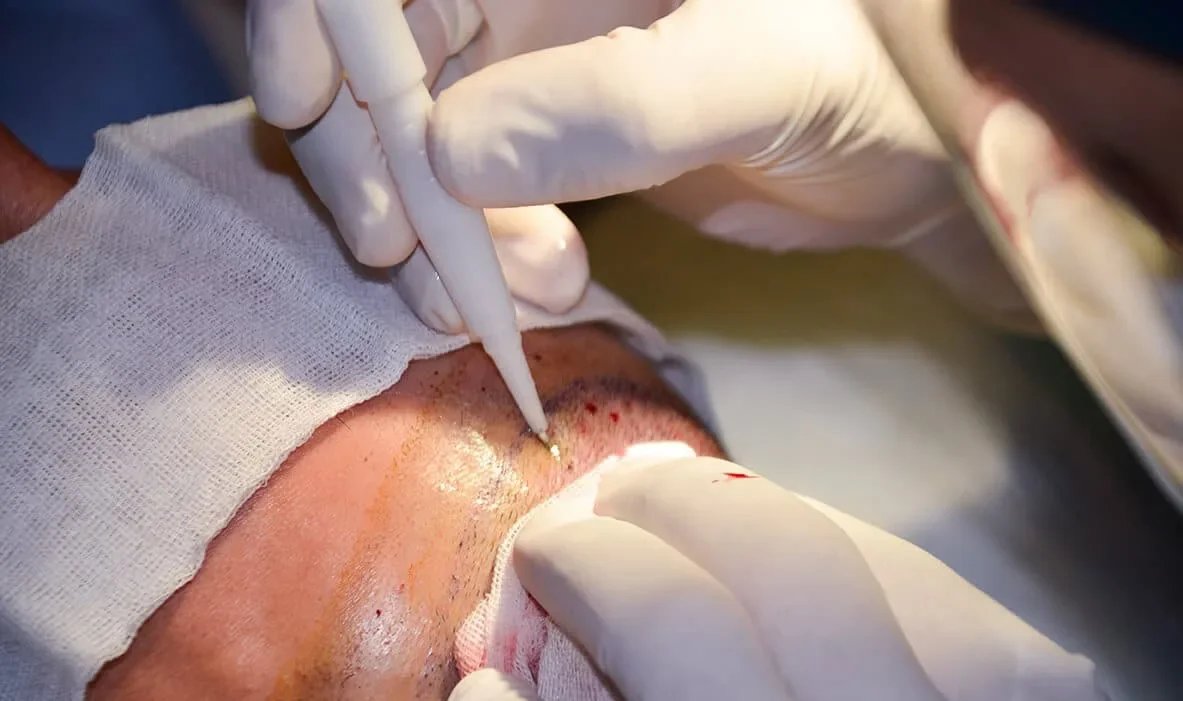
| DHI (Direct Hair Implantation) | A pen-like tool implants follicles directly without pre-made channels. |
FUE vs FUT: the two ways grafts are harvested
Every hair transplant starts by harvesting grafts from the donor area, and there are two ways to do it. In FUT (follicular unit transplantation, or the strip method), the NHS explains that a thin strip of skin is removed from the back of the head and divided into grafts of 1 to 4 hairs; it leaves a single scar that is usually hidden unless the hair is cut very short, and the head does not need to be shaved. In FUE (follicular unit extraction), the back of the head is shaved and hairs are removed one by one, leaving many tiny scars that are not very noticeable. The American Academy of Dermatology notes that removing individual hairs takes more time but avoids a long, narrow scar, which suits people who prefer close-cropped haircuts. Sapphire FUE and DHI both use FUE-style harvesting.
Each technique has its own guide: Sapphire hair transplant in Turkey, DHI hair transplant in Turkey and hair transplant techniques.
Who Is a Good Candidate for a Hair Transplant?
A hair transplant suits people with permanent, inherited pattern baldness who still have enough healthy donor hair. The NHS says it is not usually suitable for other types of hair loss, such as alopecia areata, which causes bald patches. According to the American Academy of Dermatology, you need two things:
- Enough healthy hair on the scalp that can be moved to the thinning area.
- The ability to grow hair in the thinning area.
A scalp examination, and sometimes a blood test or scalp biopsy, helps confirm the cause of hair loss. Younger men in their 20s may be advised to wait and start a hair loss medicine first, because the pattern of loss is still developing. Good general health and realistic expectations matter too: a fuller head of hair is a realistic goal, while a full head of hair may not be.
Are Turkey Hair Transplants Actually Good?
Results depend on the surgeon and the facility, not on the country. Look for licensed surgeons working in Ministry of Health–accredited hospitals or internationally certified facilities, and research the individual surgeon rather than relying on clinic marketing, since high-volume clinics where technicians do most of the work are common. Why so many patients choose Turkey is covered in why do people go to Turkey for hair transplants.
How to choose the best hair transplant in Turkey
- Confirm who performs the graft extraction and implantation: the key surgical steps should be done or directly supervised by a licensed physician, not delegated to technicians.
- Check that the facility is authorised by the Turkish Ministry of Health for hair transplantation.
- Ask for a written plan stating the technique (FUE, Sapphire FUE or DHI), the estimated graft count and exactly what the package includes.
- Look for an aftercare plan with follow-up after you return home, and be wary of any clinic that promises a guaranteed result.
Questions to ask before you book a hair transplant
The International Society of Hair Restoration Surgery (ISHRS) says diagnosis, surgical planning, donor hair harvesting, hairline design, recipient site creation and post-operative care should be performed by a licensed physician. Before you pay a deposit, ask:
- Who will assess my hair loss, and what are their qualifications and experience?
- Who will make the incisions and harvest the grafts, and will anyone who is not a licensed doctor do either?
- How many hair transplants has the surgeon performed, and how many had complications?
- Which technique do you recommend for me, and why?
- What follow-up will I get if something goes wrong after I fly home?
- Is everyone involved in my surgery covered by malpractice insurance?
Is Turkey Safe to Get a Hair Transplant?
A hair transplant in Turkey can be a reasonable choice when it is performed by a licensed surgeon in an accredited facility, but like any surgery it carries risks. The NHS lists small risks of bleeding, infection and an allergic reaction to the anaesthetic, and common side effects such as a tight, achy and swollen scalp for a few days and temporary scabbing where the hair was transplanted.
What Happens on Hair Transplant Day?
A hair transplant usually takes a single day: the American Academy of Dermatology says surgery typically lasts 4 to 8 hours, and most patients stay awake with a local anaesthetic that numbs the scalp, sometimes with a mild sedative. The usual sequence is:
- Planning: the surgeon confirms the graft plan and draws the new hairline.
- Anaesthesia: the donor and recipient areas are numbed.
- Harvesting: grafts are taken from the back or sides of the head by FUE or FUT.
- Preparation: the team prepares the grafts while the recipient area is made ready.
- Placement: grafts are placed into tiny cuts in the thinning area, or implanted directly with a DHI pen.
- Dressing: the scalp is bandaged and you receive at-home care instructions.
If a large area is being treated, the NHS notes you may need 2 or more sessions on different days, which is worth confirming before you book flights.
Hair Transplant Recovery Timeline
"Hair transplants usually take a day, but you should not need to stay overnight."
— NHS, Hair transplant.
- After 2 to 5 days: any bandages can usually be removed.
- Day 6: you should be able to wash your hair gently by hand.
- After 10 to 14 days: any non-dissolvable stitches can usually be removed.
- After about 4 months: new hair usually starts to appear.
- After 10 to 18 months: the full results should be seen.
Visible redness and swelling usually settle within 5 to 10 days, and the NHS notes you may need 1 to 2 weeks off work. A week-by-week guide is in hair transplant recovery timeline.
Aftercare in the first weeks
- Protect the grafts: the NHS says to be very careful with transplanted hair for the first 2 weeks, because the grafts are not yet secure, and not to touch them when bandages come off.
- Follow the product plan: use the spray or other products your surgeon gives you to support healing.
- Limit exercise: you may be told to cut down on exercise in the first month to reduce scarring.
- Rest before sightseeing: NHS advice on surgery abroad is to rest afterwards rather than treat the trip as a holiday, avoiding alcohol, sun exposure and swimming.
- Know the warning signs: Cleveland Clinic advises contacting your provider for a fever that does not go away, excessive bleeding, severe redness or pain, or pus from the cuts in the scalp.
How Long Do Turkey Hair Transplants Last?
Transplanted hair is generally long-lasting because it is taken from the back or sides of the head, where follicles resist DHT, the hormone behind common pattern baldness. It is normal for the newly placed hairs to shed in the weeks after surgery before new growth begins. The surrounding native hair can still thin over time, which is why some people later consider a further session.
Why transplanted hair sheds before it grows
Shedding is a normal stage, not a sign of failure. The American Academy of Dermatology explains that the transplanted hair falls out between 2 and 8 weeks after surgery, and by the third month the hair may look thinner than before the transplant. Regrowth follows, and a dermatologist may recommend a hair loss medicine afterwards, because thinning of the surrounding native hair can continue and medicine can slow it down.
Hair Transplant in Turkey vs Other Countries
The same procedure that costs $2,000 to $5,500 in Turkey often costs $10,000 to $25,000+ in the US or UK. For a direct comparison with another popular destination, read Turkey vs Mexico hair transplant, and to understand the procedure step by step, see how hair transplants work.
Sources
- NHS — Hair transplant, nhs.uk.
- NHS — Cosmetic surgery abroad, nhs.uk.
- American Academy of Dermatology — Hair transplants, aad.org.
- Cleveland Clinic — Hair Transplant, my.clevelandclinic.org.
- International Society of Hair Restoration Surgery — Consumer advocacy, ishrs.org.
A gloved surgeon implants hair grafts with a DHI implanter pen, one of the main hair transplant techniques. Photo: Könül Yazar, CC BY-SA 4.0, via Wikimedia Commons.