- How Much Is a Hair Transplant in Turkey?
- Per-graft vs flat-rate pricing: how a quote is calculated
- Hair Transplant Cost in Turkey by Graft Count: 1,000 to 6,000 Grafts
- Hair Transplant Cost in Turkey by Technique
- Is FUT (the strip method) priced differently?
- Does the Treatment Area Change the Price of a Hair Transplant?
- Crown and hairline transplant cost in Turkey
- What Is Included in a Turkey Hair Transplant Package?
- Hair transplant cost in Istanbul
- Are You a Candidate Before You Pay for a Hair Transplant?
- Extra Costs to Budget Beyond the Package
- How Much Does It Cost to Get 3,000 Hair Grafts in Turkey?
- What Affects Turkey Hair Transplant Cost?
- Red Flags in Cheap Hair Transplant Deals
- Questions to Ask Before You Accept a Hair Transplant Quote
- How Many Days Do You Need in Turkey for a Hair Transplant?
- Is a Hair Transplant in Turkey Worth It?
- Can you get a hair transplant on the NHS?
- How Much Is a Hair Transplant in Turkey vs USA?
- How Long Do Turkey Hair Transplants Last?
- What the results timeline means for your budget
- Will you need to pay for a second session?
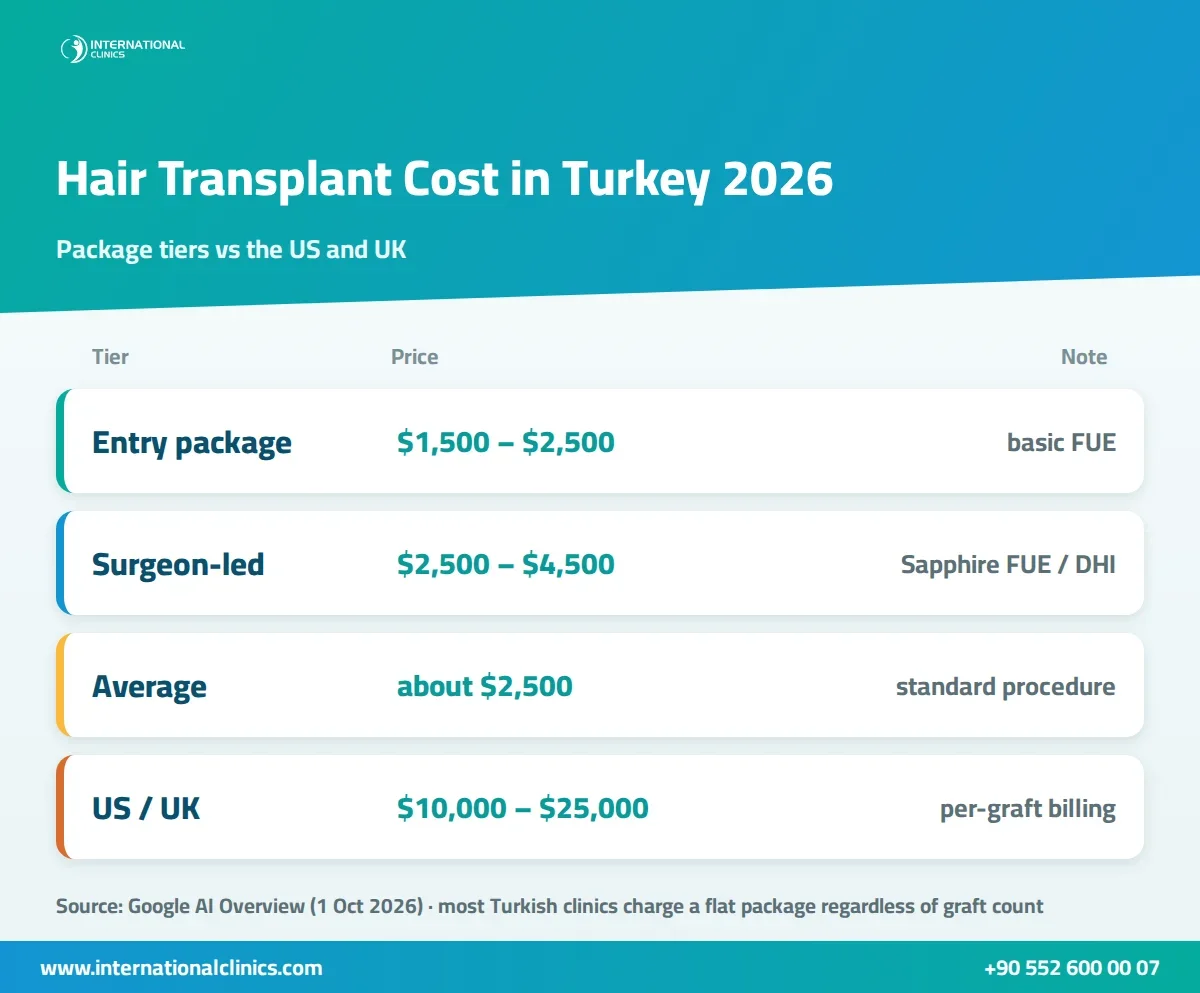
How much is a hair transplant in Turkey? In Turkey, a hair transplant typically costs between $1,500 and $5,000 for an all-inclusive package in 2026, with a standard procedure averaging around $2,500. The Turkish hair transplant cost depends mainly on the technique and on how involved the surgeon is, not on the graft count, because most clinics charge one flat package price. In the US or UK, where clinics usually bill per graft, the same procedure often costs $10,000 to $25,000.
This page focuses on cost: price by package tier, by technique and by graft count, what a package includes and what it leaves out. For the procedure itself, candidates and choosing a clinic, see our full guide to hair transplant in Turkey.
How Much Is a Hair Transplant in Turkey?
A hair transplant in Turkey typically costs $1,500 to $5,000 all-inclusive, and the average price for a standard procedure is around $2,500. Unlike Western clinics that bill per graft, most Turkish clinics use a flat-rate package, so the price stays the same whether you need 2,500 or 4,500 grafts.
| Package tier | Price range | What you get |
|---|---|---|
| Standard / entry | $1,500 – $2,500 | Basic FUE package, often at high-volume clinics where technicians perform much of the work |
| Mid-tier (surgeon-led) | $2,500 – $4,500 | Sapphire FUE or DHI with direct doctor involvement in planning and channel opening |
| US or UK (comparison) | $10,000 – $25,000 | Usually billed per graft |
For the UK alone, the NHS gives a wider range: a private hair transplant there can cost anywhere between £1,000 and £30,000, depending on how much hair loss there is, the type of procedure and the clinic (Source: NHS).
Per-graft vs flat-rate pricing: how a quote is calculated
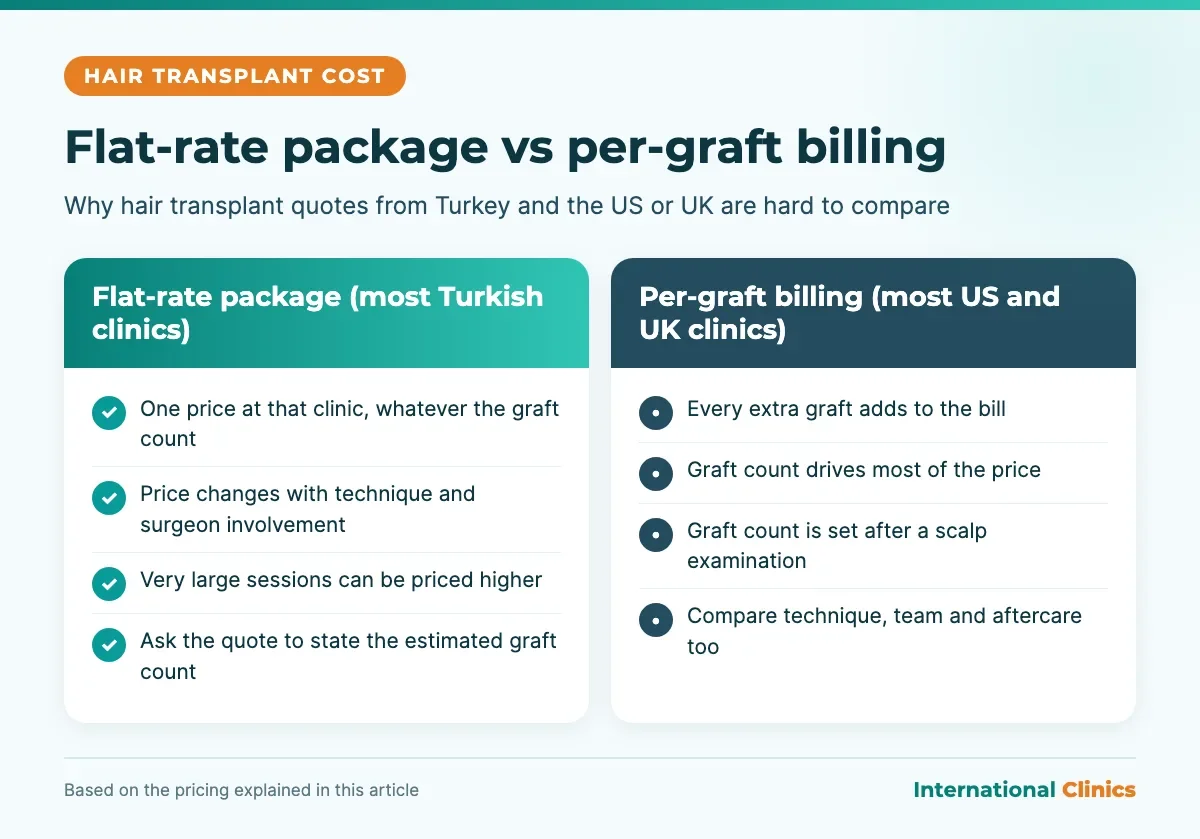
Most Turkish clinics quote one flat package price, while clinics in the US and UK usually bill per graft, which is the main reason the two are hard to compare directly. With a flat rate, the number of grafts you need does not change the price at that clinic, but the price does change with the technique, the surgeons involvement and the facility. With per-graft billing, every extra graft adds to the bill. When you compare quotes, check that each one states the estimated graft count, the technique, who performs each step and exactly what is included, so you are comparing like with like.
The graft count itself is a medical estimate, not a sales figure. It depends on how large the thinning area is and how much healthy donor hair you have, which only a scalp examination can confirm. Each graft holds 1 to 4 hairs (Source: NHS).
Premium mega-sessions with highly renowned surgeons or 5,000+ grafts can cost more than the standard range. For how the cost compares specifically with American clinics, see hair transplant cost in the USA vs Turkey.
Hair Transplant Cost in Turkey by Graft Count: 1,000 to 6,000 Grafts
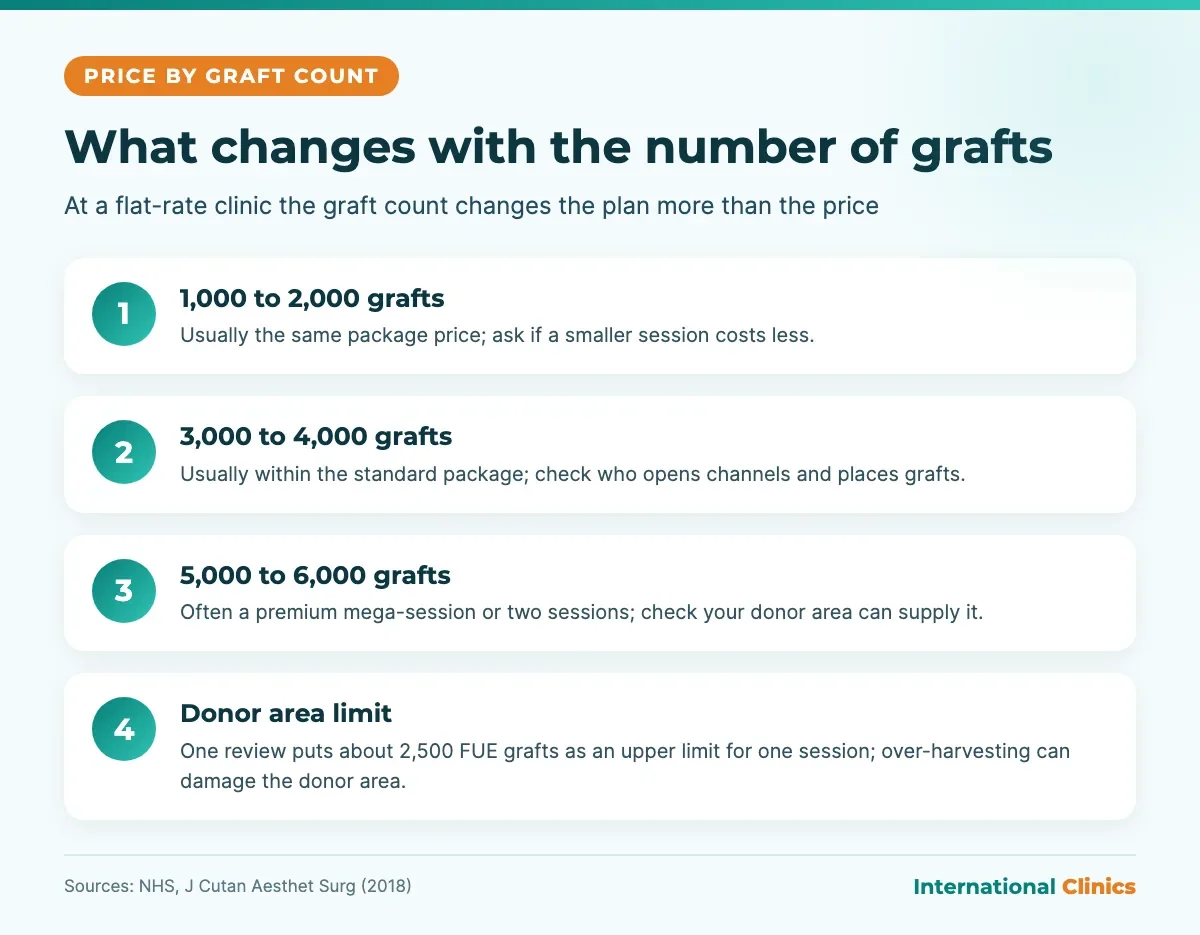
At a flat-rate clinic, 1,000, 2,000, 3,000 or 4,000 grafts usually cost the same package price within the typical $1,500 to $5,000 range; what changes with the graft count is how many sessions you need and whether your donor area can safely supply it. Very large requests, such as 5,000 or 6,000 grafts, are where quotes most often move above the standard range or into two sessions.
| Grafts requested | How it is usually priced in Turkey | What to check in the quote |
|---|---|---|
| 1,000 – 2,000 grafts | Same flat package price as larger sessions at most clinics | Whether a smaller session is offered at a lower price; a small area may not need a full package |
| 3,000 – 4,000 grafts | Usually within the standard package price | The estimated graft count after a scalp assessment, and who opens the channels and places the grafts |
| 5,000 – 6,000 grafts | Often priced as a premium mega-session or split into two sessions | Whether your donor area can supply this safely, and the price of a second session |
A large graft number is not automatically better value. A 2018 review in the Journal of Cutaneous and Aesthetic Surgery describes an upper limit of roughly 2,500 grafts that can be harvested by FUE in one session, and warns that over-harvesting can leave a "moth-eaten" donor area (Source: J Cutan Aesthet Surg).
The NHS also notes that a large area may need 2 or more sessions on different days, which is why a 6,000-graft plan should state clearly whether it is one session or two (Source: NHS).
Hair Transplant Cost in Turkey by Technique
The technique is one of the clearest drivers of price: basic FUE sits in the entry tier, while Sapphire FUE and DHI are usually sold as surgeon-led packages.
The table below is a quick summary by package tier. For how FUE, DHI and Sapphire FUE actually differ, why some techniques cost more and what each package includes, see our guide to hair transplant cost in Turkey by technique.
| Technique | Typical package tier in Turkey | How it differs |
|---|---|---|
| FUE | $1,500 – $2,500 (standard / entry) | Hairs are removed one by one from the shaved donor area and placed into tiny cuts in the scalp |
| Sapphire FUE | $2,500 – $4,500 (surgeon-led) | FUE harvesting, with the recipient channels opened using sapphire blades |
| DHI | $2,500 – $4,500 (surgeon-led) | Grafts are implanted directly with a pen-like tool, without pre-made channels |
A higher tier reflects more doctor involvement and the facility, not a promise of a better result. Results depend on the surgeon and on your own donor hair.
Is FUT (the strip method) priced differently?
FUT is the other main way of harvesting grafts, and whether a clinic offers it, and at what price, varies, so ask for it to be quoted separately; see FUT hair transplant in Turkey. The NHS explains that FUT removes a strip of scalp from the back of the head and divides it into grafts, leaving one scar that is usually hidden unless the hair is cut very short, and only the strip area needs trimming. FUE removes hairs one by one from a shaved donor area and leaves many tiny, less noticeable scars (Source: NHS).
The American Academy of Dermatology notes that removing hairs one by one takes more time but avoids the long, narrow scar, which matters if you like very short haircuts (Source: AAD).
Does the Treatment Area Change the Price of a Hair Transplant?
At most Turkish clinics the treatment area does not change a flat package price, but it can change how many sessions you need. A hairline or crown that can be covered in one session usually stays within a single package. If a large area is being treated, the NHS notes that you may need 2 or more sessions on different days, and some clinics price a second session as a separate package (Source: NHS).
- Hairline: the design is planned around your face and the long-term pattern of loss, because surrounding hair can keep thinning (Source: NHS).
- Crown: coverage depends on how much donor hair is available after the front is treated.
- Women: the American Academy of Dermatology says men and women can both be good candidates, but the cause of hair loss should be confirmed first, sometimes with a blood test or scalp biopsy, which may add to the cost of the consultation. Our guide to female hair transplant covers the options in more detail (Source: AAD).
Crown and hairline transplant cost in Turkey
A crown or hairline transplant in Turkey is normally sold at the same flat package price as other areas; the quote should still say how many grafts each area will receive. Because hair around a transplant can continue to thin, a hairline plan should leave donor hair in reserve for later, and a crown treated together with the front shares the same limited donor supply (Source: NHS).
What Is Included in a Turkey Hair Transplant Package?
Most packages bundle the main trip expenses into their flat rate. A typical package includes:
- The surgery: the full medical team, local anaesthesia and the grafts needed.
- Accommodation: 2 to 3 nights in a 4-star or 5-star hotel.
- Transfers: private transport between the airport, hotel and clinic.
- Aftercare: post-operative medications and aftercare products.
Hair transplant cost in Istanbul
Many hair transplant packages in Turkey are performed in Istanbul, so Istanbul prices follow the same $1,500 to $5,000 range and the same flat-rate model described above. International Clinics is based in Istanbul, and the package details (hotel nights, transfers, aftercare) are confirmed in writing after your hair loss has been assessed.
Are You a Candidate Before You Pay for a Hair Transplant?
Check that a transplant suits your type of hair loss before comparing prices. The NHS says a hair transplant is suitable for permanent baldness that runs in families, and not usually for other types of hair loss such as alopecia areata (Source: NHS).
The American Academy of Dermatology adds that you need enough healthy donor hair and the ability to grow hair in the thinning area, and that men in their 20s may be advised to wait and start a hair loss medicine first. A clinic that confirms a package price from a couple of photos, without assessing these points, is skipping a medical step (Source: AAD).
Extra Costs to Budget Beyond the Package
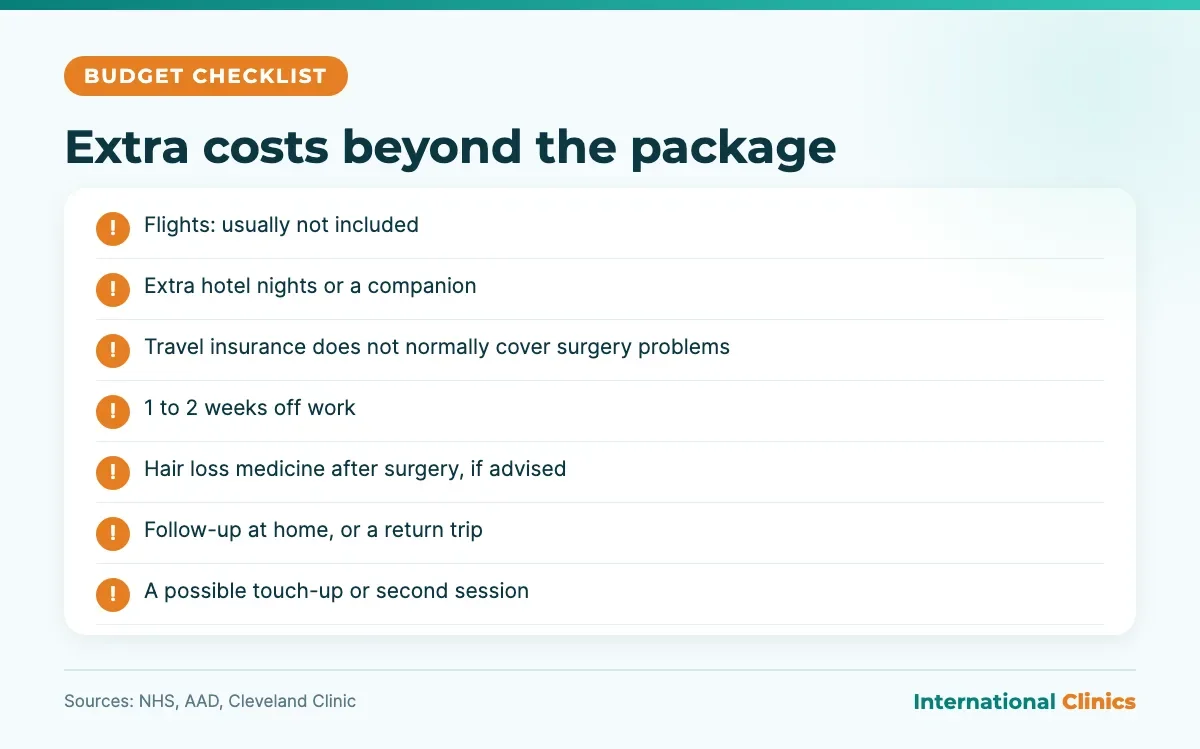
The package price rarely covers the whole trip. The NHS advises understanding all the costs involved before any cosmetic procedure, including aftercare and any future procedures you might need (Source: NHS).
Budget separately for:
- Flights: usually not included in the package.
- Extra nights or a companion: staying longer than the included hotel nights, or bringing someone with you, normally costs extra.
- Travel insurance: the NHS warns that travel insurance does not normally cover you if something goes wrong in surgery, so ask what the clinics own insurance covers (Source: NHS).
- Time off work: the NHS says you may need 1 to 2 weeks off (Source: NHS).
- Ongoing medicine: a dermatologist may recommend a hair loss medicine after surgery to protect your result, because thinning can continue (Source: AAD).
- Follow-up at home: local check-ups, or a return flight if a problem needs the original clinic. The NHS notes that overseas clinics may not provide follow-up treatment, or not to the same standard as in the UK (Source: NHS).
- A further session: Cleveland Clinic notes some people need touch-up procedures to achieve a natural-looking result (Source: Cleveland Clinic).
How Much Does It Cost to Get 3,000 Hair Grafts in Turkey?
Because most Turkish clinics charge a flat package price, 3,000 grafts usually cost the same as a smaller or larger session at the same clinic, within the typical $1,500 to $5,000 range. In the US or UK, where clinics bill per graft, the same number of grafts is far more expensive.
What Affects Turkey Hair Transplant Cost?
- Technique: basic FUE is at the lower end; Sapphire FUE and DHI usually sit in the surgeon-led tier.
- Surgeon involvement: clinics where the doctor plans and performs key steps cost more than technician-led clinics.
- Clinic reputation and facility: accredited hospitals and well-known surgeons charge more.
- Session size: very large mega-sessions can move a package above the standard range.
Technique guides: Sapphire FUE and DHI hair transplant in Turkey.
Red Flags in Cheap Hair Transplant Deals
A low price is not a problem on its own, but some warning signs suggest the savings come from cutting corners on safety:
- No consultation with the surgeon: the NHS advises booking a consultation with the practitioner and discussing what you expect before you decide (Source: NHS).
- Technicians doing surgical steps: the International Society of Hair Restoration Surgery (ISHRS) warns that at fraudulent clinics, including clinics in Turkey, most procedures are performed by technicians without medical licences or surgical training (Source: ISHRS).
- "Scarless" claims: the ISHRS says there is no such thing as scarless hair transplant surgery, and no machine can perform every step on its own (Source: ISHRS).
- Promised results: any guaranteed outcome or graft survival claim should make you cautious.
- Payment pressure: the NHS says you should be offered a cooling-off period after any consultation, and that you can walk away if you are not completely comfortable (Source: NHS).
- Social-media-only marketing: the NHS notes influencers are usually paid to promote a service (Source: NHS).
Questions to Ask Before You Accept a Hair Transplant Quote
- Who will assess my hair loss, and what are their training and licence?
- Who will be involved in my surgery, and what will each person do?
- Will anyone who is not a licensed doctor make incisions or harvest grafts?
- Which technique do you recommend for me, and why?
- How many hair transplants has the surgeon done, and how many had complications?
- What follow-up do I get if things go wrong, and is it included in the price?
- Is everyone involved covered by malpractice insurance?
These questions combine NHS guidance on choosing a hair transplant surgeon with the ISHRS checklist for patients (Source: NHS, ISHRS).
How Many Days Do You Need in Turkey for a Hair Transplant?
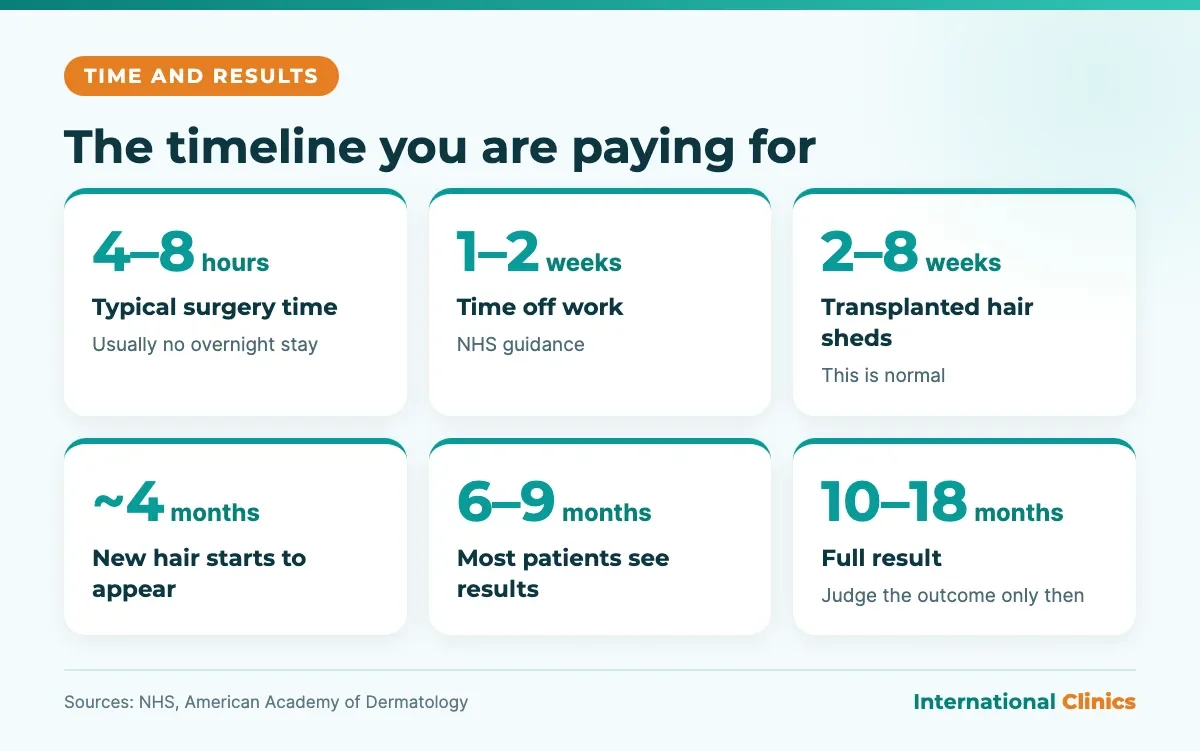
Most packages include 2 to 3 hotel nights, which usually covers the consultation, the procedure day and an early check before you fly. The procedure itself usually takes a day without an overnight hospital stay, according to the NHS, and bandages can usually be removed after 2 to 5 days. Plan more time if a large area may need a second session on a different day (Source: NHS).
The American Academy of Dermatology says surgery typically lasts 4 to 8 hours (Source: AAD).
Avoid booking sightseeing straight afterwards: NHS advice on surgery abroad is to rest, and to avoid alcohol, sunbathing and going in the water (Source: NHS).
Is a Hair Transplant in Turkey Worth It?
A hair transplant in Turkey can be worth it for the financial savings, but it carries real risks around quality control and follow-up care. The main risks to weigh:
- Technician-led procedures: some high-volume clinics let unlicensed technicians handle critical steps instead of the doctor (Source: ISHRS).
- Overharvesting: aggressive mega-sessions can damage the donor area and limit later corrections (Source: J Cutan Aesthet Surg).
- Complications and follow-up: infections, unnatural hairlines or failed grafts are harder to manage when your surgeon is far away (Source: NHS).
The medical risks are the same wherever you are treated. The NHS describes a small risk of bleeding, infection and an allergic reaction to the anaesthetic, plus a small risk that the transplant does not take or that a noticeable scar forms (Source: NHS).
Cleveland Clinic also lists numbness on the scalp as a possible risk. Factor in what it would cost to manage any of these after you are home (Source: Cleveland Clinic).
Can you get a hair transplant on the NHS?
No. The NHS states that hair transplants are not available on the NHS because they are cosmetic surgery, so UK patients pay privately whether they are treated at home or abroad. That is a major reason many compare private UK quotes, which the NHS puts at £1,000 to £30,000, with packages in Turkey (Source: NHS).
How Much Is a Hair Transplant in Turkey vs USA?
Neither country is better by default: the outcome depends on the surgeon and the facility. Turkey is usually far cheaper ($1,500 to $5,000 versus $10,000 to $25,000), while treatment at home makes follow-up care easier. Choosing a licensed, surgeon-led clinic matters more than the country. You can also compare with Turkey vs Mexico hair transplant.
How Long Do Turkey Hair Transplants Last?
When you pay for a hair transplant, you are paying for a result that takes many months to judge.
Transplanted hair is generally long-lasting because donor follicles from the back of the head are androgen (DHT) resistant, which is why this area is used as the donor site (Source: J Cutan Aesthet Surg).
The NHS notes that new hair usually starts to appear after about 4 months and the full results should be seen after 10 to 18 months. Recovery week by week is covered in hair transplant recovery timeline, real results in hair transplant before and after, and the full overview in hair transplant Turkey (Source: NHS).
What the results timeline means for your budget
The American Academy of Dermatology explains that transplanted hair falls out between 2 and 8 weeks after surgery, and by the third month the hair may look thinner than before; this is normal, and most patients see results 6 to 9 months after surgery. Because the outcome cannot be judged for months, check before you pay how the clinic reviews your progress remotely, for example through photo check-ins, and whether those reviews are included in the package (Source: AAD).
Will you need to pay for a second session?
Some people do. The NHS notes that your hair might continue to thin around the transplant (Source: NHS).
Cleveland Clinic says several touch-up procedures may be needed for a natural-looking result (Source: Cleveland Clinic).
A good surgeon designs the hairline with future thinning in mind and leaves enough donor hair for later, and the American Academy of Dermatology notes that hair loss medicine can help keep the result. Ask at the consultation whether a second session is likely in your case and how the clinic prices it (Source: AAD).
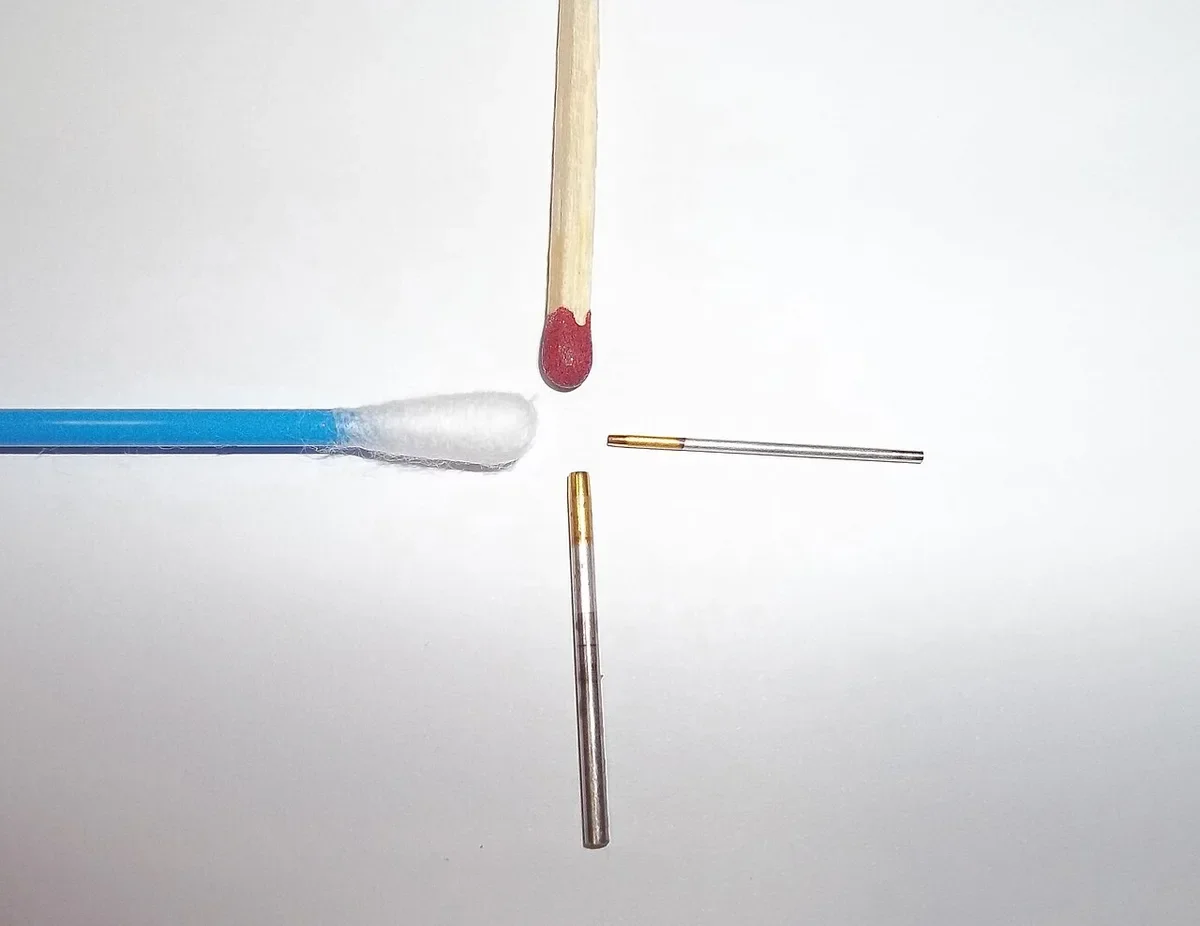
FUE hair transplant punch needles in two sizes, shown next to a match and a cotton swab for scale. Photo: Ostheimer, CC BY-SA 3.0, via Wikimedia Commons.
Medical review and disclaimer:
This article was reviewed by a specialist physician contracted with International Clinics. It is general health information, not a substitute for medical advice, and results vary between individuals.