- FUT hair transplant procedure in Turkey
- FUT vs FUE hair transplant Turkey
- Post-operative care hair transplant
- FUT hair transplant side effects Turkey
- FUT Hair transplant before and after inTurkey
- Who Is a Good Candidate for FUT Hair Transplant?
- FUT Hair Transplant Results: Month by Month
- Is FUT Hair Transplant in Turkey Safe?
- Summary
FUT hair transplant in Turkey (follicular unit transplantation, or the strip method) is one of the two main hair transplantation techniques used for hair restoration in Turkey, alongside FUE: a thin strip of scalp is taken from the back of the head, divided into grafts of 1 to 4 hairs and placed into thinning areas, leaving a fine linear scar that is usually hidden by hair. Results take time, as new hair usually appears at about 4 months and full results are seen at 10 to 18 months, and no package, standard or “premium”, can guarantee them (Source: NHS).
Hair transplantation is today the standard surgical approach for androgenetic alopecia (male and female pattern hair loss), which is its most common indication. It moves follicular units from the back of the scalp, whose hairs resist the hormone-driven hair loss. Good results depend on choosing suitable candidates with a stable pattern of loss and good donor hair (Source: StatPearls, NCBI).
There are currently two main varieties of hair transplantation:
- Follicular Unit Extraction (FUE)
- Follicular Unit Transplantation (FUT)
During FUT surgery, the surgeon removes a strip of skin from the back or side of your head and the team separates it into individual follicular unit grafts. The grafts are then placed where baldness is present on the scalp. FUT can treat a receding hairline due to male pattern baldness, as long as there is enough donor hair (Source: American Academy of Dermatology).
Continue reading to learn what to expect during FUT hair restoration in Turkey, the FUT hair transplant recovery time in Turkey, the difference between FUT vs. FUE hair transplants in Turkey, and what FUT hair transplant costs in Turkey. For the full picture of all techniques, see our hair transplant Turkey guide.
FUT hair transplant procedure in Turkey

During follicular unit transplantation in Turkey, a surgeon cuts a strip of skin from the scalp, typically from the back of the head. The strip is usually about 0.5 to 1.5 cm wide and 5 to 30 cm long, and its size depends on the number of follicles needed to cover areas of baldness (Source: ISHRS).
Hair transplantation surgeries take anywhere between 4 and 8 hours. Most people stay awake during the procedure and are given a local anesthetic to their scalp, sometimes with a mild sedative (Source: American Academy of Dermatology).
Generally, FUT surgery is quicker than FUE surgery, does not require shaving the head and can move a large number of grafts in one session (Source: ISHRS).
Heres the FUT procedure in Turkey, step by step:
- The surgeon draws your hairline and marks the donor area. You may be given the option to take a sedative before surgery, and your scalp is numbed with local anesthesia. FUT does not require shaving the whole head; only the hair over the strip is trimmed where needed.
- The surgeon will cut off the skin strip with hair follicles that will be used as a graft.
- The surgical team dissects the strip under magnification into grafts of 1 to 4 hairs and keeps them ready for transplantation.
- The surgeon closes the donor wound with sutures or staples, often with a trichophytic closure that lets hair grow through the scar (Source: ISHRS).
- The hair follicles will then be inserted into the thinning parts of your scalp in a pattern that resembles natural growth.
- Then, bandages are applied to your scalp; they usually come off after 2 to 5 days (Source: NHS).
Related article: Beard Transplant in Turkey: Great Advantages & Low Costs
FUT vs FUE hair transplant Turkey

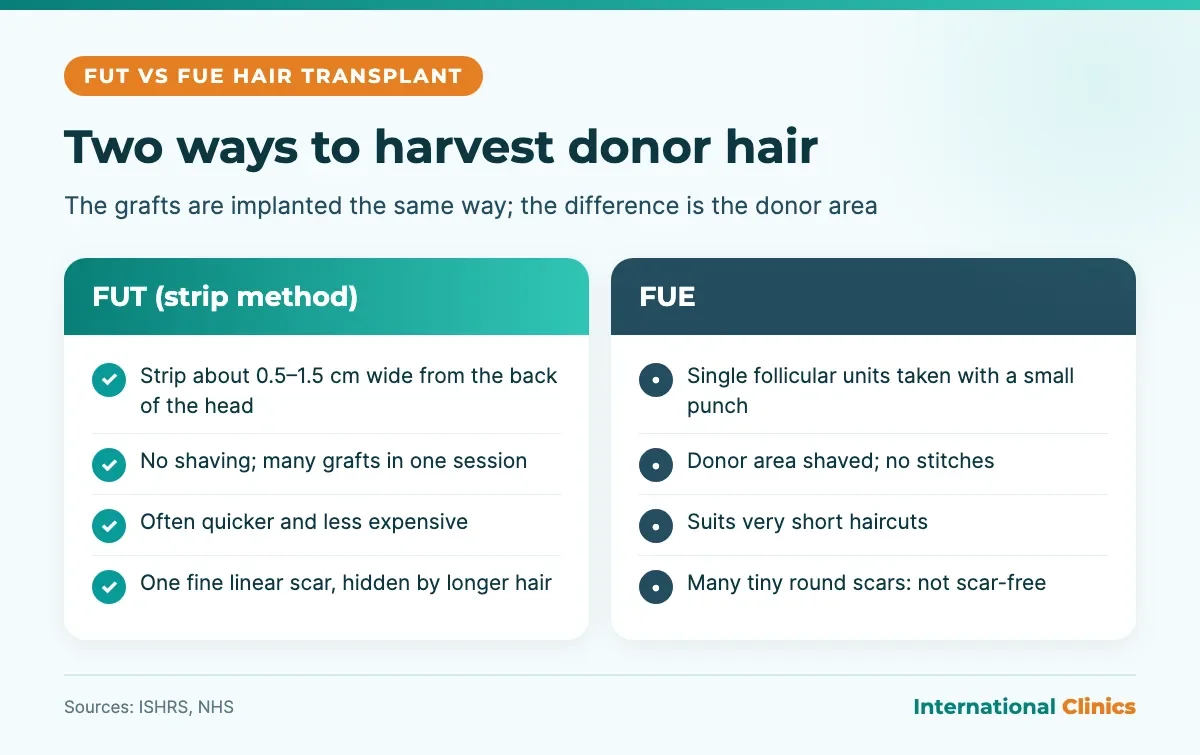
FUT and FUE differ only in how the donor hair is harvested: FUT removes a strip and leaves one linear scar, while FUE removes follicular units one by one with a small punch and leaves many tiny round scars. Individual hair follicles are transplanted in both FUT and FUE procedures, and the grafts are implanted the same way (Source: ISHRS).
During FUE surgery, the surgeon will extract individual hair follicles from the head instead of removing a strip of skin from the scalp; the back of the head is shaved and the tiny wounds heal without stitches (Source: NHS).
Through the comparison between FUT and FUE hair transplants in Turkey, we find that each of them has its own advantages. The following are a few benefits of FUE:
- The donor area heals without stitches.
- Usually less discomfort after surgery than FUT.
- No linear scar, which suits people who wear their hair very short; it still leaves small round scars, so it is not scar-free (Source: ISHRS).
- Donor scabs are visible for about a week, but there is no stitched wound to look after.
- It avoids the tightness and stitches of a strip wound.
Among FUTs benefits are:
- It can move a large number of grafts in one session, and it is often preferred for advanced hair loss (Norwood 6 or 7), where the narrow donor area limits FUE.
- Reduced duration of operation, and no need to shave the head.
- Often less expensive surgery, because it needs less surgeon time per graft (Source: ISHRS).
| FUT vs FUE | FUT (strip) | FUE |
| Donor harvesting | A strip about 0.5–1.5 cm wide, divided into grafts | Single follicular units removed with a small punch |
| Shaving | Not needed | The donor area is shaved |
| Donor scar | One fine linear scar, hidden unless hair is very short | Many tiny round scars |
| Stitches | Yes; non-dissolvable stitches out at 10–14 days | No |
| Best suited to | Longer hair, many grafts, advanced hair loss | Very short haircuts, smaller sessions |
The table summarises the differences described by the NHS and ISHRS; the choice depends on your donor area, hairstyle and goals. For a detailed comparison, read FUE vs FUT and our page on FUE hair transplant in Turkey (Sources: NHS and ISHRS).
Related article: Afro-Hair Transplants in Turkey: Natural Curls hair
Post-operative care hair transplant
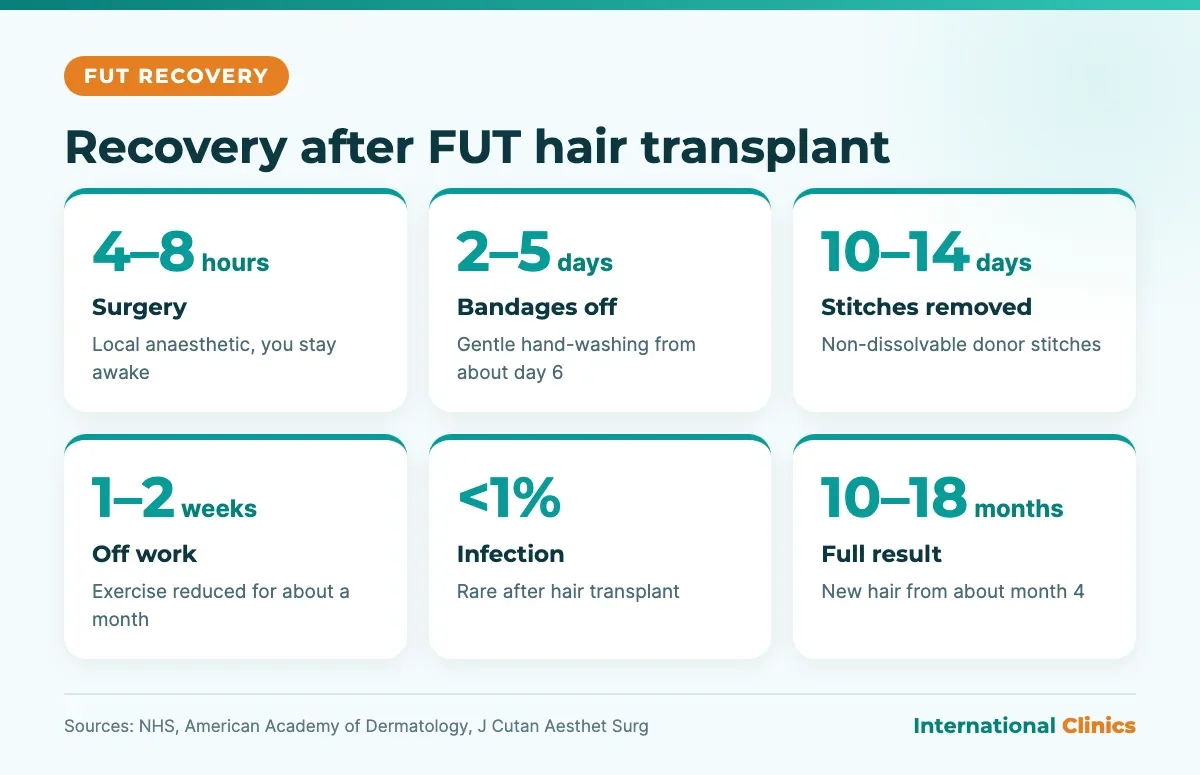
After a FUT hair transplant in Turkey, most people need 1 to 2 weeks off work: bandages usually come off after 2 to 5 days, gentle hand-washing of the hair starts at around day 6, non-dissolvable stitches are removed after 10 to 14 days and exercise may need to be reduced for the first month (Source: NHS).
When following these medical guidelines, the person can recover more smoothly. They include:
- Bandaging and Scalp Care: Right after a FUT hair transplant, the scalp is bandaged to protect the treated area. The bandages should not be tampered with and should be removed only according to your doctors advice.
- Medication: Your doctor may prescribe medication for pain to reduce discomfort, antibiotics to prevent infection, and anti-inflammatory medication to reduce swelling.
- Sleep Position: The patient is advised to sleep with his head elevated for a few nights. This helps reduce the swelling and protects the site of transplantation.
- Avoid Physical Activities: Heavy lifting and strenuous exercise should be reduced for about the first month to protect the donor wound and avoid stretching the scar.
- Hair washing is usually allowed from around day 6, gently by hand with a mild shampoo, following your surgeon’s instructions so as not to dislodge the grafts.
- Itchiness and Scabbing: Itching and scabbing will generally occur; this is part of the healing process. Avoid scratching or picking the scabs, as this may damage the grafts.
- Follow-Up Appointments: Regular follow-ups with your surgeon are important for proper healing; if you travelled for surgery, agree in advance who will remove the stitches at 10 to 14 days. For more detail, see our hair transplant recovery timeline.
FUT hair transplant side effects Turkey
After FUT, serious complications are uncommon. The scalp has a rich blood supply that supports healing, and infections are rare, occurring in less than 1% of procedures (Source: J Cutan Aesthet Surg).
Among the possible issues are:
- an unnatural-looking hairline if grafts are placed too low or at the wrong angle
- small bumps (cobblestoning) or visible scars
- Folliculitis, or inflammation of the hair follicles
- bleeding
- swelling of the scalp and forehead for a few days
- pain or tightness around the donor wound
- feeling numb in the donor area, from cutting small scalp nerves
- Scarring from FUT, and temporary “shock” loss of existing hair (Source: J Cutan Aesthet Surg).
Note that the hair removal location is scarred after FUT surgery. Although the scar is permanent, it usually fades and is hidden by hair, but it can show if you wear your hair very short. A wide scar can be improved by re-excision, by transplanting hair into it or by scalp micropigmentation (Source: ISHRS).
Likewise, transplanted hair normally falls out between 2 and 8 weeks after surgery, and by the third month the hair may look thinner than before the transplant; both are expected. Most patients see results 6 to 9 months after surgery, and some take 12 months (Source: American Academy of Dermatology).
FUT Hair transplant before and after inTurkey
FUT hair transplant results in Turkey depend on the same factors as anywhere else: the quality and density of the donor hair, the extent of hair loss, a natural hairline design and the experience of the surgical team. Many patients come to hair transplant clinics in Istanbul for hair restoration of bald areas, and their before-and-after photos are the best way to see what the technique can achieve. Browse more cases in our hair transplant before and after gallery.
When you compare before-and-after photos, check that they were taken from the same angles and in the same light, and ask how many months after surgery they were taken, since full results take 10 to 18 months. Ask the clinic about its complication rates, follow-up care and patient satisfaction rates (Source: NHS).
ISHRS advises confirming that the physician will personally perform your surgery rather than delegating it to an unlicensed technician, and being cautious about cross-border offers that look too good to be true (Source: ISHRS).
The video above shows a hair transplant patient of International Clinics 8 months after surgery.
At International Clinics, a hair transplant specialist assesses your donor area and recommends FUT or FUE before you travel. Don’t hesitate to contact us to learn about FUT hair transplant travel packages.
Who Is a Good Candidate for FUT Hair Transplant?
A good candidate for FUT has enough healthy donor hair and can still grow hair in the thinning area; men and women of all races can qualify (Source: American Academy of Dermatology).
- People who wear their hair longer and do not want to shave their head.
- Patients with advanced hair loss (Norwood 6 or 7), where the narrow donor area limits FUE.
- Older patients, whose FUT scars tend to heal well (Source: ISHRS).
A young man in his 20s may be advised to wait and start a hair loss medicine first, because the pattern of loss is not yet clear, and a blood test or scalp biopsy may be needed before surgery (Source: American Academy of Dermatology).
FUT Hair Transplant Results: Month by Month
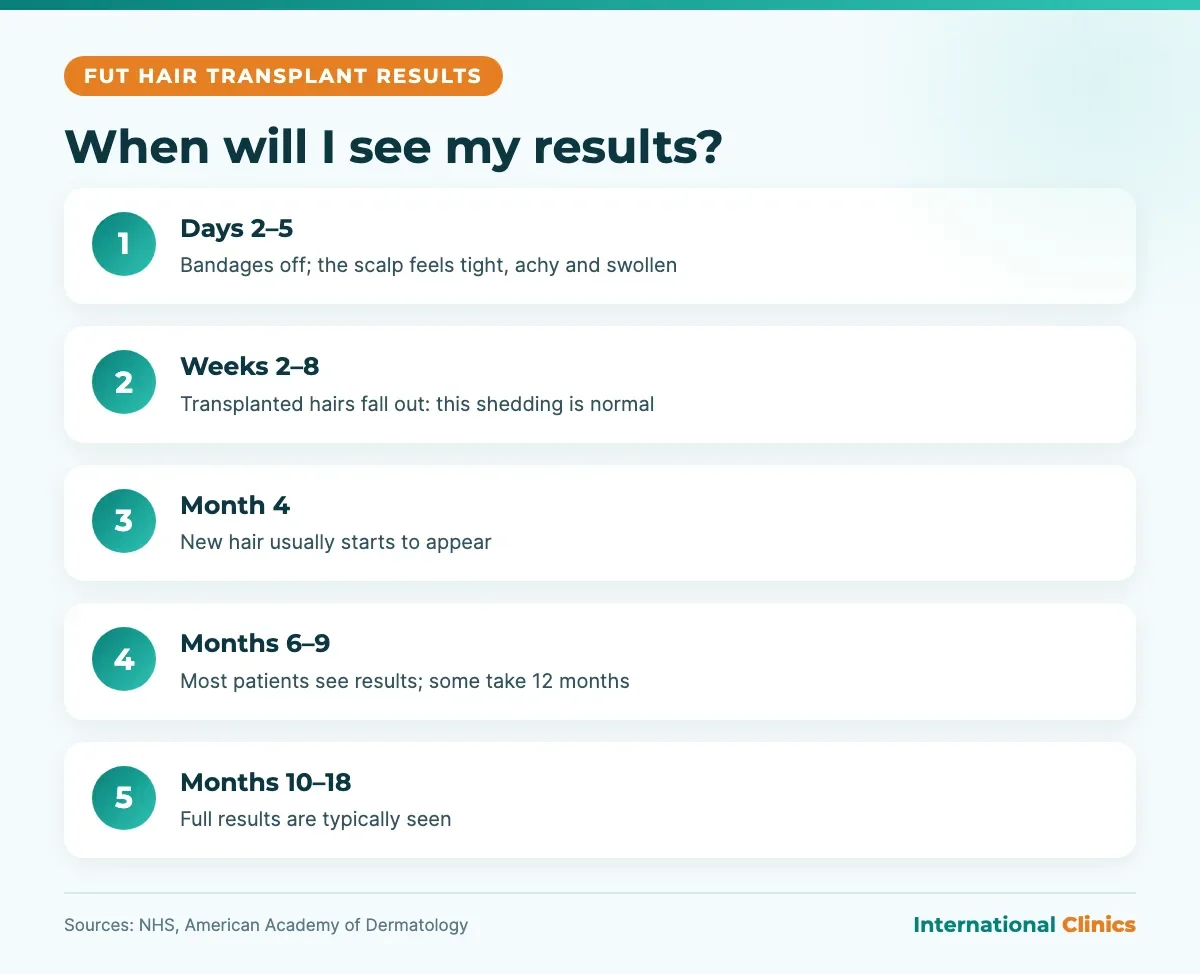
FUT hair transplant results appear slowly: the transplanted hairs shed first, regrow from about month 4 and reach their full effect between 10 and 18 months (Source: NHS).
- Days 2 to 5: bandages off; the scalp is tight, achy and swollen.
- Weeks 2 to 8: the transplanted hairs fall out; this shedding is normal.
- Month 3: the hair may look thinner than before the transplant.
- Months 6 to 9: most patients see results; some take 12 months (Source: American Academy of Dermatology).
Transplanted hair comes from the back of the scalp, which resists the hormone-driven hair loss, so the transplanted hairs keep their donor characteristics (Source: StatPearls, NCBI).
The hair around the transplant can still thin over time, so a dermatologist may recommend a hair loss medicine to keep the results for years (Source: American Academy of Dermatology).
Is FUT Hair Transplant in Turkey Safe?
FUT is generally safe when a qualified surgeon performs it under local anaesthetic, but like any surgery it carries a small risk of bleeding, infection, grafts that do not take and a noticeable scar (Source: NHS).
Specialists warn that complications seen after hair transplants abroad often come from cheap clinics, so check who will perform each step of your operation (Source: ISHRS).
Before booking, read why patients choose Turkey for hair transplant and compare costs on our hair transplant cost by graft count page.
Summary
Hair restoration in Turkey with FUT transplant procedures is an effective option for restoring hair, especially when many grafts are needed or you prefer not to shave your head. It leaves a linear scar that is usually hidden by hair, recovery takes about 1 to 2 weeks, and the full result appears at 10 to 18 months. Choose a team that assesses your donor area honestly, explains FUT and FUE, and provides follow-up after you return home.
Related article: Sapphire hair transplant turkey: Advanced technology of 2026
Medical review and disclaimer:
This article was reviewed by a specialist physician contracted with International Clinics. It is general health information, not a substitute for medical advice, and results vary between individuals.