
Glaucoma symptoms are usually absent at first: open-angle glaucoma damages side vision so slowly that it is normally found at a routine eye test. Acute angle-closure glaucoma is the exception — sudden severe eye pain, a red eye, rainbow-coloured halos around lights, blurred vision, headache and nausea are a medical emergency.
What are the symptoms of glaucoma?
Glaucoma is not one disease but a group of them, and the symptoms depend on which type you have and how far it has progressed. The table below is the reference list used throughout this page: five types, what each one does early, and what it does later.
| Type of glaucoma | Early symptoms | Later symptoms | How it starts |
|---|---|---|---|
| Open-angle glaucoma (most common) | None — no pain and no warning | Patchy blind spots in side vision, then difficulty seeing in the centre | Slowly, over years |
| Acute angle-closure glaucoma | Bad headache, severe eye pain | Blurred vision, halos or coloured rings around lights, red eye, nausea or vomiting | Suddenly — a medical emergency |
| Normal-tension glaucoma | None in the early stages | Gradually blurred vision, then loss of side vision | Slowly, with eye pressure in the normal range |
| Pigmentary glaucoma | Halos around lights, blurred vision with exercise | Gradual loss of side vision | In episodes, often after activity such as jogging |
| Glaucoma in children | A dull or cloudy eye, increased blinking, tears without crying | Blurred vision, short-sightedness that gets worse, headache | At birth or in the first years of life |
Across all types, the complaints most often reported are eye pain or pressure, headaches, red or bloodshot eyes, double vision, blurred vision, and blind spots or tunnel vision that develop gradually. Glaucoma usually affects both eyes, but it may be worse in one. Sources: NHS, Mayo Clinic and Cleveland Clinic.
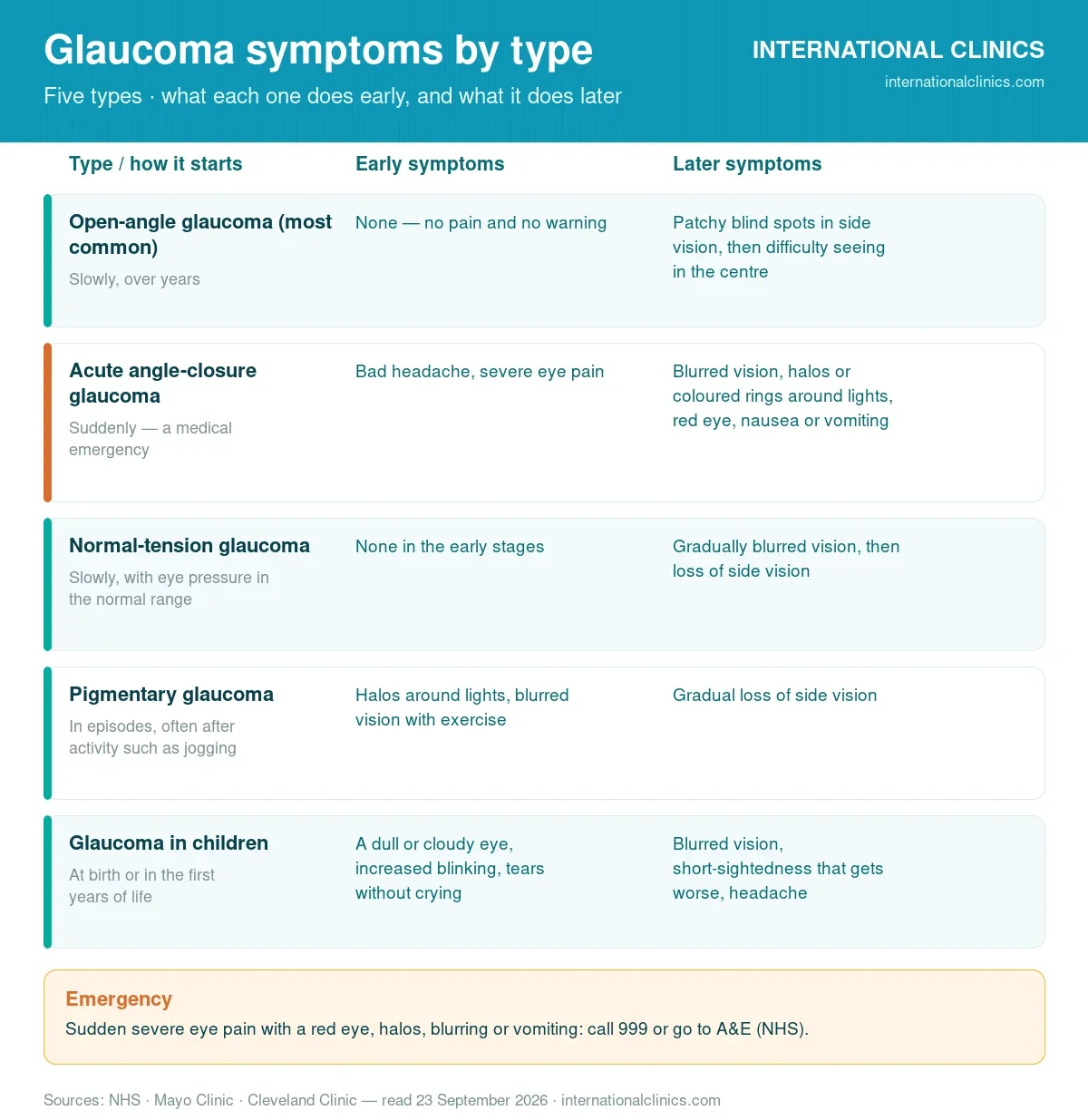
Every item in this infographic is taken from the symptom table above.
What is glaucoma, and how does raised eye pressure damage sight?
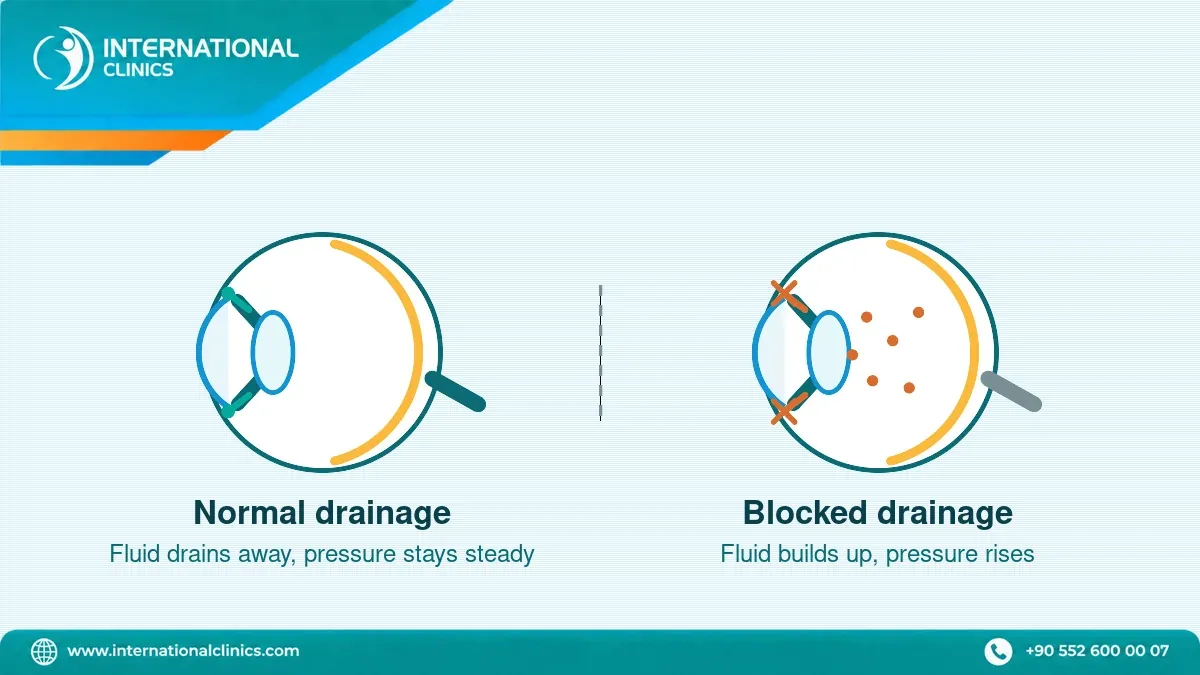
Your eye constantly makes a fluid called aqueous humour. It flows through the pupil to the front of the eye and drains away through a mesh of tissue where the iris and cornea meet. When that drainage slows, fluid builds up and pressure inside the eye rises. That pressure damages the optic nerve, the cable that carries what you see to the brain, and the damage shows up as blind spots.
Two points explain why the symptoms arrive so late. The damage starts at the edges of the visual field, where the brain fills in the gap from the other eye; and it is painless in the common type. Cleveland Clinic describes glaucoma as the second-leading cause of blindness worldwide. Mayo Clinic adds that glaucoma can happen even when eye pressure is typical, which is why a normal pressure reading alone does not rule it out.
What is usually the first sign of glaucoma?
For most people there is no first sign they can feel. The first sign is something an optometrist sees: a change in the shape of the optic nerve head, a raised pressure reading, or a gap on a visual field test. Cleveland Clinic states that up to half of people in the United States who have glaucoma may not know it.
When a symptom is the first thing noticed, it is usually one of two. In open-angle glaucoma it is missing patches at the edge of vision, noticed late — bumping into door frames, or missing a car in the wing mirror. In angle-closure glaucoma it is pain: a sudden, severe ache in and around one eye with halos and blurring. A slow, painless blur with glare and faded colours is a different problem — see cataract symptoms. Vision that disappears within minutes or hours is different again: read causes of sudden vision loss and seek care the same day.
Open-angle glaucoma symptoms: why there is no early warning
Open-angle glaucoma is the common type and the quiet one. The drainage angle stays open, but the mesh drains too slowly, so pressure creeps up over years. Mayo Clinic lists its symptoms in three stages: no symptoms at first, then patchy blind spots in peripheral vision, then difficulty seeing things in central vision in the later stages.
Tunnel vision is the popular image of glaucoma, and it is accurate — but it describes an advanced stage, not an early one. Sight lost to glaucoma does not come back, so the whole point of eye tests is to find the pressure before the field is gone.
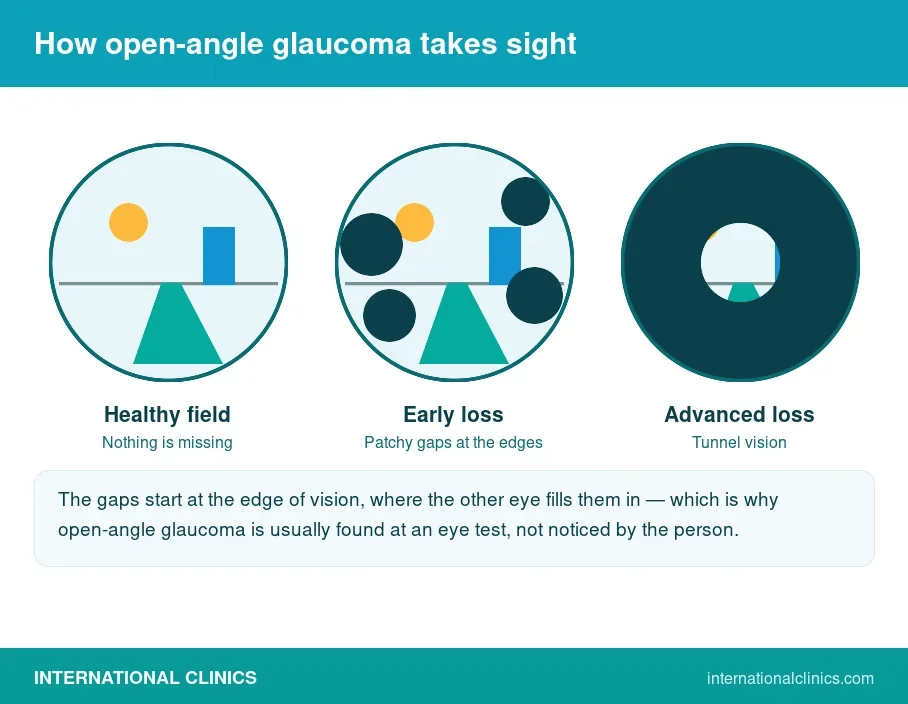
Open-angle glaucoma removes the edges of the visual field first, which is why it is found at an eye test rather than noticed.
Acute angle-closure glaucoma symptoms are a medical emergency
In angle-closure glaucoma the iris bulges forward and blocks the drainage angle. Pressure rises within hours rather than years, and the symptoms are impossible to ignore.
| Emergency symptom | What it feels like |
|---|---|
| Intense eye pain | A deep ache in or around one eye, often with a bad headache on the same side |
| A red eye | Visible redness with tenderness when the eye or the area around it is touched |
| Rainbow-coloured circles around bright lights | Halos or coloured rings around lamps and headlights |
| Blurred vision | Sight that clouds over quickly, sometimes with loss of vision |
| Feeling sick and being sick | Nausea or vomiting arriving together with the eye pain, not on its own |
The NHS advice is explicit: call 999 or go to A&E if you develop symptoms of glaucoma suddenly, because this is a medical emergency that may require immediate treatment, and you should not drive yourself. Mayo Clinic gives the same instruction in different words — go to an emergency room or call an ophthalmologist immediately. Other conditions, including uveitis and an eye injury, can cause similar symptoms, which is a reason to be examined rather than a reason to wait.
Normal-tension, pigmentary and childhood glaucoma symptoms
Three less common types change what you should be watching for.
- Normal-tension glaucoma. The optic nerve is damaged while eye pressure stays in the normal range. There are no symptoms early on, then gradual blurring, then loss of side vision. Mayo Clinic notes the nerve may be unusually sensitive or receiving less blood flow.
- Pigmentary glaucoma. Pigment granules flake off the iris and clog the drainage tissue. The giveaway is halos around lights and blurred vision after exercise such as jogging, which stirs the granules up.
- Glaucoma in children. A baby or young child cannot report blur. The signs are a dull or cloudy eye, increased blinking and tears without crying; later, headaches and short-sightedness that keeps getting worse.
Secondary glaucoma is a fourth group: pressure driven up by something else — an eye injury, uveitis, an eye operation, or long-term use of corticosteroid medicines, especially eye drops.
High eye pressure symptoms: what raised pressure actually feels like
Usually nothing at all. Raised intraocular pressure on its own — ocular hypertension — has no reliable symptom, which is exactly why it is measured rather than felt. Pressure high enough to be felt as pain is the angle-closure emergency above, not the everyday picture.
This is the single most useful thing to understand about glaucoma: the number that matters is one you cannot sense. If you want to know how it is taken and what the readings mean, see our guide to eye pressure measurement methods.
What causes glaucoma, and who is most at risk?
The cause is damage to the optic nerve, usually linked to a build-up of fluid and pressure. Risk is not evenly spread.
| Risk factor | What is reported | Source |
|---|---|---|
| Age | Risk is higher over 50; most types affect people aged 40 and over, and an estimated 10% of people aged 75 and over have glaucoma | NHS; Cleveland Clinic |
| Family history | Higher risk if a parent, sibling or child has glaucoma — more frequent eye tests may be advised | NHS; Cleveland Clinic |
| Ethnic background | Higher risk in people of Black African, Caribbean or Asian background; people of African descent are reported as 15 times more likely to be blinded by open-angle glaucoma | NHS; Cleveland Clinic |
| Other medical conditions | Diabetes, high blood pressure, migraine and sickle cell anaemia are linked to higher odds | NHS; Mayo Clinic |
| Short- or long-sightedness | Short-sightedness raises the risk of open-angle glaucoma; long-sightedness raises the risk of angle-closure | NHS; Cleveland Clinic |
| Eye injury, eye surgery or steroid drops | All can raise eye pressure and cause secondary glaucoma | Mayo Clinic; Cleveland Clinic |
| Thin central corneas and high measured eye pressure | Listed among the main risk factors for glaucoma damage | Mayo Clinic |
None of these factors causes symptoms by itself. They change how often you should be tested, not what you will feel.
How is glaucoma diagnosed if the symptoms come late?
By examination, not by description. A glaucoma work-up is built from tests that are part of a full eye examination: visual acuity, visual field testing, tonometry for eye pressure, pachymetry for corneal thickness, a slit lamp examination, and gonioscopy to look at the drainage angle. Imaging of the optic nerve, such as optical coherence tomography, is added when damage is suspected. Our guide to a full vision examination explains what each test involves.
How often to be tested depends on age and risk.
| Who | Suggested interval | Source |
|---|---|---|
| Everyone | An eye test at least every 2 years | NHS |
| Under 40 | A comprehensive eye exam every 5 to 10 years | American Academy of Ophthalmology, via Mayo Clinic |
| 40 to 54 | Every 2 to 4 years | American Academy of Ophthalmology, via Mayo Clinic |
| 55 to 64 | Every 1 to 3 years | American Academy of Ophthalmology, via Mayo Clinic |
| 65 and over | Every 1 to 2 years | American Academy of Ophthalmology, via Mayo Clinic |
| Anyone at higher risk | More often than the interval above — the schedule is set by your eye specialist | NHS; Mayo Clinic |
Can glaucoma be cured, and what happens if the symptoms are ignored?
There is currently no cure for glaucoma. The NHS is direct about it: treatment can slow the damage and help stop your vision getting worse, but it cannot restore sight that has already gone. Treatment is chosen according to the type and how far sight is affected, and it usually starts with eye drops, then laser treatment, then surgery.
Left untreated, the direction of travel is one way. Cleveland Clinic states that without care to lower the pressure, glaucoma damages the retina and optic nerve until they stop working, and the end result is blindness in the affected eye. No treatment and no operation is risk-free or guaranteed, and eye drops only work while they are actually used — which is why follow-up appointments are part of the treatment rather than an optional extra. If you are weighing up options, our guides cover glaucoma treatment in Turkey and glaucoma drainage surgery.
“Glaucoma does not usually have symptoms and most people do not realise they have it.”
NHS, Glaucoma, 2026 — nhs.uk
When to see an optician or eye doctor about glaucoma symptoms
Book an eye test if you have any concern about your vision, if side vision feels narrower than it used to, or if you are over 40 with a parent, brother or sister who has glaucoma. Go to A&E or call 999 straight away for sudden severe eye pain with a red eye, halos, blurring or vomiting. If you are preparing for an eye procedure abroad, our checklist on eye surgery preparation covers what to bring and what to ask.
If you already have a recent eye-test report or a pressure reading and are unsure what it means, our eye team can look at it and tell you what the sensible next step is. Ask our eye specialists a question — no obligation, and no answer that replaces an in-person examination.
References
- NHS — Glaucoma (read 23 September 2026)
- Mayo Clinic — Glaucoma: Symptoms and causes (5 November 2024)
- Cleveland Clinic — Glaucoma (last updated 12 November 2024)