
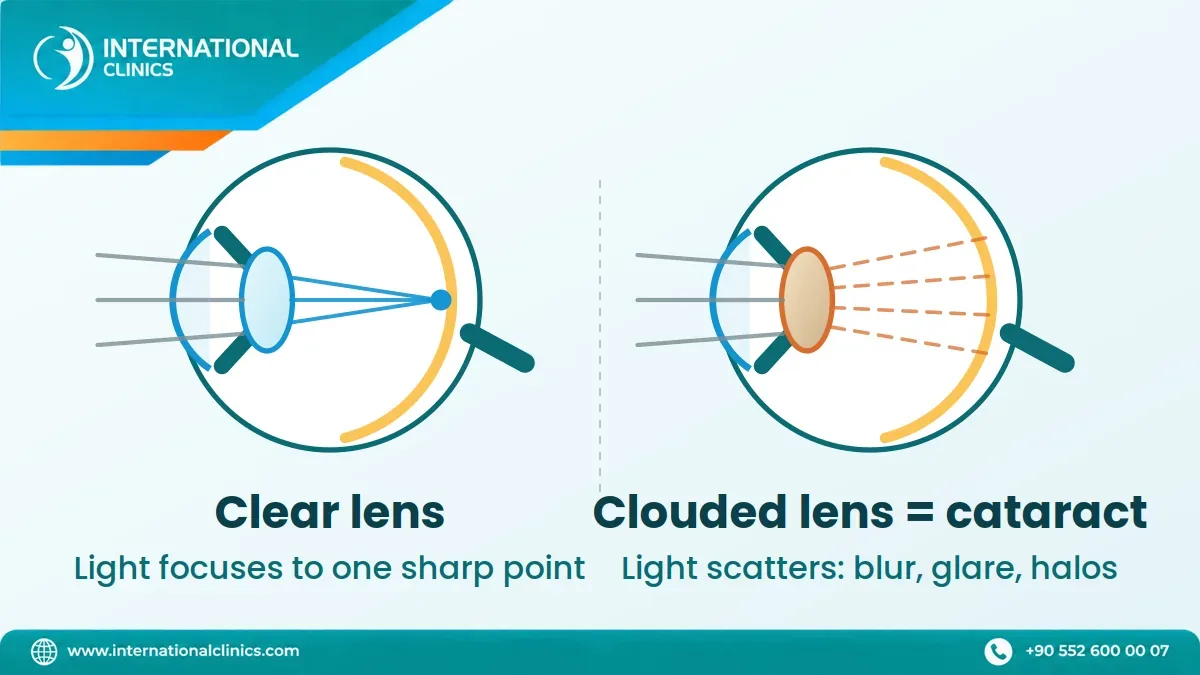
Cataract symptoms include clouded or blurred vision, glare and sensitivity to light, halos or starbursts around lights at night, poor night vision, faded or yellowed colours, frequent changes to your glasses prescription, and double vision in one eye. They usually build slowly in both eyes, so any lasting change in your sight is worth an eye test.
What are the symptoms of cataracts?
A cataract is a clouding of the eye’s natural lens. Because the lens scatters and blocks light before it reaches the retina, the complaints below tend to appear together rather than one at a time. The table is the reference list used throughout this page.
| Cataract symptom | What you notice day to day | Why the lens causes it |
|---|---|---|
| Clouded, blurred or dim vision | Sight feels hazy or filmy, like looking through a fogged-up window | Light is scattered before it reaches the retina |
| Needing brighter light | Reading, sewing or cooking needs a stronger lamp than it used to | Less light passes through the clouded lens |
| Glare and light sensitivity | Sunlight and oncoming headlights feel harsh or uncomfortable | Scattered light spreads across the retina instead of focusing |
| Halos or starbursts around lights | Glowing rings or bright flares around streetlamps at night | Uneven clouding bends light in several directions at once |
| Poor night vision | Driving or moving around in dim light becomes harder | The lens transmits too little light for low-light tasks |
| Faded or yellowed colours | Colours look washed out, dull or tinged brown; blue fades first | The lens yellows with age and filters short wavelengths |
| Frequent prescription changes | New glasses stop helping within months | The lens keeps changing shape and density as it clouds |
| Double vision in one eye | Two overlapping images from a single eye, still there when the other eye is shut | Different parts of the clouded lens focus light differently |
Cataracts usually affect both eyes, but not at the same speed, so one eye can be noticeably worse than the other. Sources: NHS and Mayo Clinic.
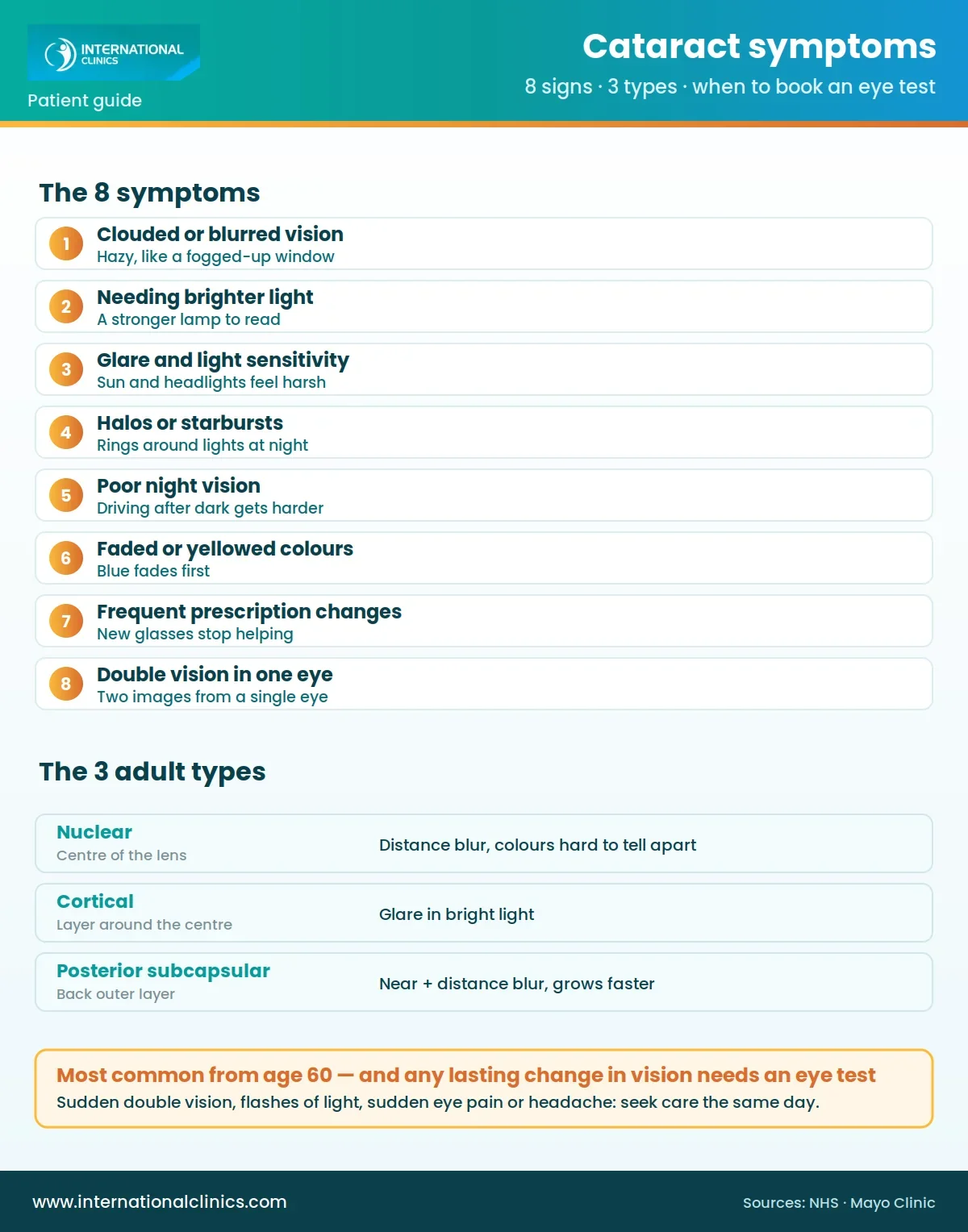
Every figure in this infographic is taken from the symptom table above.
What is the first sign of cataracts?
For most people the first sign is a slight, painless blur that no amount of cleaning your glasses fixes — sight described as foggy or frosted rather than sharp. Two other early clues often arrive at the same time: headlights and sunshine start to glare more than they used to, and your optician changes your prescription sooner than expected.
Early cataract changes are painless and gradual, which is exactly why they are missed. There is no redness, no discharge and no sudden loss of sight. If your vision drops suddenly, that points to a different problem — see causes of sudden vision loss and seek care the same day.
Cataract symptoms by stage: early, moderate and advanced
Cataracts are graded by how much of the lens has clouded and how far the clouding has spread, not by a fixed timetable. The pattern below is the usual progression.
| Stage | What the lens looks like | Symptoms at this stage |
|---|---|---|
| Early | A small part of the lens is cloudy; the pupil still looks normal | Mild blur, more glare at night, stronger reading light needed |
| Moderate | Clouding covers more of the lens | Blur affects daily tasks, halos at night, colours fade, prescription changes often |
| Advanced | Dense clouding; the pupil may look grey or white | Reading and recognising faces become difficult; glasses no longer help |
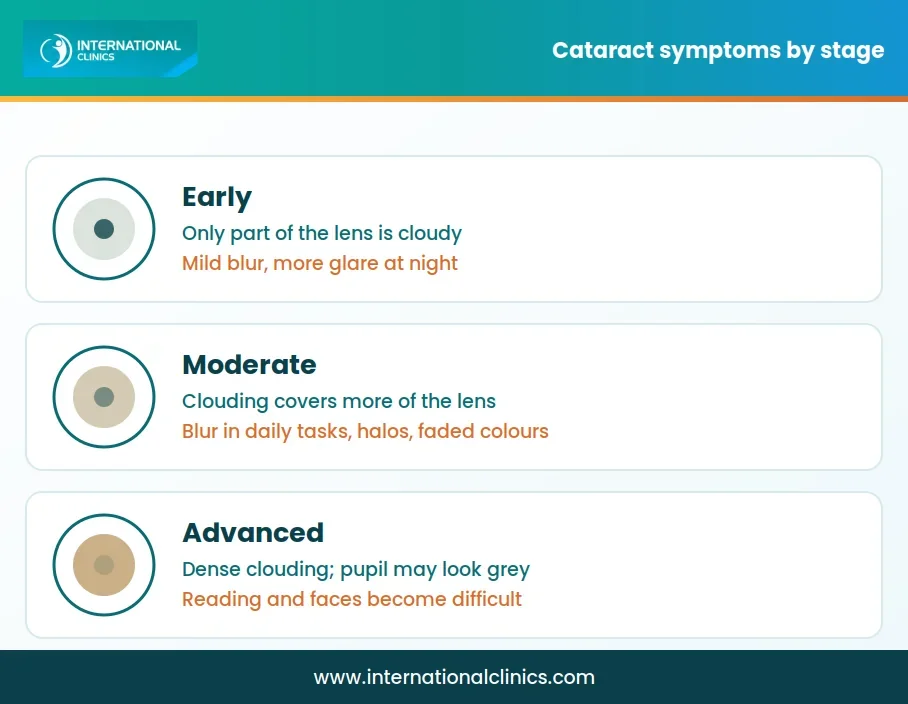
Stronger glasses and brighter lighting can carry you through the early stage. They stop working once the clouding is dense, because the problem is the lens itself rather than the focus.
At what age do cataract symptoms usually start?
Cataracts are mainly an age-related change, and the NHS lists being aged 60 or over as a risk factor for developing them. Symptoms can begin earlier after an eye injury, previous eye surgery, long-term steroid treatment or with conditions such as type 2 diabetes. Babies and children can also be born with cataracts or develop them in childhood, which is a separate condition and is managed differently.
What are the 3 types of cataracts, and which symptom does each one cause?
The three adult types are named after where in the lens the clouding sits, and each one announces itself differently.
| Type | Where the clouding sits | The symptom that stands out |
|---|---|---|
| Nuclear cataract | The centre (nucleus) of the lens | Distance blur first; the lens yellows or browns, making colours hard to tell apart |
| Cortical cataract | The cortex, the layer wrapping the nucleus | Glare in bright light; grows slowly, and the lens can end up looking white |
| Posterior subcapsular cataract | The back outer layer of the lens | Affects near and distance vision and bright-light vision; tends to grow faster |
Childhood cataract is a fourth, separate category, present from birth or appearing later in childhood. Type classification is made by an eye specialist at the slit lamp, not from symptoms alone.
What causes cataracts, and who is most at risk?
Most cataracts form when ageing or injury changes the proteins and fibres inside the lens, which break down and clump together until the lens turns hazy. Recognised risk factors include being 60 or over, diabetes, smoking, long-term steroid medicines, heavy alcohol use, obesity, a family history of cataracts, previous eye injury or eye surgery, other eye conditions such as uveitis or high short-sightedness, and years of unprotected sun exposure.
No treatment has been proved to prevent or slow a cataract. Mayo Clinic notes that regular eye exams, not smoking, managing conditions such as diabetes, a diet rich in fruit and vegetables, wearing UV-blocking sunglasses and cutting down alcohol are all thought to be sensible measures, without any guarantee attached.
Cataract or glaucoma? How the symptoms differ
Both are common causes of sight loss in later life and both can be present at once, which is why the two are so often confused. Our separate guide covers glaucoma treatment in detail.
| Cataract | Glaucoma | |
|---|---|---|
| What goes wrong | The lens clouds over | The optic nerve is damaged, usually with raised pressure inside the eye |
| Typical symptoms | Blur, glare, halos, faded colours, poor night vision | Often none at first; later, loss of side vision closing in from the edges |
| Onset | Slow and painless | Usually slow and painless; the acute form causes sudden eye pain, redness and haloes |
| Is sight loss reversible? | Usually restored once the clouded lens is replaced | Sight already lost cannot be restored; treatment aims to protect what remains |
That last row is the reason the distinction matters. A routine vision examination checks for both, and only an eye examination can separate them.
Risks of leaving cataract symptoms untreated
A cataract does not stay still. The NHS states that cataracts affect your sight and, without treatment, will eventually cause sight loss. Waiting also carries practical and surgical risks that grow with time:
- Driving. Glare and poor night vision can take your eyesight below the legal standard. In the UK you must tell the DVLA if your eyesight no longer meets the minimum standards for driving.
- Falls and daily tasks. Poor contrast and dim vision make steps, kerbs and unfamiliar rooms harder to judge.
- A denser lens is a harder operation. Very advanced cataracts take more energy to break up and remove, which can lengthen surgery and recovery.
- A missed second diagnosis. A dense cataract makes it harder for a specialist to examine the retina and optic nerve behind it.
Cataract surgery is common and usually successful, but it is still surgery, and no operation is risk-free or guaranteed. Recognised complications include swelling, infection, retinal detachment and clouding of the membrane behind the new lens, which is why the decision to operate is made with an eye specialist rather than from a symptom list.
“Make an appointment for an eye exam if you notice any changes in your vision.”
Mayo Clinic, Cataracts — Symptoms and causes, 2026 — mayoclinic.org
Mayo Clinic adds that sudden changes — double vision, flashes of light, sudden eye pain or a sudden headache — need same-day medical attention rather than a routine appointment.
When to see an optician or eye doctor about cataract symptoms
Book a routine eye test if the symptoms in the table above have lasted more than a few weeks, if night driving has become uncomfortable, or if your glasses prescription has changed more than once in a short period. The NHS advice is to see an optician if you have symptoms of cataracts; if they suspect a cataract, they refer you to an eye specialist for tests and treatment.
Surgery is offered when the cataract interferes with the things you do every day — not at a fixed level of blur and not on a timetable. If you have reached that point and want to understand the operation itself, our guides cover cataract surgery in Turkey, the phacoemulsification technique, extracapsular cataract extraction and lens replacement surgery.
If you are unsure whether what you are noticing is a cataract, our eye team can review your current prescription and recent eye-test report and tell you what the next sensible step is. Ask our eye specialists a question — no obligation, and no answer that replaces an in-person examination.
References
- NHS — Cataracts in adults (last reviewed 12 March 2025)
- Mayo Clinic — Cataracts: Symptoms and causes (14 March 2026)