
Astigmatism symptoms are blurred or distorted vision at every distance, eye strain, headaches, squinting, glare and halos around lights at night, and sometimes double vision. They are easy to mistake for tiredness, which is why astigmatism is usually found at a routine eye test rather than noticed as a problem.
Astigmatism Symptoms: The Six Signs to Look For
Six signs recur across the medical sources, and the table below is the reference list used throughout this page. Most people have more than one, and the first thing they usually notice is not the blur itself but how tired their eyes feel by the end of the day.
| Sign | What it feels like | When it is most obvious |
|---|---|---|
| Blurred or distorted vision | Objects near and far look out of focus, stretched or slightly wavy rather than simply far away | At all distances, all the time |
| Eye strain and tiredness | Eyes feel tired, heavy or sore, and vision drifts in and out of focus | After long reading or screen sessions |
| Headaches | A nagging ache around the forehead and the eyes from the effort of focusing | Late in the working day |
| Squinting | Narrowing the eyes to sharpen detail, often without realising it | Reading signs, screens or subtitles |
| Glare, starbursts and halos | Rings or spikes of light around streetlights and headlights, and dazzle from oncoming cars | At night and when driving after dark |
| Double vision or ghosting | Text or images appear to overlap, with a faint second copy beside them | Usually in one eye, and worse when tired |
The NHS names blurred vision, headaches and eye strain as the main three; Cleveland Clinic adds squinting, glare and halos, and double vision with overlapping images. The six above are the combined list.
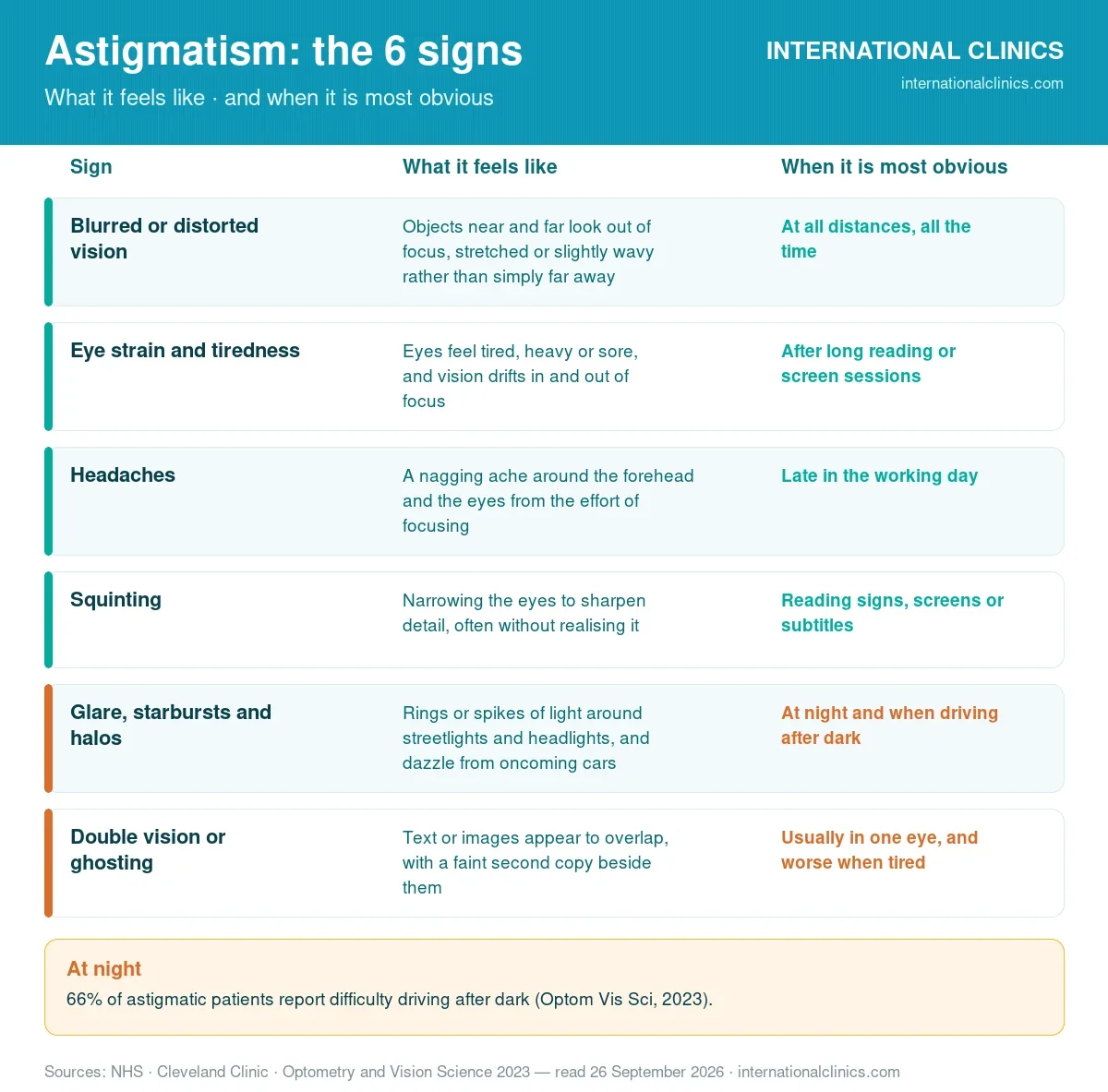
Every item in this infographic is taken from the table above.
What Is Astigmatism, and Why Does It Blur Vision?
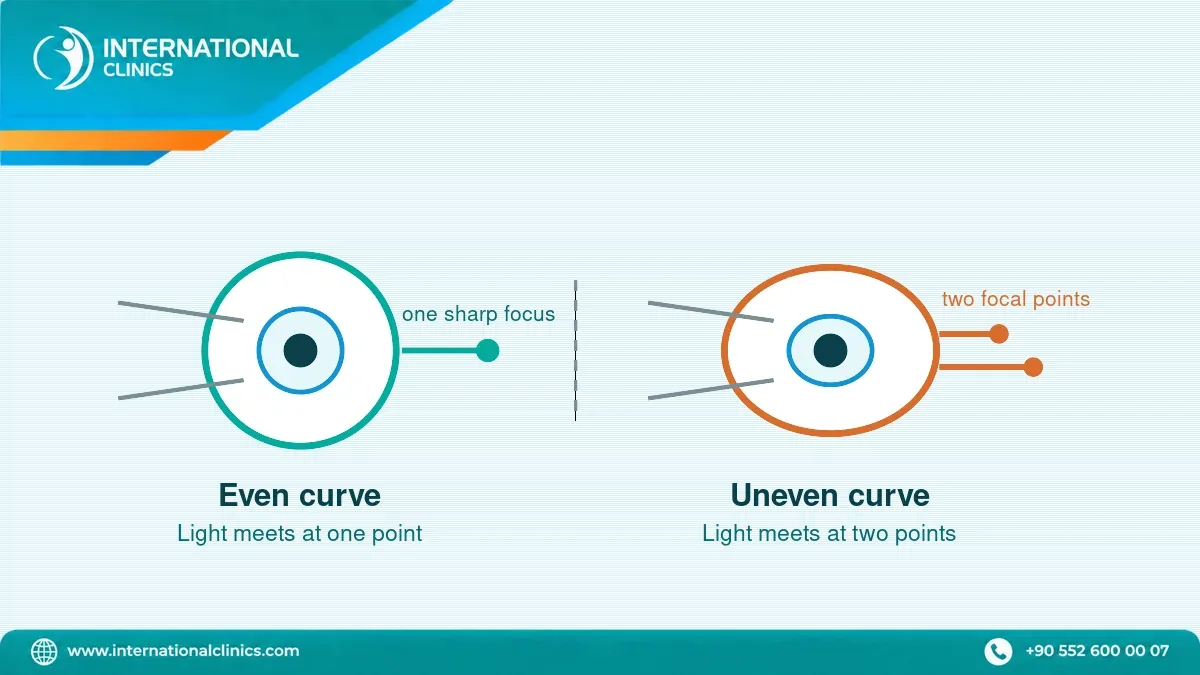
Astigmatism is a refractive error, not a disease. In an eye without it, the cornea is curved evenly in every direction, like a football, so light comes to a single sharp focus on the retina. In an eye with astigmatism the front surface is curved more steeply in one direction than the other — the NHS compares it to a rugby ball — so light focuses at more than one point.
That is why the blur is directional rather than general: straight lines in one orientation stay reasonably sharp while lines at another angle smear. It also explains why astigmatism does not improve by moving closer or further away, which is the everyday test people apply to their own eyesight and the reason it goes unnoticed for years. It commonly occurs alongside short-sightedness or long-sightedness rather than on its own — what causes short-sightedness covers the neighbouring error.
The Astigmatism Test: What an Eye Exam Measures
There is no reliable way to measure astigmatism at home. An optician measures it with a refraction test, moving lenses in front of each eye until the sharpest combination is found, and records the result in three numbers on your prescription:
| On your prescription | What it means |
|---|---|
| SPH (sphere) | The short- or long-sightedness in that eye, which is separate from the astigmatism |
| CYL (cylinder) | The amount of astigmatism, in dioptres. A blank or 0.00 means none was measured |
| AXIS | The direction of the steeper curve, from 1 to 180 degrees. It says nothing about severity |
The NHS advice is to book a test if you notice these symptoms, or if you or your child have not had an eye test in the last 2 years. Astigmatism is measured at the same appointment as everything else, so no separate test is needed.
Why Astigmatism Is Worse at Night: Glare and Halos
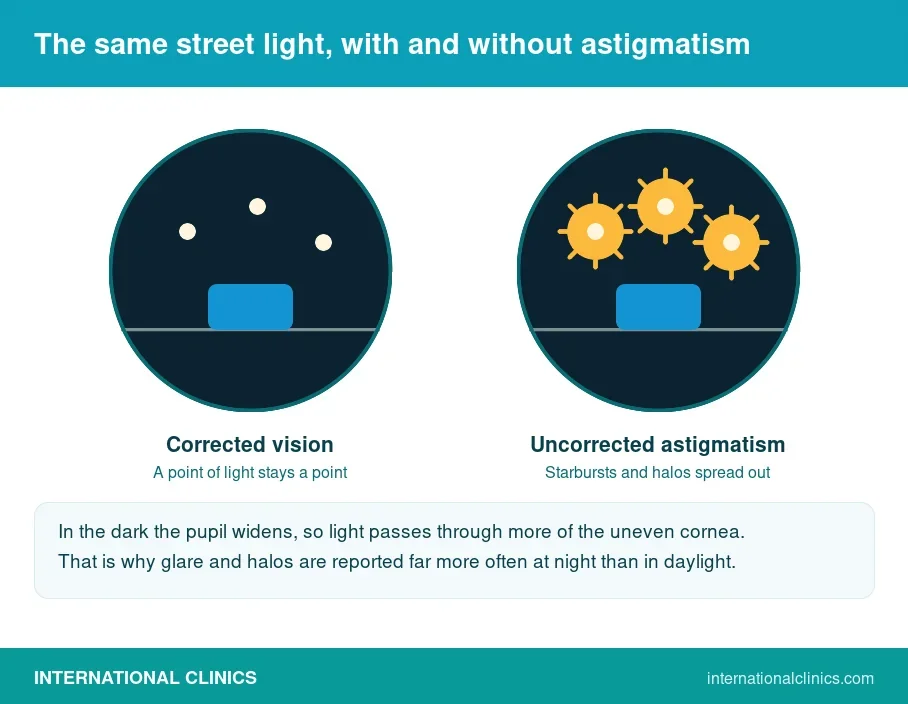
Night is when uncorrected astigmatism is least forgiving. In the dark the pupil widens, so light passes through more of the mis-shaped cornea, and the smearing that is tolerable in daylight becomes streaks and rings around every bright point.
A 2023 systematic review in Optometry and Vision Science put numbers on how often this is reported by people with astigmatism:
| Reported problem | Share of astigmatic patients |
|---|---|
| Increased glare | 53–77% |
| Halos around lights | 28–80% |
| Difficulty driving at night | 66% |
| Dependence on spectacles | 45–85% |
Source: Zhang et al., Optometry and Vision Science, 2023. If headlights have started to dazzle you more than they used to, that is a reason to be tested rather than a reason to drive less.
Eye Strain and Headaches From Uncorrected Astigmatism
Eye strain from astigmatism is the cost of constant refocusing. The eye keeps hunting for a sharp image it cannot reach, and the muscles doing the hunting do not rest. The result is the pattern most people describe: fine in the morning, aching by mid-afternoon, worse on screen-heavy days.
The same review measured the performance cost against fully corrected vision, and the size of the error is the part worth reading twice:
| Amount of uncorrected astigmatism | Speed on vision tasks | Errors made |
|---|---|---|
| 1 dioptre | 9% slower | 38% more errors |
| 2 dioptres | 29% slower | 370% more errors |
One dioptre is a mild prescription most people would not think worth correcting. Two dioptres produces almost five times the error rate of one. This is the clearest argument against the common view that a small amount of astigmatism is not worth glasses.
What Causes Astigmatism?
In most cases there is no single cause. The shape of the cornea is largely inherited, and astigmatism is usually present from birth and simply not noticed until vision is tested. The recognised contributors are:
- Family history — corneal shape runs in families.
- Eye injury — scarring changes the curve of the cornea.
- Previous eye surgery — including cataract surgery, which can leave or alter astigmatism.
- Keratoconus — progressive thinning that makes the cornea bulge into a cone, producing irregular astigmatism.
What does not cause it: reading in dim light, sitting close to a screen, or squinting. Those make the symptoms more noticeable; they do not change the shape of the eye.
Types of Astigmatism: Corneal, Lenticular and Axis
Astigmatism is grouped in two ways, and the grouping decides which correction works.
| Grouping | Types | What it changes |
|---|---|---|
| By where the irregular curve sits | Corneal (the front surface) or lenticular (the lens inside the eye) | Cleveland Clinic names both; corneal is the more common |
| By how regular the curve is | Regular (two even meridians) or irregular (uneven, often after injury or in keratoconus) | Regular corrects with glasses; irregular usually needs rigid or scleral lenses |
| By the axis of the steeper curve | With-the-rule, against-the-rule or oblique | With-the-rule is commoner at 40 or younger; against-the-rule and oblique increase with age |
The age pattern in the last row is measured, not folklore: the 2023 review found with-the-rule astigmatism more prevalent in people aged 40 or younger, with against-the-rule and oblique rising as people get older.
Astigmatism in Children: What Parents Notice First
Children rarely report blurred vision, because they have nothing to compare it with. What parents notice instead is behaviour:
- Sitting unusually close to the television or holding a book very near the face
- Screwing up the eyes, tilting or turning the head to look at something
- Rubbing the eyes, or complaining of headaches after school
- Avoiding reading, or losing their place on the page
- Falling behind on board work while being fine with close work, or the reverse
Uncorrected astigmatism in early childhood can hold back the development of vision in the affected eye, so this is the age group where testing matters most — and where the NHS two-year interval is a floor, not a target.
Does Astigmatism Get Worse Over Time?
It can change, and the direction of change depends on age. Prevalence across the general population is reported between 8% and 62% depending on the group studied and the threshold used, with the highest rates in people aged 70 or older. The axis also shifts with age, from with-the-rule in younger adults towards against-the-rule and oblique later.
In practice this means two things. A prescription that was right five years ago may no longer be. And a sudden change — rather than a gradual one — is worth an examination rather than a new pair of glasses, because rapid change can point to keratoconus or to a corneal problem rather than to ordinary drift. Blur that arrives with its own separate pattern, such as colours fading and lights haloing together, may be a different condition entirely: cataract symptoms overlap with astigmatism more often than people expect.
Astigmatism Treatment: Glasses, Toric Lenses and Laser
Astigmatism does not always need treating. The NHS is explicit that it may be left alone if it is mild and not causing problems. When it is corrected, these are the options, with our published prices for the surgical routes at International Clinics in Turkey.
| Option | How it works | Our published price |
|---|---|---|
| Glasses with cylindrical lenses | An extra curve in the lens cancels the extra curve of the eye | Not a surgical procedure |
| Toric contact lenses | Weighted so they hold their orientation on the eye instead of rotating | Not a surgical procedure |
| Orthokeratology | Rigid lenses worn overnight to reshape the cornea temporarily | Not a surgical procedure |
| Femto-LASIK | A femtosecond laser makes the flap and an excimer laser reshapes the cornea | $400–$800 per eye |
| PRK | No flap: the surface layer is removed and the cornea reshaped directly | Around $1,350 for both eyes |
Which one suits you is decided by the amount and the regularity of the astigmatism, by corneal thickness, and by whether short- or long-sightedness needs correcting at the same time. Our PRK page sets out the surface-laser route, and can you have LASIK twice covers what happens when a laser correction needs revisiting.
Risks of Leaving Astigmatism Uncorrected
Uncorrected astigmatism is not dangerous in the way a detached retina is, but it is not harmless either. The measured consequences are reduced quality of vision, more glare and halos, difficulty driving at night reported by two-thirds of patients, slower and more error-prone visual work, and — in children — the risk that vision in the affected eye does not develop fully.
Laser correction carries its own risks, and no result can be promised in advance. Recognised risks include dry eye, glare or halos at night that persist for a period after surgery, under- or over-correction needing a second procedure, and, rarely, infection or flap complications. Not every eye is suitable: thin corneas, keratoconus, unstable prescriptions and some medical conditions rule it out, which is what the assessment is for.
Book an eye test rather than waiting if:
- Your vision is blurred or ghosted at every distance, not only far away
- Headlights and streetlights have started to produce rings, spikes or dazzle
- Reading or screen work gives you headaches or aching eyes by the afternoon
- Your child squints, tilts their head, or sits very close to the screen
- Your vision has changed noticeably since your last prescription
This page is general information and does not replace an eye examination. If you would like your prescription and corneal measurements reviewed by our ophthalmology department, our patient team can arrange it and explain which correction fits your eyes, including whether Femto-LASIK in Turkey is an option for your prescription.