
- Conjunctivitis Symptoms: The Nine Signs to Look For
- Conjunctivitis Symptoms by Cause: Viral, Bacterial or Allergic
- Pink Eye Symptoms: Is Pink Eye the Same as Conjunctivitis?
- How Long Does Conjunctivitis Last?
- Is Conjunctivitis Contagious, and for How Long?
- What Causes Conjunctivitis?
- Conjunctivitis Symptoms in Adults and in Children
- Conjunctivitis Treatment: What Helps and What Does Not
- Red Flag Symptoms: When Conjunctivitis Needs Urgent Care
- Getting a Correct Diagnosis
Conjunctivitis symptoms are redness in the white of the eye, a gritty or burning feeling, watering, itching, swollen eyelids and a discharge that crusts on the lashes overnight. The pattern of that discharge is what separates viral, bacterial and allergic conjunctivitis, and it is what decides whether the eye is contagious.
Conjunctivitis Symptoms: The Nine Signs to Look For
Conjunctivitis is inflammation of the conjunctiva, the clear membrane covering the white of the eye and lining the inside of the eyelid. It can affect one eye or both, and the signs below are the ones clinicians look for first.
- Redness in the white of one or both eyes.
- A gritty feeling, as if something is stuck in the eye.
- Burning or irritation rather than deep pain.
- Itching, which is mild in infection and intense in allergy.
- Watering or excessive tearing.
- Discharge that dries into crusts on the lashes, most obvious on waking.
- Swollen or puffy eyelids.
- Blurred vision that clears when you blink the discharge away. Blurring that does not clear is a different problem, such as astigmatism or cataract.
- Light sensitivity that is mild; severe light sensitivity is a red flag, not a symptom of simple conjunctivitis.
“Conjunctivitis that produces sticky pus is contagious.” — NHS, Conjunctivitis, page last reviewed 23 April 2024.
Conjunctivitis Symptoms by Cause: Viral, Bacterial or Allergic
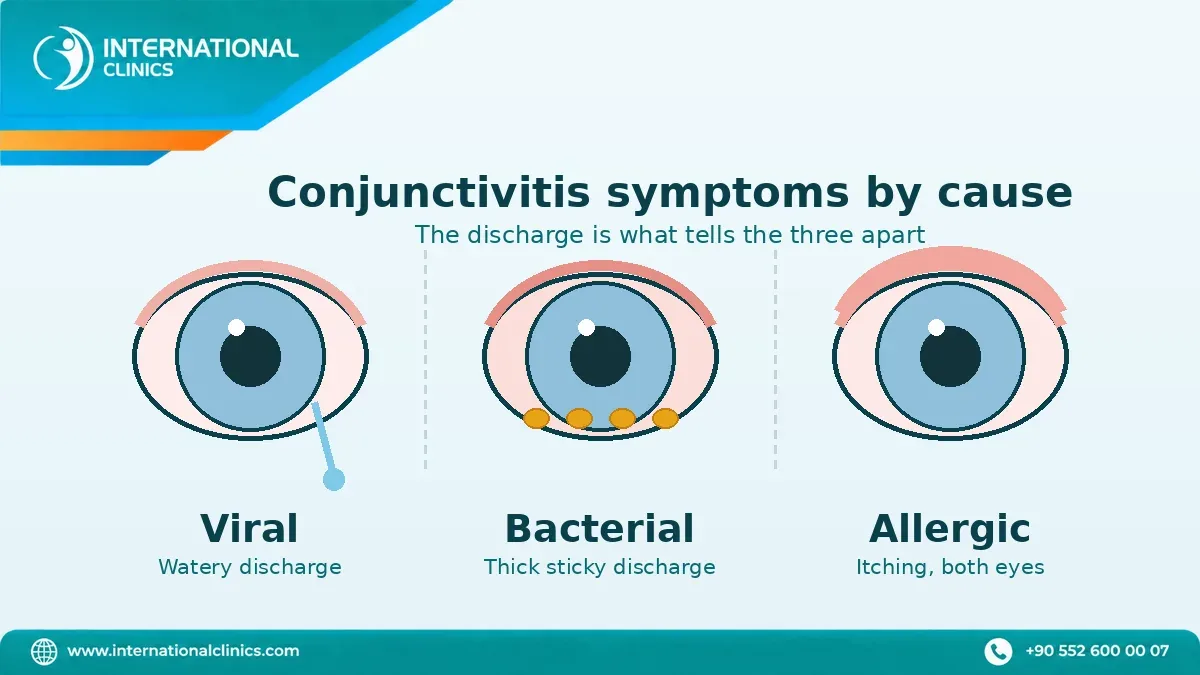
Most people search for conjunctivitis symptoms because they want to know which type they have. Discharge, itch and the number of eyes involved answer that faster than redness does, because redness looks the same in all three.
| Type | Discharge | Typical extra sign | How long it lasts | Contagious |
|---|---|---|---|---|
| Viral | Watery | Often follows a cold, sore throat or flu; starts in one eye then spreads | Usually 5 to 7 days; some cases 3 to 4 weeks | Yes |
| Bacterial | Thick and sticky, yellow, green or white | Lashes glued shut in the morning | Around 10 days | Yes |
| Allergic | Watery | Intense itching, both eyes at once, often with sneezing | As long as you are exposed to the allergen | No |
Durations and discharge descriptions above are from Cleveland Clinic; the contagious column follows NHS guidance, which notes that allergic conjunctivitis makes eyes red and watery but is not contagious.
Pink Eye Symptoms: Is Pink Eye the Same as Conjunctivitis?
Yes. Pink eye is the everyday name for conjunctivitis, and red eye is a third name for it. Searching pink eye symptoms and conjunctivitis symptoms returns the same condition, so nothing in the list above changes with the word you use.
The name is only a description of colour. It says nothing about the cause, which is why two people with an identically pink eye can need completely different treatment. A gritty, red eye without discharge is more often dry eye syndrome than conjunctivitis.
How Long Does Conjunctivitis Last?
It depends entirely on the cause. Viral conjunctivitis usually lasts 5 to 7 days, although some cases run 3 to 4 weeks. Bacterial conjunctivitis usually lasts around 10 days. Allergic conjunctivitis lasts as long as the allergen is around you.
Clinicians also divide it by duration rather than cause: conjunctivitis lasting under four weeks is called acute, and beyond four weeks it is called chronic. If your symptoms have not cleared within 7 days, the NHS advises seeing a GP rather than waiting it out.
Is Conjunctivitis Contagious, and for How Long?
Infectious conjunctivitis spreads easily, by hand-to-eye contact and by shared towels, pillowcases and make-up. The sticky, pus-producing eye is the contagious one, and so is the red, gritty eye. Allergic conjunctivitis does not spread at all.
To limit spread: wash hands with warm soapy water often, wash pillowcases and face cloths in hot water and detergent, do not share towels or pillows, and do not rub the eyes. You do not need to stay off work or school unless you feel very unwell.
What Causes Conjunctivitis?
Causes divide into infectious and non-infectious. Among infections, the adenovirus family is the most common cause of acute conjunctivitis, and bacteria are the second most common. Measles, mumps, COVID-19 and eye herpes can also cause it, and bacterial sexually transmitted infections such as chlamydia and gonorrhoea can too, in which case it takes longer to settle.
Non-infectious causes include allergens such as pollen and mould, irritants such as soap, cosmetics, smoke and pool chlorine, contact lenses or lens solution, and eye injuries. Autoimmune disease and, rarely, tumours can produce redness mistaken for conjunctivitis.
Conjunctivitis Symptoms in Adults and in Children
In adults the complaint is usually grittiness and discharge, and many adults carry on working. In toddlers and babies the visible signs come first: crusted lashes on waking, rubbing, watering and a reluctance to open the eye in bright light.
Two paediatric situations are not routine. A baby under 30 days old with red, sticky eyes needs an urgent appointment, and a child under 2 needs a GP prescription rather than pharmacy treatment.
Conjunctivitis Treatment: What Helps and What Does Not
Most cases settle without prescription treatment. Self-care that is recommended: clean the lids by boiling water, letting it cool, then wiping the lashes with a clean cotton pad, one pad per eye; hold a cool compress on the closed eye; wear glasses and stop contact lenses until the eye is better, and throw away the lenses and case you were using.
A pharmacist can advise and suggest eye drops or antihistamines. Antibiotics are prescribed only when the cause is bacterial — they do not work on viral or allergic conjunctivitis, which is the single most common misunderstanding about this condition.
Red Flag Symptoms: When Conjunctivitis Needs Urgent Care
It is uncommon for conjunctivitis itself to cause lasting eye damage, but several more serious conditions look like it in the first days. Treat the following as reasons to seek urgent advice rather than wait:
- Pain in the eye, particularly severe pain rather than irritation.
- Sensitivity to light that is marked.
- Any change in vision, including blurring that does not clear, reduced vision, wavy lines or flashing lights — flashes and floaters are retinal detachment symptoms.
- A very red eye with pain and haloes, which can indicate acute glaucoma rather than conjunctivitis.
- A large amount of discharge.
- A baby under 30 days old with red, sticky eyes.
- Symptoms that have not cleared within 7 days.
Contact lens wearers with conjunctivitis symptoms plus spots on the eyelids should also be assessed. Sudden loss of vision is never a conjunctivitis symptom and needs immediate attention — see causes of sudden vision loss.
Getting a Correct Diagnosis
Diagnosis is made by examining the eye and asking when symptoms began and whether they are worsening. Where the cause is unclear, a soft-tipped swab of the discharge can be sent for laboratory testing to guide treatment.
If your symptoms are not following the pattern in the table above, are worsening after a few days, or involve pain or changed vision, an eye examination is the right next step. Our ophthalmology team can review your symptoms and arrange an examination.