
- Blepharitis Symptoms: The Full List
- Is Blepharitis Contagious?
- What Causes Blepharitis?
- Anterior and Posterior Blepharitis: Why There Are No “Four Stages”
- Blepharitis Treatment: Lid Hygiene First
- Can Blepharitis Be Cured?
- Complications: What Untreated Blepharitis Can Lead To
- Red Flag Symptoms: When to Seek Urgent Advice
- Getting a Diagnosis
Blepharitis symptoms are sore, swollen or greasy-looking eyelids, itching and a gritty or burning feeling in the eyes, flakes or crusts around the roots of the eyelashes, and eyelids that stick together on waking. Symptoms are typically worst first thing in the morning, and they come and go rather than clear once and for good.
Blepharitis Symptoms: The Full List
Blepharitis is inflammation of the eyelids, usually along the lid margins where the lashes grow, and it usually affects both eyes. These are the signs reported by the NHS and Mayo Clinic:
- Sore, swollen eyelids, sometimes with a change in eyelid colour.
- Itching or stinging along the edges of the lids.
- A gritty or burning sensation, as if sand is in the eye.
- Flakes or crusts around the roots of the eyelashes.
- Eyelids that look greasy or become crusted with scales clinging to the lashes.
- Eyelids stuck together when you wake up.
- Watery eyes, or tears that look foamy.
- Red eyes and more frequent blinking.
- Sensitivity to light.
- Blurred vision that usually improves when you blink. Blurring that persists is a different problem, such as astigmatism or cataract.
The single most useful clue is timing: blepharitis symptoms are typically worse in the morning and ease as the day goes on. A red, painful eye that gets worse through the day is pointing at something else.
Is Blepharitis Contagious?
No. The NHS states plainly that blepharitis cannot be spread to other people, and Mayo Clinic says the same. It is an inflammatory condition of your own eyelid margin, not an infection you catch or pass on, so there is no reason to stay off work or school or to keep a child at home.
What Causes Blepharitis?
Three causes account for most cases, according to the NHS: a type of bacteria that normally lives on the skin growing in unusual numbers, a skin condition such as seborrhoeic dermatitis, and the oil glands inside the eyelids not producing enough oil. Mayo Clinic adds that in some cases the cause is simply not known.
Conditions that raise the risk include dandruff of the scalp and eyebrows, rosacea, allergies to eye medicines, contact lens solutions or eye make-up, dry eyes, and an excess of eyelash mites or, rarely, lice.
Anterior and Posterior Blepharitis: Why There Are No “Four Stages”
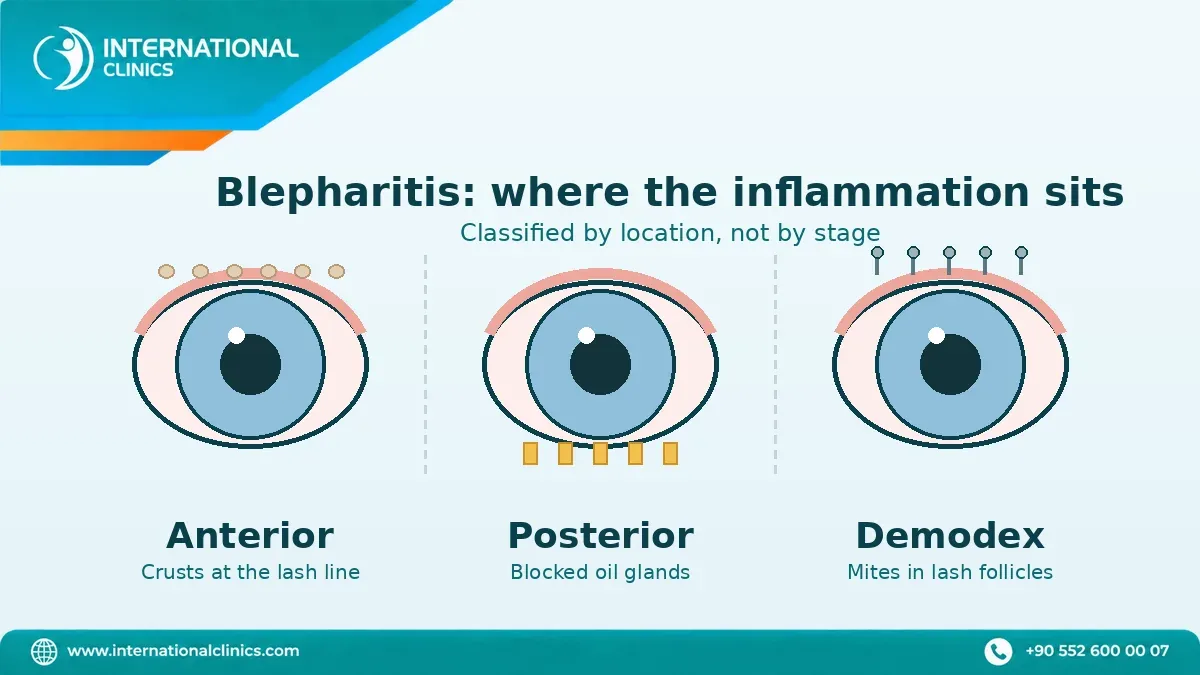
People often search for the four stages of blepharitis, but neither the NHS nor Mayo Clinic describes the condition in stages. Clinicians classify it by where the inflammation sits, not how far it has progressed:
| Type | Where the problem is | Typical picture |
|---|---|---|
| Anterior | The outer edge of the lid, where the lashes attach | Flakes and crusts at the lash roots; linked to skin bacteria and to seborrhoeic dermatitis |
| Posterior | The inner lid margin, at the oil glands | Greasy lids and an unstable tear film; linked to glands not producing enough oil |
| Demodex-related | The lash follicles | Persistent itching at the lash line associated with an excess of eyelash mites |
Blepharitis is chronic and relapsing rather than staged. That is why it is described as coming and going, and why treatment is measured in daily habits rather than a course with an end date.
Blepharitis Treatment: Lid Hygiene First
Eyelid cleaning is the first-line treatment, and the NHS sets out the method precisely:
- Soak a clean flannel or cotton wool in warm water and hold it on the closed eyelid for 5 to 10 minutes.
- Gently massage the eyelids for around 30 seconds.
- Wipe along the edge of the eyelids with cotton wool or a cotton bud to remove flakes and crusts, using a small amount of baby shampoo in water if it helps.
Do this twice a day, and keep doing it even after symptoms clear. While you have symptoms, avoid contact lenses and avoid eye make-up, particularly eyeliner and mascara. A pharmacist can suggest eye pads, wipes and eye drops.
If cleaning alone does not settle it, a GP may prescribe an antibiotic cream or ointment for the eyelid. Where blepharitis has caused a cyst, antibiotic eye drops or tablets may be used, and severe cases or those with other eye symptoms may be referred to an ophthalmologist.
Can Blepharitis Be Cured?
“Blepharitis can’t be cured, but daily care and treatments can usually control the symptoms.” — Mayo Clinic, Blepharitis — Symptoms & causes, 20 September 2025.
That is the honest answer, and it changes how you should judge treatment. Success is measured by how well symptoms stay controlled while you keep up lid hygiene, not by the condition disappearing. Stopping the cleaning routine when the eyes feel better is the most common reason symptoms return.
Complications: What Untreated Blepharitis Can Lead To
Mayo Clinic lists the problems long-standing blepharitis can cause near the eyes:
- Eyelash problems — lashes falling out, losing colour, or growing inwards towards the eye.
- Eyelid skin changes — scarring, or lid edges turning inward or outward.
- Dry eyes or excess tearing from an irregular tear film — see what helps dry eye syndrome.
- A stye, a painful bump at the base of a lash or in an oil gland.
- A chalazion, a swollen bump from a blocked oil gland, usually painless but tender as it grows.
- Repeated conjunctivitis — blepharitis can lead to frequent episodes of pink eye, so it is worth knowing the conjunctivitis symptoms to look for.
- Corneal injury from constant irritation or misdirected lashes.
Blepharitis usually does not cause permanent damage to eyesight, but these complications are the reason it is worth controlling rather than tolerating.
Red Flag Symptoms: When to Seek Urgent Advice
The following are not blepharitis symptoms and need urgent assessment rather than more lid cleaning:
- Pain in the eye.
- Any change to your vision, including blurred vision that does not clear when you blink, or sudden loss of vision.
- A very red eye, which with pain and haloes can indicate acute glaucoma.
See a GP if blepharitis symptoms do not improve or are getting worse despite regular eyelid cleaning.
Getting a Diagnosis
Blepharitis is diagnosed by examining the eyelid margins, lashes and tear film. Because it overlaps with dry eye disease and can trigger repeated conjunctivitis, an examination is what separates the three and decides whether lid hygiene alone is enough. Our ophthalmology team can assess your eyelids and set out a routine you can keep up.