- Who Is a Good Candidate for Veneers?
- Types of Veneers in Turkey: E-max, Zirconia and Composite
- Porcelain vs composite veneers: which should you choose?
- E-max or zirconia veneers?
- Getting Veneers in Turkey: Day-by-Day Timeline
- Preparing for your trip and first consultation
- Is It Safe to Get Veneers in Turkey?
- “Turkey teeth” are usually crowns, not veneers
- Veneers vs crowns: what is the difference?
- How to Choose a Clinic for Veneers in Turkey
- How Long Do Turkey Veneers Last?
- Caring for veneers after you fly home
- What Is the 4-8-10 Rule for Veneers?
- Veneers Turkey: How Much Are Veneers in Turkey? A Short Price Summary
- What changes the veneers Turkey cost?
- How Much Does a Full Set of Veneers Cost in Turkey?
Dental veneers in Turkey are thin porcelain or composite facings bonded to the front of the teeth: porcelain is stronger, longer-lasting and more stain-resistant, composite costs less and is easier to repair, and fitting porcelain veneers usually takes 5 to 7 days in one trip. This guide explains how to choose the type, what happens at each appointment, how to check safety and why many “Turkey teeth” are full crowns rather than veneers. If your question is how much are veneers in Turkey, prices per tooth, the full set price and what changes them are in our guide to veneers in Turkey cost.
Veneers in Turkey are a long-term decision: most types are permanent because some enamel is removed, so the material and the dentist matter more than the headline price. Before you compare dental veneers prices, make sure the quote is for true veneers, not the full crowns often sold as “Turkey teeth”.
Who Is a Good Candidate for Veneers?
Veneers are thin, custom-made coverings bonded to the front surfaces of the teeth to change their colour, shape or size; unlike crowns, they cover only the front of the tooth (Source: American Dental Association).
Veneers suit people who want to change the look of healthy teeth. Cleveland Clinic says they can conceal chips, cracks, gaps between teeth, discoloration and stains that do not improve with whitening. They are only an option if you are free of extensive cavities and gum disease: serious oral health problems need treating first, before any cosmetic work. Veneers improve appearance but do not necessarily strengthen or repair teeth, so a badly damaged tooth may need a different treatment (Source: Cleveland Clinic).
Veneers may also not be the right choice if you clench or grind your teeth or have a deep overbite, and because enamel is removed, the treatment cannot be undone (Source: American Dental Association).
Types of Veneers in Turkey: E-max, Zirconia and Composite
The main types of veneers in Turkey are porcelain (including E-max), composite, no-prep or minimal-prep and removable snap-on veneers. Porcelain and E-max veneers are chosen for their natural appearance and durability. E-max is covered in depth in E-max veneers in Turkey, and removable alternatives in snap-on veneers. If you only need small chips or gaps fixed, composite bonding in Turkey may be enough.
Composite veneers may need less enamel removal and fewer visits and are easier to repair, but they do not resist stains and wear as well as porcelain (Source: American Dental Association).
| Type of veneer | How it is made and fitted | Points to know |
|---|---|---|
| Porcelain and E-max | Custom-made in a laboratory from impressions after some enamel is removed | Stain resistant; most types are not reversible |
| Composite | Tooth-coloured resin, the same material used for bonding, shaped directly on the tooth | No impressions needed; suits milder cosmetic issues |
| No-prep or minimal-prep | Custom-made, with less enamel removal than traditional veneers | Still need some enamel removal; not right for everyone |
| Removable (snap-on) | Fit over the natural teeth and can be taken out like a retainer | Can make eating difficult and affect speech; little research so far |
Ask your dentist which type suits your teeth and bite, and how much enamel each option would remove. No-prep and minimal-prep veneers are the only fixed type described as reversible; most types are permanent (Source: Cleveland Clinic).
Porcelain vs composite veneers: which should you choose?
Choose porcelain if you want the longest-lasting, most stain-resistant result and accept more enamel removal and a laboratory stage; choose composite if you want a lower-cost, repairable option with less enamel removal and fewer visits. Porcelain veneers are strong, long-lasting and natural-looking, while composite veneers are not as stain- or wear-resistant but are easier to fix if damaged (Source: American Dental Association).
| Question | Porcelain (including E-max) | Composite |
|---|---|---|
| How is it made? | In a laboratory, from an impression or scan | Shaped directly on the tooth; no impressions needed |
| Enamel removed | A small amount from the front and sides | May be less |
| Stains and wear | Stain resistant | Less stain- and wear-resistant |
| Repairs | Harder to repair than composite | Easier to repair |
| Long-term evidence | 95.5% still in place after 10 years in a 2021 review | 88% pooled survival over about 2 to 8 years in a 2023 meta-analysis |
The table combines the American Dental Association’s and Cleveland Clinic’s descriptions with the two systematic reviews cited in the lifespan section below (Sources: American Dental Association, Cleveland Clinic, J Clin Med, 2021, J Evid Based Dent Pract, 2023).
Your bite matters as much as the material. Veneers may not be a good choice if you clench or grind your teeth or have a deep overbite (Source: American Dental Association).
A 2024 review also found that fractures were more common in people with habits such as grinding, and that keeping more enamel improved how long veneers last (Source: J Funct Biomater, 2024).
E-max or zirconia veneers?
E-max is a lithium disilicate glass ceramic, and most long-term veneer evidence comes from porcelain and glass-ceramic veneers; there is much less long-term evidence on zirconia veneers. A 2024 review found that glass-ceramic veneers placed with minimal or no preparation had the highest survival rates (Source: J Funct Biomater, 2024).
The 2021 systematic review behind the 95.5% ten-year figure included studies of lithium disilicate and other glass-ceramic veneers, with fracture as the most common complication and debonding second (Source: J Clin Med, 2021).
If a clinic offers zirconia, ask whether it is planned as a veneer on the front of the tooth or as a full crown, and why. Prices for E-max and zirconia are compared in our veneers in Turkey cost guide.
Getting Veneers in Turkey: Day-by-Day Timeline
Getting veneers in Turkey usually takes 5 to 7 days in one trip, because the laboratory makes the veneers while you stay. A typical timeline looks like this:
- Day 1: consultation, digital smile design and minimal shaving of the natural enamel (conservative preparations for porcelain veneers are usually about 0.3 to 0.5 mm, kept within the enamel), followed by temporary teeth (Source: J Conserv Dent, 2011).
- Days 2 to 4: custom permanent veneers are made in a laboratory using CAD/CAM technology.
- Day 5: trial fitting and final bonding of the permanent veneers.
At the fitting appointment the dentist checks the veneers before bonding them, and composite veneers do not need impressions or a laboratory stage at all. Most types of veneer are permanent once bonded, so raise anything you do not like about the shape or shade at the trial fitting, before the final bonding (Source: Cleveland Clinic).
Cleveland Clinic notes there is no downtime after veneers are placed: you can return to normal activities the same day and eat once the anaesthetic has worn off. At home, the usual pattern is two visits a few weeks apart while the laboratory makes the veneers, so a one-trip timeline depends on an on-site or nearby laboratory (Source: Cleveland Clinic).
Preparing for your trip and first consultation
Speak to your own dentist before you travel. The General Dental Council recommends this because your regular dentist knows your dental history, can advise on the suggested treatment and needs to know your plans in case of later complications (Source: General Dental Council).
A proper consultation in Turkey, in person or online, should include questions about:
- Your medical history and any long-term health conditions.
- The medicines you take.
- Past dental treatment, previous surgery or anaesthetic.
- Smoking or alcohol use.
If these are not discussed, treat it as a warning sign. Before agreeing, make sure a qualified dentist examines you and ask for a clear treatment plan with a full cost breakdown: the GDC says you should always be assessed by a qualified dentist before being given a treatment plan and cost estimate (Source: General Dental Council).
Is It Safe to Get Veneers in Turkey?
Veneers in Turkey can be safe when a qualified, registered dentist plans and places them, but check exactly which treatment you are getting. True porcelain veneers only need a thin layer of front enamel removed; some aggressive low-cost providers instead shave healthy teeth down into pegs and fit full crowns, an irreversible procedure that can lead to nerve damage or root canal treatment later.
“Turkey teeth” are usually crowns, not veneers
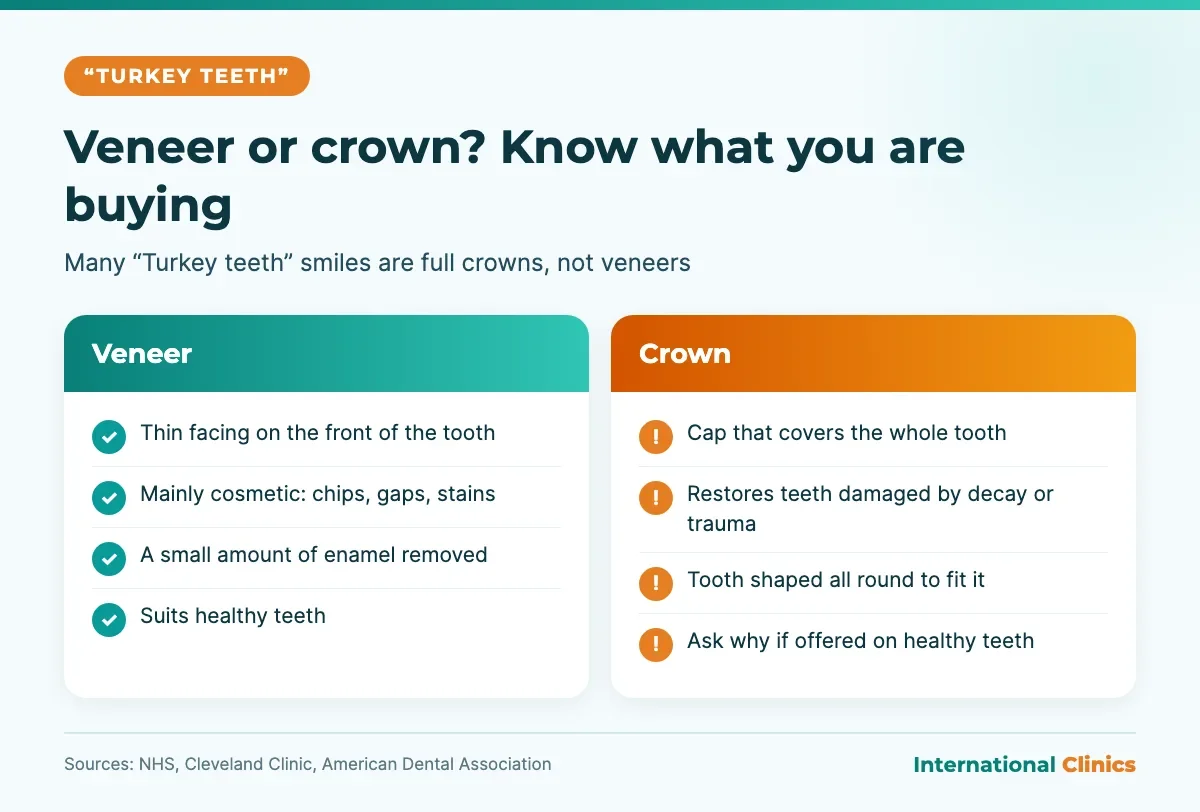
The bright, uniform smiles called “Turkey teeth” are often full crowns rather than veneers. A crown is a cap that completely covers a real tooth, and the tooth must be shaped so the crown can be fixed onto it, while a veneer is a thin facing fitted over the front of the tooth (Source: NHS).
In a 2022 British Dental Association survey of 1,000 UK dentists, 86% of those who had seen patients treated abroad had treated cases that developed problems, and 87% named crowns as the treatment most likely to need follow-up work. Dentists reported over-prepared teeth, where more of the tooth is removed than necessary, ill-fitting crowns and full crowns placed on previously healthy teeth during “smile makeovers” (Source: British Dental Association).
Veneers vs crowns: what is the difference?
A veneer covers only the front surface of a tooth to improve how it looks, while a crown covers the whole tooth to add strength and protection. Cleveland Clinic explains that the main purpose of a crown is to restore teeth badly damaged by decay or trauma (Sources: Cleveland Clinic, Cleveland Clinic).
If your treatment plan lists crowns on healthy front teeth, ask why, and request the plan in writing with the exact treatment named for each tooth. A full comparison is in veneers vs crowns.
"Most types of dental veneers are permanent, meaning they aren’t reversible."
— Cleveland Clinic, Dental Veneers.
The difference between veneers and the crowns often called "Turkey teeth" is explained in how much are Turkey teeth. Cleveland Clinic also lists the key downsides: you lose at least some natural enamel, teeth may become more sensitive to heat and cold, and a veneer can fall off or become dislodged (Source: Cleveland Clinic).
The Oral Health Foundation lists problems reported after dental treatment abroad, including serious infection, severe sensitivity after veneer preparation, poor gum health around the new work, inadequate follow-up care and communication problems. It also notes that crowns, bridges and veneers often need follow-up visits such as bite adjustments, that standards and clinical approaches vary between countries, and that correcting work after you return home can be expensive (Source: Oral Health Foundation).
The BDA survey found the same pattern: 65% of dentists said repairs cost patients at least £500, and over half said more than £1,000 (Source: British Dental Association).
How to Choose a Clinic for Veneers in Turkey
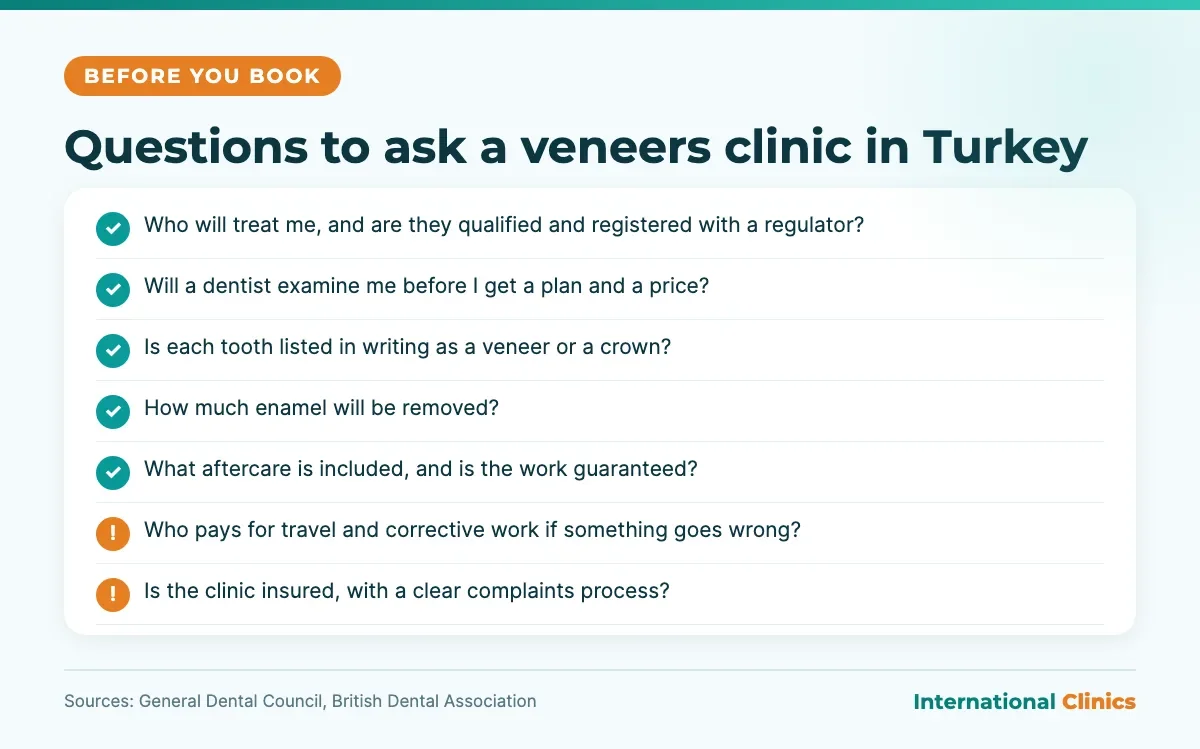
Choose a clinic on the dentist’s qualifications and the clarity of the plan, not on the lowest quote. Before you book, get clear answers to these questions, adapted from the checklist that the General Dental Council publishes and the Oral Health Foundation reproduces (Source: General Dental Council):
- Who will carry out my treatment, what are their qualifications, and are they registered with a professional regulator?
- How often does the dentist do this procedure?
- Will the team speak my language, or is a translator provided?
- How much enamel will be removed, and is this a veneer or a crown?
- What aftercare is included, and what happens if I am unhappy with the result?
- Who pays for extra travel, accommodation or corrective work if something goes wrong?
- Does the clinic have insurance and a clear complaints process?
- Is the work guaranteed, and for how long?
Look at examples of the clinic’s own work and read patient reviews, ideally speaking to people who have had treatment there. If clear answers are not given, think carefully before going ahead. More on this is in our guide to choosing a dental clinic in Turkey.
The BDA also advises checking a dentist’s qualifications and experience and whether they are insured if things go wrong, and factoring the cost of follow-up treatment into the price (Source: British Dental Association).
How Long Do Turkey Veneers Last?
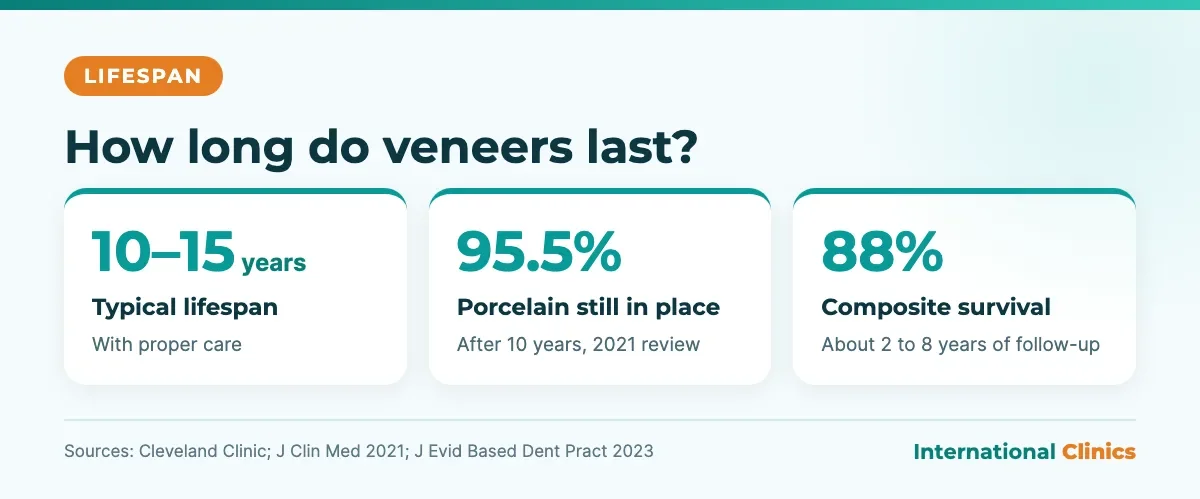
Dental veneers from Turkey typically last 10 to 15 years, and Cleveland Clinic gives the same lifespan of 10 to 15 years with proper care (Source: Cleveland Clinic).
Long-term studies back this up for porcelain. A 2021 systematic review of 25 studies with 6,500 porcelain veneers estimated that 95.5% were still in place after 10 years; fracture was the most common problem, followed by debonding, and most failures happened in the first years after fitting (Source: J Clin Med, 2021).
| Material | Average lifespan |
|---|---|
| Porcelain and E-max | 10 – 15 years |
| Zirconia | Limited long-term data on zirconia veneers; ask your dentist |
| Composite resin | Shorter than porcelain; easier to repair |
Composite veneers wear and stain more than porcelain. A 2023 meta-analysis found a pooled survival of 88% for resin composite veneers over average follow-up periods of about 2 to 8 years, with surface roughness, colour mismatch and marginal discoloration as the most common complications (Source: J Evid Based Dent Pract, 2023).
Caring for veneers after you fly home
Brushing, flossing and regular dental visits are all veneers need, according to Cleveland Clinic. To help them last:
- Brush at least twice a day with a soft-bristled toothbrush and non-abrasive fluoride toothpaste.
- Floss once a day and use an antibacterial mouthwash.
- Avoid whitening products, which can scratch veneers.
- Do not bite directly into hard foods such as apples, carrots and tough meats; cut them up and chew with your back teeth.
- Limit dark foods and drinks such as berries, red wine, coffee and tea.
- Never use your teeth as tools, for example to open packages.
- See a dentist for routine check-ups and cleanings, as the tooth underneath a veneer can still decay (Source: Cleveland Clinic).
What Is the 4-8-10 Rule for Veneers?
The 4-8-10 rule is an informal cosmetic dentistry guideline, not a clinical standard, for how many upper front veneers are needed for a balanced smile, matching the number of veneers to the visible smile zone:
- 4 veneers: the four front teeth, for minor chips, slight discoloration or small gaps in a narrow smile.
- 8 veneers: extends to the canines and first premolars for a wider smile.
- 10 veneers: adds the second premolars, for a broad smile that shows more teeth at the sides.
The right number for you depends on how many teeth show when you smile and on the health of each tooth, which only an examination can confirm. Veneering teeth that do not show, or healthy teeth that do not need treatment, adds cost and removes enamel for no benefit.
Veneers Turkey: How Much Are Veneers in Turkey? A Short Price Summary
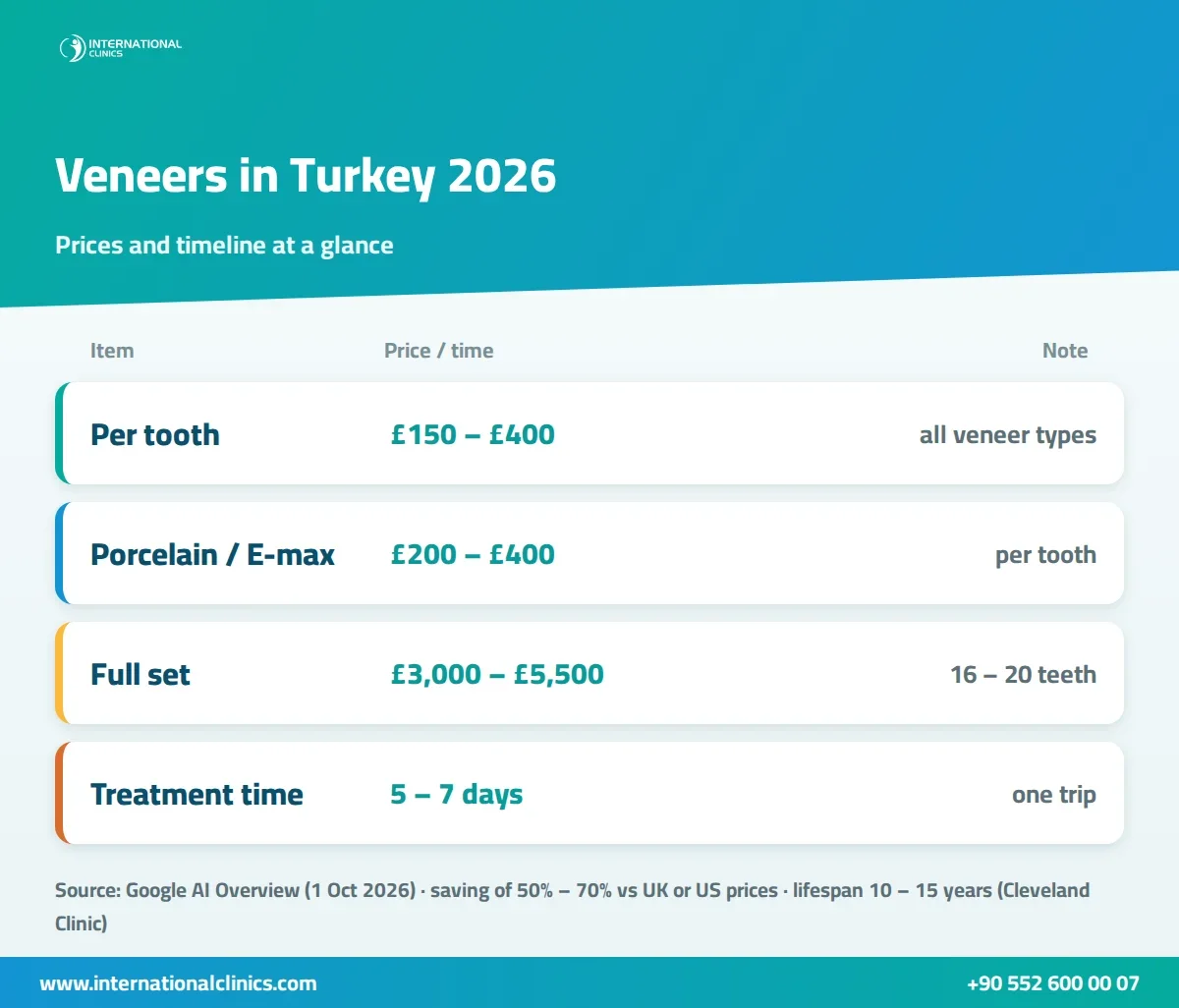
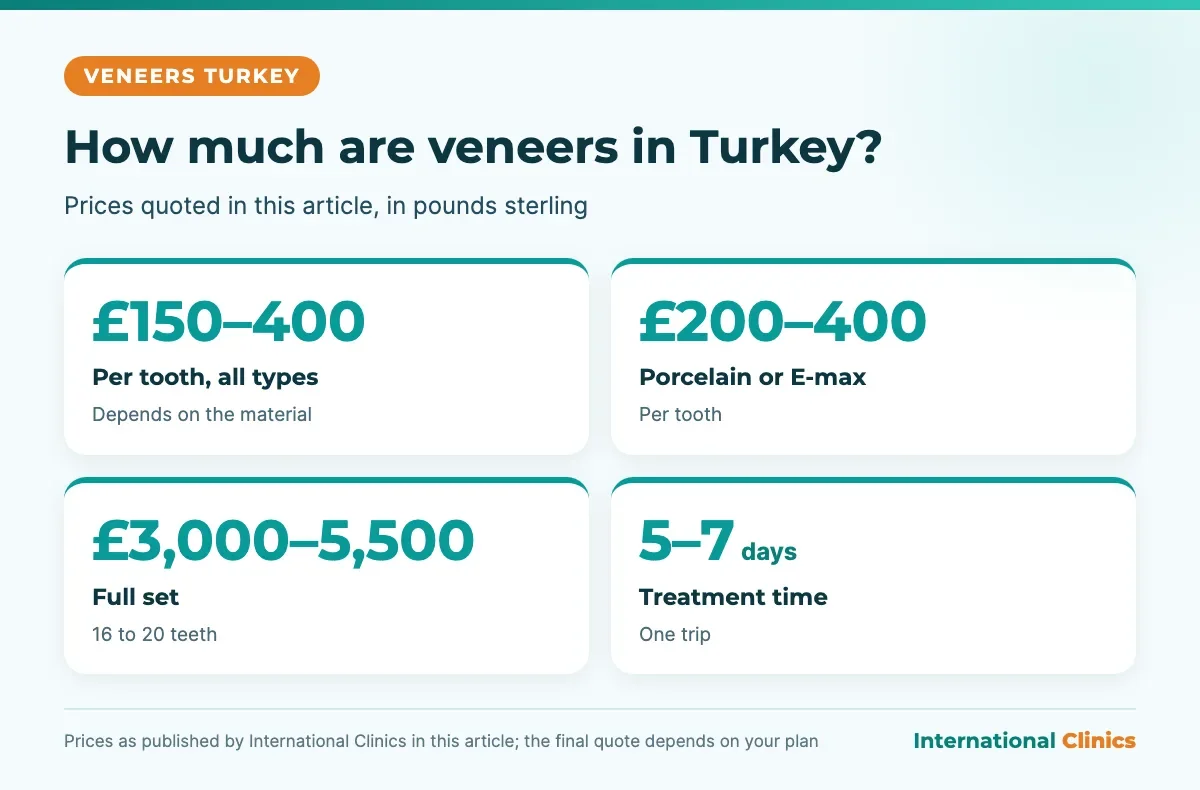
In short, veneers in Turkey cost £150 to £400 per tooth, as the summary table below shows. Prices by material, full-set and package prices, and what a written quote should list are covered in our veneers in Turkey cost guide.
| Item | Price in Turkey |
|---|---|
| Veneers per tooth (all types) | £150 – £400 |
| Porcelain or E-max veneers per tooth | £200 – £400 |
| Full set (16 – 20 teeth) | £3,000 – £5,500 |
| Treatment time | 5 – 7 days, one trip |
What changes the veneers Turkey cost?
The material, the number of teeth and what the package includes change the final price; the full breakdown is in the cost guide linked above. Composite veneers are the less expensive option and porcelain costs more (Source: American Dental Association).
How Much Does a Full Set of Veneers Cost in Turkey?
A full set of veneers in Turkey, covering 16 to 20 teeth for a complete smile makeover, typically costs £3,000 to £5,500. Package contents and prices are compared in how much is a full set of veneers and veneers in Turkey cost; for a full upper and lower makeover, see Hollywood smile prices.
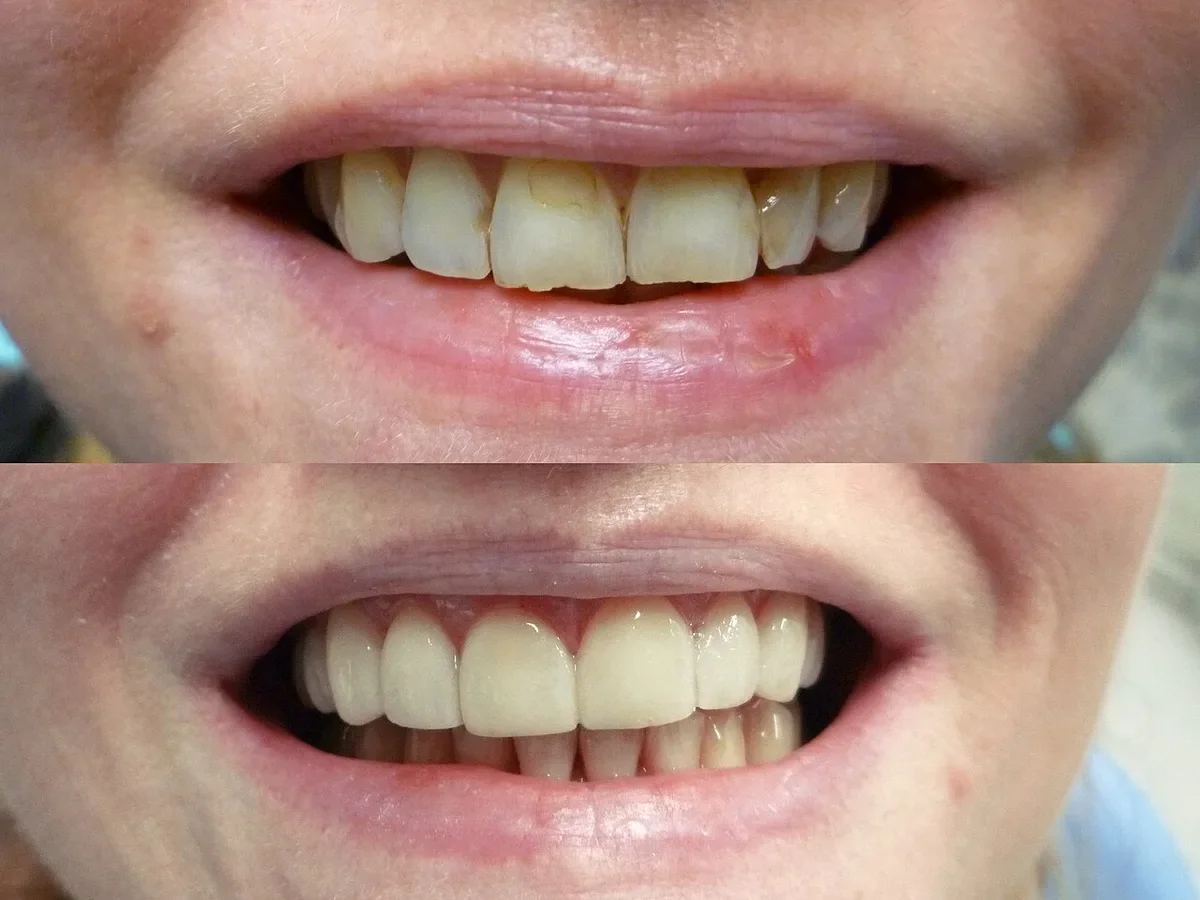
Before (top) and after (bottom) aesthetic veneers on the upper front teeth. Photo: Yvul, CC BY-SA 4.0, via Wikimedia Commons.
Medical review and disclaimer:
This article was reviewed by Dr. Burhan Mollamusa, after its translation into the appropriate language. It is general information and does not replace an in-person examination by a dentist; treatment plans and results vary from patient to patient depending on the condition of the mouth and teeth.