- Dental Implants Turkey Cost at a Glance: How Much Are Dental Implants in Turkey?
- What Is a Dental Implant? The Three Parts
- Types of Dental Implant Treatment in Turkey
- How Much Does a Teeth Implant Cost in Turkey?
- Full Mouth Dental Implants in Turkey
- All-on-4 vs All-on-6: what is the difference?
- Who Is a Good Candidate for Dental Implants?
- Bone Grafts and Sinus Lifts: When Extra Treatment Is Needed
- Dental Implants in Turkey: The Two-Trip Process
- Dental implant surgery step by step
- Will you have teeth while the implants heal?
- Do dental implants hurt?
- How Long Do You Need to Stay in Turkey for Dental Implants?
- Is It Worth Getting Dental Implants in Turkey?
- Is It Safe to Have Dental Implants in Turkey?
- Signs of a problem after you get home
- How to Choose a Dental Implant Clinic in Turkey
- What Is Included in a Dental Implant Package in Turkey?
- Which Country Is Best for Dental Implants?
- Dental Implants vs Bridges vs Dentures
- How Long Do Turkey Implants Last?
- How to care for dental implants
- Sources
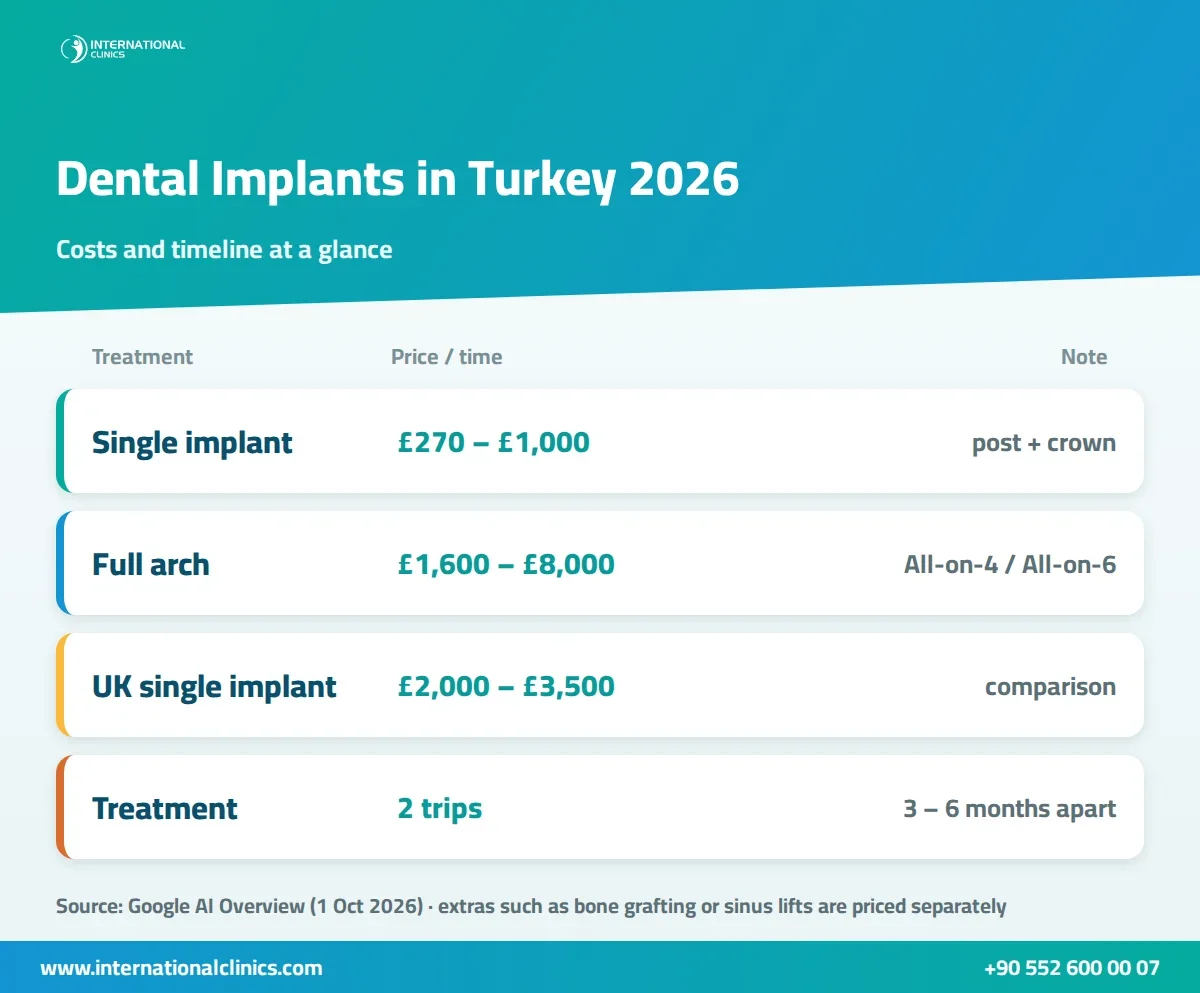
Dental implants in Turkey typically cost between £270 and £1,000 for a single implant including the post and crown, and £1,600 to £8,000 for full-arch systems such as All-on-4 or All-on-6, saving up to 70% compared with UK or US prices. Standard treatment usually takes two trips spaced 3 to 6 months apart.
Dental Implants Turkey Cost at a Glance: How Much Are Dental Implants in Turkey?
A dental implant is a titanium or zirconia post placed in the jawbone that fuses with the bone and supports a crown, bridge or full arch. Turkey attracts many UK patients because the same treatment costs a fraction of UK private prices.
| Treatment | Price in Turkey | Note |
|---|---|---|
| Single implant (post + crown) | £270 – £1,000 | A single implant in the UK often costs £2,000 – £3,500 |
| Full arch (All-on-4 / All-on-6) | £1,600 – £8,000 | Depends on materials and number of implants |
| Extras | Priced separately | Bone grafting, sinus lifts or extractions |
What Is a Dental Implant? The Three Parts
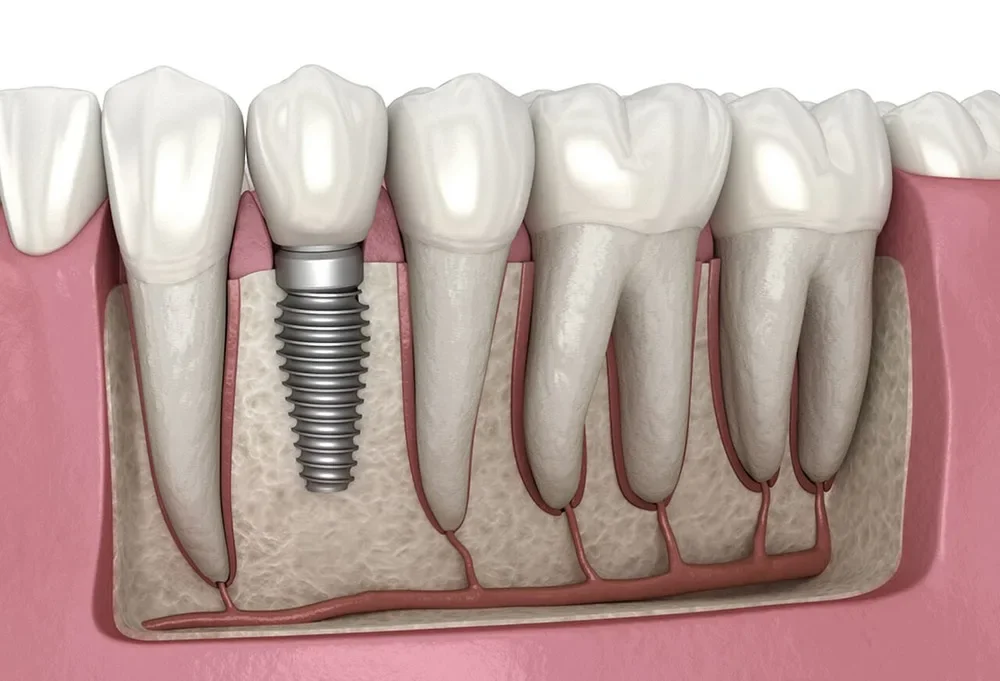
A dental implant is an artificial tooth root that supports a replacement tooth, and Cleveland Clinic describes three main parts:
- Threaded post: the implant itself, placed in the jawbone during surgery.
- Abutment: a small connector that screws into the post and sits just above the gum.
- Restoration: the visible tooth or teeth, usually a crown, a bridge or an implant-supported denture.
Most implants are made of titanium, and some are ceramic; Cleveland Clinic says both materials are safe and biocompatible. Unlike a tooth-supported bridge, an implant does not require shaving down the neighbouring teeth.
Types of Dental Implant Treatment in Turkey
The right treatment depends on how many teeth are missing and how much healthy jawbone you have.
| Treatment | What it replaces | How it works |
|---|---|---|
| Single-tooth implant | One missing tooth | One implant supports a crown |
| Implant bridge | Three or more teeth in a row | Two or more implants support a permanent bridge |
| Full arch | All upper or all lower teeth | Usually four to six implants support a fixed or snap-on denture |
| All-on-4 | A full arch | A specific type of fixed implant denture that uses four implants |
Source: Cleveland Clinic, Dental Implants and Implant-Supported Dentures. With every type, there must be enough jawbone to hold the implant; if there is not, bone grafting may be needed first.
How Much Does a Teeth Implant Cost in Turkey?
A single tooth implant in Turkey costs £270 to £1,000, including the post and crown. Full-arch treatments like All-on-4 or All-on-6 cost £1,600 to £8,000 depending on the materials and the number of implants. Extra procedures such as bone grafting, sinus lifts or extractions can add to the total. For full-arch options, see All-on-4 dental implants in Turkey and All-on-4 implants cost.
Full Mouth Dental Implants in Turkey
Full mouth dental implants replace an entire arch of teeth, or both arches, with a denture fixed to implants in the jawbone, and full-arch treatment in Turkey costs £1,600 to £8,000 depending on the materials and the number of implants. Ask whether a full-arch quote is for one jaw or both, as this is a common source of confusion when comparing prices.
Cleveland Clinic describes two options:
- Removable implant-supported dentures: the denture snaps on to the implants and can be taken out every day for cleaning.
- Fixed implant-supported dentures: sometimes called hybrid dentures, they attach permanently; you cannot remove them at home, so you clean them like natural teeth with floss threaders and small brushes, and your dentist removes them for maintenance.
The process usually starts with removing any decayed or damaged teeth and grafting bone where needed, sometimes followed by a few months of healing. Cleveland Clinic says the implants then take about three to six months to fuse with the jawbone, during which you wear a healing denture before the final denture is fitted. With good care, the implants can last a lifetime, while the overdenture on top usually needs replacing every 15 to 20 years.
All-on-4 vs All-on-6: what is the difference?
Both are full-arch treatments; the name refers to the number of implants supporting the arch. Cleveland Clinic notes that a full arch usually uses four to six implants, and that All-on-4 replaces a whole arch with just four. Which option suits you depends on the quality and volume of your jawbone and on your dentists assessment from 3D scans, so be cautious of any clinic that decides the number of implants before seeing your scans.
Who Is a Good Candidate for Dental Implants?
Most adults with enough healthy jawbone can have implants. Cleveland Clinic says the minimum age is typically 18, there is no upper age limit, and you must have finished growing. Implants may not be the best option if you have:
- Active or untreated gum disease.
- Extensive tooth decay or poor oral hygiene.
- Severe bone loss in the jaw.
- Unmanaged diabetes.
- Bone disorders or some autoimmune diseases.
Smoking or vaping can disrupt healing. Only a dentist who has examined you and reviewed your medical history can confirm whether you are a candidate.
Bone Grafts and Sinus Lifts: When Extra Treatment Is Needed
A bone graft adds volume and density to the jaw where bone has been lost, so that an implant has a stable foundation. Cleveland Clinic explains that grafting material can be your own bone, donor bone, animal-derived bone or a lab-made substitute, and that grafting is also used to lift the maxillary sinus before some upper-jaw implants. These procedures are priced separately from the implant itself.
A graft also changes your timeline. Cleveland Clinic says initial recovery takes about a week, but the graft needs at least three months to heal, and a large graft may take nine to 12 months. If you need grafting, ask the clinic whether it will be done on your first trip and how it affects the timing of the second.
Dental Implants in Turkey: The Two-Trip Process
Standard treatment usually needs two visits spaced 3 to 6 months apart so the post can fuse with the jawbone (osseointegration):
- First trip (8 to 10 days): consultation, 3D scans, any extractions, and placement of the implant post with a temporary restoration.
- Healing at home (3 to 6 months): the implant fuses with the bone.
- Second trip (5 to 7 days): fitting of the final crown or bridge.
Dental implant surgery step by step
Each plan is personalised, but Cleveland Clinic outlines the usual surgical steps:
- Anaesthesia: the gums are numbed, with sedation if you choose it.
- Incision: a small cut in the gum exposes the bone.
- Preparing the jaw: a small hole is made and widened to the right size for the implant.
- Placing the implant: the post is set into the jawbone.
- Closing: the gum is repositioned and stitched.
- Final restoration: after healing, the abutment and the crown, bridge or denture are attached, which usually takes about an hour and may need a second minor procedure.
"This process can take anywhere from three to nine months. It depends on how quickly your body heals."
— Cleveland Clinic, Dental Implants (on osseointegration).
Same-day options exist for selected patients with good bone density. The healing stages are explained in dental implant healing stages.
Will you have teeth while the implants heal?
Usually, yes. Cleveland Clinic says a temporary tooth is made for implants near the front of the mouth so you do not have a gap, while one at the back may not need it. For full-arch treatment, you wear a healing denture while the implants fuse with the bone, which often takes three to nine months.
Do dental implants hurt?
You should not feel pain during the procedure because the gums are numbed with anaesthetic, and sedation is an option. Afterwards, Cleveland Clinic says slight discomfort and swelling are normal and over-the-counter pain relief usually helps; most people feel like themselves within about a week. Most people can return to routine activities in two to three days, but avoid strenuous exercise for at least 48 hours after surgery.
How Long Do You Need to Stay in Turkey for Dental Implants?
Standard implant treatment usually means about 8 to 10 days on the first trip and 5 to 7 days on the second, with 3 to 6 months at home in between while the implants fuse with the bone. Your plan can be longer if you need extractions or bone grafting first: Cleveland Clinic says a bone graft needs at least three months to heal before an implant can be placed in it, and longer for a large graft. Same-day options suit only selected patients with good bone density. Build in a few spare days on each trip in case the dentist needs to adjust a temporary restoration before you fly.
Is It Worth Getting Dental Implants in Turkey?
Dental implants in Turkey can save a significant amount of money, but they carry distinct risks around aftercare and long-term complications. Implants need several stages and months of healing, and if an implant fails or an infection develops after you return home, it can be hard to find a local dentist willing to repair work done abroad. Plan how follow-up care will be handled before you book.
Is It Safe to Have Dental Implants in Turkey?
Dental implants in Turkey can be safe when an experienced, registered dentist plans and places them in a well-equipped clinic, but no implant surgery is risk-free. Cleveland Clinic notes that when an experienced surgeon places implants, the risk of complications is minimal. Possible complications include infection, nerve damage, injury to the mouth and sinus perforation (a hole in the sinus membrane).
Distance adds its own risks. The Oral Health Foundation lists problems reported after dental treatment abroad, including failed implants, infection, ongoing pain, treatment that was more extensive than expected and difficulty getting follow-up care. It also notes that standards vary between countries, including the willingness to extract teeth instead of saving them, so ask why any extraction is recommended.
Signs of a problem after you get home
Cleveland Clinic advises calling your dentist if you notice:
- A loose or wobbly implant.
- Bleeding or swollen gums.
- Fever.
- Pus around the implant.
- Swollen lymph nodes in the neck along with any of the above.
How to Choose a Dental Implant Clinic in Turkey
Choose the clinic on the dentists qualifications, the quality of the plan and the aftercare, not only on price. The Oral Health Foundation strongly recommends speaking to your own dentist first, and says a proper consultation should cover your medical history, long-term conditions, medicines, past dental treatment, smoking and alcohol use, and previous surgery or anaesthetic. Then ask the clinic:
- Who will place my implants, what are their qualifications, and are they registered with a professional regulator?
- How often do they carry out this procedure?
- Will I have 3D scans before the plan is finalised?
- Which implant system will be used, and will I get its details in writing so a dentist at home can identify it?
- What aftercare is included, and what happens if an implant fails?
- Who pays for extra travel, accommodation or corrective work if something goes wrong?
- Does the clinic have insurance and a clear complaints process?
Look at examples of the clinics own work and read patient reviews, and if clear answers are not given, think carefully before going ahead.
What Is Included in a Dental Implant Package in Turkey?
Package contents differ between clinics, so ask for a written list before comparing quotes. Check whether the price includes:
- The consultation, X-rays and 3D scans.
- Any extractions.
- Bone grafting or a sinus lift, which are usually priced separately.
- Temporary teeth or a healing denture between trips.
- The abutment and the final crown, bridge or denture, and the material used.
- Hotel nights and transfers for both trips.
- Follow-up checks and what happens if an adjustment is needed.
Which Country Is Best for Dental Implants?
No country is best for everyone: the right choice balances price, the dentists experience, the facilitys accreditation and how you will access follow-up care. Turkey is chosen mainly for its lower prices; a wider comparison is in cheapest country for dental implants.
Dental Implants vs Bridges vs Dentures
Implants generally last longer than bridges and traditional dentures and help preserve the jawbone, while bridges are usually more affordable and quicker to complete. This comparison draws on Cleveland Clinics guides:
| Option | How it is held | Main trade-off |
|---|---|---|
| Dental implant | Post fused with the jawbone | Surgery and months of healing; does not involve the neighbouring teeth and helps preserve bone |
| Traditional bridge | Supported by the natural teeth either side of the gap | Those teeth must be shaved down; typical lifespan of five to 15 years |
| Traditional denture | Rests on the gums | Can shift or slip when you chew or speak |
| Implant-supported denture | Attached to implants in the jaw | More stable than a traditional denture; needs enough bone for the implants |
How Long Do Turkey Implants Last?
The implant post is designed to be a long-term fixture, while the crown on top wears with chewing and usually needs repair or replacement after 10 to 15 years.
| Part | Typical lifespan |
|---|---|
| Implant post (titanium or zirconia) | Long-term; Cleveland Clinic notes implants "can often last a lifetime" with good care |
| Crown or prosthetic | 10 – 15 years before repair or replacement |
For comparison with a non-implant option, read dental implants vs dental bridges.
How to care for dental implants
Good hygiene and regular dental visits are what help implants last. Cleveland Clinic recommends:
- Brushing and flossing thoroughly around your implants.
- Cleaning implant-supported dentures at least twice a day, and soaking removable ones in denture solution overnight.
- Brushing fixed dentures with a soft-bristled toothbrush and non-abrasive toothpaste.
- Seeing a dentist regularly for exams and cleanings, including after you return home.
After a bone graft, Cleveland Clinic also suggests ice packs on the outer jaw, soft foods for a few days, keeping your head elevated and keeping the surgical site clean, and says tenderness, swelling and bruising should settle within a week or two.
Sources
- Cleveland Clinic — Dental Implants, my.clevelandclinic.org.
- Cleveland Clinic — Implant-Supported Dentures, my.clevelandclinic.org.
- Cleveland Clinic — Dental Bone Graft, my.clevelandclinic.org.
- Cleveland Clinic — Dental Bridges, my.clevelandclinic.org.
- Oral Health Foundation — Going abroad for dental treatment, dentalhealth.org.
Cross-section of a dental implant: a titanium screw fixed in the jawbone supporting a crown, next to natural teeth. Illustration: Alexmit art, CC BY-SA 4.0, via Wikimedia Commons.