
In this article from our «You Ask, We Answer» series, we have gathered the questions people search for most about Botox and filler injections in Turkey: prices, the difference between the two injections, how long results last, which areas are treated, side effects and how to avoid them, and how to choose the right doctor and place. We chose the questions from real search data, then answered them from our experience accompanying patients, relying on medical sources where needed. The list opens with the five most important questions, and many answers are followed by a link to our detailed article on the subject.
The five most important questions about Botox and fillers
1. How much is Botox in Turkey?
The price of Botox injections in Turkey through International Clinics starts from $100 and rises depending on the case or the patient’s choices, since it depends on the number of areas treated, the number of units and the product used. Original Botox by Allergan starts from $180, and nose Botox starts from $300 (Source: International Clinics — Turkey).
| Procedure | Price starts from |
|---|---|
| Botox injections (per area) | $100 |
| Original Botox (Allergan) | $180 |
| Nose Botox | $300 |
For comparison, the average cost of a Botox session in the United States is $435 (Source: American Society of Plastic Surgeons (ASPS)).
2. How much do dermal fillers cost in Turkey?
The price of hyaluronic acid filler injections in Turkey through International Clinics starts from $300 per syringe (1 ml) and rises depending on the case or the patient’s choices; the final price depends on the type and brand of filler and the number of syringes the area needs (Source: International Clinics — Turkey).
| Procedure | Price starts from |
|---|---|
| Hyaluronic acid lip filler | $300 |
| Cheek and face filler (per syringe) | $300 |
| Radiesse filler | $350 |
| Sculptra filler | $450 |
| Under-eye filler with Redensity | $500 |
| Nose filler | $290 |
| Jawline filler | $350 |
For comparison, the average cost of a hyaluronic acid filler syringe in the United States is $715 (Source: American Society of Plastic Surgeons (ASPS)).

For more details, see our article: Facial fillers cost.
3. Botox vs filler: what is the difference?
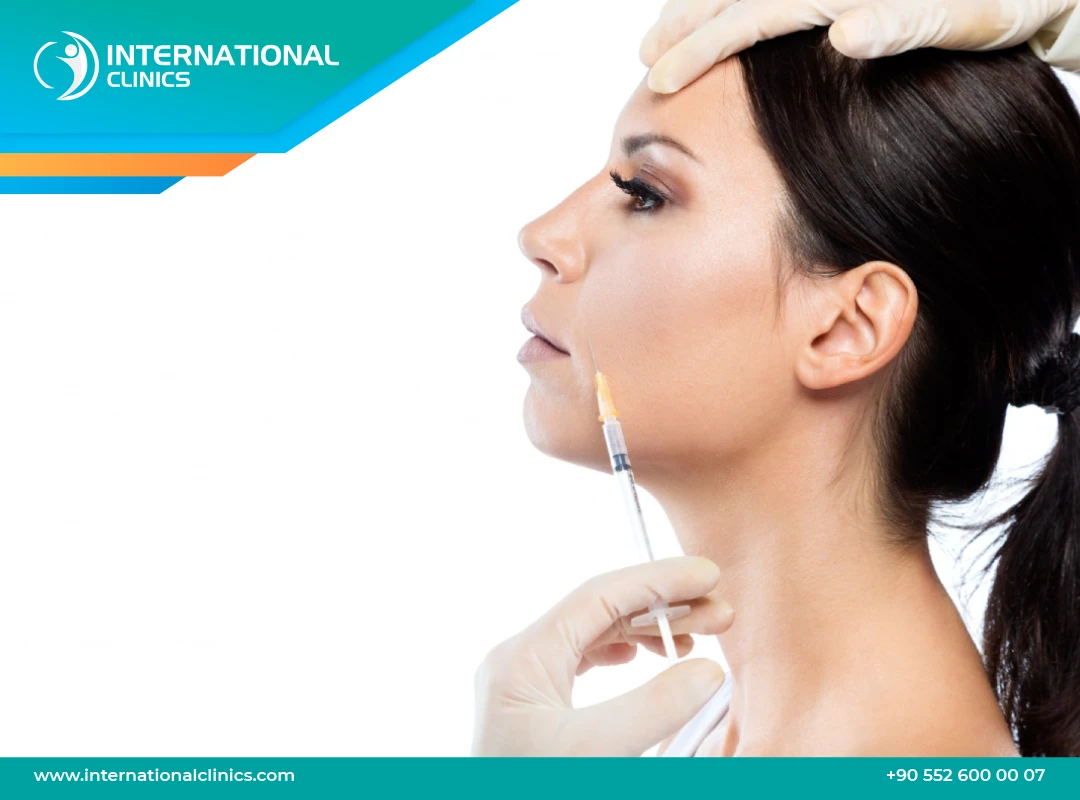
Botox and fillers are two cosmetic injections that differ in substance, mechanism and treatment areas: Botox relaxes the muscle that causes expression wrinkles, while filler fills hollows and restores lost volume under the skin.
| Comparison | Botox | Filler |
|---|---|---|
| Substance | Botulinum toxin type A | Mostly hyaluronic acid; sometimes calcium hydroxylapatite or poly-L-lactic acid |
| How it works | Relaxes the muscle so wrinkles that appear with movement soften | Fills deep lines, restores volume and defines features |
| Most common areas | Forehead, between the eyebrows and around the eyes | Lips, cheeks, under the eyes, nose, jawline and chin |
| When results appear | Within days, complete in about two weeks | Almost immediately, settling once swelling fades |
| How long results last | Usually 3 to 4 months | 6 to 18 months depending on type and area |
| Price starts from | $100 | $300 per syringe |

4. How long do Botox and fillers last?
The effect of Botox usually lasts three months or longer, after which the muscle gradually regains movement and a new session is needed to maintain the result (Source: Mayo Clinic). Fillers last longer, depending on their type and location: most hyaluronic acid fillers last 6 to 12 months, some 18 months or more, and knowing which filler was injected is the best way to estimate how long it will last (Source: American Society of Plastic Surgeons (ASPS)).
| Type | Approximate duration of results |
|---|---|
| Botox | 3 to 4 months |
| Lip filler | 6 to 12 months |
| Cheek and under-eye filler | 9 to 18 months |
| Jawline filler (Radiesse) | 12 to 24 months |
| Sculptra | About two years |

5. Are Botox and fillers safe? What are the side effects?
Botox and fillers are generally safe when injected by a qualified doctor using original, approved products. Common side effects of Botox include pain, swelling or bruising at the injection site and headache; rarely, a temporary drooping eyelid or an uneven, raised eyebrow may occur and fades as the effect wears off (Source: Mayo Clinic). Common filler side effects are swelling, redness and bruising for a few days; the most serious filler complication is injection into a blood vessel, signalled by skin blanching, unusual pain or changes in vision — an emergency that requires seeing the doctor immediately (Source: U.S. Food and Drug Administration (FDA)).
| Product | Common, temporary effects | Rare complications |
|---|---|---|
| Botox | Mild pain, swelling or bruising, and headache | Temporary eyelid drooping or uneven eyebrows |
| Filler | Swelling, redness and bruising for a few days | Filler lumps, infection and blood vessel blockage |
Botox
6. What is Botox and how does it work?
Botox is the widely used brand name for botulinum toxin type A, a purified protein injected in very small amounts into specific facial muscles. It blocks the nerve signal to the muscle, so the muscle relaxes and the wrinkles that form over it with movement soften. Botox is also used medically for excessive sweating, chronic migraine and other conditions (Source: American Society of Plastic Surgeons (ASPS)).
7. Where on the face are Botox and fillers injected?
Botox is injected into areas of expression wrinkles: forehead lines, the frown line between the eyebrows and the crow’s feet around the eyes; it may also be used to lift the tail of the eyebrow, on the chin, and in the masseter muscle to slim the lower jaw. Filler is injected where volume and definition are needed: the lips, cheeks, under-eye hollows, nasolabial folds, nose, jawline and chin.

8. Which Botox brand is best?
No single Botox brand is best for everyone: all approved brands work by the same mechanism and differ slightly in how quickly they take effect, how long they last and how far they spread. The doctor chooses the brand and number of units according to the area, the strength of the muscle and the results of any previous sessions.
| Brand | Approximate duration | What sets it apart |
|---|---|---|
| Botox (Allergan) | 4 to 6 months | The best-known and oldest brand, used for the forehead, around the eyes and the frown line |
| Dysport | 3 to 5 months | Spreads more widely, so it suits large areas such as a broad forehead |
| Xeomin | 3 to 4 months | Free of accessory proteins, so it is preferred for people with sensitivities |
| Nabota | 4 to 5 months | A lower-cost Korean alternative |
9. How long does Botox take to work?
Botox usually starts to work one to three days after the injection (Source: Mayo Clinic) and increases gradually until the full result appears after about two weeks. That is why the follow-up visit to assess the result of Botox or add a touch-up is best scheduled two weeks after the session, not earlier.
10. What is a Botox lip flip, and what are the side effects of lip Botox?
A Botox lip flip involves injecting a few units of Botox just above the border of the upper lip, so the muscle relaxes slightly and the lip turns outward, looking fuller without adding volume. The side effects of lip Botox are usually mild and temporary: slight difficulty drinking through a straw, whistling or pronouncing some sounds, or minor asymmetry, all of which fade as the effect wears off within a few weeks to about three months. Anyone who wants real lip volume is better suited to filler, and the two can be combined.
For more details, see our article: Lip flip with Botox.
11. Can Botox make your nose smaller?
Botox does not shrink the bone or cartilage of the nose, but it can slightly lift the nasal tip by relaxing the muscle that pulls it down when smiling, and it softens the wrinkles on the sides of the nose known as bunny lines. Nose Botox in Turkey starts from $300 and rises depending on the case or the patient’s choices (Source: International Clinics — Turkey). Changing the shape and size of the nose requires filler in selected cases, or rhinoplasty.
For more details, see our article: Botox nose slimming.
12. What are the aftercare instructions for Botox? Can I eat right after?
Yes, you can eat and drink right after Botox and return to work the same day. What matters is not to rub or massage the treated area for 24 hours, so the product does not spread to other muscles (Source: Mayo Clinic); to stay upright without bending over or lying down for the first four hours; and to avoid strenuous exercise, saunas and intense heat on the first day.
13. Does Botox treat excessive sweating and migraines?
Yes, Botox has approved medical uses, including treating excessive sweating of the armpits and palms, where it blocks the nerve signal to the sweat glands for months, and treating chronic migraine with periodic injections into specific areas of the head and neck. For more details, see our page on Botox for excessive sweating.
Fillers
14. What are dermal fillers and what types are there?
A dermal filler is a gel injected under the skin to restore lost volume, fill lines and define features. The most common types are (Source: American Society of Plastic Surgeons (ASPS)):
| Type | How it works | Approximate duration |
|---|---|---|
| Hyaluronic acid (such as Juvederm, Restylane and Teosyal) | A substance naturally present in the skin that attracts water and adds fullness; it can be dissolved | 6 to 18 months |
| Calcium hydroxylapatite (Radiesse) | Thicker, so it suits the jawline and chin, and it stimulates collagen | About 12 months or more |
| Poly-L-lactic acid (Sculptra) | Stimulates the skin to produce collagen gradually over several sessions | About two years |
For more details, see our article: Dermal fillers.
15. How long does lip filler last, and how much is it?
Hyaluronic acid lip filler usually lasts 6 to 12 months, a shorter time than in other areas of the face because the lips move a lot. Lip filler in Turkey through International Clinics starts from $300 and rises depending on the case or the patient’s choices (Source: International Clinics — Turkey). Half a syringe to one syringe is usually enough for a natural result, and it is better to build the result gradually rather than all at once.
For more details, see our article: How long does lip filler last?.
16. Is under-eye filler safe, and how much does it cost?
Under-eye filler is safe when injected by an experienced doctor, but it is one of the most delicate areas: the skin is thin, blood vessels are close, and too much product causes puffiness or a bluish shadow. That is why a light filler designed for this area is used, usually injected with a fine blunt cannula. Under-eye filler suits tear-trough hollows and dark circles caused by volume loss, but it does not treat bulging fat pads, which need lower eyelid surgery. Under-eye filler with Redensity starts from $500 and rises depending on the case or the patient’s choices (Source: International Clinics — Turkey).
17. Can filler reshape the nose (non-surgical nose job)?
Yes, filler can reshape the nose in selected cases: it can hide a small hump, lift the tip slightly and correct some asymmetry, without surgery or recovery time. However, nose filler does not make the nose smaller or treat breathing problems, and it requires an expert doctor because the nose is rich in blood vessels. Nose filler in Turkey starts from $290 and usually lasts 9 to 12 months.
For more details, see our article: Nose filler prices in Turkish clinics.
18. What are cheek, jawline and chin fillers, and what is the alternative?
Cheek filler restores facial fullness and lifts the midface, while jawline and chin filler gives a sharper jawline and a more balanced profile; a thick filler such as Radiesse or a dedicated hyaluronic acid is usually used for these areas. Jawline contouring with filler in Turkey starts from $350. The longer-lasting alternative for cheek volume is fat transfer, in which fat is harvested from the body and injected into the face, and part of it remains permanently.
19. What is Sculptra filler?
Sculptra is a poly-L-lactic acid filler. Unlike other fillers, Sculptra does not fill the area immediately; it stimulates the skin to produce collagen gradually, so it usually needs two or three sessions about a month apart, with results appearing over months and lasting about two years. Sculptra suits people whose faces have lost fullness with age, and it starts from $450 per vial in Turkey.
20. Can filler be dissolved if I don’t like the result?
Yes, if the filler is hyaluronic acid, it can be dissolved by injecting the enzyme hyaluronidase within one to two days. This enzyme is also used as emergency treatment if filler blocks a blood vessel. Radiesse and Sculptra cannot be dissolved this way, which is why hyaluronic acid is preferred for first-time patients.
21. Is permanent filler better than temporary filler?
No, permanent filler is not better: doctors prefer temporary, dissolvable fillers because complications of permanent filler, such as lumps and delayed inflammation, are hard to treat and may require surgery. The U.S. Food and Drug Administration warns against injectable liquid silicone for body enhancement and contouring, and against needle-free injection devices (Source: U.S. Food and Drug Administration (FDA)).
22. What are the aftercare instructions for fillers?
After filler injections, apply cold compresses to reduce swelling, do not press or massage the area unless your doctor asks you to, avoid strenuous exercise, saunas and alcohol on the first day, and postpone laser sessions and deep facials for about two weeks. See your doctor immediately if the skin turns pale, pain becomes severe or your vision changes.
23. Can Botox and fillers be done in the same session?
Yes, Botox and fillers are often combined in the same session because each treats a different concern: Botox relaxes the forehead and the area around the eyes, while filler restores volume to the lips and cheeks. One example is combining a Botox lip flip with lip filler for a softer, fuller result.
24. Who should not get Botox or fillers?
Botox and fillers are postponed during pregnancy and breastfeeding and when there is inflammation or infection at the injection site, and Botox is not injected in people with neuromuscular diseases. Filler is not injected in people allergic to its components, such as the lidocaine contained in some types (Source: U.S. Food and Drug Administration (FDA)). Tell your doctor about your medications, especially blood thinners, which increase the risk of bruising.
Videos
25. Do you have a video showing filler injections?
Yes. This short video from International Clinics shows the result of a lip filler injection in Istanbul.
26. Do you have a video of someone who had Botox and fillers?
Yes. This short video shows the result of a patient who had filler and Botox injections through International Clinics.
Botox and fillers in Turkey
27. Why do so many people choose Turkey for Botox and fillers?
Many people choose Turkey for Botox and fillers because prices are much lower than in Europe, America and the Gulf, with experienced doctors and original products from well-known international brands; the injections are performed in licensed private clinics by specialist doctors. Many combine the injections with a visit to Istanbul or another cosmetic procedure on the same trip. International Clinics is the link between you and the best doctors contracted with us in Turkey.

28. How many days do I need to stay in Turkey for Botox and fillers?
A Botox or filler session takes 15 to 45 minutes, and you can leave right afterwards. A stay of two to three days is usually enough for the doctor to confirm the initial swelling has subsided. If possible, it is best to stay two weeks after Botox to review the full result; otherwise, you can send your photos to the doctor after you return home.
29. What does International Clinics offer people who want Botox or fillers?
Your journey with International Clinics begins with a free remote consultation with medical advisers who speak your language: you send your photos, your case is presented to the right doctor, and you then receive a clear quote stating the product and the number of units or syringes. After you return home, your follow-up continues for a full year. To learn more about the treatments, see our pages on Botox injections and dermal fillers.
30. Who is the best doctor for Botox and fillers in Turkey?
No single doctor is “the best” for every patient. The right doctor for Botox and fillers is an experienced cosmetic doctor who knows facial anatomy well, uses original products and shows you the box before injecting, and plans a natural result that suits your features. Among the doctors contracted with us in Istanbul who are experienced in Botox and fillers:


Medical review and disclaimer:
This article was reviewed by a specialist physician contracted with International Clinics. It is general health information, not a substitute for medical advice, and results vary between individuals.