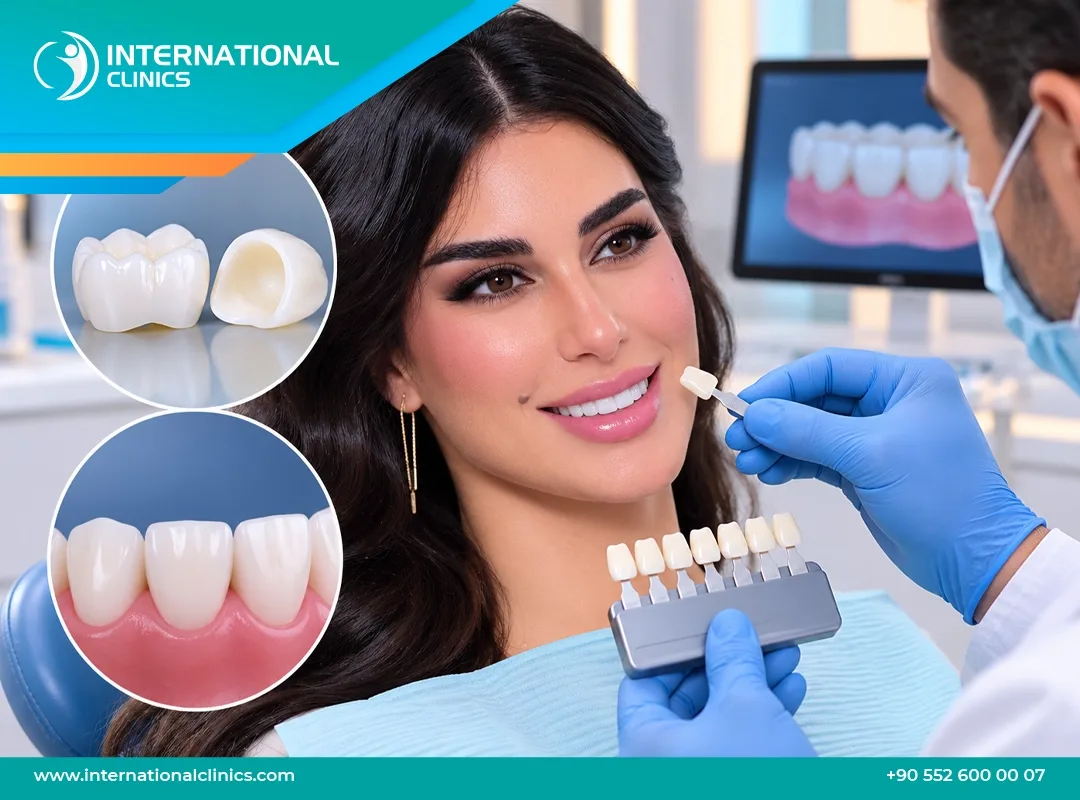
- What Are Zirconia Crowns?
- Why Choose Zirconia Crowns for Your Smile?
- Top Types of Zirconia Restorations Available
- Zirconia vs Lithium Disilicate (E-max) Crowns
- Step-by-Step Zirconia Crown Procedure
- How Long Do Zirconia Crowns Last?
- Zirconia Crowns Cost Breakdown
- Pros and Cons of Zirconia Crowns
- Recovery Stages and Aftercare
- Real Patient Stories: What the Outcome Data Show
- Guarantees and Consultation Process
- Expert Pro-Tips
- Who Is a Good Candidate for Zirconia Crowns?
- Conclusion
Zirconia crowns are tooth-shaped caps milled from zirconium dioxide, a strong, metal-free ceramic used to restore weak, broken or heavily filled teeth. In a 2026 meta-analysis, 96.8% of single-block zirconia crowns were still in place after five years, though fitting one means permanently removing some enamel, and short-term sensitivity is common. (Source: Int J Prosthodont and Cleveland Clinic)
This guide explains what the material is, which type suits which tooth, how the procedure works, how long the crowns last, what can go wrong and what they cost. It is written to help you put informed questions to your dentist, whichever treatment you eventually choose.
What Are Zirconia Crowns?
A dental crown is a cap that fits over the entire visible part of a tooth. It strengthens a weak tooth, protects a cracked one, rebuilds a worn or broken one, covers a severely discolored one, holds a bridge in place, and covers root canal-treated teeth and dental implants. A zirconia crown does these jobs using zirconia rather than metal, resin or conventional porcelain. (Source: Cleveland Clinic and MedlinePlus)
Zirconia is a polycrystalline ceramic whose crystal structure changes with temperature. Manufacturers add yttria (yttrium oxide) to keep it stable at room temperature, and the amount of yttria defines each grade of the material: about 3 mol% gives the classic high-strength 3Y zirconia, while 4Y, 5Y and 6Y contain progressively more. More yttria makes the ceramic more translucent, but it tends to reduce strength and toughness. That single trade-off explains most of the choices your dentist will discuss with you. (Source: Biomedicines)
Modern zirconia crowns are generally designed and milled by computer (CAD/CAM) from a digital or physical impression of the prepared tooth, then fired in a furnace. Same-day systems mill the crown from a solid ceramic block inside the dental office, but they are not suitable for every patient. (Source: Cleveland Clinic)
Why Choose Zirconia Crowns for Your Smile?
People usually choose zirconia because it combines high strength with a tooth-colored, metal-free finish. It is a sensible option when a tooth truly needs a crown, particularly a back tooth that takes heavy biting forces. It is not automatically the right answer for a sound tooth with a minor cosmetic flaw.

📷 Jameswasswa · CC BY-SA 4.0 · Wikimedia Commons
- Durability: Zirconia crowns are very durable, handle heavier forces than other all-ceramic crowns, and cause less wear on opposing teeth than those crowns. (Source: Cleveland Clinic)
- Metal-free design: All-ceramic crowns suit people with metal allergies, and they avoid the dark metal framework that limits the appearance of metal-ceramic crowns. (Source: Cleveland Clinic and Biomedicines)
- Natural aesthetics: Translucent grades look closer to enamel than conventional zirconia. The final shade also depends on the color of the tooth underneath and on the cement. (Source: Biomedicines)
- Fewer chips in single-block designs: Monolithic crowns, made from one block with no veneering layer, showed significantly fewer ceramic fractures and chips than veneered alternatives. (Source: Int J Prosthodont)
- Digital precision: Crowns can be made from a digital scan as well as a conventional impression, and some can be completed in a single visit. (Source: Cleveland Clinic and healthdirect)
- Gum response: One small study of 20 patients recorded lower plaque and gum scores around zirconia than around porcelain-fused-to-metal crowns at six months. That is an encouraging signal, not proof. (Source: Cureus)
To see how zirconia fits among other materials, read our guide to the types of dental crowns. If your teeth are structurally healthy and the concern is only their front surface, compare veneers vs crowns first, because a veneer may remove less tooth.
Top Types of Zirconia Restorations Available
Zirconia restorations differ mainly in yttria content, in whether they are monolithic or veneered, and in how many teeth they restore. Your dentist weighs the position of the tooth, your bite force and the space available. Published strength and translucency figures come largely from laboratory studies and vary by product, so treat them as a guide rather than a specification. (Source: Dent J)
- Solid Zirconia (3Y): The strongest and least translucent grade, with flexural strength reported at about 1,000 to 1,200 MPa. It is the usual choice for molars and heavy biters. (Source: Dent J)
- High-Translucent Zirconia (4Y and 5Y): 4Y has been reported at about 900 MPa and 5Y at about 500 MPa, with translucency rising as strength falls. Both are chosen when appearance matters more. (Source: Dent J)
- Layered (Multilayer) Zirconia: Blocks with graded color imitate the transition from the neck of the tooth to its edge. The strength of a multilayer block varies with its composition. (Source: Dent J)
- Porcelain-Fused Zirconia: A zirconia core with a veneering porcelain layer gives fine aesthetic control, but chipping of that layer is the most frequently reported technical complication with zirconia restorations. (Source: J Dent)
- Yttrium-Stabilized Zirconia: This is not a separate product category, since all of the grades above are stabilized with yttria. The number before the Y simply tells you how much is present. (Source: Biomedicines)
- Full-Arch Zirconia: A one-piece framework carried by implants replaces a complete arch of teeth. It is a major treatment that needs surgical and prosthetic planning, so discuss your own case in detail. (Source: Biomedicines)
- Zirconia Bridges: Bridges replace missing teeth, and five-year survival for tooth-supported zirconia bridges ranges from 89.4% to 100%. The most translucent 5Y grade does not meet the mechanical requirements of multi-unit bridges. See also implant-supported bridges. (Source: J Dent and Dent J)
- Zirconia Veneers: Thin zirconia restorations are possible, but thin sections are weaker. A minimum of about 1.2 mm has been cited for 4Y and 5Y, and at 0.7 mm only 3Y survived simulated chewing. (Source: Biomedicines)
The practical lesson is that the most translucent crown is not always the best crown. A narrative review of these materials concluded that translucency is not always an advantage and urged care when choosing a zirconia for fixed restorations. Ask your dentist which grade is planned for your tooth, and why. (Source: Dent J)
Zirconia vs Lithium Disilicate (E-max) Crowns
E-max is a brand of lithium disilicate, a glass-ceramic that is more translucent than zirconia, even the 5Y grade. Zirconia resists slow crack growth better. In practice, that often points to lithium disilicate for visible front teeth and to zirconia for molars, bridges and strong bites. (Source: Biomedicines)

📷 Foerch zahntechnik · CC BY-SA 4.0 · Wikimedia Commons

| Feature | Zirconia | Lithium disilicate (E-max) |
|---|---|---|
| Translucency | Lower; improves in 4Y and 5Y grades | Higher |
| Resistance to crack growth | Higher | Lower |
| Five-year survival, monolithic single crowns | 96.8% | 98.5% |
| Typical use | Back teeth, bridges, heavy bite | Front teeth, when appearance leads |
Those survival figures come from one meta-analysis, which concluded that both materials perform comparably to metal-ceramic crowns (97.1%). The difference should not be read as a reason to prefer one material for every tooth. If you are considering thin restorations on front teeth, our page on E-max veneers in Turkey covers that option. (Source: Int J Prosthodont)
Step-by-Step Zirconia Crown Procedure
Most zirconia crowns need two appointments, with two to three weeks between them while a laboratory makes the crown, and sometimes longer. Same-day milling can reduce this to one visit in suitable cases. A local anesthetic is commonly used. (Source: Cleveland Clinic and healthdirect)

- Comprehensive Assessment: The dentist examines the tooth, gums and bite, and may use X-rays, to confirm the tooth can support a crown. (Source: MedlinePlus)
- Local Anesthesia: The area is numbed before the tooth is prepared. (Source: MedlinePlus)
- Tooth Reshaping: Old fillings and decay are removed, and enamel is reduced so the crown fits. Filling material may be used to build up the tooth. (Source: Cleveland Clinic and MedlinePlus)
- Digital Impressions: A digital scan or physical impression records the prepared tooth. (Source: Cleveland Clinic)
- Temporary Protection: A resin or acrylic temporary crown protects the tooth until the permanent one is ready. (Source: Cleveland Clinic)
- CAD/CAM Milling: The crown is shaped from a zirconia block, in the laboratory or in the dental office. (Source: Cleveland Clinic)
- Try-In Session: The dentist checks the shape, color, fit and bite, and may confirm the fit with an X-ray. (Source: Cleveland Clinic and MedlinePlus)
- Final Cementation: The crown is cemented or bonded in place. Zirconia does not bond easily, so surface treatment such as air abrasion and MDP-based adhesives or resin cements are commonly used to improve adhesion. (Source: Biomedicines and Dent J)
Finishing matters as well. Laboratory work suggests that coarse polishing instruments can change the surface of the ceramic in a way linked to faster degradation, while fine polishers do not. After any bite adjustment, the surface should be smoothed again before you leave. (Source: Biomedicines)
How Long Do Zirconia Crowns Last?
Crowns in general last five to 15 years on average, and can last much longer with good care. Most of the zirconia-specific evidence reports five-year outcomes, so claims of a lifetime or of an indestructible crown go beyond the data. (Source: Cleveland Clinic and MedlinePlus)

📷 James Roback, UticaDentalLab · CC BY-SA 4.0 · Wikimedia Commons

- Monolithic zirconia single crowns: 96.8% survival at five years. (Source: Int J Prosthodont)
- Veneered zirconia single crowns: 97.3% survival at five years. (Source: Int J Prosthodont)
- Tooth-supported single crowns in an earlier summary of reviews: 91.2% to 95.9%. (Source: J Dent)
- Implant-supported single crowns: 97.1% to 97.6%. (Source: J Dent)
- Implant-supported bridges: 93.0% to 100%. (Source: J Dent)
Survival means the crown is still in the mouth, not that nothing went wrong. Across the reviews, chipping was the most common technical complication, followed by framework fracture, loss of retention, marginal problems or discoloration, rough biting surfaces and, on implants, loosening of abutments or screws. (Source: J Dent)
Zirconia Crowns Cost Breakdown
In Turkey, a zirconia crown costs about $150–300 per tooth (approx. £115–225), against a worldwide range of about $150–1,500 per tooth (approx. £115–1,150). The price depends on the grade of zirconia, the number of units, any treatment needed first, and where the dentist practices. For the full breakdown, see our zirconia dental crown cost guide.
| Procedure Type (Crown) | Estimated Cost per Unit or Restoration |
|---|---|
| Zirconia crown in Turkey | $150–300 (approx. £115–225) |
| Solid Zirconia Crown, global estimate | $800–1,500 (approx. £600–1,150) |
| High-Translucent Anterior Crown, global estimate | $1,000–1,800 (approx. £750–1,350) |
| Zirconia Dental Bridge (3 Units), global estimate | $2,500–4,500 (approx. £1,900–3,400) |
| Porcelain-Fused Zirconia Crown, global estimate | $900–1,600 (approx. £680–1,200) |
| Zirconia Crown on Implant, global estimate | $1,200–2,000 (approx. £900–1,500) |
The global estimates are market prices and they vary widely between clinics and countries (Source: social media platforms).
When you compare quotes, compare what they include. A low price per tooth can leave out X-rays, temporary crowns, root canal treatment or follow-up visits, and it says nothing about how many teeth are being prepared. If you are planning a full smile rather than one crown, read how much Turkey teeth cost, and ask whether every tooth really needs to be reduced.
Pros and Cons of Zirconia Crowns
The main advantages are strength, a metal-free tooth-colored appearance and solid five-year results. The main drawbacks are irreversible enamel removal, a higher price than simple options and lower translucency than lithium disilicate. (Source: Cleveland Clinic and Int J Prosthodont and Biomedicines)
| Advantages (Pros) | Risks (Cons) |
|---|---|
| Strength: Handles heavier forces than other all-ceramic crowns. | Tooth Reduction: Enamel removal is permanent and cannot be undone. |
| Aesthetics: No metal framework to show as a dark line at the gum. | Sensitivity: Common in the first weeks, and the nerve may occasionally need a root canal. |
| Biocompatibility: Suits people with metal allergies, and allergic reactions to crowns are rare. | Decay Beneath the Crown: The tooth under the crown can still develop a cavity. |
| Fewer Chips When Monolithic: Significantly fewer fractures than veneered designs. | Opposing Tooth Wear: Opposing teeth wear over time, and the evidence is still limited. |
| Clinical Record: Five-year survival comparable to metal-ceramic crowns. | Difficult Removal: Cutting off a zirconia crown is time-consuming and uses multiple burs. |
Wear on the opposing tooth deserves an honest explanation. A meta-analysis of four studies estimated wear of opposing teeth at about 6 micrometers a month, but the studies differed so much that no reliable comparison with natural enamel or metal-ceramic crowns could be made. Most used polished zirconia, and laboratory work suggests glazed surfaces wear enamel more. Ask for a well-polished crown and a careful bite check. (Source: J Clin Med)
Removal is also worth understanding before treatment. A crown may have to come off because of recurrent decay or a defective restoration, and a study on dummy heads showed that cutting monolithic zirconia took longer than cutting lithium disilicate with every bur tested. If a crowned tooth later needs root canal treatment, access through the crown is planned case by case. (Source: BMC Oral Health)
Recovery Stages and Aftercare
Most people resume normal activities right away. Gum soreness should fade within a few days, sensitivity to heat and cold is normal for a couple of weeks, and over-the-counter pain relief usually helps. It may take a few days to get used to the new crown. (Source: Cleveland Clinic and MedlinePlus)
- Gentle Brushing: Brush at least twice a day with fluoride toothpaste and a soft-bristled brush. (Source: Cleveland Clinic)
- Daily Flossing: Floss once a day. Around a temporary crown, slide the floss out rather than lifting it up. (Source: Cleveland Clinic and MedlinePlus)
- Antibacterial Rinse: A mouthwash can support your routine, alongside brushing and flossing. (Source: Cleveland Clinic)
- Mindful Chewing: Avoid ice cubes, very hard nuts, popcorn kernels and sticky sweets. With a temporary crown, chew on the other side. (Source: Cleveland Clinic and MedlinePlus)
- Nighttime Protection: If you grind or clench, ask about a custom mouth guard, because grinding can chip or crack a crown. (Source: Cleveland Clinic and MedlinePlus)
- Regular Checkups: Keep up with professional cleanings and examinations, since decay can form around or under a crown. (Source: Cleveland Clinic and healthdirect)
- Warning Signs: Call your dentist about a loose crown, bad breath or taste, a crack or chip, or sharp edges. (Source: Cleveland Clinic)
- Bite Problems: Report worsening swelling, a bad bite, a lost temporary crown or pain that over-the-counter medicine does not relieve. (Source: MedlinePlus)
A crown that feels high when you bite is worth correcting quickly rather than waiting for it to settle, because a poor fit can cause pain or difficulty chewing and may trap bacteria. If you travel for treatment, plan your return only after the final fit and bite have been checked, and find out who will see you at home if a problem appears. (Source: healthdirect and Cleveland Clinic)
Real Patient Stories: What the Outcome Data Show
An individual story tells you how one mouth responded, so we prefer to show what happens across large groups of patients. Pooled data give a more reliable picture of what to expect, and these are the findings most relevant to someone deciding today. (Source: Int J Prosthodont)
- Most crowns stay in service: Roughly 97 of every 100 monolithic zirconia crowns were still in place at five years. (Source: Int J Prosthodont)
- Complications still occur: Chipping, framework fracture and loss of retention are all recorded across the reviews. (Source: J Dent)
- Results depend on more than the material: Complication risk depends on how the tooth was prepared, the crown material, the fit and how well the tooth is cared for. (Source: healthdirect)
Be cautious with before-and-after stories that promise instant confidence or results that last forever. Ask instead how many similar crowns the dentist has placed, what the plan is for a tooth that becomes sensitive, and what happens if a crown fails.
Guarantees and Consultation Process
No dentist can honestly guarantee a medical result, because outcomes depend on the tooth, the bite and long-term care. What you can reasonably ask for is a clear written plan that sets out the diagnosis, the material, the price and the follow-up. Any warranty terms should be stated in writing and read before you agree.
- Diagnosis First: Ask for recent X-rays and an explanation of why each tooth needs a crown.
- Customized Treatment Plan: The plan should name the number of crowns, the grade of zirconia and the expected number of visits.
- Material Details: Ask whether the crown will be monolithic or veneered, and why that suits your tooth.
- Alternatives: Ask about options that remove less tooth, such as a filling, bonding or a veneer.
- Transparent Pricing: Confirm what is included: X-rays, temporary crowns, any root canal treatment and review visits.
- Warranty in Writing: Check what is covered, for how long and under which conditions, such as attending checkups.
- Travel Timing: If you are coming from abroad, confirm the two to three week gap or the same-day option before booking flights.
- Long-Term Follow-Up: Find out how problems will be handled after you return home.
International Clinics is neither a treatment center nor a hospital broker. It is a licensed company that links you with the right treatment: it sought out skilled dentists and well-regarded medical centers, contracted with them against high standards of medical quality, and prepares a plan suited to each patient. Treatment is carried out by dentists contracted by International Clinics, which also has international partners and is expanding its contracts in several countries, starting with the UAE.
Expert Pro-Tips
A crown protects a tooth only while the tooth and gum around it stay healthy, so most of its long-term success depends on everyday habits. These practical points follow standard dental guidance. (Source: Cleveland Clinic and MedlinePlus)
- Brush Gently: Twice a day with a soft brush and fluoride toothpaste, paying attention to the gum line. (Source: Cleveland Clinic)
- Floss Every Day: Plaque at the crown margin is where trouble usually starts, as the tooth beneath can still decay. (Source: healthdirect)
- Ditch the Ice Chewing: Ice and hard sweets are common causes of avoidable damage. (Source: MedlinePlus)
- Use a Night Guard: If you wake with a tight jaw or worn teeth, tell your dentist. (Source: MedlinePlus)
- Do Not Use Teeth as Tools: Opening packaging or biting thread puts sudden force on a crown.
- Do Not Ignore a Loose Crown: Early attention may save both the crown and the tooth. (Source: Cleveland Clinic)
- Keep the Temporary Crown Safe: Avoid sticky foods until the permanent crown is fitted. (Source: MedlinePlus)
- Visit Regularly: Keep your scheduled checkups so that gum changes and early decay are found promptly. (Source: healthdirect)
Who Is a Good Candidate for Zirconia Crowns?
A good candidate has a tooth that truly needs full coverage and healthy or treatable gums and roots. Common reasons include a large cavity with too little tooth left for a filling, a cracked or worn tooth, a tooth weakened by root canal treatment, or a crown needed on an implant. (Source: MedlinePlus and Cleveland Clinic)
A crown is a poor first choice for a healthy tooth that is only slightly discolored, because the enamel removal is permanent. It also cannot move teeth: a crown may improve the look of a slightly misaligned tooth, but it does not correct the bite in the way orthodontic treatment can. If the supporting core of the tooth is too weak, the crown may fall off, and extraction with an implant may have to be considered instead. (Source: MedlinePlus)
Conclusion
Zirconia crowns are a strong, metal-free option with reassuring five-year data, particularly for back teeth and for people with a heavy bite. They are not indestructible, and the tooth beneath them still needs care. The right decision rests on the condition of your tooth, the zirconia grade chosen and a clear look at the alternatives. Through International Clinics you can reach contracted dentists who assess your case and prepare a treatment plan, so you can compare your options with the facts in front of you.
Medical review and disclaimer:
This article was reviewed by Dr. Burhan Mollamusa, after its translation into the appropriate language. It is general information and does not replace an in-person examination by a dentist; treatment plans and results vary from patient to patient depending on the condition of the mouth and teeth.