- Zirconia Dental Crown Cost
- Direct Answer: How Much Does a Zirconia Crown Cost in Turkey?
- Why Choose Zirconia Crowns?
- Factors Influencing Zirconia Dental Crown Cost
- The Procedure Steps: Two Visits for a Zirconia Crown
- Global Cost Breakdown: Zirconia Crown Prices by Country
- Pros & Cons of Zirconia Crowns
- How Reliable Are Zirconia Crowns? What the Studies Show
- Recovery and Aftercare
- Real Patient Stories: Two Typical Situations
- Treatment Packages and Warranties
- Pro-Tips for Making a Zirconia Crown Last
- Conclusion
Zirconia Dental Crown Cost
The zirconia dental crown cost in Turkey through International Clinics is $150 to $300 (approx. £115 to £225) per tooth. Your final figure depends on the zirconia brand, the number of crowns and whether the tooth needs treatment first. Worldwide, market quotes typically run from $150 to $1,500 per tooth and can reach $2,500 in the United States (source: social media platforms).
A zirconia crown, sometimes called a zirconium cap, is a tooth-shaped ceramic cover made from zirconium dioxide. This guide sets out what the price covers, how it compares between countries, how the crown is placed and what the published evidence says about how long it lasts.
Direct Answer: How Much Does a Zirconia Crown Cost in Turkey?
A single zirconia crown costs $150 to $300 (approx. £115 to £225) through International Clinics in Turkey. The table below multiplies that per-tooth price for common cases. It is simple arithmetic to help you budget, not a quote: an examination decides how many crowns you actually need.
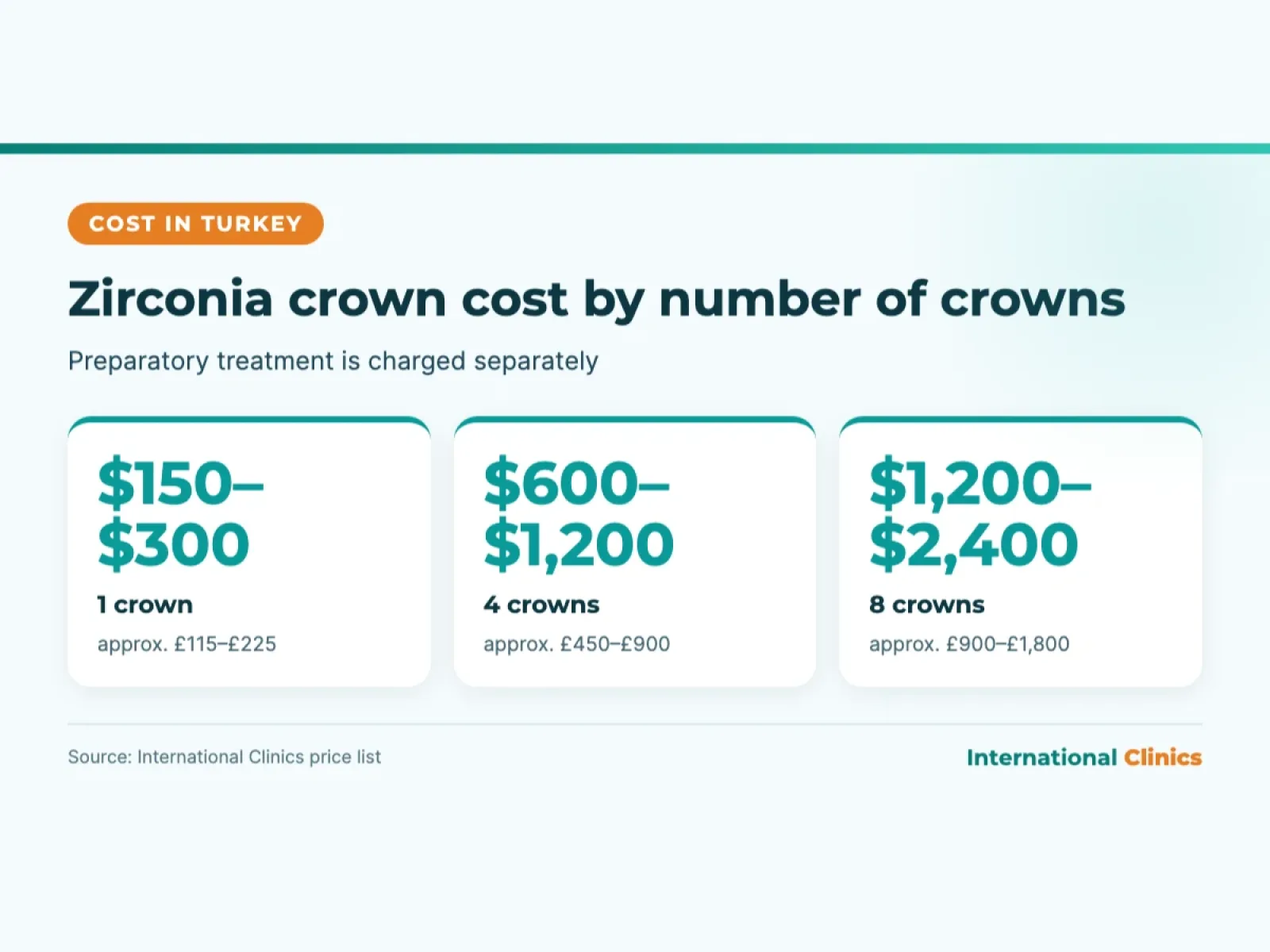
| Number of crowns | Price in Turkey |
| 1 crown | $150 to $300 (approx. £115 to £225) |
| 4 crowns | $600 to $1,200 (approx. £450 to £900) |
| 8 crowns | $1,200 to $2,400 (approx. £900 to £1,800) |
Any preparatory treatment, such as a root canal or a core build-up, is charged separately and agreed before work starts. A crown on a dental implant is a different case, because the implant has its own price; our guide to the dental implant cap explains how the parts fit together. For a thin shell rather than a full cover, see veneers vs crowns.
Why Choose Zirconia Crowns?
Zirconia is chosen mainly for its strength. Zirconia crowns are extremely durable and withstand heavier forces than other ceramic crowns (Source: Cleveland Clinic).
- Strength: Suitable for back teeth, which take the heaviest chewing load (Source: Cleveland Clinic).
- Tooth-coloured appearance: All-ceramic crowns mimic the look of enamel more closely than other crown types (Source: Cleveland Clinic).
- No metal: A ceramic crown may be a good choice if you have a metal allergy (Source: MedlinePlus).
- No metal to expose: With porcelain-fused-to-metal crowns, the porcelain coating can chip off and reveal the metal underneath (Source: Cleveland Clinic).
- Fewer chips in monolithic designs: Crowns milled from one solid piece of zirconia showed significantly fewer ceramic fractures and chips than veneered designs (Source: International Journal of Prosthodontics, 2026).
- Newer, more translucent grades: Multilayer and high-translucency zirconia widened the cosmetic options, mainly for front teeth (Source: Molecules, 2022).
- Stable colour: The shade is chosen once, and normal brushing and professional cleaning remove surface deposits at the edge of the crown.
- Quick adaptation: It usually takes a few days to get used to a new crown (Source: MedlinePlus).
Our full guide to zirconia crowns covers the material itself, and types of dental crowns compares it with the alternatives.
Factors Influencing Zirconia Dental Crown Cost
The price of a zirconia crown changes with the material, the amount of work and the condition of the tooth. Resin crowns are generally less expensive than other types, which shows how much the choice of material affects the bill (Source: Cleveland Clinic).
- Zirconia brand and grade: Blocks differ in maker, translucency and layering, so ask which one your quote uses.
- Monolithic or veneered: A veneered crown adds a porcelain layer over the zirconia, while a monolithic crown is milled from one piece.
- Position of the tooth: Front teeth call for more shade and translucency work, while back teeth prioritise strength.
- Condition of the tooth: Decay removal, a build-up or root canal treatment adds to the total (Source: Cleveland Clinic).
- Number of crowns: Larger cases may qualify for a package price, and the examination confirms how many are needed.
- Digital workflow: Scanning and CAD/CAM milling can replace putty impressions and an outside laboratory (Source: Cleveland Clinic).
- Country: Salaries, laboratory fees and premises vary widely between countries.
- Warranty: Coverage and its conditions differ, so check them in writing before comparing two prices.
Two quotes are only comparable if they name the same material, the same number of units and the same inclusions. A low figure that leaves out the temporary crown or the second visit is not necessarily cheaper.
The Procedure Steps: Two Visits for a Zirconia Crown
Placing a crown usually takes two visits (Source: Cleveland Clinic).
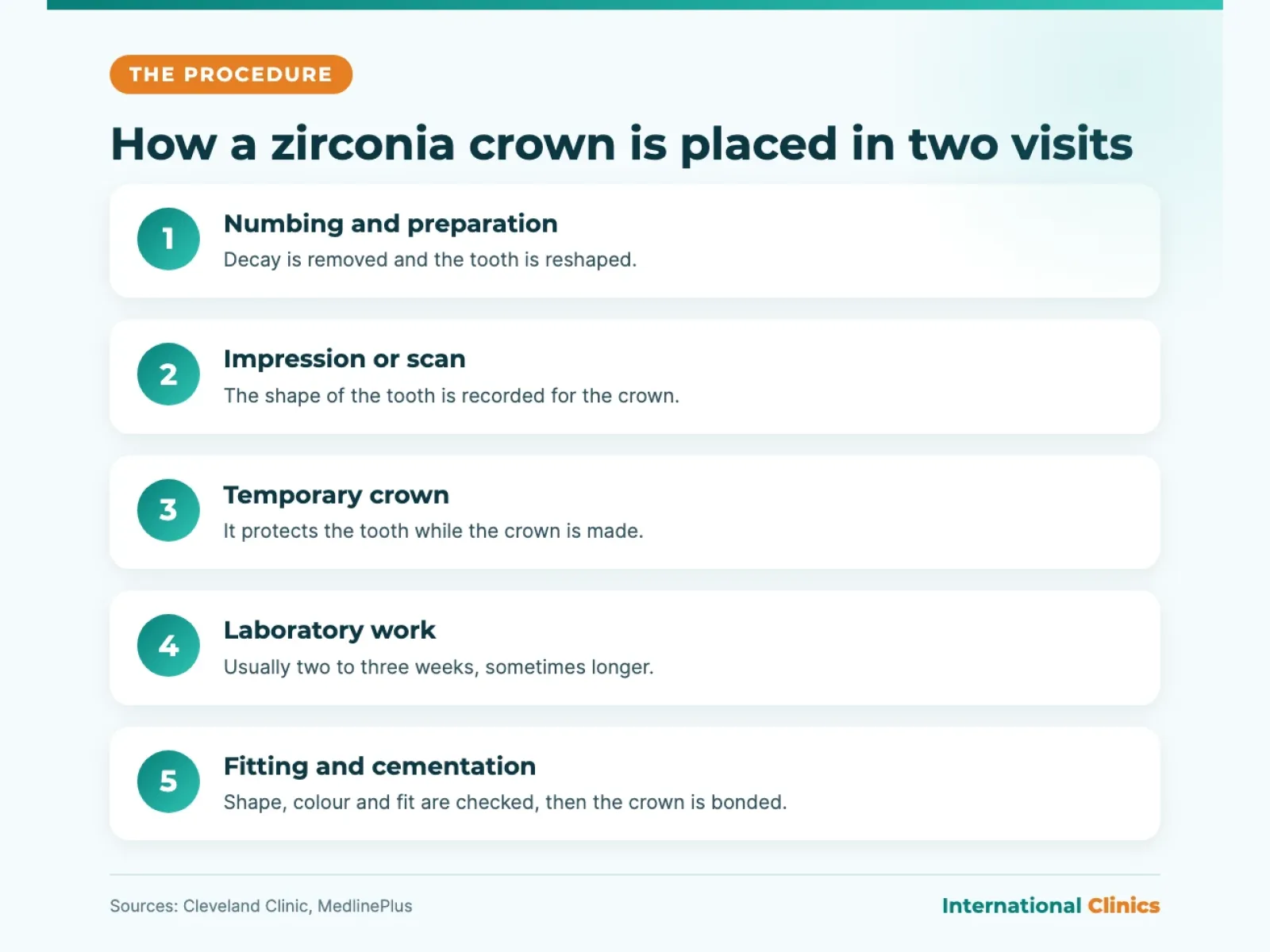
At the first visit, the dentist numbs the area, removes decay or old fillings, reshapes the tooth, takes an impression or digital scan and fits a temporary crown (Source: MedlinePlus).
A dental laboratory usually needs two to three weeks, sometimes longer, to make the permanent crown. Some dentists use CAD/CAM milling to make it in the office during one visit, but same-day crowns do not suit everyone (Source: Cleveland Clinic).
- Initial consultation: The dentist examines the tooth and reviews X-rays.
- Local anaesthetic: The tooth and the surrounding gum are numbed so you do not feel the preparation (Source: MedlinePlus).
- Tooth preparation: A small amount of enamel is removed to make room for the crown (Source: Cleveland Clinic).
- Digital impressions: An impression or a handheld scan records the shape of the tooth (Source: Cleveland Clinic).
- Temporary crown: A resin or acrylic crown protects the tooth while you wait (Source: Cleveland Clinic).
- Precision milling: The permanent crown is designed and milled from a zirconia block, then matched to the shade you agreed.
- Fitting trial: The dentist checks shape, colour and fit, and may take an X-ray (Sources: Cleveland Clinic, MedlinePlus).
- Final cementation: The crown is bonded to the tooth with dental cement (Source: Cleveland Clinic).
If you are travelling for treatment, ask how many days the plan needs before you book. The laboratory time decides whether one trip is enough.
Global Cost Breakdown: Zirconia Crown Prices by Country
Private dental fees are rarely published, so most country figures below are market prices rather than official tariffs. The Turkey row is our own price. The NHS row is an official charge, shown because it comes from a primary source.
| Country | Estimated Price (Per Tooth) | What this figure is |
| Turkey | $150 to $300 (approx. £115 to £225) | International Clinics price |
| United States | $1,000 to $2,500 | Market price (source: social media platforms) |
| United Kingdom, private | $800 to $1,500 | Market price (source: social media platforms) |
| UAE (Dubai) | $500 to $1,200 | Market price (source: social media platforms) |
| Eastern Europe | $300 to $600 | Market price (source: social media platforms) |
In England, a crown on the NHS falls under Band 3, which costs £332.10 for the course of treatment. That band also covers bridges and dentures, and you may be offered a metal-coloured crown on a back tooth, so it is not a like-for-like price for a zirconia crown (Source: NHS).
When you compare countries, add what the crown price leaves out: flights, the length of stay while the laboratory works, and follow-up with a dentist at home. Agree in advance who will handle an adjustment or a repair after you return.
Pros & Cons of Zirconia Crowns
Zirconia suits many teeth but not every case. Translucent grades trade away some strength, and the effect on opposing teeth depends on how the surface is finished.
| Advantages (Pros) | Risks (Cons) |
| Aesthetic appeal: All-ceramic crowns closely mimic tooth enamel. | Higher price: Crowns in general may be expensive, and zirconia usually costs more than resin. |
| Extreme strength: Withstands heavier forces than other ceramic crowns. | Enamel removal: Some natural enamel must be removed permanently. |
| Suitable with metal allergy: Allergic reactions to crowns are rare. | Opacity: Conventional zirconia has low translucency, which matters most on front teeth. |
| Fewer chips when monolithic: No veneering layer to fracture. | Sensitivity: Sensitivity to heat and cold is normal for a couple of weeks. |
| Good survival: About 97% at five years, similar to metal-ceramic crowns. | Decay and fit: A poorly fitting crown can trap bacteria and lead to decay. |
The sources for this table are in the sections on reliability and recovery below, and in Cleveland Clinic.
Wear on the opposing tooth is a debated point. An umbrella review found that polished monolithic zirconia causes enamel wear equal to or less than natural enamel (Source: Journal of the Indian Prosthodontic Society, 2024).
A 2026 meta-analysis of nine short clinical studies found more wear than enamel against enamel, and its authors note that polishing, glazing and the measuring method influence the results (Source: Dentistry Journal, 2026).
In practice, ask your dentist to polish any adjustment made to the biting surface.
Translucency has a trade-off as well. Newer grades are more translucent but weaker than conventional zirconia, so the highest-translucency materials are limited to single crowns and short front-tooth bridges (Source: Molecules, 2022).
How Reliable Are Zirconia Crowns? What the Studies Show
Zirconia crowns perform about as well as metal-ceramic crowns over five years. A 2026 meta-analysis of 64 studies and more than 11,500 single crowns reported five-year survival of 96.8% for monolithic zirconia, 97.3% for veneered zirconia and 97.1% for metal-ceramic crowns (Source: International Journal of Prosthodontics, 2026).
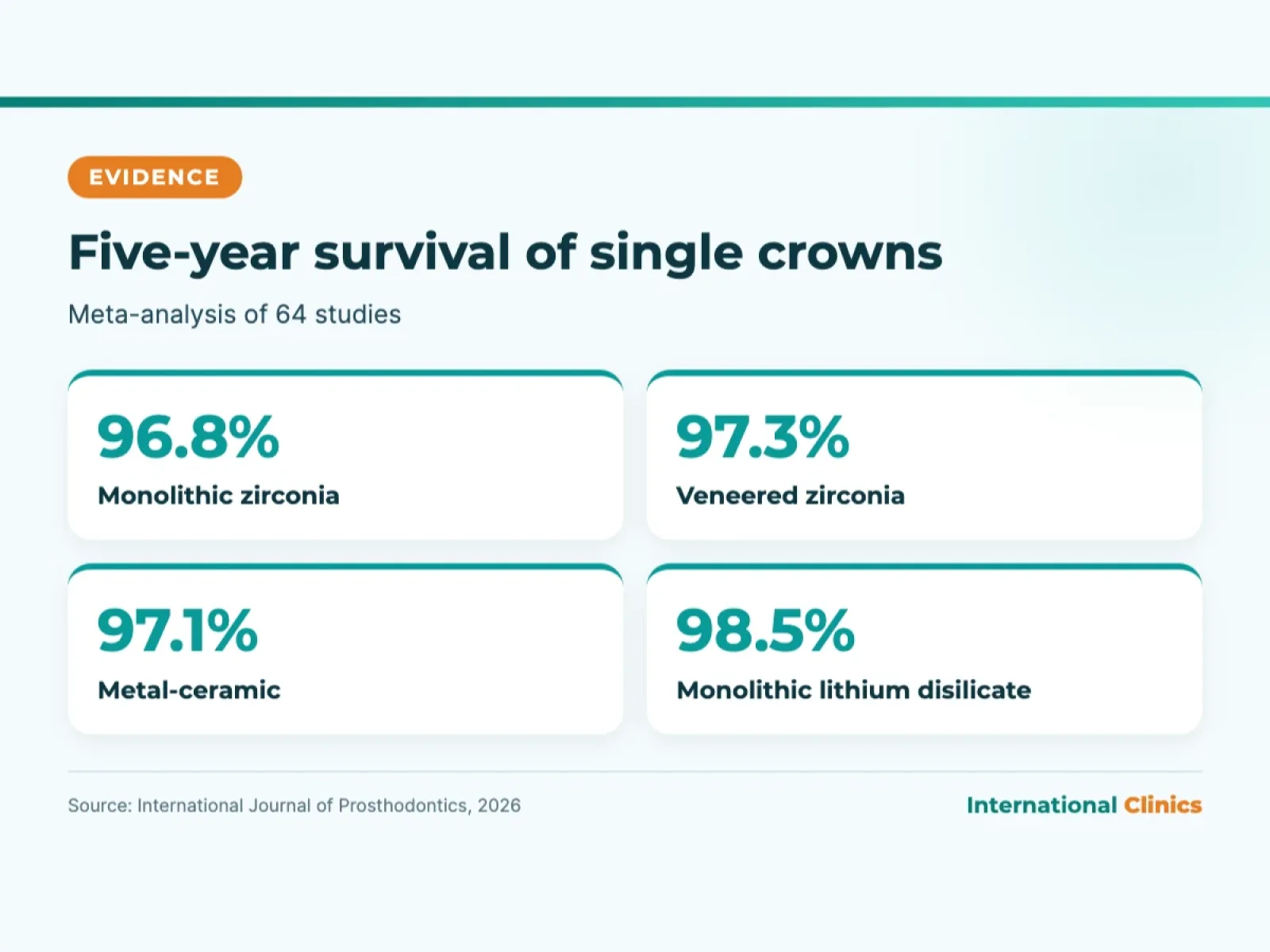
In the same analysis, monolithic lithium disilicate reached 98.5%. Zirconia performed similarly on front and back teeth, and monolithic designs had fewer fractures and chips than veneered ones (Source: International Journal of Prosthodontics, 2026).
These figures cover five years, so they do not tell you how a crown behaves after twenty. For longer horizons, use the lifespan ranges in the next section.
Recovery and Aftercare
Most people return to work and routine activities straight after a crown is placed. Sensitivity to heat and cold for a couple of weeks is normal, and soreness in the gums should settle within a few days (Source: Cleveland Clinic).
The average lifespan of a dental crown is 5 to 15 years, and with proper care it can reach 30 years (Source: Cleveland Clinic).
The temporary crown needs extra care. Slide floss out sideways rather than lifting it up, avoid sticky foods and try to chew on the other side of the mouth (Source: MedlinePlus).
- Pain relief: Over-the-counter pain relievers can ease temporary discomfort (Source: Cleveland Clinic).
- Avoid hard foods: Ice cubes, very hard nuts, popcorn kernels and sticky sweets can damage or dislodge a crown (Source: Cleveland Clinic).
- Gentle brushing: Brush at least twice a day with a fluoride toothpaste and a soft-bristled brush (Source: Cleveland Clinic).
- Daily flossing: Floss between the teeth every day, because the tooth under a crown can still decay (Source: MedlinePlus).
- Mouthwash use: An antibacterial mouthwash helps keep plaque under control (Source: Cleveland Clinic).
- Regular checkups: Keep up regular dental cleanings and examinations (Source: Cleveland Clinic).
- Bite monitoring: Contact your dentist if your bite feels wrong (Source: MedlinePlus).
- Night guard: If you grind or clench your teeth, ask about a custom mouth guard (Source: Cleveland Clinic).
Call a dentist if the crown feels loose, if it cracks or chips, if you notice a bad taste or bad breath, or if a sharp edge bothers your tongue or gums (Source: Cleveland Clinic).
Real Patient Stories: Two Typical Situations
These are generalised examples of how such cases usually unfold, not testimonials from specific people.
Worn front teeth: A patient researches the zirconia dental crown cost, sends X-rays and photos, and receives an estimate before travelling. The teeth are prepared and scanned at the first visit, temporary crowns go on, and the permanent crowns are fitted once the laboratory has finished them.
Comparing prices at home and abroad: A patient compares a local quote with the price in Turkey. The useful comparison includes any preparatory treatment, the days of stay needed for the laboratory work, and follow-up with a dentist at home.
Treatment Packages and Warranties
Through International Clinics, the price of a zirconia crown goes beyond the crown itself. Preparatory treatment, if your tooth needs it, is charged separately and agreed in advance. Ask for a written plan that lists each of the items below for your case.
- Free consultation: An individual treatment plan based on your X-rays and photos.
- Panoramic X-rays: Imaging to assess the teeth and the bone.
- Digital scan and temporary crown: Both are part of the price.
- VIP transfers: Transport between the airport, the hotel and the dental centre.
- Accommodation: A hotel stay during treatment.
- Personal translator: Help with communication during your appointments.
- Local anaesthesia: Numbing during tooth preparation.
- Extended warranty: The terms for your crowns are set out in writing before treatment.
- Remote follow-up: Contact with the team after you return home.
A warranty does not replace daily care. Crowns are durable but not indestructible, and they will need replacing at some point (Source: Cleveland Clinic).
Pro-Tips for Making a Zirconia Crown Last
How long a crown lasts depends largely on daily habits and regular visits. A crown can chip or crack, and the tooth beneath it can still develop a cavity (Source: MedlinePlus).
- Brush twice: Clean around the gum line of the crown morning and night.
- Stop biting nails: Do not use the crown on nails, pens or packaging.
- Floss daily: Plaque collects where the crown meets the tooth.
- Limit stains: Coffee and tea can darken the natural teeth next to the crown, so the shades may drift apart.
- Whiten first: If you plan to whiten your teeth, do it before the shade is chosen, because a ceramic crown keeps the colour it was made in.
- Check the bite: If the crown feels high, have it adjusted promptly.
- Wear a guard: A custom night guard protects the crown if you grind your teeth (Source: MedlinePlus).
- Choose carefully: Pick a dentist who states the price, the material and the warranty terms in writing.
Before you agree to crowns on healthy teeth, ask why a crown is needed. Preparation removes enamel permanently, and a veneer or a filling may be enough. Our guide to choosing a dental clinic in Turkey lists the questions to ask.
Conclusion
A zirconia crown in Turkey costs $150 to $300 (approx. £115 to £225) per tooth through International Clinics, with preparatory treatment charged separately. Dental crowns last 5 to 15 years on average, and zirconia reaches about 97% survival at five years, so care and regular checkups matter as much as the price.
International Clinics is neither a dental centre nor a hospital broker. It is the link between you and the right treatment: it selected skilled dentists and reputable medical centres, contracted with them against high standards of medical quality, and prepares a plan that fits your case. It is a licensed company with international partners, and it is expanding its contracts across several countries, starting with the UAE. Send a panoramic X-ray or photos of your teeth to receive an estimate before you travel.
Medical review and disclaimer:
This article was reviewed by Dr. Burhan Mollamusa, after its translation into the appropriate language. It is general information and does not replace an in-person examination by a dentist; treatment plans and results vary from patient to patient depending on the condition of the mouth and teeth.