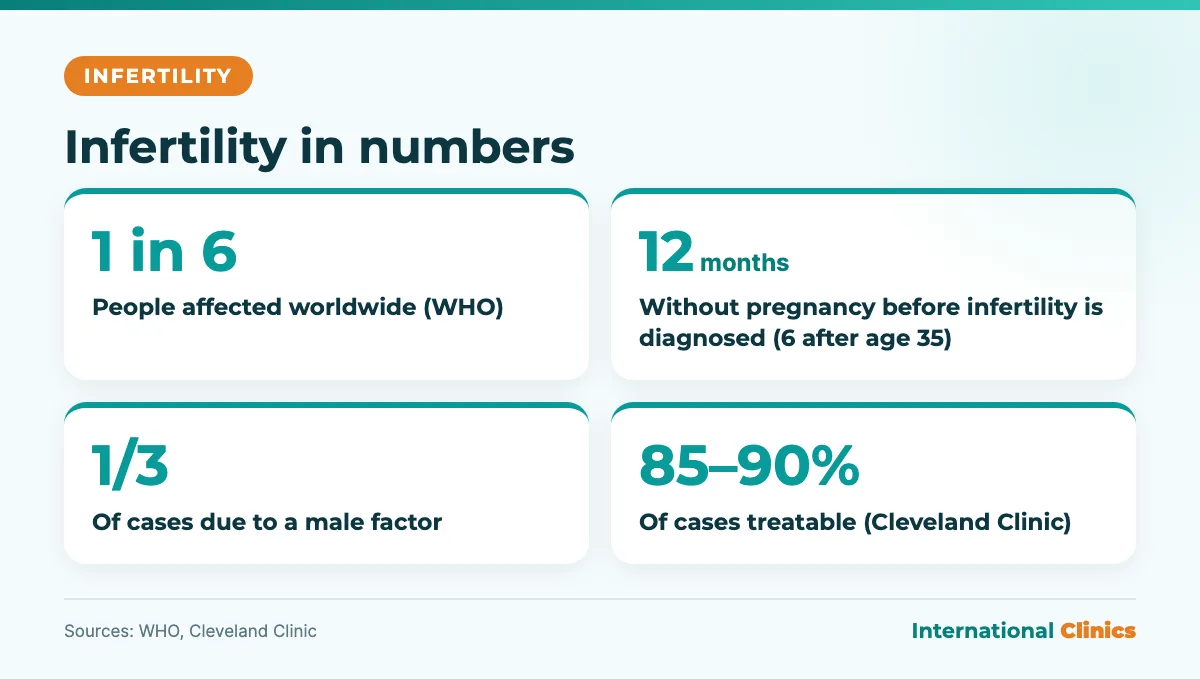
Can infertility be treated? Yes, in the great majority of cases. Infertility treatment for men and women depends on the cause, whether it lies with one partner or both, and may combine lifestyle changes, medication, surgery and assisted reproduction such as intrauterine insemination (IUI), in vitro fertilisation (IVF) and ICSI. According to Cleveland Clinic, these options successfully treat 85% to 90% of infertility cases.
Doctors speak of infertility when a couple has not conceived after a year of regular sex without contraception, or after six months if the woman is 35 or older. This guide explains the main causes in men and in women, the signs that should prompt a check-up, the tests that find the cause, every treatment option from tablets to IVF, and the practical steps that can protect fertility.

What is infertility?
Infertility is a disease of the male or female reproductive system. The World Health Organization defines it as the failure to achieve a pregnancy after twelve months or more of regular unprotected sex. It affects roughly one in six people of reproductive age worldwide at some point in their lives, so it is common, it is nobody’s fault, and it is very often treatable.
It is also normal for a pregnancy to take a few months. The NHS notes that more than eight in ten couples conceive naturally within a year when the woman is under 40 and they have regular sex. That is why doctors usually suggest trying for a year before starting tests, unless one of the situations described later in this guide applies.
Is infertility treatable?
Yes, infertility can be treated in most cases, but the right treatment always depends on the cause. Cleveland Clinic reports that lifestyle changes, medication, surgery or assisted reproduction treat 85% to 90% of cases, and that around nine in ten couples go on to conceive after fertility treatment.
In about a quarter of couples no clear cause is found, which is called unexplained infertility. Even then, options such as IUI or IVF remain open and often give good results. In other words, “no cause found” does not mean “nothing can be done”.
Male or female factor: who has the problem?
The cause lies with the man in about a third of cases, with the woman in another third, and with both partners or no identifiable reason in the remaining third. Around one couple in four has more than one factor at the same time. For this reason both partners should be assessed together from the very beginning, rather than the woman alone for months while the man is never tested.
For men, a semen analysis is one of the very first tests. It is quick, painless and inexpensive, and its result immediately guides the rest of the work-up, together with hormone tests and a physical examination. If the problem turns out to be on the male side, our detailed guide to male infertility treatment in Turkey explains the specific treatments, while women can read more in our article on female infertility treatment.
Types of infertility
Doctors distinguish primary infertility, when a pregnancy has never occurred, from secondary infertility, when a couple struggles to conceive again after at least one earlier pregnancy. Infertility is also classified by its origin, male or female. Secondary infertility is more common than many people think and deserves the same investigation, even if the couple already has a child.
Causes of male infertility
According to the WHO, male infertility is most often caused by problems with sperm production, sperm shape or sperm movement, a blockage that stops sperm from leaving the body, or a hormone imbalance.
Abnormal sperm
Several conditions can lead to a low sperm count, poor motility or abnormally shaped sperm:
- an undescended testicle in childhood;
- a varicocele, which is a swelling of the veins inside the scrotum;
- genetic conditions;
- diabetes;
- infections such as epididymitis, orchitis or some sexually transmitted infections.
Problems with sperm delivery
Sometimes sperm is produced normally but does not reach the ejaculate. Causes include a blockage of the tubes that carry sperm, the congenital absence of these tubes (often linked to cystic fibrosis), retrograde ejaculation, in which semen flows backwards into the bladder, and erectile dysfunction.
Lifestyle and environmental factors
- recreational drugs, cannabis and heavy drinking;
- anabolic steroids and hormone supplements taken to build muscle;
- smoking;
- regular exposure to heat that raises the temperature of the testicles, such as hot tubs and saunas;
- some medical treatments, especially chemotherapy and radiotherapy.
Secondary infertility in men
When a man who has already fathered a child has difficulty conceiving again, the causes are usually the same as in primary infertility: a varicocele, an infection or a hormone problem. The NHS adds that age, weight gain, smoking, alcohol and sexually transmitted infections also play a part.

Causes of female infertility
The NHS lists ovulation disorders, blocked or damaged fallopian tubes and endometriosis as the most common causes of infertility in women. Any of them can cause primary or secondary infertility.
Ovulation disorders
Polycystic ovary syndrome (PCOS) is one of the most frequent reasons a woman does not ovulate regularly. An overactive or underactive thyroid can also disturb the cycle, as can being very underweight or overweight, and intense physical stress.
Problems with the uterus
Benign growths such as fibroids and polyps, an abnormal shape of the uterus, cervix or vagina, or scar tissue inside the uterus can stop an embryo from implanting. Endometriosis, in which tissue similar to the womb lining grows outside the uterus, is another important cause. Age matters a great deal too: female fertility falls noticeably in the late thirties and during the forties.
Fallopian tubes
A blocked or removed fallopian tube prevents the egg and sperm from meeting. Untreated sexually transmitted infections, chlamydia in particular, are a classic cause of tube damage.
Cancer treatment
Chemotherapy and radiotherapy can harm fertility in both women and men. It is therefore wise to discuss freezing eggs or sperm with the doctor before treatment begins.
| In men | In women |
|---|---|
| Low, slow or abnormally shaped sperm | Ovulation disorders, including PCOS |
| Varicocele | Blocked or damaged fallopian tubes |
| Blockage of the sperm ducts | Endometriosis |
| Hormone problems | Fibroids, polyps or an abnormally shaped uterus |
| Smoking, alcohol, heat, steroids | Age, especially after 35 |
Age and fertility
A woman’s age is the single factor that most affects the chance of pregnancy, whether natural or assisted. The number and quality of eggs decline gradually from 30, more clearly after 35 and sharply after 40. In men the decline is slower, but sperm quality also falls over the years and the time needed to conceive grows longer.
This is why the advice on when to seek help is stricter after 35. A couple in which the woman is 38 should not wait two years “to see what happens”: early tests make it possible to choose the most suitable treatment in time and, if the ovarian reserve is low, to move straight to IVF.
When should you see a doctor?
See a doctor if you have not conceived after a year of trying, or sooner in the following situations:
- after six months of trying if the woman is between 35 and 39, and without waiting six months if she is 40 or older;
- very painful periods;
- very irregular periods or no periods at all;
- repeated miscarriages;
- a known male fertility problem, such as a history of an undescended testicle or a varicocele;
- after any cancer treatment.
Signs of male infertility
In most men the only sign of infertility is that a pregnancy does not happen. Cleveland Clinic lists some symptoms that should nevertheless lead to a check-up:
- a lump or swelling near a testicle;
- difficulty ejaculating or a small volume of semen;
- erection problems or a low sex drive;
- breast enlargement or reduced body or facial hair;
- a reduced sense of smell;
- repeated chest infections, in some rare genetic conditions.
Fertility tests: how the cause is found
Assessment starts with the medical history and a physical examination of both partners, followed by targeted tests. The aim is to identify the exact cause so that the simplest effective treatment can be offered first.
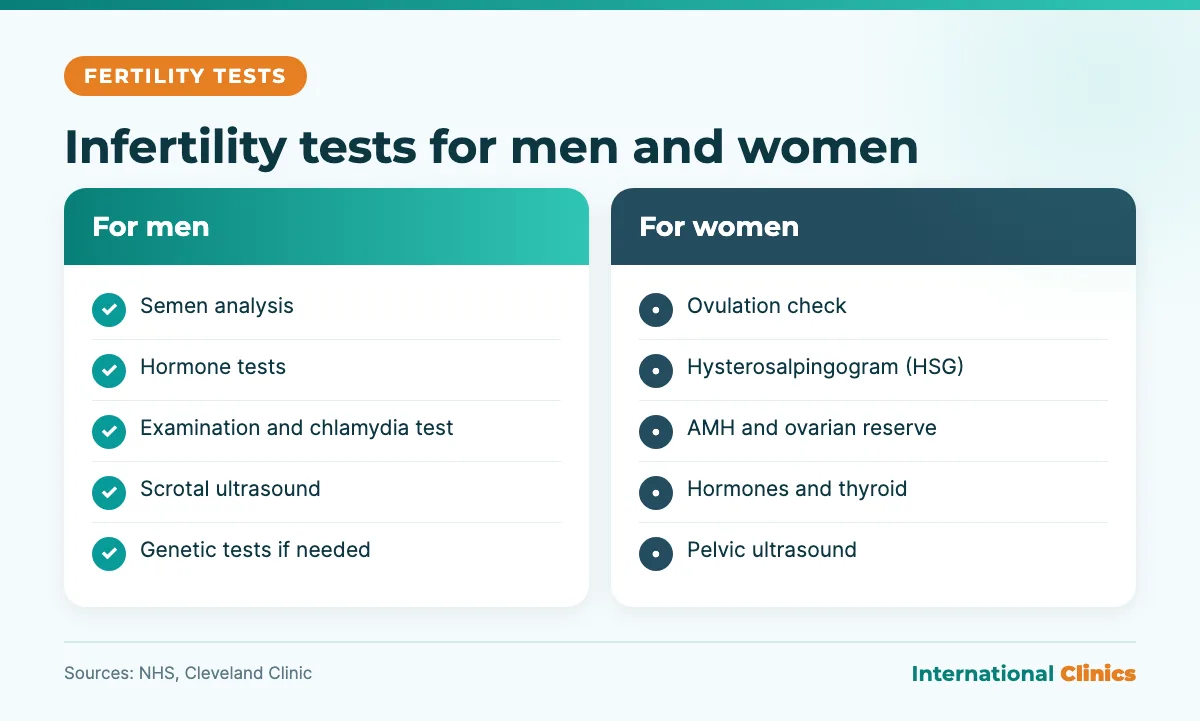
Tests for men
- Semen analysis: measures the number, movement and shape of sperm.
- Hormone tests: testosterone and the pituitary hormones that control sperm production.
- Physical examination of the testicles and a chlamydia test.
- Genetic tests: a chromosome analysis and gene tests in selected cases.
- Testicular biopsy: a tiny piece of tissue is examined in the laboratory, and the same procedure can retrieve sperm for ICSI.
- Scrotal ultrasound to look for a varicocele, and sometimes an MRI scan.
Tests for women
- Ovulation check: a blood test for progesterone in the second half of the cycle, plus other hormones if periods are irregular.
- Hysterosalpingogram (HSG): dye is passed into the uterus under X-ray to check the cavity and whether the tubes are open.
- Ovarian reserve: an AMH blood test and an early-cycle ultrasound estimate how many eggs remain.
- Hormone tests: ovulation, pituitary and thyroid hormones.
- Pelvic ultrasound, with a hysteroscopy or laparoscopy if the doctor needs to look directly at the uterus, tubes and ovaries.
Once the results are in, the specialist can propose a treatment plan. You can also send your existing results to International Clinics for a free remote consultation before deciding whether to travel.
Infertility treatment options
MedlinePlus notes that the choice of treatment depends on the cause, the age of both partners and how long they have been trying. The main options are treating the underlying cause, medication, surgery and assisted reproduction.
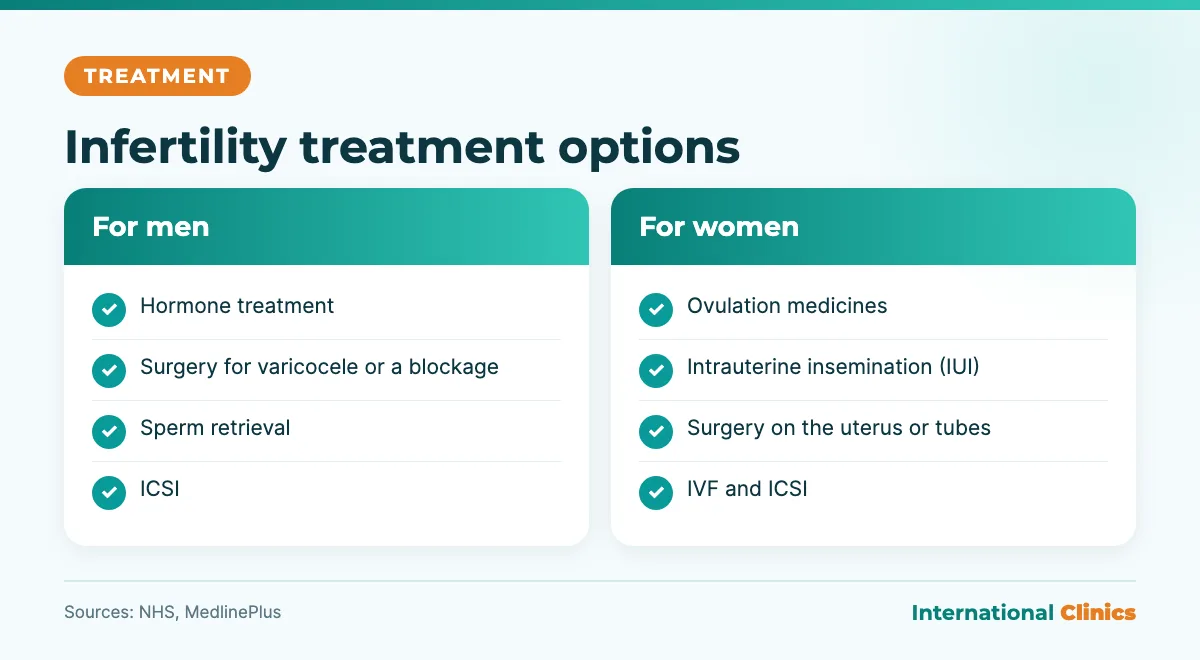
Treatment for men
- Medication: hormone treatment can improve sperm production when the cause is a hormone imbalance, and erectile dysfunction can be treated if it is delaying pregnancy.
- Surgery: to clear a blockage in the epididymis or to repair a varicocele.
- Sperm retrieval: sperm is collected directly from the testicle or epididymis and used for ICSI. This is an option when the ducts are blocked or absent from birth, or after a vasectomy.
Treatment for women
- Fertility medicines: clomifene or gonadotrophins stimulate ovulation, and metformin helps some women with PCOS.
- Intrauterine insemination (IUI): prepared sperm is placed directly into the uterus through a thin tube at the time of ovulation. It is simple and suits some couples, but not every cause of infertility.
- Surgery: removal of polyps, fibroids or scar tissue, repair of the fallopian tubes, or keyhole surgery for endometriosis.
Assisted reproduction: IVF and ICSI
IVF: the ovaries are first stimulated with medication, then the eggs are collected with a fine needle and fertilised in the laboratory. A few days later an embryo is transferred into the uterus. A full cycle takes about three to six weeks, according to the NHS. In Turkey, a standard IVF or ICSI cycle starts from $2,500, and an all-inclusive package with hotel and transfers starts from $3,750; prices, the legal framework and success rates are covered in our guide to IVF in Turkey: cost, law and success rates.
ICSI: not to be confused with insemination. In ICSI a single sperm is injected into each egg in the laboratory as part of an IVF cycle, whereas IUI places sperm in the uterus without collecting any eggs. ICSI is the main solution for severe male infertility, and even when there is no sperm at all in the ejaculate, sperm can sometimes be retrieved surgically from the testicle and used for ICSI.

Can infertility be prevented?
Not every cause of infertility can be prevented, especially genetic ones, but a healthy lifestyle reduces several risk factors.
For men
- avoid excessive heat around the testicles, such as hot baths, saunas and a laptop on the lap;
- limit exposure to toxins and industrial chemicals;
- avoid anabolic steroids, and ask a doctor before taking any medicine that may affect fertility;
- exercise moderately and keep a healthy weight;
- stop smoking, drinking heavily and using drugs, and treat sexually transmitted infections early.
For women
- keep a healthy weight, because being very overweight or underweight can disturb ovulation;
- stop smoking and drinking alcohol;
- treat sexually transmitted infections early;
- avoid delaying pregnancy for too long where possible, or discuss egg freezing with a doctor.
The treatment journey, step by step
| Step | What happens |
|---|---|
| 1. Assessment of the couple | Medical history, examination, semen analysis, hormone tests and ultrasound |
| 2. Diagnosis | The specialist identifies the cause, or concludes that the infertility is unexplained |
| 3. First-line treatment | Lifestyle changes, medication, surgery or IUI, depending on the cause |
| 4. Assisted reproduction if needed | IVF or ICSI when simpler treatments are not enough or age is pressing |
| 5. Follow-up | Pregnancy test, early scan and support after you return home |
The journey is not always linear. With blocked tubes, severe male infertility or a woman over 40, the specialist will often recommend IVF straight away rather than spend time on steps that are unlikely to work.
Having fertility treatment in Turkey: what to know
Turkey has many assisted-reproduction centres licensed by the Ministry of Health, especially in Istanbul, with modern embryology laboratories and short waiting times. The legal framework is strict, however: IVF is available only to married couples using their own eggs and sperm. Egg donation, sperm donation and surrogacy are not permitted, and sex selection without a medical reason is prohibited.
In practice, much of the work-up can be done in your home country. You send your results, the specialist proposes a written plan and price, and the trip is arranged only for the steps that must happen in person, such as egg collection and embryo transfer during IVF.
Emotional support matters too
Infertility is often a heavy burden: waiting for each cycle, repeated tests, and feelings of unfairness or guilt. These emotions are normal and affect both partners. Talking openly with each other, seeing a counsellor or joining a support group, and remembering that infertility is a medical condition rather than anyone’s failure, help many couples go through treatment more calmly.
Distinguished doctors in infertility treatment



How International Clinics helps
International Clinics is not a medical centre: we are the link between patients and fertility specialists and licensed hospitals in Turkey. When a pregnancy is slow to come, the first step is to assess both partners together to find the cause, then to choose the right treatment with the specialist. Send your test results for a free remote consultation and you will receive a written treatment plan and help with travel, and our team stays in touch with you for a year.
Medical review and disclaimer:
This article has been reviewed by a specialist doctor contracted with International Clinics. The information is for general health education and does not replace a consultation with a specialist. Results and medical recommendations may vary from person to person depending on their health condition.