

- How much does IVF in Turkey cost in 2026?
- IVF cost in Turkey vs the UK and the United States
- What an all-inclusive fertility package usually covers
- Who is legally allowed to have treatment under Turkish law
- Is there an age limit for IVF in Turkey?
- Gender selection and PGT: what Turkish law permits
- IVF success rates in Turkey: how to read the numbers
- How long you need to stay: a two to three week timeline
- Risks and complications to discuss before you travel
- How to choose a fertility clinic in Istanbul or Antalya
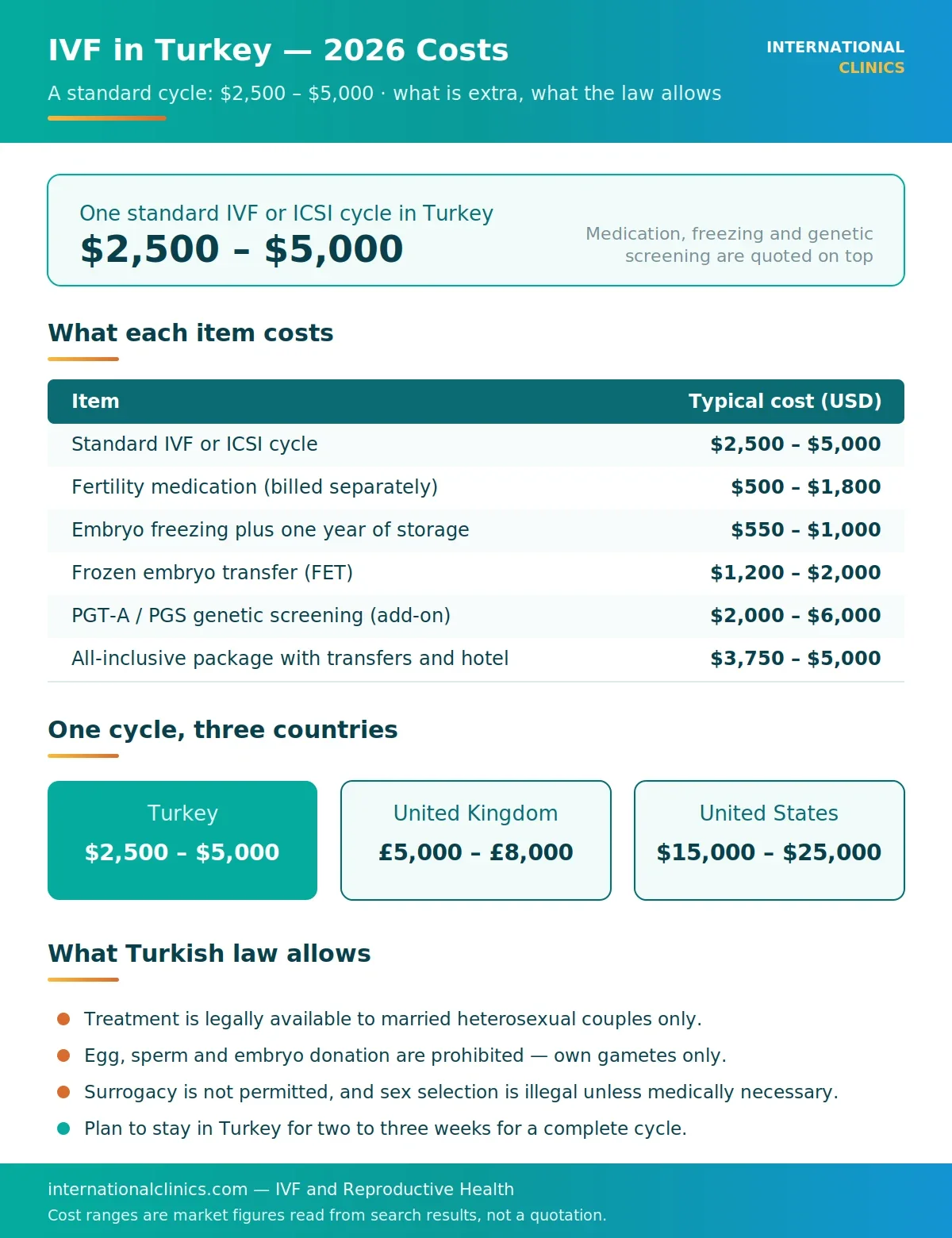
A standard IVF cycle in Turkey typically costs $2,500 to $5,000, compared with £5,000 to £8,000 in the United Kingdom and $15,000 to $25,000 in the United States. The price gap is real, but it is not the only thing that decides whether Turkey is the right place for your treatment: Turkish fertility law is stricter than the law in most of Europe, and it rules some patients out before cost ever becomes the question.
This guide sets out what a cycle costs, what a package does and does not cover, who is legally allowed to be treated, how long you need to stay, and the risks worth raising with a doctor before you book anything.
How much does IVF in Turkey cost in 2026?
One standard IVF or ICSI cycle in Turkey is quoted at $2,500 to $5,000. That figure covers the core clinical work — ovarian stimulation monitoring, egg collection, fertilisation in the laboratory, and a fresh embryo transfer. Medication, freezing and genetic screening are usually quoted on top.
| Item | Typical cost in Turkey (USD) |
|---|---|
| Standard IVF or ICSI cycle | $2,500 – $5,000 |
| Fertility medication (billed separately) | $500 – $1,800 |
| Embryo freezing plus one year of storage | $550 – $1,000 |
| Frozen embryo transfer (FET) | $1,200 – $2,000 |
| PGT-A / PGS genetic screening (add-on) | $2,000 – $6,000 |
| All-inclusive package with transfers and hotel | $3,750 – $5,000 |
Two points matter more than the headline number. First, medication is the line that moves most between patients: a woman who needs a high stimulation dose can add four figures to a quote that looked fixed. Second, a quote for "one cycle" is a quote for one attempt, not for a baby — and many patients need more than one.
IVF cost in Turkey vs the UK and the United States
| Country | Cost of one IVF cycle |
|---|---|
| Turkey | $2,500 – $5,000 |
| United Kingdom | £5,000 – £8,000 |
| United States | $15,000 – $25,000 |
For a UK patient paying privately, one Turkish cycle plus flights and two weeks of accommodation still tends to land below a single self-funded cycle at home. The saving narrows once you add a second cycle, repeat travel, and any add-on you would have declined at home. Comparing the total cost of a realistic treatment plan — not one cycle against one cycle — is the honest comparison.
What an all-inclusive fertility package usually covers
Accredited clinics in Istanbul and Antalya commonly sell bundled packages in the $3,750 to $5,000 band. A package at that level normally includes:
- Medical fees: the first specialist consultation, monitoring ultrasound scans, and blood work.
- Procedures: egg retrieval under sedation, laboratory fertilisation (often including ICSI), and embryo transfer.
- Logistics: hotel accommodation near the clinic, airport-to-clinic transfers, and an English-speaking coordinator or translator.
What is usually outside the package is just as important: stimulation drugs, embryo freezing and storage, genetic screening, a second transfer if the first fails, and your flights. Ask for the exclusions in writing before you pay a deposit, and ask what a cancelled cycle costs if too few eggs develop.
Who is legally allowed to have treatment under Turkish law
This is where Turkey differs most sharply from the UK, Spain, Greece or Cyprus, and it is the part most cost comparisons leave out.
- Married couples only. Fertility treatment is legally available to married heterosexual couples. Clinics cannot treat single women or same-sex couples.
- Your own eggs and sperm. Egg, sperm and embryo donation are prohibited. Treatment must use the couples own gametes.
- No surrogacy. Surrogacy arrangements are not permitted.
If your treatment plan depends on donor gametes or a surrogate, Turkey is not an option at any price, and a clinic that suggests otherwise is a reason to walk away. Couples in that position are usually better served by looking at destinations whose law permits what they need. Where the barrier is a diagnosed male-factor or female-factor problem rather than the law, our guides to male infertility treatment in Turkey and treatment of female infertility cover the diagnostic route first — including the two conditions most often found behind an IVF referral, uterine fibroids and endometriosis.
Is there an age limit for IVF in Turkey?
Turkish law does not set a single national cut-off age for private IVF. In practice clinics apply their own upper limits, and they apply them on clinical grounds: egg quality and the chance of a live birth fall steadily from the mid-thirties, and sharply after 40.
Two things follow. A clinic that accepts every patient regardless of age and ovarian reserve is not being generous, it is selling attempts. And an age limit you meet is not a prediction — it is a threshold. Ask instead what the clinics live birth rate is for women in your age band with your diagnosis.
Gender selection and PGT: what Turkish law permits
Choosing the sex of a baby for social or family-balancing reasons is illegal in Turkey. Preimplantation genetic testing is permitted where it is medically necessary — for example to avoid passing on a serious sex-linked genetic disorder — and in that case sex is identified as a consequence of the medical test, not as the purpose of it.
Genetic screening for aneuploidy (PGT-A) is offered as a paid add-on at $2,000 to $6,000 depending on how many embryos are tested. It is worth asking a clinician whether the evidence supports it in your specific case, rather than accepting it as a default upgrade.
IVF success rates in Turkey: how to read the numbers
Clinic websites quote success rates in ways that are not comparable. Before you weigh one number against another, check three things: whether the figure is a live birth rate or only a pregnancy rate; whether it is per cycle started or per embryo transfer; and which patients are in the denominator.
The NHS sets out the factors that actually move the odds:
"Your chance of having a baby using IVF can depend on many factors such as: whats causing your fertility problems, your age, your body mass index (BMI), lifestyle factors, such as smoking or drinking alcohol."
— NHS, IVF, page last reviewed 15 April 2025
A rate quoted per transfer will always look better than a rate quoted per cycle started, because cycles that were cancelled before transfer have been removed from it. Ask for both.
How long you need to stay: a two to three week timeline
A complete IVF cycle requires you to be in Turkey for roughly two to three weeks, most commonly in Istanbul, Ankara or Antalya. Stimulation and monitoring take up most of that window; egg collection and transfer are short procedures near the end of it. It is generally considered safe to fly home around 24 to 48 hours after the embryo transfer is completed.
Many couples split the trip: initial tests at home, then a single stay for stimulation, collection and transfer. Confirm with the clinic which scans it will accept from your home country, because repeating them in Turkey adds both days and cost.
Risks and complications to discuss before you travel
IVF is a widely performed procedure and most people come through it without a health problem, but it does carry recognised risks and no clinic can promise a result. The recognised risks include:
- Ovarian hyperstimulation syndrome (OHSS): too many eggs develop in the ovaries in response to stimulation drugs. The ovaries can become enlarged and painful, and the treatment cycle may have to be stopped.
- Multiple pregnancy: carrying more than one baby, which carries added risk for both the mother and the babies.
- Ectopic pregnancy: a fertilised egg implants outside the womb. It is a medical emergency, and the symptoms to act on — one-sided tummy pain, vaginal bleeding, shoulder-tip pain — are worth knowing before you travel.
Treatment abroad adds a layer that treatment at home does not have. As the NHS puts it:
"Clinics in other countries may not be regulated in the same way as they are in the UK."
— NHS, IVF, page last reviewed 15 April 2025
Ask before booking who you contact if you develop pain, bloating, vomiting or bleeding after you fly home, and which doctor answers that call. Seek urgent medical advice locally if those symptoms appear — do not wait for a follow-up appointment abroad.
How to choose a fertility clinic in Istanbul or Antalya
There is no single "best" clinic, and any ranking that claims otherwise is selling placement. What separates a clinic worth travelling for is answerable in writing before you pay:
- A named specialist who will perform the retrieval and transfer, with their registration verifiable.
- Live birth rates broken down by age band and by cycle started, not one headline percentage.
- A written quotation listing inclusions, exclusions, and the cost of a cancelled cycle.
- A named point of contact for complications after you return home.
- Records and embryology reports released to you in English.
If you are weighing Turkey against treatment at home, it helps to understand how the wider system works for international patients first — our complete guide to medical tourism in Turkey covers accreditation, travel planning and patient rights. You can also browse the full IVF and reproductive health section, or the wider gynaecology and obstetrics department, for the conditions that sit behind a fertility diagnosis.
IVF is a medical decision before it is a travel decision. Speak to a fertility specialist about your own diagnosis, your own test results and your own realistic chance of success, and treat the price list as the last question rather than the first.