- Hydraulic Penile Implant: What It Is and How It Works
- Why Choose Hydraulic Penile Implant in Turkey?
- Hydraulic Penile Implant Procedure: Step by Step
- After the operation: when can you use the implant?
- Types of Hydraulic Penile Implant
- Two-piece implants
- Three-piece implants
- Differences Between Semi-Rigid Implants and Hydraulic Penile Implants
- Hydraulic Penile Implant Cost in Turkey
Hydraulic penile implant in Turkey, in short: a hydraulic penile implant, also called an inflatable penile prosthesis (IPP) or simply a «hydraulic penis» implant, is a fluid-filled device placed inside the erection chambers: two cylinders in the penis, a small pump in the scrotum and, in the three-piece model, a reservoir in the lower abdomen. Squeezing the pump fills the cylinders to give an erection on demand, and a release valve returns the penis to a soft state. It is offered when tablets, injections or a vacuum device have not worked or are unsuitable, or when a man prefers a definitive solution (Sources: Cleveland Clinic and EAU Guidelines).
A penis implant in Turkey of the hydraulic type costs $6,000–10,000 (approx. £4,470–7,450), depending on the device and the patient’s needs (details in the cost section below).
The devices you keep hearing about (penile implants or prostheses) are usually used to help treat erectile dysfunction.
Recent years have seen some improvements in the design of cylinders, reservoirs, and pumps of these implants.
Deflation is now simpler, thanks to advances in pump design, and modern penile prostheses are made to be discreet and practical. When the implant is deflated, the penis looks soft and natural in clothing, and partners usually cannot tell that a device is present (Source: Cleveland Clinic).
The implants can help men who want to have sex get and maintain an erection that is appropriate for sex. Because the cylinders are placed inside the erectile tissue, the operation is considered permanent; guidelines recommend it when other treatments fail or depending on the patient’s preference, after full information on its benefits and harms (Source: EAU Guidelines).
With or without a pump or reservoir in the scrotum or pelvis, the device consists of two inflated parts or pliable rods that are placed into the penile shaft.
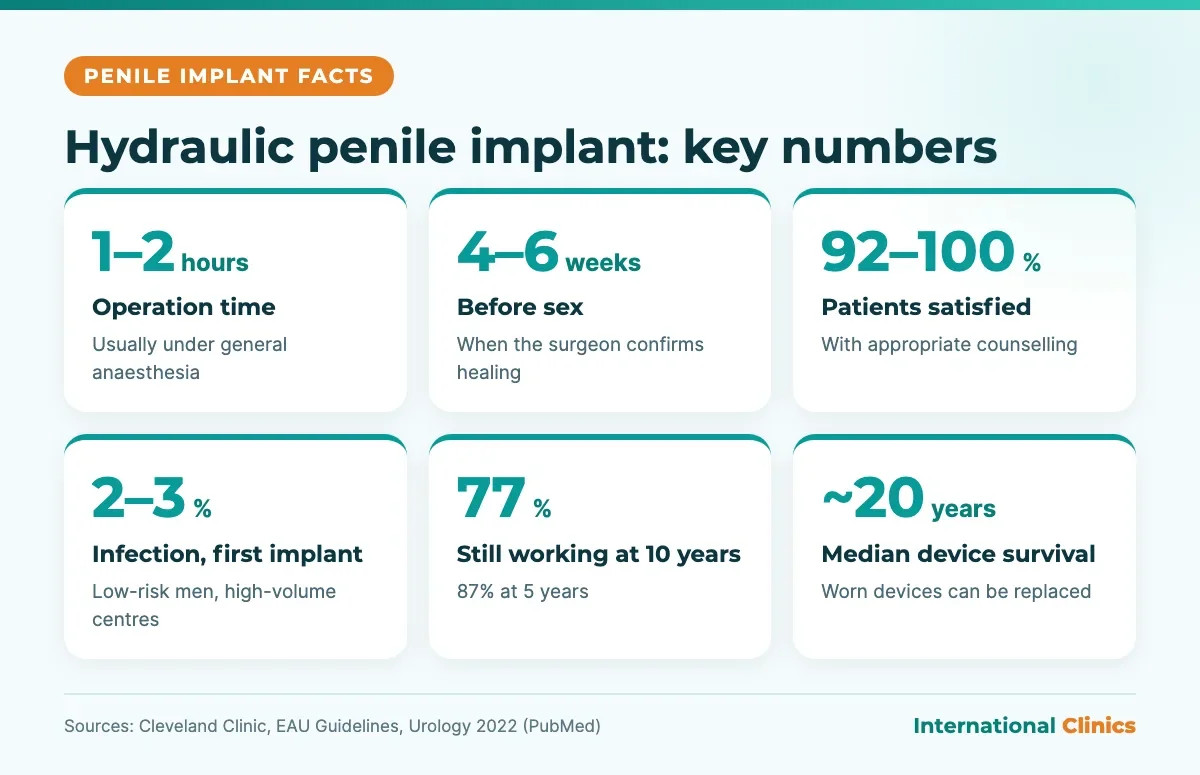
They provide an effective treatment for erectile dysfunction, even if the look and feel are not exactly like a natural erection. With appropriate counselling, 92–100% of patients and 91–95% of partners report being satisfied (Source: EAU Guidelines).

Hydraulic Penile Implant: What It Is and How It Works
A hydraulic (inflatable) penile implant is a closed system of cylinders, tubing and a pump that moves sterile saline into the penis to create an erection and back out to make it soft again (Source: Cleveland Clinic).
Although they are more complex to implant than semi-rigid rods, hydraulic or inflatable penile prostheses (IPP) are widely used because they allow both a soft (flaccid) state and a firm erection; the three-piece model may be preferred for the most natural erection (Source: EAU Guidelines).
Because it produces more natural erections, the inflatable device is chosen by many patients, which makes it one of the most popular Penile Implant Size Options. However, no head-to-head trial has shown that one manufacturer or implant type is superior to another (Source: EAU Guidelines).
A reservoir placed next to the bladder (in the space behind the pubic bone, under the abdominal muscles), an activation pump in the scrotum, and two cylinders implanted in the peniss corpora cavernosa make up this type of penile prosthesis (Sources: Cleveland Clinic and J Surg Tech Case Rep, 2011).
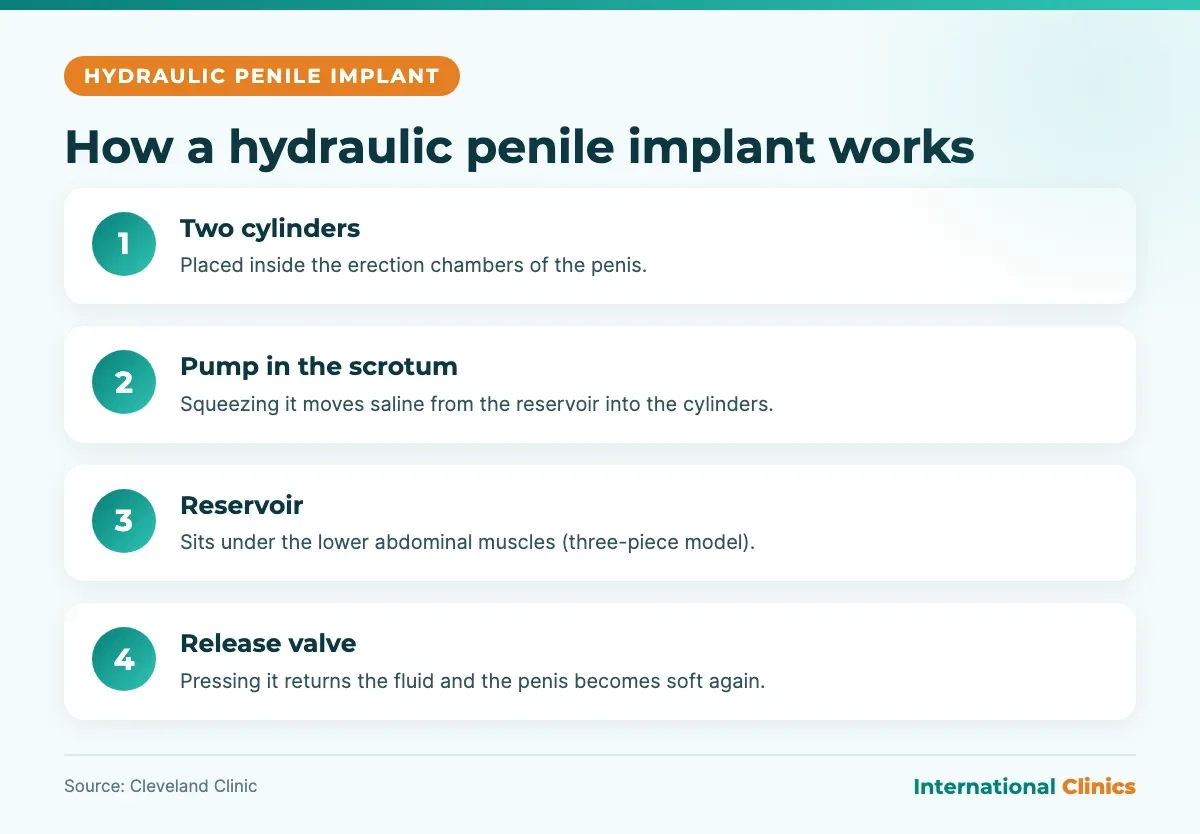
So, How Do Penile Implants Work? The mechanism is based on a hydraulic system that transfers fluid between the prosthesiss various parts to alter the penis stiffness in accordance with the patients requirements.
Because the implant is not in the glans, the head of your penis does not become rigid (engorged) following inflation. So, it is not a method for Penile Glans Enlargement.
This may give the impression that your penis is smaller than it was before the implant. An implant cannot make the penis larger than it was before surgery, although newer cylinders may slightly increase length, girth and stiffness over time; your surgeon places the largest implant that is safe for your measurements (Source: Cleveland Clinic).
To help blood flow to the head of your penis, your doctor may recommend a medicine.
These penile implants are also used for Peyronie’s disease with erectile dysfunction that has not improved with medication, and after phalloplasty or metoidioplasty as part of gender affirmation surgery (Source: Cleveland Clinic).
A hydraulic implant is a medical treatment for erectile dysfunction. It is different from cosmetic silicone girth implants such as the Penuma procedure, which sit under the skin to change size and do not treat erection problems. To understand the causes of erection problems first, read our guide to erectile dysfunction.
Why Choose Hydraulic Penile Implant in Turkey?
Men choose Turkey mainly for the price and for package care that includes the hospital, transfers and an interpreter. You can get hydraulic penile implants in selected urology centres in Istanbul, Turkey, which often also perform penis plastic surgery.
Whatever the country, the result depends mostly on the surgeon’s experience: infection after a first implant is about 2–3% in low-risk patients at high-volume centres, so ask how many implants your urologist performs each year (Source: EAU Guidelines).
Patients usually look for:
- Affordability: Turkish clinics offer different types of penile implants at lower prices than many Western countries; compare what each quote includes (device brand, hospital nights, follow-up).
- Convenience: once healed, the implant gives an erection on demand, without tablets or injections before sex, and it lasts as long as you want until you release the valve (Source: Cleveland Clinic).
- Usability: running the pump is easy to learn; patients are usually taught to operate the inflatable prosthesis about six weeks after surgery (Source: J Surg Tech Case Rep, 2011).
- Longevity: in a meta-analysis of 12 studies (20,161 men), about 87% of inflatable implants were still working at 5 years and 77% at 10 years; the median device survival is about 20 years, and a worn-out device can usually be replaced (Source: Urology, 2022).
- Privacy: The implant is hidden inside the body, and treatment abroad allows discretion. The same reason explains the interest in other procedures such as the Penuma Procedure in Turkey.
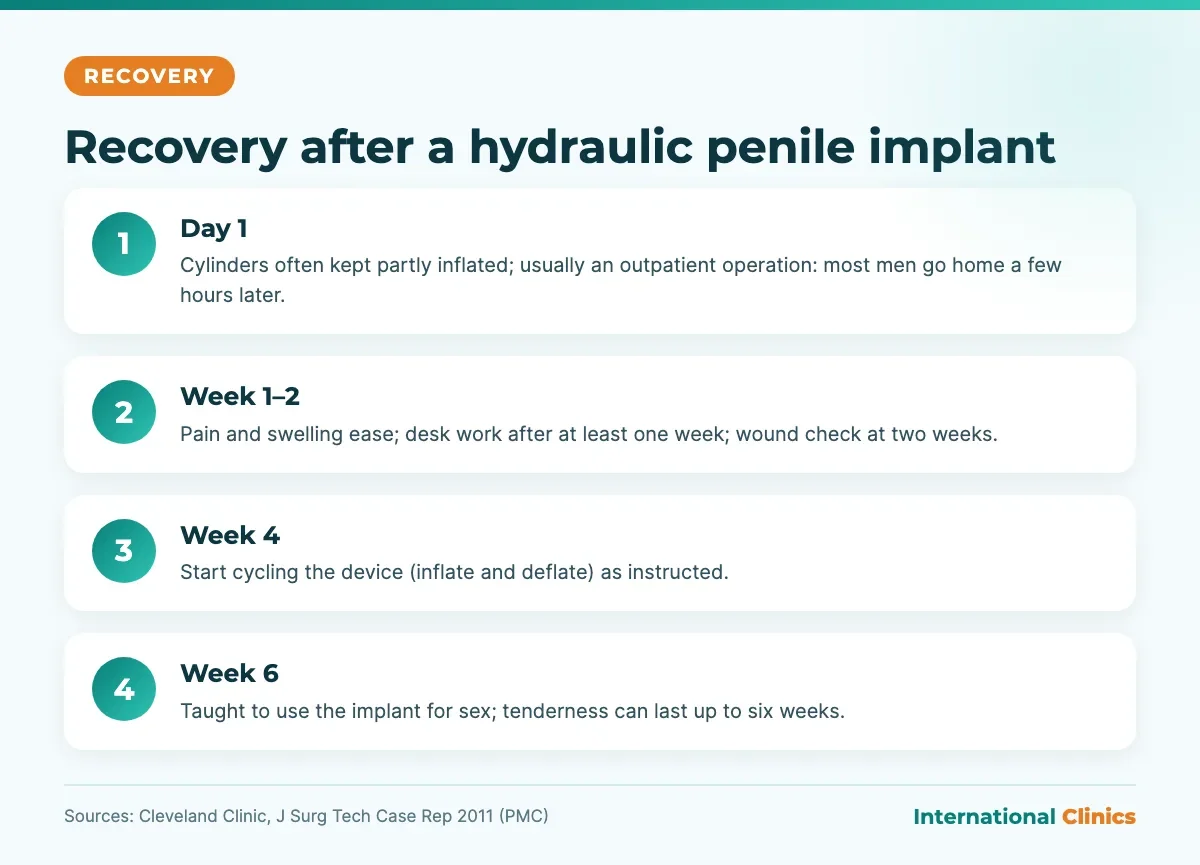
- Recovery: it is usually an outpatient operation. Pain and swelling ease after about a week, tenderness can last up to six weeks, desk workers need at least one week off and physical jobs two to four weeks, and sex usually resumes after four to six weeks, when the surgeon allows it (Source: Cleveland Clinic).
Hydraulic Penile Implant Procedure: Step by Step
The operation is done under general anaesthesia and usually takes one to two hours; most men go home a few hours later, as an outpatient (Source: Cleveland Clinic).
There is no need for circumcision to receive this type of penile implant. So, you should only do what is required and suggested. Less is preferable when it comes to penile surgery.
The whole prosthesis is usually implanted through one small transverse incision at the junction of the penis and scrotum (penoscrotal approach), which avoids the sensory nerves on the top of the penis and lets the pump sit in the scrotum (Source: J Surg Tech Case Rep, 2011).
Both erection and detumescence (return to the flaccid state) are close to natural in the penile implant – hydraulic models that are now in use, especially with three-piece devices (Source: EAU Guidelines).
The cylinders are inserted into your penis by the surgeon. The cylinders are connected by tubes to a separate reservoir beneath your lower abdominal muscles (Source: Cleveland Clinic).
There is fluid in the reservoir. This system is also connected to a pump. It is located between your testicles, behind the loose skin of your scrotum.
You push the pump in your scrotum to inflate the implant (prosthesis). Your testicles are not under any pressure when you squeeze the pump.
Your peniss cylinders are inflated to the desired hardness by the pump, which moves fluid from the reservoir to them.
Even after an orgasm, you may keep your erection going for as long as you choose. Pressing a valve on the pump causes your penis to deflate and return the fluid to the reservoir when you choose to cease being erect (Source: Cleveland Clinic).
After the operation: when can you use the implant?
After surgery the cylinders are often left partly inflated for about a day, the wound is checked at around two weeks, patients start cycling (inflating and deflating) the device at about four weeks, and they are taught to use it for sex at about six weeks (Source: J Surg Tech Case Rep, 2011).
Antibiotics are given around the operation, and surgery is postponed if there is an active skin or urinary infection. Diabetes and low testosterone increase the risk of infection, so blood sugar should be well controlled beforehand (Source: EAU Guidelines).

Types of Hydraulic Penile Implant
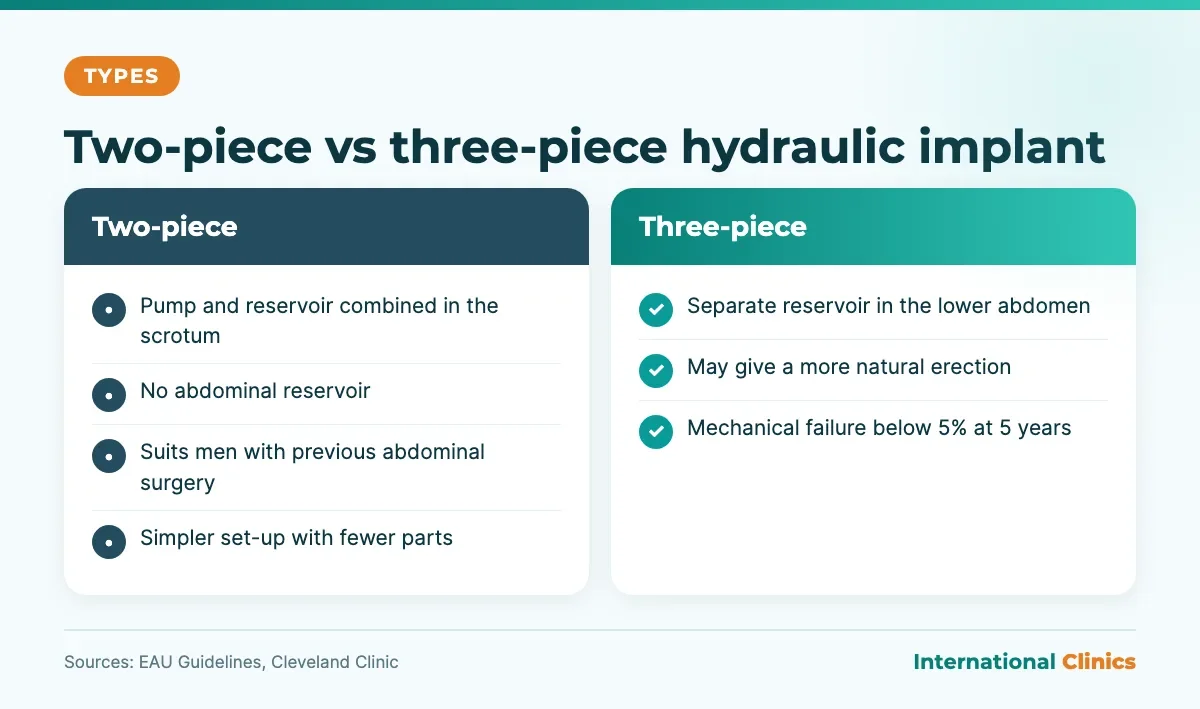
There are two kinds of hydraulic implant, the two-piece and the three-piece; both work with a pump in the scrotum. The largest implant that is safe to insert is chosen after your surgeon measures the interior of your penis (Sources: Cleveland Clinic and EAU Guidelines).
The cylinders come in several lengths and are sized to your inner anatomical dimensions. The types of hydraulic penile implant include:
Two-piece implants
These come with a resipump (a combined pump and reservoir) in the scrotum and two cylinders inside the corpora cavernosa.
So, inflatable cylinders inside the penis shaft and a combined fluid reservoir and pump unit in the scrotum make up the two-piece inflatable penile implant. It suits men at high risk of reservoir problems, for example after previous abdominal surgery (Source: EAU Guidelines).
Three-piece implants
These include a pump in the scrotum, a reservoir next to the bladder, and two cylinders inside the corpora cavernosa.
So, inflatable cylinders inside the penis shaft, a fluid reservoir beneath the abdominal wall, and a pump inside the scrotum make up the three-piece inflatable penile implant. Modern three-piece models have a mechanical failure rate below 5% at five years (Source: EAU Guidelines).
Read more in our guide to the 3-piece penile implant.
Differences Between Semi-Rigid Implants and Hydraulic Penile Implants
The main difference is that a semi-rigid (malleable) implant is always firm and is bent up or down by hand, while a hydraulic implant is filled only when you want an erection. Semi-rigid rods were used before inflatable devices were developed in the 1970s (Source: J Surg Tech Case Rep, 2011).
Semi-rigid devices are still used because they are simpler to implant and easier to operate, which helps men with limited hand dexterity (Source: EAU Guidelines).
However, there are drawbacks to semi-rigid prostheses that inflatable devices do not have: the erection is permanently firm and the penis is harder to conceal (Source: EAU Guidelines).
When curvature from Peyronie’s disease is straightened during the operation, one study reported good straightening in 84% of men with inflatable implants versus 54% with malleable implants (Source: J Surg Tech Case Rep, 2011).
Additionally, these implants prevent the penis from becoming fully flaccid, which can be challenging to conceal.
For both types, the main risks are infection (which usually means removing the implant), bleeding, injury to the urethra, scar tissue, erosion of the device through the tissue, movement of the pump or reservoir, mechanical failure, a penis that seems shorter and, rarely, reduced blood flow to the glans (Source: Cleveland Clinic).
Tenderness can last up to six weeks after either operation. There is no clinically meaningful difference in efficacy or safety between implant types or surgical approaches, so the choice depends on your hands, your anatomy, previous surgery and what you prefer (Sources: EAU Guidelines and Cleveland Clinic).

Hydraulic Penile Implant Cost in Turkey
In Turkey, a hydraulic penile implant costs $6,000–10,000 (approx. £4,470–7,450) at International Clinics (Source: International Clinics, Turkey); the final figure depends on the device (two-piece or three-piece, brand) and on what your case requires.
Unfortunately, the majority of our patients pay for themselves, and the majority of insurance companies do not cover penile implants.
The price of a penile implant may seem high, but it is a long-term treatment: the median device survival is about 20 years, and many men no longer need tablets or injections before sex (Source: Urology, 2022).
Many clinics are happy to help you with the refund claim or the claim directly from your insurance company on your behalf if your insurance company pays the cost of treatment or diagnostic testing.
The cost of surgical therapy will vary depending on the procedure, implant type, and patients unique situation.
In Turkey, hydraulic penile implants can cost $6,000–10,000 (approx. £4,470–7,450), depending on the exact specifications and requirements of the patients. For a comparison with other types, see penile implant Turkey cost; if your erection problem is mild, ask also about non-surgical options such as shockwave therapy for ED.
If you are deemed a suitable candidate for surgical treatment after your appointment, you will receive an estimate that includes all costs, including those for medical supplies, hospital stays, anesthetists, surgeons, etc.
Interesting read:
How Long Do Penile Implants Last? Risk & Life Expectancy
Stem Cell Penis Enlargement Treatment for ED & Growth
Medical review and disclaimer:
This article was reviewed by Assoc. Prof. Dr. Zülfü Sertkaya. It is general health information, not a substitute for medical advice, and results vary between individuals.