Gastric Sleeve in Turkey: $2,500-$5,500 Cost & All-Inclusive Package [2026]
Smart Digest
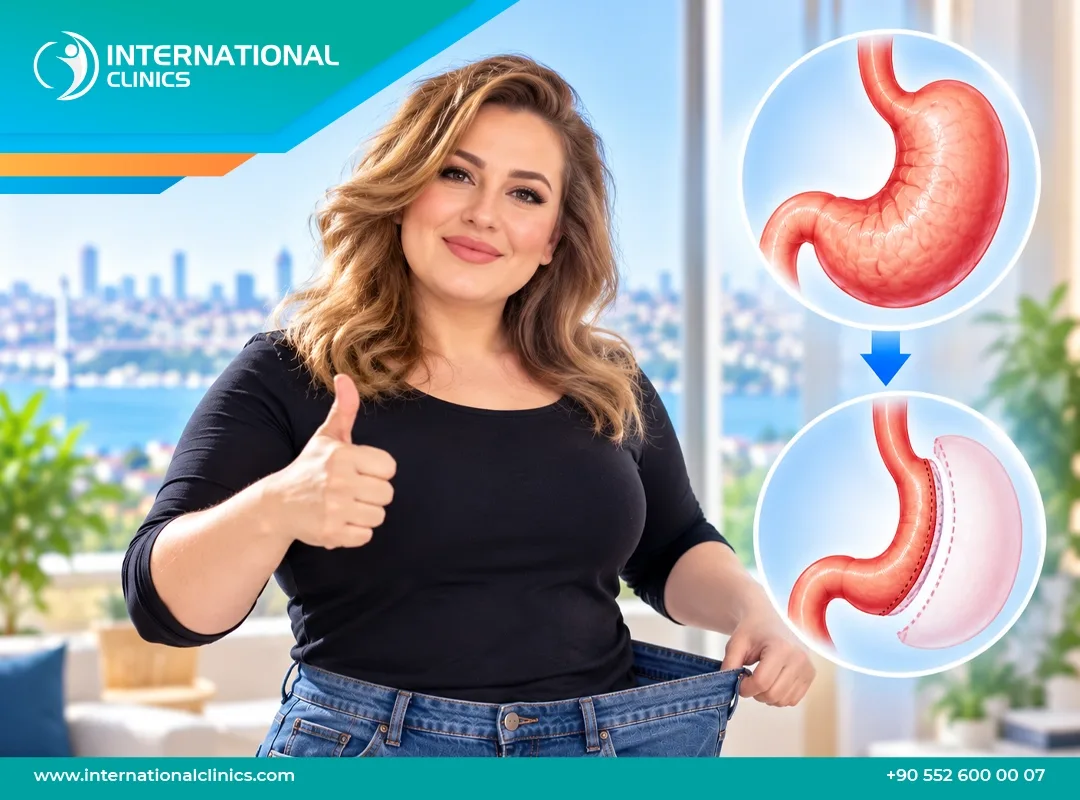
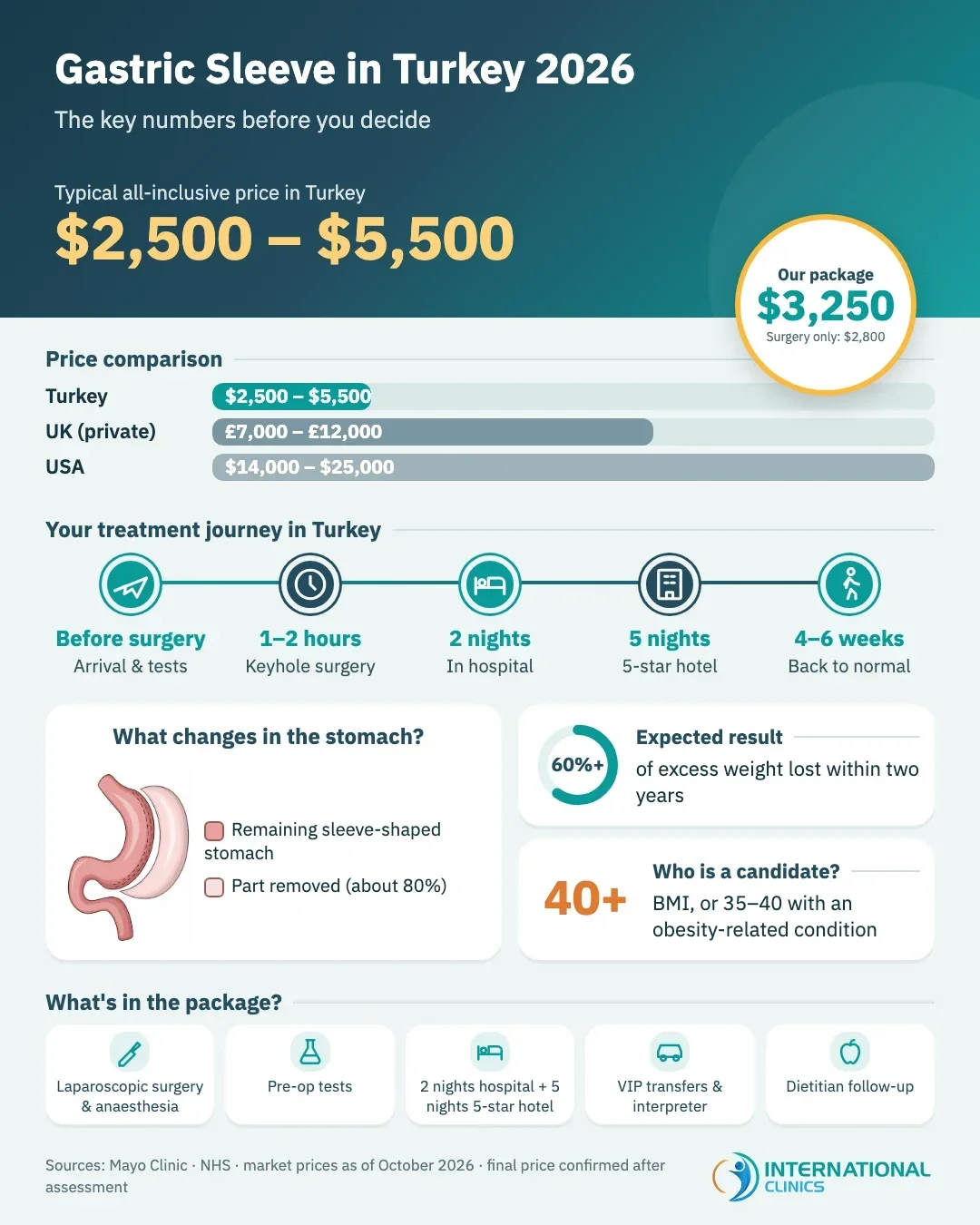
Gastric sleeve surgery in Turkey typically costs $2,500-$5,500 for a standard all-inclusive package, with premium packages up to about $8,000, compared with £7,000-£12,000 privately in the UK and $14,000-$25,000 in the US.
At International Clinics in Istanbul the surgery costs $2,800 and the all-inclusive package $3,250, covering pre-op tests, the laparoscopic operation (about 1-2 hours), 2 nights in hospital, 5 nights in a 5-star hotel, VIP transfers, an interpreter, dietitian support, discharge medication and complications insurance; flights are not included.
The NHS says weight loss surgery may be considered with a BMI of 40 or more, or 35-40 with an obesity-related condition, and most people return to normal activities after 4-6 weeks.
Mayo Clinic reports possible loss of about 60% or more of excess weight within two years, and Cleveland Clinic an average 25-30% of total body weight in the first one to two years.
A gastric sleeve in Turkey typically costs $2,500 to $5,500 for a standard all-inclusive package, and premium packages reach about $8,000 — against roughly £7,000 to £12,000 privately in the UK and $14,000 to $25,000 in the US. At International Clinics in Istanbul the surgery costs $2,800 and the all-inclusive package costs $3,250: pre-op tests, the laparoscopic operation, 2 nights in hospital, 5 nights in a 5-star hotel, VIP transfers, an interpreter, dietitian support, discharge medication and complications insurance (flights are not included).
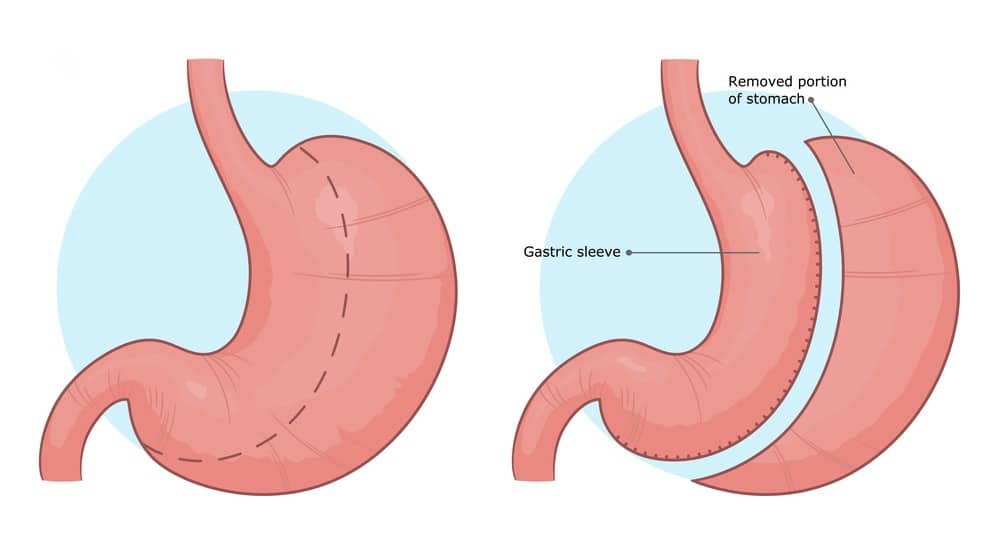
Sleeve gastrectomy removes about 80% of the stomach and leaves a narrow, banana-sized tube, so you eat less and feel full sooner (Mayo Clinic). Below you will find the price comparison, what the package covers, who qualifies, how long to stay in Turkey, recovery, results, risks and how to judge safety.
What Is a Gastric Sleeve?
Sleeve gastrectomy, commonly known as vertical sleeve gastrectomy (VSG) or gastric sleeve surgery, aims at limiting the quantity of food you can eat by removing about 80% of your stomach, according to Mayo Clinic. People with a smaller stomach eat less food, and the surgery also causes hormonal changes that reduce appetite.
Sleeve gastrectomy is a minimally invasive procedure that Turkish surgeons perform regularly. A gastric sleeve can help people lose enough weight, but it may, however, be performed before a gastric bypass, which is another surgery that shortens the path that food takes through the digestive system, preventing some calories from being absorbed.
Patients with a complicated surgical history or who have other problems that put them at risk in case they undergo bypass surgery may choose to undergo gastric sleeve instead. During gastric sleeve in Turkey, the surgeon divides your stomach vertically to form a long, narrow pouch (or sleeve) and removes a part of your stomach to make it smaller - about the size and shape of a banana.
Pros and Cons of Gastric Sleeve (Weight Loss Surgery in Turkey)
Below are the main advantages and disadvantages of gastric sleeve:
Gastric Sleeve Pros
Removing about 80% of the stomach will not only reduce the capacity for food storage but also decrease the production of hormones that signal hunger. Other benefits of the surgery include:
Significant weight loss: 60% or more of excess weight within two years, according to Mayo Clinic.
A shorter procedure time compared to more complex procedures such as gastric bypass.
Prevents and improves many obesity-related problems, such as diabetes.
A safer option for high-risk patients.
Less chance of intestinal obstruction.
Doesn’t involve the insertion of foreign bodies like bands or clamps.
Gastric Sleeve Cons
The gastric sleeve comes with many benefits and pros, but it also carries some potential risks and drawbacks:
Irreversible surgery.
Can cause or worsen acid reflux (GERD).
Produces fewer weight loss results than gastric bypass surgery.
Requires lifelong supplements. Mayo Clinic states you will need “a multivitamin twice a day, a calcium supplement once a day and a vitamin B-12 injection once a month for life.”
Options & Techniques for Gastric Surgery in Turkey
In Turkey, most surgeons perform gastric sleeve laparoscopically to minimize the risks of scars and trauma. In rare cases, however, some Turkish surgeons may choose open surgery. The laparoscopic operation is known as laparoscopic sleeve gastrectomy (LSG) and is the technique of choice for most surgeons. It is still surgery (keyhole surgery); if you are looking for an option without incisions, read about endoscopic sleeve gastroplasty, which narrows the stomach from the inside through the mouth.
The surgery is performed in a hospital while the patient is under general anesthesia. The surgeon makes several small incisions in the abdomen and then uses a thin, elongated tool with a small camera on the end to remove around 80% of the stomach.
The surgery is guided by images displayed on a TV screen in the operating room. The removed section of the stomach is called the fundus, which is the portion that bulges outward. After removing the fundus, the remaining portion of the stomach is shaped into a tube, resembling a banana or the sleeve of a shirt.
With a smaller stomach, individuals will feel full more quickly and eat less. Additionally, the fundus of the stomach is where the hormone ghrelin is primarily secreted. Thus, removing this portion may also help decrease feelings of hunger and aid in weight loss.
Interestingly, sleeve gastrectomy is one of the most widely performed obesity surgery in the world today. During the surgery, Turkish surgeons usually use a laparoscope, a tube-like instrument with a light and camera to provide digital footage. The steps of sleeve gastrectomy include the following:
After giving you general anesthesia, your surgeon will make numerous tiny incisions in your belly.
Next, they insert a laparoscope to examine the inside of the abdomen.
Your surgeon will remove a portion of your stomach and make a "sleeve" with various surgical instruments.
The operation usually takes about 1 to 2 hours (Cleveland Clinic puts it at 60 to 90 minutes). Our package includes 2 nights in hospital, and food is reintroduced in stages over the following weeks.
Single Incision Gastric Sleeve
Some clinics in Turkey offer a less invasive form of gastric sleeve called single-incision laparoscopic surgery (SILS). The main difference between this technique and the traditional laparoscopic gastric sleeve is that it involves the making of just one incision instead of multiple incisions to provide access to the laparoscopic tools and instruments.
Making just one incision can mean less visible scarring. However, not everyone is a good candidate for this approach, and it is technically more demanding for the surgeon, so it is not offered routinely.
How Much Is a Gastric Sleeve in Turkey? Gastric Sleeve Turkey Price 2026
How much is gastric sleeve surgery in Turkey? Standard all-inclusive packages are generally priced between $2,500 and $5,500, and premium packages (private rooms, upgraded hotels, longer stays) can reach about $8,000. The same operation is usually quoted at £7,000 to £12,000 in a private UK hospital and $14,000 to $25,000 in the United States. Here is how the numbers compare:
Option
Price
What it covers
Gastric sleeve package in Turkey (market range)
$2,500 – $5,500 (premium up to about $8,000)
Surgery, hospital stay, hotel and transfers; contents vary between clinics
Typical market ranges as of October 2026; final price confirmed after medical assessment. International Clinics prices: our gastric sleeve procedure page. Flights are not included.
Why such a wide range? A lower headline price often leaves out tests, hotel nights, a dietitian or aftercare. Compare packages on what they list in writing, not on the number alone.
Gastric Sleeve Turkey Package: What the All-Inclusive Price Includes
The International Clinics all-inclusive gastric sleeve package costs $3,250 and covers both the medical and the travel side of the trip:
Laparoscopic sleeve gastrectomy by an experienced bariatric surgeon
General anaesthesia and the operating room
Pre-operative tests: blood tests, ECG, ultrasound and endoscopy
2 nights in hospital
5 nights in a 5-star hotel
VIP transfers between the airport, hotel and clinic
An interpreter and patient guidance throughout your stay
Dietitian support
A discharge medication kit
Complications insurance
Not included: international flights. Whichever clinic you choose, ask for the written package list before paying a deposit and check that it names the number of hospital and hotel nights, the tests, and who handles complications after you fly home. For practical preparation, see what to pack for gastric sleeve surgery.
How Long Do You Need to Stay in Turkey for a Gastric Sleeve?
Plan for about 7 nights in Turkey: 2 nights in hospital after the operation, then 5 nights in the hotel, while the team checks how you are drinking, walking and healing before you fly. The NHS says people usually leave hospital 1 to 3 days after weight loss surgery and start returning to normal activities after 4 to 6 weeks, so plan time off work at home as well.
What Factors Affect Gastric Sleeve Cost in Turkey?
Three things move the price most:
Hospital accreditation. Facilities with international JCI accreditation charge more, and that difference buys you audited safety standards and a proper intensive-care backup.
Surgeon experience. A bariatric surgeon with thousands of completed sleeves commands a higher fee than a general surgeon who performs a few each year.
VIP add-ons. A private room, extra hotel nights or a luxury hotel upgrade raise the price of the same operation; this is what premium packages of up to about $8,000 usually add.
The surgical technique itself changes the price far less than these three.
Candidates for Sleeve Gastrectomy in Turkey
The NHS says weight loss surgery may be considered if your BMI is 40 or more, or between 35 and 40 with a condition that could improve with weight loss, such as type 2 diabetes or high blood pressure. You also need to commit to lasting lifestyle changes and regular check-ups. Your surgeon makes the final decision after a consultation and pre-op tests.
“In general, sleeve gastrectomy surgery could be an option for you if: Your body mass index (BMI) is 40 or higher (extreme obesity). Your BMI is 35 to 39.9 (obesity), and you have a serious weight-related health problem, such as type 2 diabetes, high blood pressure or severe sleep apnea. In some cases, you may qualify for certain types of weight-loss surgery if your BMI is 30 to 34 and you have serious weight-related health problems.” — Mayo Clinic, Sleeve gastrectomy
Gastric sleeve in Turkey isn’t suitable for everyone. Before a patient is approved for surgery, the surgeons must ensure that they meet certain criteria. In general, gastric sleeve surgery is recommended for morbidly obese adults (people with a BMI of 40 or above). However, many surgeons are considering providing surgery for people with low BMI. In any case, candidates for gastric sleeve should also:
Have no health issues that make surgery extremely dangerous.
Have a stable psychological state and are ready to adopt significant lifestyle modifications.
Usually be an adult; the upper age limit is assessed case by case by the surgeon.
Be willing to take a multivitamin, calcium and a monthly vitamin B-12 injection for life.
Sleeve gastrectomy is a well-established weight-loss operation; Cleveland Clinic reports serious complications in less than 1% of operations. In Turkey, surgeons perform gastric sleeve surgery using methods and techniques similar to those used in the United States and the United Kingdom. Three things bring international patients here, and they are the same three things that move the price:
Cost. Turkish clinics offer affordable prices for gastric sleeve and gastric bypass surgery, and those prices mainly reflect lower local operating costs — not a different operation.
Surgeon experience. Most Turkish surgeons perform gastric sleeves laparoscopically, which doesn’t leave large scars and only requires a few small incisions in the abdomen. If the surgery is not suitable for you, they can suggest other obesity treatments, such as gastric balloons.
Comprehensive packages. Packages cover interpretation, accommodation, medical consultations and follow-up, so you arrive with a clear, written treatment plan and a known total price.
Is Weight Loss Surgery in Turkey Safe?
Gastric sleeve surgery in accredited Turkish hospitals uses the same laparoscopic technique as in the UK or the US, so the main risks are those of the operation itself. Cleveland Clinic reports serious complications in less than 1% of sleeve gastrectomies, but no surgery is risk-free: the NHS lists blood clots, a stomach leak, wound infection, a blocked gut and gallstones among possible complications of weight loss surgery. Travelling for surgery adds questions to settle before you book:
Accreditation: is the hospital internationally accredited (for example JCI), and does it have an intensive care unit on site?
Surgeon: who exactly will operate, how many years of bariatric experience do they have, how many sleeves do they perform each year, and can you speak with them before travelling?
Time before flying: does the plan keep you close to the hospital for several days? Our package includes 2 hospital nights and 5 hotel nights.
Aftercare at home: who follows up your diet, supplements and blood tests after you return, and what happens if a complication appears?
Gastric Sleeve in Istanbul or Another City: Which Location?
When deciding to undergo gastric sleeve in Turkey, you may become confused about which city you want to stay during the process. Of course, this depends on the hospital or clinic that you’re going to choose.
Most patients prefer to undergo the gastric sleeve in Istanbul since the city is closer to Europe and hosts incredible tourist activities and attractions. International Clinics is based in Istanbul and treats international patients there.
Bariatric surgery is also offered in other cities, such as Antalya and Izmir. Whichever city you choose, the hospital accreditation, the surgeon and the aftercare plan matter more than the location.
What is The Success Rate of Gastric Sleeve in Turkey
Success after a gastric sleeve is measured by how much weight you lose and keep off. Mayo Clinic states it is possible to lose about 60% or more of your excess weight within two years, and Cleveland Clinic reports an average loss of 25% to 30% of total body weight in the first one to two years, which it describes as consistent over five years. Results cannot be promised: they depend on your starting weight and on following the diet, supplements and follow-up.
laparoscopic sleeve gastrectomy (LSG) was proven safe and highly effective as a stand-alone procedure in a study published in 2017. Many obesity-related health issues such as type 2 diabetes, hypertension, fatty liver disease, and high cholesterol tend to improve or even resolve after the surgery.
However, not all patients face success or get the results they were expecting before surgery. Some people may opt to undergo revisional surgery, especially those who have experienced complications or inadequate weight loss. The revisional surgery could involve a "re-sleeve" procedure or a complete revision to gastric bypass.
Recovery timeline after gastric sleeve
Days 1–2: you walk on the day after surgery and stay 2 nights in hospital (our package).
Days 3–7: hotel stay in Turkey with check-ups before your flight home.
Weeks 1–8: food is reintroduced in stages: liquids first, then puréed and soft food. Most people return to a normal-texture diet between about 4 and 8 weeks, following their teams plan (NHS).
Weeks 4–6: most people start returning to normal activities (NHS); Cleveland Clinic advises allowing about a month before you feel like yourself or work at full capacity.
Our Clients Reviews on Gastric Sleeve Surgery in Turkey
When you read gastric sleeve Turkey reviews, prefer reviews on platforms where you can see the reviewer and the date and look at how a clinic answers complaints, not only at the star rating.
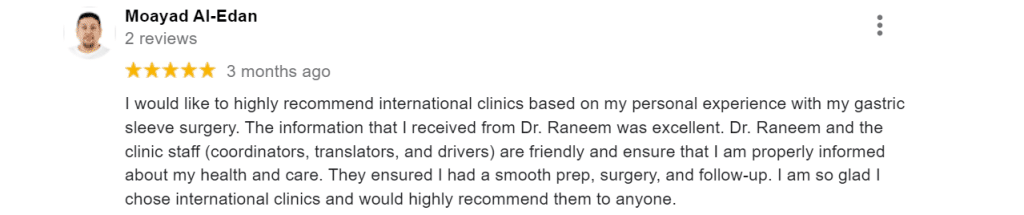
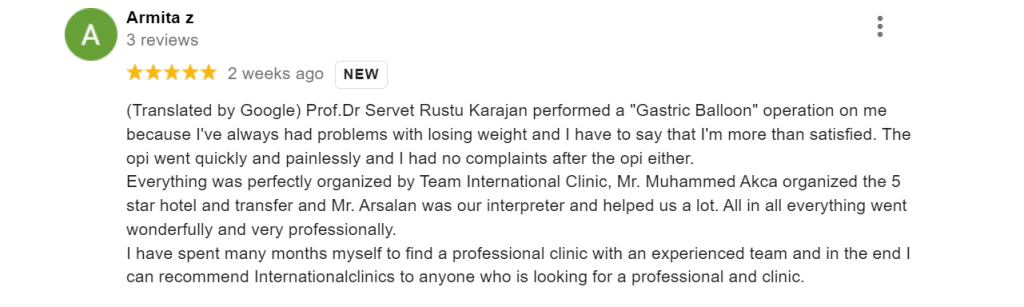
Below are screenshots of online reviews left by people who had a gastric sleeve or other bariatric procedures at International Clinics in Turkey. They describe individual experiences; results vary between people.
How to Choose a Doctor and Hospital for Gastric Sleeve in Turkey
There is no independent ranking of the "best" gastric sleeve doctor or hospital in Turkey, so judge them on what you can verify:
Surgeon: a named general or bariatric surgeon, their years of experience and how many sleeve operations they perform each year.
Hospital: international accreditation (for example JCI) and an intensive care unit on site.
Team: anaesthetist, dietitian and an interpreter you can reach during your stay.
Aftercare: a written plan for follow-up and for complications after you return home.
At International Clinics in Istanbul, gastric sleeve surgery is performed by Assoc. Prof. Dr. Gökmen Öztürk, a general and bariatric surgeon with more than 25 years of surgical experience. Prof. Dr. Servet Rüştü Karahan also performs bariatric procedures for international patients at International Clinics.
Gastric Sleeve Diet
To make the procedure safer and lower the risk of complications, you must start your pre-op diet for a gastric sleeve before surgery and follow a post-op diet in the weeks that follow the surgery.
Before surgery: Dietitians usually recommend people reduce their intake of carbs and focus more on consuming protein-rich foods before surgery. They also recommend patients drink more water and avoid unhealthy fats.
After surgery: Dietitians pay great attention to the patient’s diet after gastric sleeve. They usually recommend patients stick to clear liquids in the first week following the surgery. In the second week, you can add thicker liquids, such as Greek yogurt and protein shakes. In the following weeks, you can gradually add puréed and then soft foods, like eggs and fish; most people return to a normal-texture diet between about 4 and 8 weeks, following their team’s plan, while staying mindful of the portion size. For the years after surgery, see our long-term diet after gastric sleeve.
Gastric Sleeve in Turkey Before and After
The outcome of gastric sleeve surgery can differ from person to person; however, many patients notice a considerable drop in weight in the aftermath of the surgery. Results differ between individuals.
Below are before and after gastric sleeve pictures of patients who had the surgery at International Clinics in Turkey:
What are The Risks of Gastric Sleeve Surgery
Understandably, the major risk of the gastric sleeve comes from the fact that you will lose a large portion of your stomach permanently. This makes gastric sleeve a procedure that requires determination and solid decisions to prevent frustration and regret. Moreover, this surgery carries potential short-term and long-term risks. Mayo Clinic lists the following:
Short-termrisks: excessive bleeding, infection, adverse reactions to anesthesia, blood clots, lung or breathing problems, and leaks from the cut edge of the stomach.
Long-term risks: Many of the long-term risks and issues are related to malnutrition, which results from consuming fewer nutrients than before. The risks also include hernias, vomiting, gastrointestinal blockage, gastroesophageal reflux and low blood sugar (hypoglycemia). Very rarely, complications can be fatal.
Cleveland Clinic puts serious complications at less than 1% of sleeve operations and notes that acid reflux can get worse after surgery in people who already had it; it can often be treated with medication. Tell your surgeon about any reflux symptoms before the operation.
Gastric Sleeve Turkey: Final Thoughts
A gastric sleeve in Turkey typically costs $2,500 to $5,500 for a standard all-inclusive package; at International Clinics the package is $3,250 with 2 hospital nights and 5 hotel nights. After the price, what matters is whether your BMI, your health history and your willingness to take supplements for life make you a candidate, and whether your clinic has a clear aftercare plan.
Send us your BMI and medical history and we will tell you, in writing, whether you qualify — and what your package would include.
Medical review and disclaimer:
This article was reviewed by a specialist physician contracted with International Clinics. It is general health information, not a substitute for medical advice, and results vary between individuals.
A standard all-inclusive gastric sleeve package in Turkey typically costs $2,500 to $5,500, and premium packages can reach about $8,000. At International Clinics in Istanbul the surgery costs $2,800 and the all-inclusive package costs $3,250, including pre-op tests, 2 nights in hospital, 5 nights in a 5-star hotel, VIP transfers, an interpreter, dietitian support, discharge medication and complications insurance. Flights are not included.
Is it safe to go to Turkey for a gastric sleeve?
It can be, if you choose the hospital and surgeon carefully. Accredited Turkish hospitals use the same laparoscopic technique as hospitals in the UK and the US, and Cleveland Clinic reports serious complications in less than 1% of sleeve gastrectomies. No operation is risk-free: the NHS lists blood clots, stomach leaks, wound infection and a blocked gut among possible complications. Before booking, check the hospital accreditation, who your surgeon is and how many sleeves they perform, how many days you stay near the hospital before flying, and who follows you up at home.
Which country is the cheapest to get gastric sleeve surgery?
Among the countries most often compared, Turkey is the least expensive: standard all-inclusive packages are typically $2,500 to $5,500, against £7,000 to £12,000 privately in the UK and $14,000 to $25,000 in the US. The lowest price should not be the deciding factor: compare what each package includes in writing, the surgeon, the hospital accreditation and the aftercare plan.
Which is the best hospital in Turkey for gastric sleeves?
There is no independent ranking of hospitals for gastric sleeve surgery, so judge each one on verifiable criteria: international accreditation (for example JCI), an on-site intensive care unit, a named bariatric surgeon with years of experience and a high yearly volume of sleeve operations, a dietitian on the team, a written package list, and a clear plan for follow-up and complications after you return home.
What happens 10 years after gastric sleeve?
Long-term results depend largely on diet, activity and follow-up. Cleveland Clinic reports that the average loss of 25% to 30% of body weight stays consistent over five years, while some people regain part of the weight; acid reflux can appear or get worse and may need medication. Because you eat much less, lifelong vitamin and mineral supplements and regular blood tests are needed. Some people later need revision surgery, for example conversion to gastric bypass.
How long do I need to stay in Turkey for a gastric sleeve?
Plan for about 7 nights: our package includes 2 nights in hospital after the operation and 5 nights in a 5-star hotel, so the team can check your recovery before you fly home. The NHS says most people start returning to normal activities 4 to 6 weeks after weight loss surgery.
Why is gastric sleeve so cheap in Turkey?
Prices in Turkey are lower mainly because local staff, hospital and living costs are lower than in the UK or the US, and because clinics combine surgery, hotel and transfers into one package. A lower price does not mean a different operation: accredited Turkish hospitals use the same laparoscopic sleeve gastrectomy technique.
How much weight will I lose after a gastric sleeve?
Mayo Clinic states that it is possible to lose about 60% or more of your excess weight within two years. Cleveland Clinic reports an average loss of 25% to 30% of total body weight in the first one to two years. Your own result depends on your starting weight and on how closely you follow the diet and follow-up plan.
How risky is gastric sleeve surgery?
Gastric sleeve surgery carries real surgical risk. Mayo Clinic lists excessive bleeding, infection, adverse reactions to anesthesia, blood clots, lung or breathing problems and leaks from the cut edge of the stomach as short-term risks, and gastrointestinal blockage, hernias, gastroesophageal reflux, low blood sugar, malnutrition and vomiting as longer-term ones. Very rarely, complications can be fatal. Cleveland Clinic puts serious complications at less than 1% of operations.
Is gastric sleeve better than gastric bypass?
Neither is better for everyone. A sleeve is simpler: it removes about 80% of the stomach without rerouting the intestine, so there is no intestinal bypass or anastomosis. A bypass usually leads to somewhat more weight loss and may suit people with severe acid reflux. Your surgeon will recommend one based on your BMI, health conditions and reflux symptoms.
×
Get a Free Consultation
International Clinics Guarantees
Reliable medical care provided within our accredited facilities
Final fixed price with no hidden costs
Full medical support with professional interpreters
Clear treatment plans and follow-up at international standards
Personalized assistance throughout the entire treatment journey
We use our own cookies and third-party cookies so that we can display this website and better understand how you use it, with the aim of improving the services we offer. If you continue browsing, we consider that you have accepted the cookies.