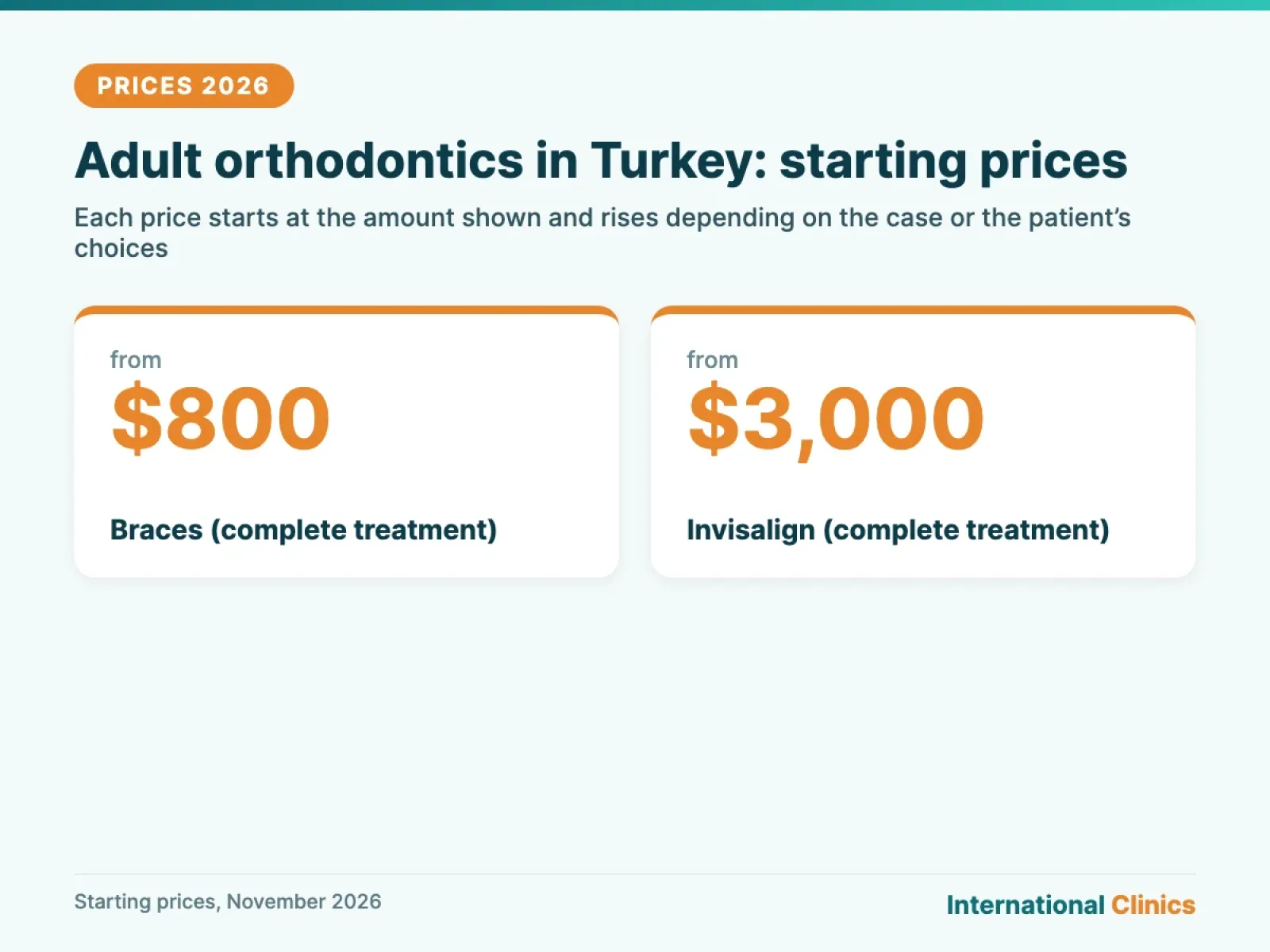
Adult orthodontics in Turkey starts from $800 for a complete course of fixed braces, and a complete Invisalign treatment starts from $3,000; each price rises depending on the case or the patient’s choices, such as the type of brackets, the number of aligners and the length of treatment. In Western Europe the same treatment is usually billed every six months, so the total is often several times higher.
This guide explains what adults actually pay for braces and clear aligners, why the bill depends on time more than on the appliance, how a treatment in Turkey is organised when you live abroad, and which details in a quote should make you ask more questions.
Adult orthodontics cost in Turkey: starting prices
The starting prices below are the prices published by International Clinics for a complete treatment. They include the active treatment; the final quote depends on the clinical examination, the 3D scan and the treatment plan.
| Treatment in Turkey | Starting price | Note |
|---|---|---|
| Braces (complete treatment) | From $800 | Rises with the type of brackets and the treatment length |
| Invisalign (complete treatment) | From $3,000 | Rises with the package and the number of aligners |
Fixed metal braces are the least expensive option and treat simple and complex cases alike. Ceramic brackets, lingual braces and premium aligner packages cost more because the appliance itself is more expensive to make and adjust.

Why adult braces are priced by treatment time
An orthodontist does not really sell an appliance; the fee pays for the months of active treatment, the adjustment visits and the laboratory work. That is why two quotes for the same braces can be very different: one case may be finished in 12 months and another may need 30 months.
Most adult treatments last 12 to 24 months, and some full bite corrections take longer. Ask every clinic to write the expected duration in months on the quote, because duration is the main driver of the final cost.
Types of braces for adults
Adults can choose between three families of appliances, and each one is priced differently.
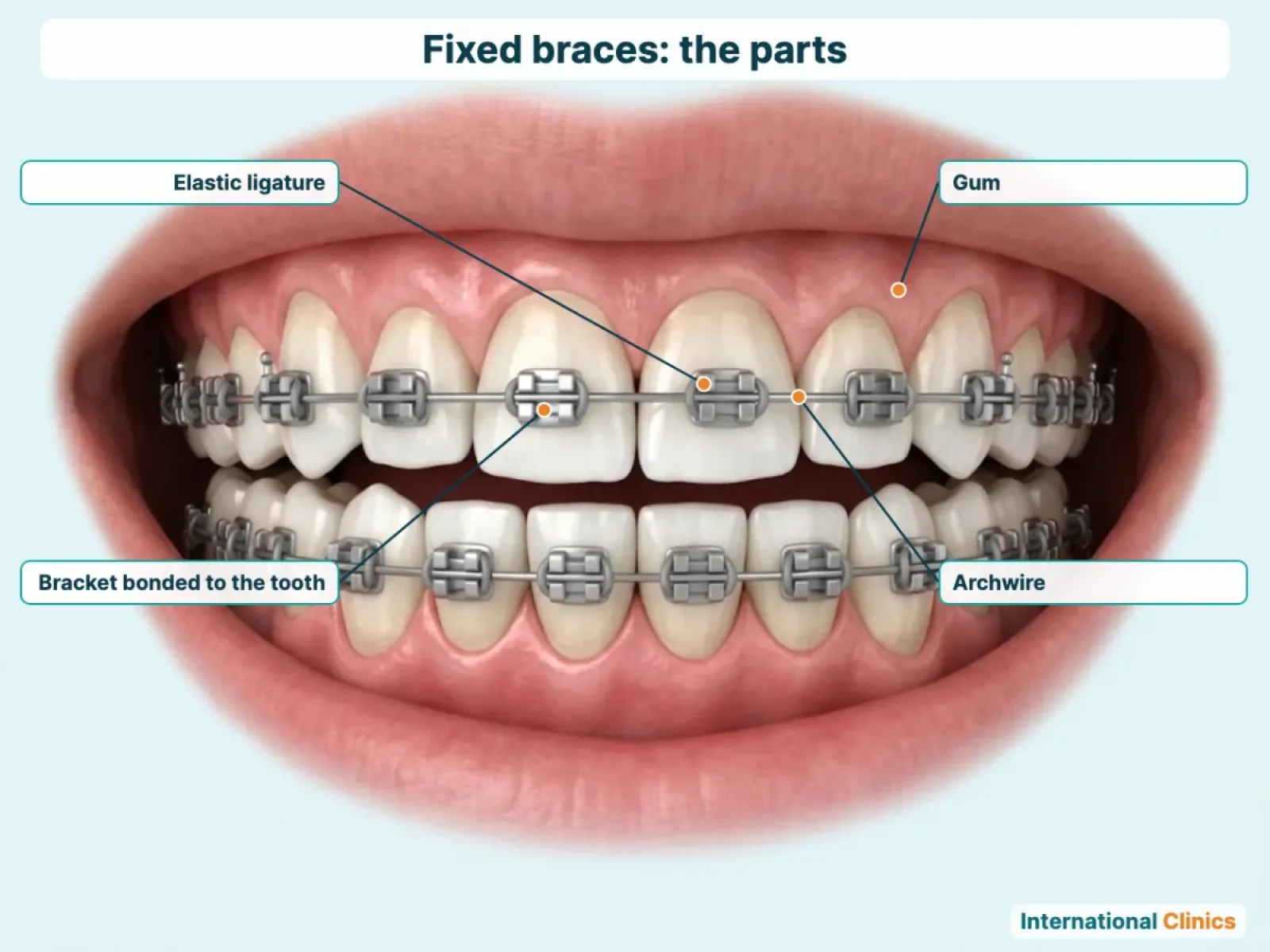
- Labial (front) braces in metal, ceramic or clear resin, bonded to the visible surface of the teeth. They are the most versatile option.
- Lingual braces, bonded to the inner surface of the teeth. They are invisible from the front but custom-made and slower to adjust.
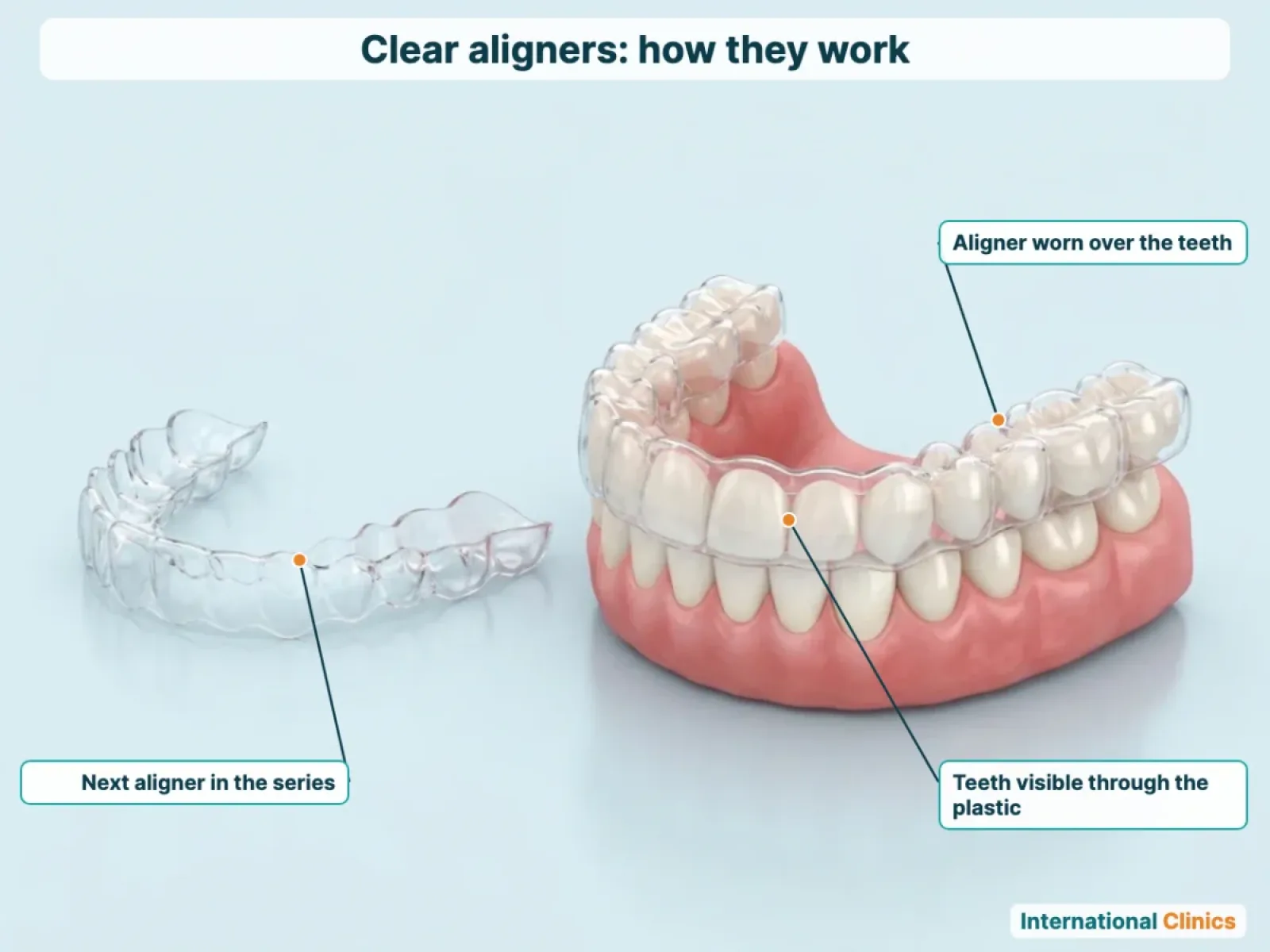
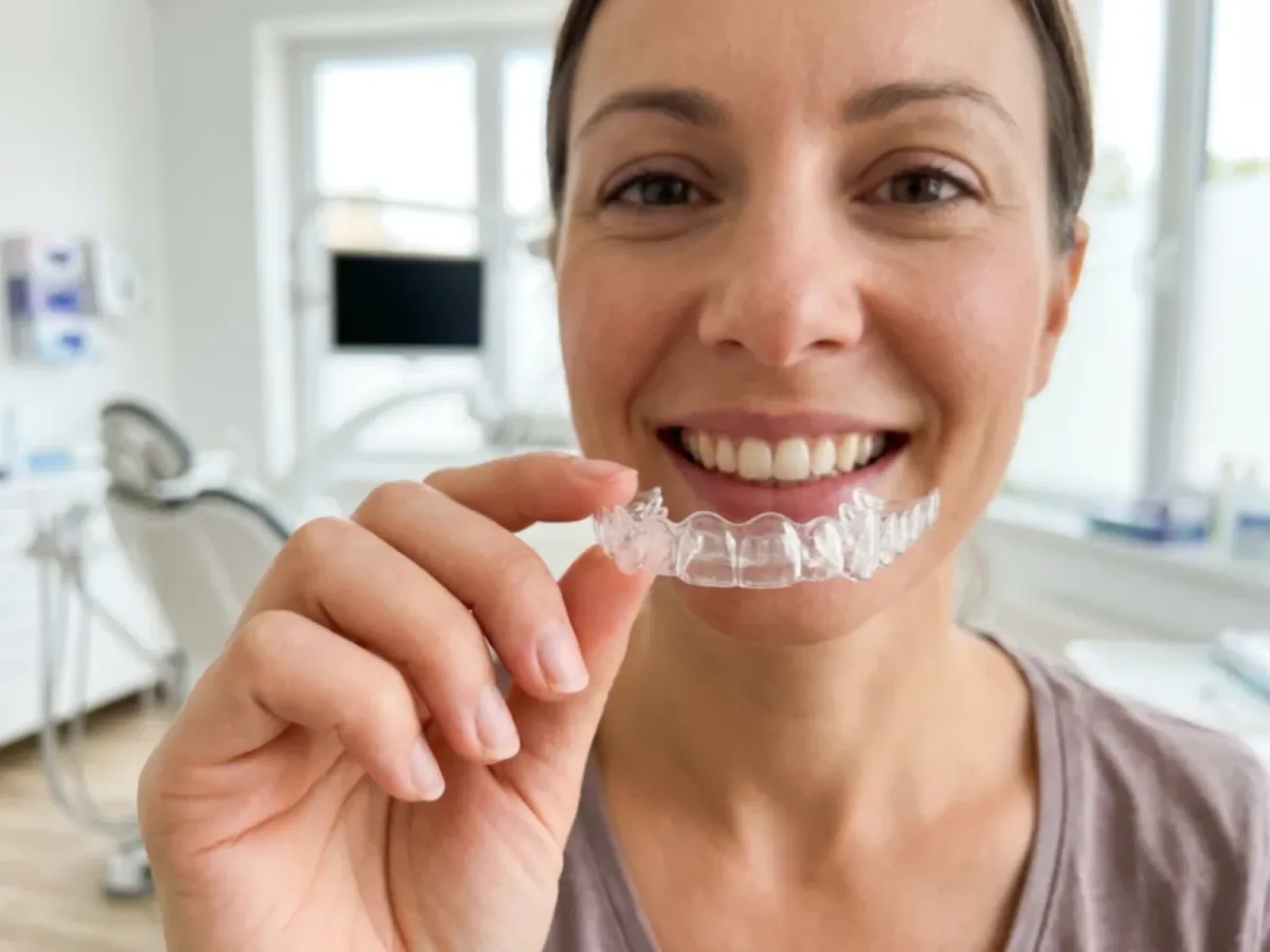
- Clear aligners, removable trays changed every one to two weeks. They suit mild to moderate crowding and spacing and must be worn about 22 hours a day, as the NHS explains.
Invisible braces for adults: clear aligners, Invisalign and lingual braces
Clear aligners are usually priced as one package, because the laboratory manufactures the full series of trays in advance. The price therefore follows the number of aligners the case needs, not the number of months. For the best-known brand, our page on Invisalign in Turkey details the packages and the treatment steps.
Lingual braces are the most discreet fixed option and also the most expensive, because each bracket is custom-made for the inner surface of the tooth. Ceramic braces are the middle ground: visible up close but discreet at a distance.
How Turkey compares with Western Europe
In France, for example, orthodontists set their own fees and adult treatment usually starts at about €750 per six-month period for metal braces and about €1,500 per period for lingual braces, so a two-year treatment easily exceeds €3,000 before retention. Public health insurance there covers orthodontics only when treatment starts before the age of 16, according to Service-public.fr, so adults usually pay the full amount themselves.
Because a complete course of braces in Turkey starts from $800, many adults compare the two options. The saving is real, but it must be weighed against travel and the follow-up visits that orthodontics needs.
Total cost of adult orthodontics: the four parts of the bill
- Active treatment: the braces or the aligner series and the adjustment visits.
- Retention: the bonded wire or removable retainer that keeps the teeth in place once treatment ends.
- Check-ups: regular visits during treatment, in person or remotely for aligners.
- Preparatory care: X-rays, 3D scan, any extractions and the treatment of cavities or gum problems before the appliance is fitted.
Ask whether retention and preparatory care are included, because they explain most of the gap between the advertised price and the money actually spent.
Adult orthodontic treatment in Turkey: how the visits work
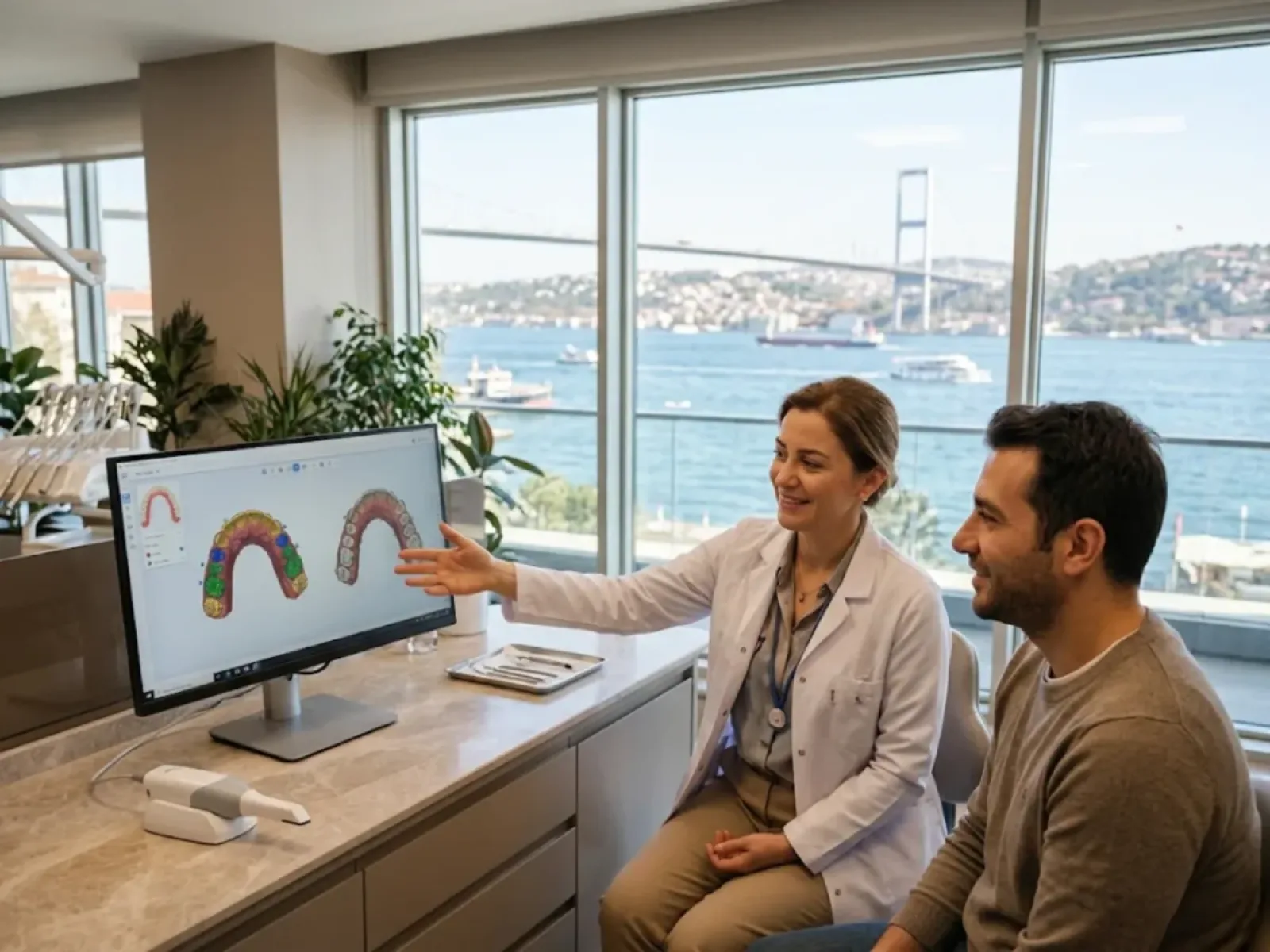
Orthodontics needs regular control for one to two years, which matters when you live abroad. Clear aligners are the easiest option: the examination, the 3D scan and the first aligners are done during a stay in Istanbul, and follow-up is done at spaced visits or remotely. With fixed braces, an adjustment is needed every four to eight weeks, so you should plan several trips or a local orthodontist for the follow-up.

What changes the price of adult orthodontics
- Treatment duration, by far the biggest factor.
- Technique: metal, ceramic, lingual or aligners.
- Complexity: mild crowding of the front teeth is not comparable to a full bite correction.
- Additional procedures: extractions, temporary anchorage mini-implants, gum or cavity treatment.
- Retention: the type of retainer and how many years it is monitored.
Warning signs in a cheap orthodontic quote
A price below the market is not suspicious in itself. What should worry you is a quote that does not say what you are buying.
- A single amount without the expected duration of treatment.
- A price that excludes retention without saying so.
- A guaranteed result or a fixed end date: tooth movement depends on how the bone responds.
- Aligners sold without a clinical examination or a panoramic X-ray.
Adult orthodontics is possible at any age as long as the teeth and gums are healthy, as the American Association of Orthodontists points out. It still carries real risks that no price removes: gum inflammation or recession, root shortening, soreness after each adjustment and relapse if the retainer is not worn as prescribed, according to the NHS.
Medical review and disclaimer:
This article was reviewed by Dr. Burhan Mollamusa, after its translation into the appropriate language. It is general information and does not replace an in-person examination by a dentist; treatment plans and results vary from patient to patient depending on the condition of the mouth and teeth.