
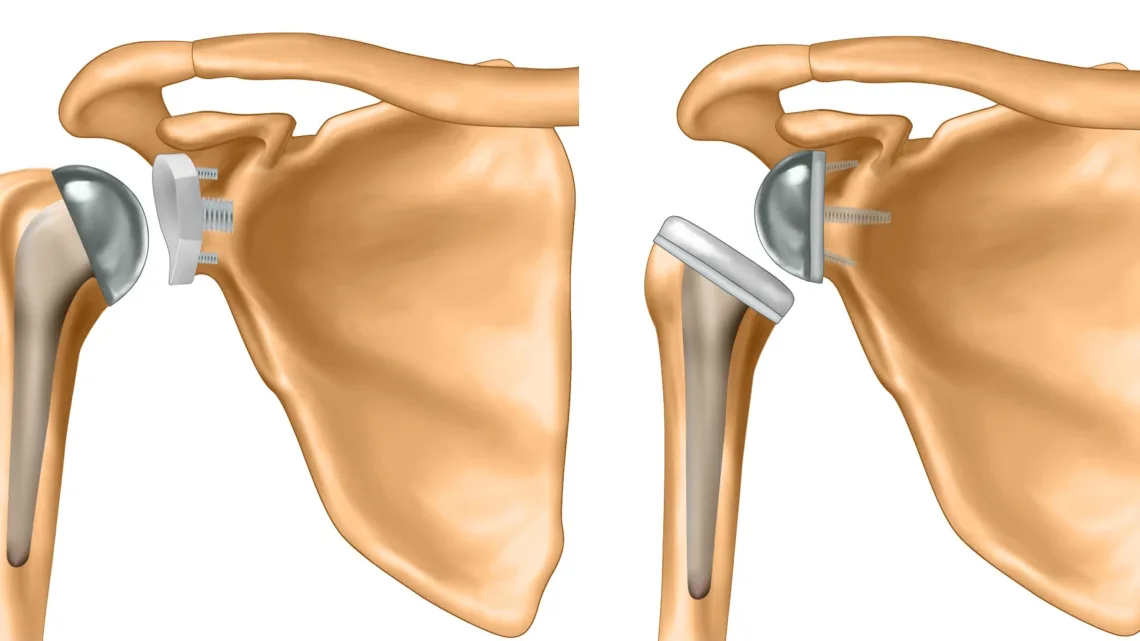
Shoulder replacement surgery (or shoulder arthroplasty) is a highly effective procedure to relieve chronic pain and restore motion in patients with severe shoulder joint damage. The choice of implant is critical, beginning with the distinction between anatomic total shoulder replacement and reverse total shoulder replacement.
At International Clinics, we specialize in global shoulder replacement, offering state-of-the-art treatment in our internationally accredited facility in Turkey. Our all-inclusive packages make quality care accessible and reliable for patients seeking treatment abroad.
When to Consider Shoulder Replacement Surgery
Surgery is indicated for patients with severe shoulder joint pathology causing persistent pain, limited range of motion, and functional impairment that has not improved after the failure of conservative treatment.
- Underlying Medical Conditions (Determining Implant Type): The primary indications include arthritis (Osteoarthritis, Rheumatoid Arthritis), degeneration after a complex fracture, and Rotator Cuff Tear Arthropathy the condition solved specifically by the reverse replacement.
- Clinical Symptoms (Determining Necessity): Surgery is necessary when patients experience constant pain at rest or during sleep, difficulty with daily movements (like dressing), and all non-surgical treatments have failed to provide lasting relief.
References: Rockwood & Matsen’s the Shoulder, 5th Ed., Elsevier, 2017.
The Types of Shoulder Replacement Surgery
The following table details the four primary replacement types
Which type is right for me?
TypeCore Indication | Simplified Core Benefit | Expected Lifespan | Cost (Turkey All-Inclusive) |
1. Anatomic Total (TSR) Arthritis with Intact Rotator Cuff | Best for Natural Motion: Works like your original joint, relying on your own strong tendons. | 15 – 20+ Years | $6,000 – $10,300 USD |
2. Reverse Total (RTSR) Arthritis with Irreparable Rotator Cuff Tear | Best for Lifting: Rewires your shoulder to use the large deltoid muscle to lift the arm. | 10 – 15 Years | $7,000 – $12,000 USD |
3. Partial (Hemiarthroplasty) Isolated damage to the Arm Bones Ball; socket is healthy. | Bone Preservation: Replaces only the worn ball, leaving your natural socket intact. | 10 – 15 Years | $4,000 – $7,800 USD |
4. Resurfacing Limited, early-stage arthritis; minimal wear. | Minimally Invasive: Covers the bone surface with a cap; easiest option to revise later. | 8 – 15 Years | $6,000 – $9,200 USD |
Surgical Procedure: How the Types Differ
All shoulder replacement surgeries share the initial common steps (anesthesia and the front-of-the-shoulder incision). The surgery is defined by its outcome goal:
Procedure Type | How the Surgery Works (Simplified) | Most Important Post-Op Risk | The Goal |
Anatomic Total (TSR) | The surgeon fits a plastic socket and metal ball, trying to replicate your original anatomy. This only works if your Rotator Cuff is strong enough to hold the new ball in place. | The Plastic Socket Loosening and/or the Tendon Repair Failing. | Restores the Natural Center of Rotation for full range of motion. |
Reverse Total (RTSR) | The joint is "flipped": the ball goes on the shoulder blade. This shifts the center of movement, giving the Deltoid Muscle (the big shoulder muscle) the leverage to lift the arm, even without the rotator cuff. | Dislocation or Scapular Notching (wear near the implant) because of the new, less natural mechanics. | Provides a New Fulcrum for lifting and eliminates pain from the cuff tear. |
Partial (Hemiarthroplasty) | The surgeon replaces the head of the arm bone (the ball) with metal, but leaves your natural socket alone. | Pain may persist or return if the unreplaced socket cartilage continues to wear down. | To Preserve Bone Stock and avoid the risks of a plastic socket. |
References: Rockwood & Matsen’s The Shoulder, 5th Ed., 2017; Campbell’s Operative Orthopaedics, 14th Ed., 2021.
Modern & Specialized Techniques
Stemless / Short-Stem Implants: These are variations of the Total/Reverse designs. Their main advantage is preserving the humeral bone by avoiding insertion deep into the shaft. This minimizes the risk of fracture during surgery and makes any necessary future revision easier.
Custom / Modular Implants: Used for patients with severe bone loss or complex deformities. Implants are designed using pre-operative 3D imaging to ensure a perfect anatomical fit, which improves stability in the most challenging cases
.Biologic/Hybrid Implants: These are specialized, bone preserving techniques that may use materials like pyrocarbon or tissue grafts to delay the need for a full total replacement in younger patients.
References: Orthopaedics Today (2019); Journal of Shoulder and Elbow Surgery (2020).Comparing Global Costs and Medical Coding
Global Cost Comparison: Turkey vs. UK and USA (2025 Estimates)
Turkey is a leading destination for orthopedic medical tourism due to its significant cost savings on all-inclusive packages which bundle the surgery, implant, hospital stay, and logistics.
Procedure Type | Turkey (All-Inclusive Tourism Price) | UK (Private Care Price) | USA (Uninsured/Self-Pay Price) |
Total Shoulder Replacement (TSR) | $6,000 – $10,300 USD | $13,000 – $25,000 USD | $30,000 – $70,000+ USD |
Reverse Total Shoulder Replacement (RTSR) | $7,000 – $12,000 USD | $15,000 – $30,000 USD | $35,000 – $85,000+ USD |
Partial Replacement (Hemiarthroplasty) | $4,000 – $7,800 USD | $12,000 – $22,000 USD | $25,000 – $60,000+ USD |
Medical Insurance and Surgical Codes
For patients seeking reimbursement from their home countrys insurer, accurate documentation using standard international medical codes is essential.
Surgery Type | CPT Code (USA Standard) | ICD-10-PCS Code (Procedure Code) |
Anatomic/Reverse Total Shoulder Replacement | CPT 23472 | 0RRJ0JZ (Right Shoulder, Synthetic Substitute) |
Partial Shoulder Replacement (Hemiarthroplasty) | CPT 23470 | 0RRH0JZ (Right Shoulder, Humeral Surface) |
Revision Surgery (Two Components) | CPT 23474 | 0RRJ00Z (Reverse Ball and Socket, Open Approach) |
Note on Coding: Most payers, including those in the US, use CPT code 23472 for both Anatomic Total and Reverse Total Shoulder Replacement. The specific procedure type is distinguished by the diagnosis codes and surgical reports. We provide all necessary documentation for your claim.
References: CPT 2025 Professional Edition, AMA; Centers for Medicare & Medicaid Services (CMS) Guidelines.
Why Choose International Clinics for Your Shoulder Replacement
Our facility in Istanbul, Turkey, is a highly sought-after destination because we balance medical excellence with exceptional value.
Quality & Safety: We are an internationally accredited (JCI) facility, ensuring our protocols and surgical safety standards meet global benchmarks.
Expertise: Your procedure is performed by fellowship-trained orthopedic surgeons specializing in advanced joint arthroplasty, including robotic-assisted surgery and custom implants.
Support: Our all-inclusive packages simplify medical travel, covering logistics, transfers, and providing 12 months of remote video follow-up to support your recovery after returning home.
Contact International Clinics today to receive a personalized treatment plan and start your journey toward a pain-free, fully functional shoulder.