
- What is the LON Method of Limb Lengthening Surgery?
- Who is Candidate for LON Limb Lengthening Surgery
- How Does LON Limb Lengthening Surgery Work?
- Recovery Time After LON Method Limb Lengthening
- Walking after LON Limb Lengthening Surgery
- LON method Limb Lengthening Scar
- Pain During LON Limb Lengthening
- How Much Height You Gain With LON Limb Lengthening?
- LON Limb Lengthening Before & After Results Timeline
- LON Method Limb Lengthening Cost
- LON limb lengthening cost by Country
- Why LON Limb Lengthening is More Affordable in Turkey
- What’s Included in LON Packages in Turkey
- Factors Influencing LON Limb Lengthening Prices
- LON Method Side Effects
- Advantages of the LON Method
- Disadvantages of the LON Method
- Why Choose Turkey for LON Limb Lengthening?
- FAQs About LON Method Limb Lengthening
Limb lengthening surgery, also known as height surgery, has become an increasingly popular solution for those seeking cosmetic or medical height gain. While all techniques involve cutting the bone, they differ in how the bone is stabilized and gradually elongated. The LON method stands out as a hybrid approach, combining internal and external fixation to provide stability, early weight-bearing, and cost-effectiveness, making it a preferred choice for many patients.
What is the LON Method of Limb Lengthening Surgery?
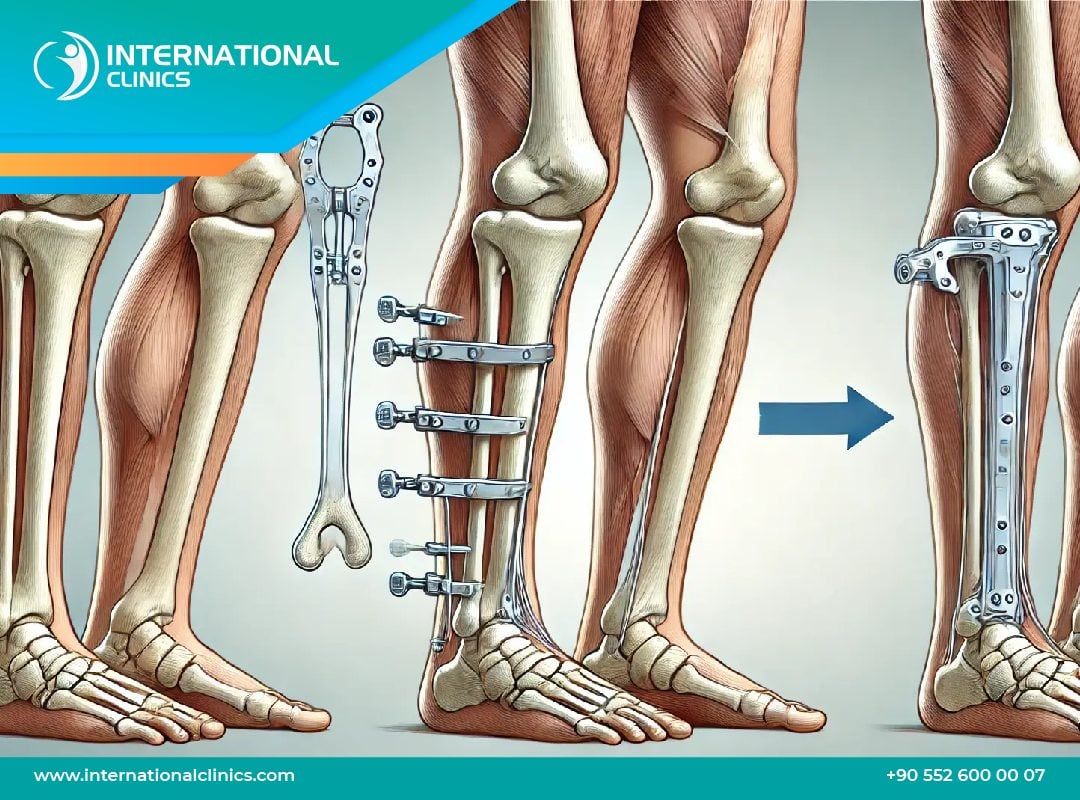
The LON (Lengthening Over Nail) method is a hybrid limb lengthening surgery that uses both an internal intramedullary nail and an external fixator to gradually lengthen a bone.
LON method for height surgery is distinguished by combining the stability of an internal nail method like Precice, with the controlled lengthening of an external device like Ilivasor, allowing for earlier weight-bearing, removal of the external hardware and faster mobility and return to daily activities after the external frame is removed.
The main advantages of the LON technique for tall surgery over fully internal lengthening nail surgery are lower cost, reduced external fixator time (leading to earlier mobilization), and improved stability with weight-bearing during the lengthening phase.
Who is Candidate for LON Limb Lengthening Surgery
Candidates for LON limb lengthening are generally healthy adults (18–50) with strong bones, no serious systemic diseases (like diabetes or autoimmune issues), who are non-smokers, mentally prepared for extensive physical therapy, and have realistic goals. They may seek the procedure for medical reasons, correct leg length discrepancies, or for cosmetic height increase for people who want to get taller
Who is not suitable for LON limb lengthening:
- Children with open growth plates
- People with severe bone diseases (osteoporosis, osteogenesis imperfecta)
- Patients with uncontrolled chronic conditions (diabetes, heart disease)
- Poor candidates for surgery or anesthesia due to general health
- Individuals unwilling or unable to comply with post-operative rehabilitation
How Does LON Limb Lengthening Surgery Work?
- Insertion on internal nail: The LON (Lengthening Over Nail) method begins by surgically cutting the targeted bone, usually the tibia or femur, and inserting an internal titanium nail to provide structural support.
- Fixation by external frame: Next, an external fixator is attached to the leg, with pins connecting the frame to the nail through the skin. This external frame is used during the initial phase to gradually separate the bone at a controlled rate, typically about 1 millimeter per day.
- External frame removal: Once the desired length is achieved, the external fixator is removed in a second procedure. The internal nail remains in place to support the bone while new bone tissue solidifies in the gap over several months, ensuring proper healing and stability.
Recovery Time After LON Method Limb Lengthening
Recovery from LON method limb lengthening is a multi-phase process that typically takes 6 to 12 months or more. The initial hospital stay is about 3 to 7 days, followed by a lengthening (distraction) phase of 2 to 3 months, where a 1mm daily length gain is achieved with an external fixator.
The consolidation phase, where the new bone hardens, can take 6 to 9 months, with most patients regaining unassisted walking around 3 months after the external fixator is removed. Full recovery and return to sports typically occur within 9 to 12 months.
Recovery from limb lengthening surgery, such as LOAN (lengthening over an internal nail), is typically shorter and less painful than with external fixators, but still requires months of physical therapy and gradual weight-bearing.
Walking after LON Limb Lengthening Surgery
Patients can start weight-bearing from Day 1 after LON limb lengthening using crutches or a walker, though the weight is limited. Full weight-bearing gradually increases as the bone heals, with most patients walking unassisted within 2–4 months. High-impact activities are usually restricted for 9–12 months to ensure full bone strength. Compared to traditional external fixator methods, LON allows earlier mobility and faster progression to unassisted walking.
Physical therapy after LON method limb lengthening is essential for restoring mobility, strength, and function, beginning within a week of surgery.
LON method Limb Lengthening Scar
Scarring after LON limb lengthening includes tiny surgical scars from inserting the internal rod and several pin-site marks from the external fixator. These scars typically lighten over months, but they are more noticeable than scars from fully internal limb lengthening systems.
Pain During LON Limb Lengthening
Pain during Lengthening Over Nails (LON) limb lengthening is expected, especially initially, feeling like intense muscle tightness or growing pains as bone and soft tissues stretch, managed with strong medication post-op and then oral meds with diligent physical therapy (PT) for spasms and stiffness, with pain usually easing but requiring active management through PT and prescribed exercises as you progress and consolidate. The level of pain varies depending on the phase of treatment:
- Surgical pain (first 3–7 days):
Moderate to severe pain is normal after the bone is cut and the internal rod is inserted. Hospital pain control is essential during this stage. - Lengthening phase (the most challenging part):
As the bone is gradually separated by 0.75–1 mm per day, muscles, nerves, and soft tissues stretch.
Patients describe this as tightness, pulling, or deep discomfort rather than sharp pain. - Physical therapy pain:
Daily physiotherapy can be painful because it prevents joint stiffness. This pain is expected but necessary for a good outcome. - Post-lengthening pain:
Once the distraction ends and the fixator is removed, pain decreases significantly. Most patients report steady improvement each week.
How Much Height You Gain With LON Limb Lengthening?
With the LON (Lengthening Over Nails) method, average lengthening per single bone ranges from 5 to 8 cm (2 to 3.1 inches).
Typically, the femur can be lengthened up to 10 cm (4 inches) and the tibia up to 7 cm (2.75 inches).
By combining both femurs and tibias in separate stages, total height can potentially increase by up to 13 cm (around 6 inches).
Individual results vary depending on anatomy, the specific bones treated, and post-operative physiotherapy.
LON Limb Lengthening Before & After Results Timeline
Timeline | Progress & Results |
Before Surgery | Normal limb length and alignment; baseline X-rays and gait evaluation; no height increase yet |
1 Month After Surgery | Bone begins distraction phase; early height gains of 1–3 cm; visible external fixator but improving mobility |
3 Months After Surgery | Majority of height gain is completed (5–7 cm); external fixator typically removed; walking improves but still assisted; leg shape more symmetrical |
6 Months After Surgery | Bone consolidation progresses; walking becomes natural and independent; height fully retained; scars soften and mobility improves |
12 Months After Surgery | Bone fully healed; posture and gait normalize; final height increase maintained; return to regular physical activity |
LON Method Limb Lengthening Cost
The cost of LON (Lengthening Over Nails) limb lengthening surgery varies depending on the bone, procedure type, and location. For one leg, a single bone (tibia or femur) typically costs $15,000 to $100,000 or more, while lengthening both the femur and tibia can cost between $25,000 and $30,000.
The cost of LON limb lengthening varies by bone:
- Tibia Lengthening: $14,000 – $16,000
- Femur Lengthening: $15,000 – $18,000
- Femur and Tibia Combined: $25,000 – $30,000
The cost also varies significantly by country and clinic. Turkey is among the most affordable destinations, with LON procedures costing $22,000 to $25,000 per leg, which is around 70% cheaper than the US and Europe, where prices typically start at $100,000 per leg.
LON limb lengthening cost by Country
Country | Approximate Cost | Notes |
Turkey | $15,000 – $40,000 | Affordable packages cover surgery, accommodation, and 24/7 care |
India | $5,500 – $25,000 | Very affordable, however variable quality |
Mexico | $20,000 – $40,000 | Savings compared to US |
Europe | $55,000 – $80,000 | Costs vary by country |
United States | $75,000 – $150,000+ | Most expensive, often extra fees |
Why LON Limb Lengthening is More Affordable in Turkey
The reasons for the more affordable prices of LON limb lengthening in Turkey include:
- Lower hospital and operational costs compared to the US and Europe
- Competitive pricing among highly experienced orthopedic surgeons
- Lower cost of living, which reduces overall treatment expenses
- Medical tourism infrastructure, allowing bundled packages for surgery, accommodation, and post-op care
- High-quality care at international standards without the premium pricing of Western countries
What’s Included in LON Packages in Turkey
- Surgical fees and implants (internal nail and external fixator)
- Hospital stay (4–5 nights)
- Pre-operative tests (X-rays, bloodwork)
- Medications during hospital or hotel stay
- Accommodation (up to 3 months)
- Daily nursing and physiotherapy
- Follow-up visits and fixator removal
- Airport transfers and local coordinator
Factors Influencing LON Limb Lengthening Prices
Several factors can affect the final cost of LON limb lengthening surgery:
- Hospital and surgeon experience: Highly experienced surgeons and reputable hospitals often charge more, but ensure safety and optimal results.
- Geographic location: Prices vary significantly between countries and cities.
- Post-operative care and rehabilitation: Extended physiotherapy, nursing, and follow-up visits can increase overall cost.
LON Method Side Effects
The LON (Lengthening Over Nail) method, a type of limb lengthening surgery, has potential side effects including pain, swelling, bruising, and infection (especially at pin sites). Other risks involve:
- Pain: Pain after the LON method limb lengthening is most intense in the first few days post-surgery and is manageable with strong pain medication. Also, significant pain is expected, especially during the distraction and physical therapy phases.
- Swelling and bruising: Common around the surgical areas.
- Infection: Risk of superficial pin-site infections; deep bone infections (osteomyelitis) are less common. Compared to fully internal methods, Lengthening Over Nail (LON) has a higher risk of pin-site infections, soft tissue complications
- Joint stiffness or contracture: Muscles and joints near the lengthened bone can become stiff without consistent physiotherapy.
- Muscle weakness: Temporary weakness occurs as muscles stretch along with the bone. Physical therapy and rehabilitation is essential from the first days to minimize
- Nerve or blood vessel injury: Nerves may be stretched, causing numbness or tingling; blood vessel injury is rare.
Advantages of the LON Method
- High bone Stability: The internal nail provides structural support, leading to a more predictable and even lengthening process.
- Reduced infection risk: While external fixators carry a risk of pin site infections, the LON method minimizes this risk by using an internal nail alongside the external frame.
- Earlier mobility: Some patients can walk with a walker immediately after surgery and may regain unaided walking sooner once the external frame is removed, compared to traditional external fixation.
- Faster healing: The LON method often results in quicker bone healing, allowing a faster return to daily activities.
- Less scarring: Using an internal nail reduces visible scarring compared to traditional external fixator methods.
Disadvantages of the LON Method
- Complexity: Combining an internal nail with an external fixator increases procedural complexity and the potential for complications.
- Cost: The LON method is generally more expensive than traditional external fixators.
- Bone union time: Healing may take longer compared to fully internal lengthening methods.
- Reduced total lengthening: Some studies suggest that the maximum achievable bone lengthening with the LON method may be lower than with other techniques.
- Infection risk: While pin site infection risk is reduced, there remains a potential for deep infections with the LON method.
Why Choose Turkey for LON Limb Lengthening?
Turkey is one of the most popular destinations for LON limb lengthening due to its high-quality medical care at a more affordable cost.
Experienced orthopedic surgeons and modern hospitals offer comprehensive packages that often include surgery, hospital stay, post-operative physiotherapy, accommodation, and local support.
Compared to the US and Europe, costs in Turkey can be up to 70% lower, without compromising on safety or results.
Additionally, Turkey has a well-established medical tourism infrastructure, making travel, recovery, and follow-up convenient for international patients.
For those considering LON limb lengthening, international clinics in Turkey offer expert care, comprehensive packages, and personalized support to ensure a safe and successful journey. Contact a reputable clinic today to start your treatment and plan your recovery.
Related articles:
- Shoulder Replacement Surgery in Turkey: Explore options for total, partial, or reverse shoulder replacement procedures.
- Knee Replacement Surgery: Learn about knee replacement techniques, recovery, and outcomes in Turkey.