- Shoulder Anatomy
- What Is Shoulder Replacement Surgery?
- When Is Shoulder Replacement Surgery Recommended?
- 1. Underlying Medical Conditions (Determining Implant Type)
- 2. Clinical Symptoms Prompting Surgery (Determining Necessity)
- Types of Shoulder Replacement Surgery
- Step-by-Step Shoulder Replacement Procedure
- Comparing Total vs Reverse Shoulder Replacement
- Cost of Shoulder Replacement Surgery in Turkey
- What’s Included in the Cost for International Patients
- Cost of shoulder replacement surgery across the globe
- Medical Insurance and Surgery Codes for Shoulder Replacement Surgery
- Why Choose International Clinic for Your Shoulder Replacement?
- How to Choose the Right Surgeon and Hospital
- By the end contact for free consultation
The Shoulder replacement surgery, which is also known as shoulder arthroplasty, helps to relieve chronic pain and restore motion in patients with severe shoulder joint damage caused by arthritis, injury, or degenerative wear.
This surgery includes many options starting from new modern stemless and the most famous types such as anatomic total shoulder replacement, which replaces the ball and socket to match the natural anatomy, and reverse total shoulder replacement, which reverses the ball and socket placement. Each type is designed to restore function and reduce pain based on the patient’s condition.
At the International Clinics in Turkey, patients benefit from experienced orthopedic surgeons, modern facilities, and tailored support for international medical travelers. High-quality shoulder replacement surgery at International Clinic starts from $4,000 USD, making it an affordable and reliable option for patients seeking care abroad.
This article explains the types of shoulder replacement surgery, recovery, costs, and modern surgical techniques, helping patients make informed decisions and achieve optimal outcomes.
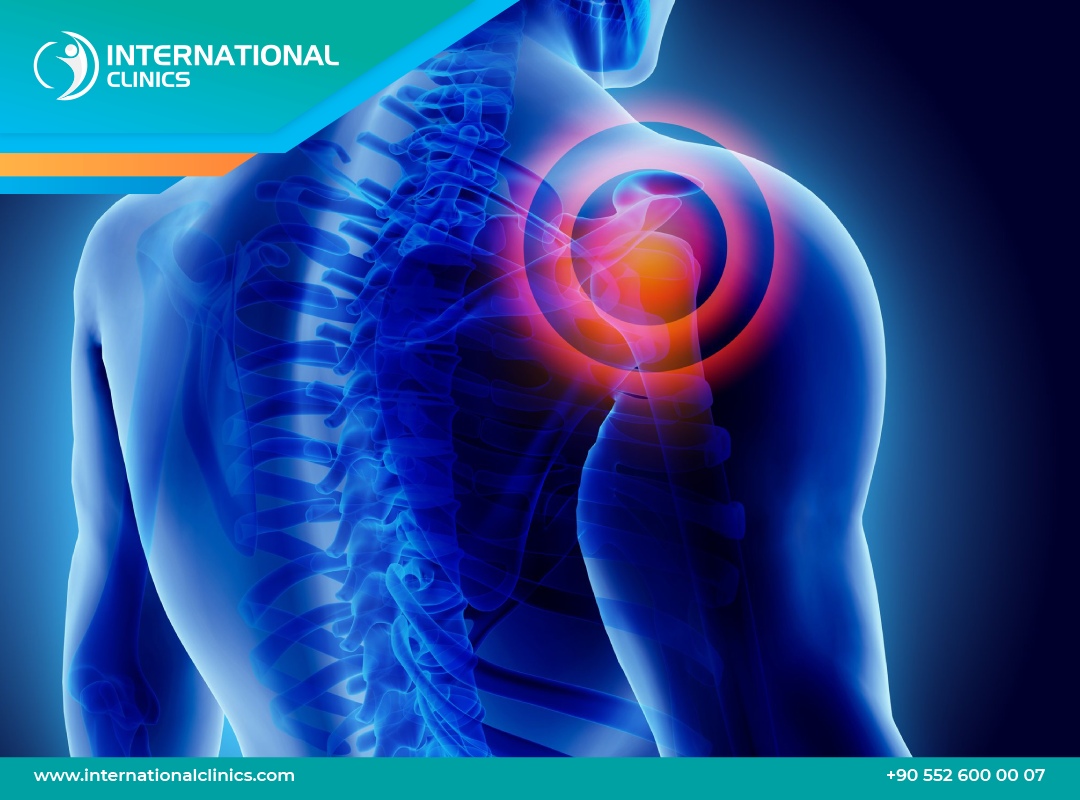
Shoulder Anatomy
Understanding the anatomy of the shoulder is essential before considering shoulder replacement surgery. The shoulder is a highly flexible joint that allows a wide range of motion, but it is also prone to damage from arthritis, injury, or rotator cuff tears.
- Humerus (Upper Arm Bone): Forms the “ball” of the shoulder joint.
- Scapula (Shoulder Blade): Contains the glenoid socket, where the humeral head sits.
- Clavicle (Collarbone): Connects the shoulder to the chest, providing stability.
- Rotator Cuff Muscles: A group of four muscles and tendons that stabilize the joint and enable movement.
- Cartilage: Smooth tissue covering the bones, reducing friction and allowing fluid motion.
When these structures are damaged, patients may experience extreme pain and limited mobility, and difficulty performing daily activities, which can lead to the need for shoulder replacement surgery.
What Is Shoulder Replacement Surgery?
Shoulder replacement surgery is a medical procedure in which the damaged components of the shoulder joint, typically the humeral head (upper arm bone) and sometimes the glenoid (socket) are replaced with prosthetic implants.
The primary goals of the surgery are to:
Relieve chronic pain caused by arthritis, injury, or degenerative conditions
Restore shoulder mobility, allowing patients to perform daily tasks and activities
Improve overall quality of life by enabling more comfortable and functional arm movement
At the International Clinics, surgeons customize the procedure based on each patient’s diagnosis, age, activity level, and overall health, ensuring the most effective results for international and local patients alike.
When Is Shoulder Replacement Surgery Recommended?
Shoulder replacement surgery is indicated for patients with severe shoulder joint pathology causing persistent pain+ limited range of motion, and functional impairment.
The need for shoulder replacement surgery is determined by two factors: the Underlying Medical Condition (which dictates the type of implant needed) and the severity of Clinical Symptoms (which determines the necessity of the procedure).
1. Underlying Medical Conditions (Determining Implant Type)
These are the specific diagnoses that show the joint is too damaged for non-surgical treatment.
Glenohumeral Osteoarthritis (The most common reason for replacement): This is advanced "wear-and-tear" degeneration affecting both the ball (humeral head) and the socket (glenoid) cartilage. It leads to persistent pain and stiffness and is typically treated with Anatomic Total Shoulder Replacement (TSR).
Rotator Cuff Tear Arthropathy (CTA): This is a severe combination of arthritis alongside a massive, irreparable rotator cuff tear. The lack of the cuff muscle allows the arm bone to migrate upward (superior migration). This problem is primarily solved using a Reverse Total Shoulder Replacement (RTSR).
Rheumatoid Arthritis or Inflammatory Arthropathies: Chronic inflammation caused by these systemic diseases leads to widespread joint destruction and deformity. Surgery is considered when medication fails to control the joint breakdown.
Post-Traumatic Arthritis: Joint degeneration that develops following a major mechanical event, such as an old, severe fracture, a chronic dislocation, or the failure of previous fixation hardware.
Complex Proximal Humerus Fractures: Severe, multi-piece fractures of the upper arm bone, usually in older patients with poor bone quality, where attempting to fix the bone fragments is less likely to succeed than replacing the joint immediately (often with a Partial Replacement or RTSR).
2. Clinical Symptoms Prompting Surgery (Determining Necessity)
Surgery is only recommended when a patient experiences these profound symptoms that have not improved with conservative treatments.
Persistent Pain at Rest or During Sleep: This is a key indicator of severe joint damage, as the pain is constant and no longer tied solely to activity.
Restricted Range of Motion: Significant loss of the ability to move the arm, making overhead activities or essential movements like dressing and reaching behind the back difficult or impossible.
Functional Impairment Affecting Daily Life: The physical limitations directly prevent the patient from performing routine, necessary daily tasks, severely reducing independence and quality of life.
Failure of Conservative Management: All non-surgical treatments including medications (like NSAIDs), physical therapy, and corticosteroid injections have failed to provide long-term, meaningful relief.
International Clinics evaluates each patient individually, using X-ray, CT, and MRI imaging and clinical assessment to determine the most appropriate type of shoulder replacement.

Types of Shoulder Replacement Surgery
- Anatomic Total Shoulder Replacement (TSR)
Replaces the ball and socket of the shoulder to match natural anatomy.
Indications:Advanced shoulder arthritis with an intact rotator cuff
Post-traumatic arthritis or prior surgery where anatomy can be restored
Surgical Approach Surgeons make an incision in the front of the shoulder, between the deltoid muscle (shoulder muscle) and pectoralis major (chest muscle).The rotator cuff tendon is gently moved aside to access the joint.The damaged ball (upper arm bone) and socket (shoulder blade) are removed and replaced with prosthetic components.
Benefits:Restores natural shoulder motion,Reduces chronic pain,Improves strength and daily function
Risks:Infection, implant loosening, tendon injury (rare)Recovery can take several months
Implant Lifespan: 15–20+ years
- Reverse Total Shoulder Replacement (RTSR)
Reverses the ball and socket placement.
Indications:Severe rotator cuff tears,Shoulder instability with arthritis,Complex fractures in older patients
Surgical Approach The incision is also in the front of the shoulder (deltopectoral approach).
The ball is placed on the shoulder blade side and the socket on the upper arm side.The deltoid muscle takes over lifting the arm when the rotator cuff is damaged.
Benefits:Stabilizes the shoulder despite rotator cuff deficiency,Reduces pain,Restores ability to lift the arm
Risks:Slightly higher chance of dislocation,Mechanical wear over time,Infection (rare)
Implant Lifespan: 10–15 years
- Partial Shoulder Replacement (Hemiarthroplasty)
Replaces only the ball (upper arm bone) while leaving the socket intact.
Indications:Localized arthritis,Proximal humerus fractures,Healthy shoulder socket
Surgical Approach Small incision in the front of the shoulder,The damaged ball is replaced with a prosthetic ball,The socket is preserved to maintain natural joint structure
Benefits:Less invasive than full replacement,Preserves bone for potential future surgeries,Shorter recovery
Risks:Persistent socket pain if arthritis progresses,Possible implant loosening
Implant Lifespan: 10–15 years
- Resurfacing Shoulder Replacement
Replaces only the damaged surface of the humeral head.
Indications:Younger patients with limited arthritis,Good bone quality and minimal socket damage
Surgical Approach Small incision in the front of the shoulder. Surgeon caps the damaged surface of the humeral head with a prosthetic piece,Minimal bone removal; socket is left intact
Benefits:Preserves bone,Less tissue damage,Faster recovery,Suitable for younger patients
Risks:Pain may continue if socket arthritis worsens,Limited long-term motion compared to total replacement
Implant Lifespan: 10–15 years
- Stemless Shoulder Replacement
Anatomic replacement without a long humeral stem.
Indications:Good bone quality,Intact rotator cuff,Patients who may need revision in the future
Surgical Approach
Front shoulder incision (deltopectoral),Humeral head replaced without inserting a long stem into the arm bone,Less bone removed, but same joint mechanics restored
Benefits:Preserves bone,Easier future revision,Shorter surgery time
Risks:Implant loosening if bone is poor
Implant Lifespan: 15–20 years
- Short-Stem Implants
Uses a shorter humeral stem than standard replacement.
Indications:Younger patients,Good humeral bone quality
Surgical Approach Front shoulder incision,Short humeral stem inserted to support the prosthetic ball,Minimal bone removal compared to traditional implants
Benefits:Preserves bone,Less stress on humerus,Easier revision
Risks:Loosening or misalignment if bone quality is poor
Implant Lifespan: 15–20 years
- Custom / Modular Implants
Patient-specific implants designed with 3D imaging.
Indications:Severe bone loss,Shoulder deformities,Failed previous surgery
Surgical ApproachIncision location depends on patient anatomy or deformity,Implant is customized to fit the patient’s bone exactly
Benefits:Perfect anatomical fit,Restores function in complex cases,Precise alignment
Risks:High cost,Standard surgical risks,Limited long-term data
Implant Lifespan: 15–20 years
- Rare Surgical Types
- Partial Humeral Head / Custom Partial Arthroplasty: Only part of the ball replaced, preserves bone.
- Biologic / Hybrid Implants: Prosthetic plus cartilage scaffolds, experimental.
- 3D-Printed Custom Implants: Severe deformity or tumor-related cases exact fit.
Note: Rare surgeries are used for complex or unusual cases and require specialized surgeons.
You may be interested in :
Meniscus Surgery Recovery: A Comprehensive TimeLine with Tips and FAQs
Step-by-Step Shoulder Replacement Procedure
Preoperative Evaluation:Physical examination, imaging (X-rays, CT scans), and lab tests to ensure readiness for surgery.
Anesthesia:General anesthesia is administered to ensure the patient is comfortable and pain-free.
Surgical Approach:
The surgeon makes an incision, typically at the front of the shoulder (deltopectoral approach).
Muscles, tendons, and soft tissues are carefully preserved.
Joint Exposure and Preparation
Diseased humeral head is removed.
Damaged cartilage from the glenoid is removed if a total replacement is planned.
Implant Placement
Metal stem inserted into the humeral shaft.
Prosthetic ball placed on top of the stem.
For total replacement, a polyethylene socket is attached to the glenoid.
For reverse replacement, the ball and socket are reversed to compensate for a deficient rotator cuff.
Alignment and Stability Check
Surgeon ensure proper placement, alignment, and stability of the implant.
Closure
Soft tissues and muscles are sutured back in place.
Sterile dressing applied to protect the incision.
Postoperative Care
Pain management, antibiotics, and monitoring.
Hospital stay typically 3–5 days.
Rehabilitation
Begin with gentle passive movements under supervision.
Gradually progress to active exercises for strength, flexibility, and functional motion.
Follow-Up
Regular check-ups, including remote consultations for international patients.
Full functional recovery usually occurs in 4–6 months depending on procedure type and patient health.
Comparing Total vs Reverse Shoulder Replacement
Both Anatomic Total Shoulder Replacement (TSR) and Reverse Total Shoulder Replacement (RTSR) are common procedures for shoulder arthritis and dysfunction, but they differ in mechanics, indications, and outcomes.
Surgeons at International Clinics evaluate imaging, tendon status, and lifestyle to recommend the most suitable procedure.
Feature | Anatomic Total Shoulder Replacement (TSR) | Reverse Total Shoulder Replacement (RTSR) |
Surgical Mechanics | Replaces humeral head (ball) and glenoid (socket) matching natural anatomy. Relies on intact rotator cuff. Preserves natural biomechanics. | Reverses ball and socket (ball on shoulder blade, socket on humerus). Deltoid muscle compensates for damaged rotator cuff. Ideal for rotator cuff arthropathy or severe tears. |
Indications | ||
Rotator Cuff Status | Must be intact | Irreparable tears or arthropathy |
Arthritis Type | Primary or post-traumatic | Rotator cuff arthropathy, cuff-deficient |
Fracture Use | Rarely used for complex fractures | Often used in elderly with proximal humerus fractures |
Benefits | Restores natural movement and strength. Reduces pain with functional rotator cuff. Allows near-normal arm mechanics. | Stabilizes shoulder despite absent or torn rotator cuff. Reduces pain significantly. Restores ability to elevate the arm. |
Risks | Implant loosening or wear. Rotator cuff failure post-surgery. Standard surgical risks (infection, nerve injury). | Slightly higher risk of dislocation. Scapular notching. Standard surgical risks (infection, nerve injury). |
Recovery Expectations | Sling use for 4–6 weeks. Gradual physical therapy (range of motion then strengthening). Near-normal function within 4–6 months. | Sling use for 4–6 weeks. Physical therapy emphasizes deltoid strengthening. Full functional recovery may take 4–6 months, but heavy lifting may be limited. |
Implant Longevity | 15–20+ years | 10–15 years (may vary with activity level) |
Discover more about:
Bone Density Measurement (DEXA) in Turkey: Tests, T-Scores, and Costs
Cost of Shoulder Replacement Surgery in Turkey
Understanding the financial aspect is crucial for international patients considering shoulder replacement surgery at International Clinics in Turkey. Costs vary by type of procedure, hospital, implant, and country.
Type of Shoulder Replacement Surgery | Estimated Cost Range (USD) |
Anatomic Total Shoulder Replacement (TSR) | $6,000 – $10,300 |
Reverse Total Shoulder Replacement (RTSR) | $7,000 – $12,000 |
Partial Shoulder Replacement (Hemiarthroplasty) | $4,000 – $7,800 |
Resurfacing Shoulder Replacement | $6,000 – $9,200 |
Total / Any Type | $4,000 – $12,000 |
Cost Notes:RTSR is generally the most expensive due to implant complexity and specialized surgical technique.
Hemiarthroplasty is typically the lowest cost as it is less complex.
Stemless, Short-Stem, and Custom/Modular Implants generally fall within TSR or RTSR ranges and may be higher due to advanced technology.
What’s Included in the Cost for International Patients
- Surgery, including prosthetic implant
- Surgeon and anesthetist fees
- Hospitalization (typically 3–5 nights)
- Pre-operative tests and post-operative medications
- Logistical services (airport transfers, accommodation, interpreter services)
Disclaimer: Prices are estimates for 2025 and may vary depending on hospital, implant brand, surgeon experience, and individual patient factors. Always request a written, all-inclusive quotation.
Cost of shoulder replacement surgery across the globe
Procedure Type | Turkey (Medical Tourism) | India (Medical Tourism) | USA (Uninsured) | Western Europe (Private) | Spain (Medical Tourism) |
TSR | $6,000 – $10,300 | $5,100 – $16,000 | $20,000 – $50,000+ | $15,000 – $25,000 | $26,000 – $28,000 |
RTSR | $7,000 – $12,000 | $6,700 – $18,000 | $25,000 – $60,000+ | $18,000 – $30,000 | $35,000 |
Hemiarthroplasty | $4,000 – $7,800 | $4,000 – $14,000 | $18,000 – $45,000+ | $14,000 – $22,000 | $22,000 |
Why Turkey have an advantage?
Turkey offers significant cost savings: Patients can save 50–70% compared to USA, UK, or Germany.
Quality of care: Many Turkish hospitals are JCI-accredited and surgeons are internationally trained.
All-inclusive packages: Bundled surgery, hospital stay, pre-op tests, and logistics provide price certainty.
Convenient travel: Turkey is easily accessible for patients from Europe and the Middle East with well-developed recovery infrastructure.
Beyond orthopedics, Turkey has also gained a strong reputation for performing complex surgeries, including spine surgery such as lumbar and cervical spine procedures. With the integration of minimally invasive spine surgery, risks are significantly reduced, further solidifying Turkeys position as a leader in advanced medical care.
Spinal Fusion Surgery: Understanding Types, Complications, and Recovery
Medical Insurance and Surgery Codes for Shoulder Replacement Surgery
- Insurance Coverage
- Shoulder replacement surgery may be covered by private or public insurance, depending on the patient’s home country and policy.
- Coverage often includes:
- Surgeon and hospital fees
- Implant costs (partially or fully)
- Pre- and post-operative care
- International patients typically pay out-of-pocket and may request reimbursement from their insurer. Always check with your insurance provider before surgery.
- Common Surgery Codes
For billing and insurance purposes, shoulder replacement surgeries are assigned specific procedure codes:
Surgery Type | CPT / ICD-10-PCS Code (USA Reference) |
Anatomic Total Shoulder Replacement (TSR) | CPT 23472 / ICD-10-PCS 0RRJ0JZ |
Reverse Total Shoulder Replacement (RTSR) | CPT 23473 / ICD-10-PCS 0RRK0JZ |
Partial Shoulder Replacement (Hemiarthroplasty) | CPT 23470 / ICD-10-PCS 0RRH0JZ |
Resurfacing Shoulder Replacement | CPT 23469 / ICD-10-PCS 0RRH0ZZ |
Notes:
CPT = Current Procedural Terminology (used in USA and recognized internationally for insurance and documentation)
ICD-10-PCS = International Classification of Diseases, Procedure Coding System
Codes help ensure proper insurance billing and facilitate international reimbursement requests
- Tips for International Patients
- Request a detailed invoice and medical report from your surgeon or clinic.
- Confirm with your insurance provider if reimbursement is possible.
- Keep copies of all surgical reports, implant details, and billing codes for claims.

You may be interested in :
Meniscus Surgery Recovery: A Comprehensive TimeLine with Tips and FAQs
Why Choose International Clinic for Your Shoulder Replacement?
For international patients, choosing a surgical destination is about balancing excellence, safety, and affordability.
International Clinics, located in Istanbul, Turkey, is a Joint Commission International (JCI) accredited facility, meeting the highest global standards for safe, successful, and affordable orthopedic care.
Expert Surgeons with Proven Results
Surgeon Profile: Your procedure will be led by a highly experienced specialist,afellowship-trained orthopedic surgeon with over 20 years of focus on shoulder arthroplasty.
Surgical Volume: Our surgeons have performed 1,000+ successful anatomic and reverse shoulder replacements.
Expertise: Skilled in complex cases, custom implants, and modern surgical techniques, ensuring optimal outcomes and restored shoulder function.
Facilities & Accreditation
Global Standard: JCI-accredited, the gold standard for healthcare quality and safety, ensuring our facilities meet international benchmarks.
Advanced Operating Rooms: Equipped with robotic-assisted tools for enhanced precision and alignment.
Dedicated Rehabilitation Centers: Structured programs for post-operative recovery and functional restoration.
Affordable, All-Inclusive Packages (2025 Pricing)
Transparent, all-inclusive packages eliminate financial uncertainty. Patients typically save 50–70% compared to costs in the US or Western Europe without compromising quality.
Procedure Type | All-Inclusive Package Starting Price (USD) |
Total Shoulder Replacement (TSR) | $8,500 |
Reverse Total Shoulder Replacement (RTSR) | $9,500 |
Package Includes:
- Surgery and premium implant
- Surgeon and anesthesia fees
- 3–5 nights hospital stay
- Pre-operative diagnostics
- Initial post-operative medications
- International Patient Support
- End-to-End Logistics: Assistance with translation, VIP airport transfers, and comfortable local accommodation.
- Personalized Guidance: Support throughout pre-op and post-op care.
- Post-Op Peace of Mind: Includes 12 months of complimentary remote video follow-up consultations after you return home.
How to Choose the Right Surgeon and Hospital
Selecting the right surgeon and hospital is critical for safety, successful outcomes, and peace of mind, particularly for international patients.
- Verify Surgeon Credentials and Experience: Look for fellowship-trained orthopedic specialists with high surgical volume in anatomic and reverse shoulder replacements.
- Check Hospital Accreditation and Quality Standards: Ensure JCI or equivalent certification, advanced operating rooms, and robust rehabilitation facilities.
- Evaluate International Patient Support: Translation, VIP transfers, accommodation, and post-op remote follow-up.
- Review Patient Outcomes: Check success stories, functional recovery, and complication rates.
- Confirm Personalized Care: Surgeons should offer customized surgical and rehabilitation plans tailored to your anatomy, condition, and lifestyle.
- International Clinics meets all these standards, ensuring safe, successful, and supported care for global patients.
Innovations and Future of Shoulder Replacement
International Clinics is at the forefront of orthopedic innovation, offering:
- Robotic-assisted surgery for enhanced precision and alignment
- 3D-printed custom implants for severe bone loss or unique anatomy
- Minimally invasive approaches to reduce tissue trauma and accelerate recovery
By the end contact for free consultation
Shoulder replacement surgery at International Clinic is a highly effective solution for pain relief and mobility restoration.
Benefit from expert surgeons, modern technology, and comprehensive international support.
Transparent, all-inclusive packages offer affordable care without compromising quality.
Contact International Clinics today to receive a personalized treatment plan and start your journey toward a pain-free, fully functional shoulder.
Related health topics:
Meniscus Surgery Recovery: A Comprehensive TimeLine with Tips and FAQs
PRP Injection for Knee Pain: Benefits, Procedure, and Recovery
Related health topics:
What Are the Symptoms of Nerve Damage After Back Surgery?